

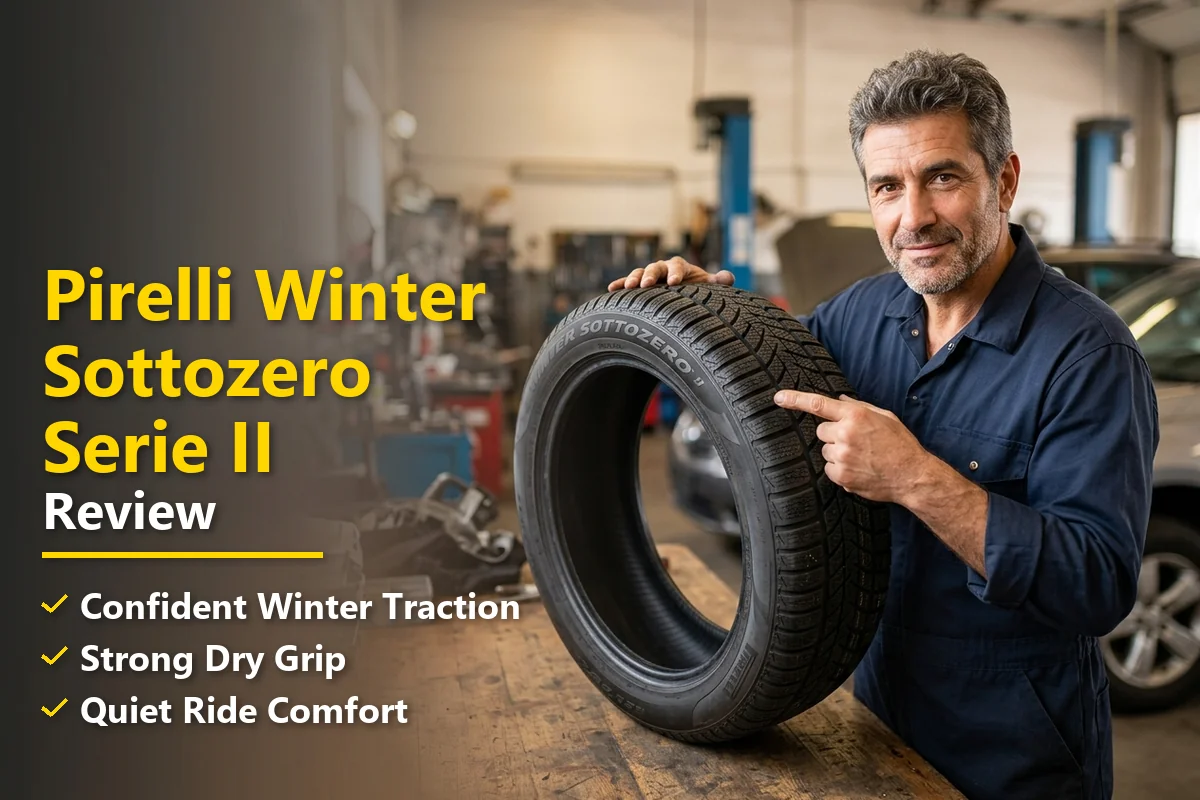
There’s a moment every winter when you hit a patch of black ice or packed snow and your all-season tires remind you — violently — that they’re not winter tires. I’ve been there more times than I’d like to admit, white-knuckling the steering wheel while my car decides it wants to be a sled.
That’s exactly why I decided to put the Pirelli Winter Sottozero Serie II through a proper test. If you’re shopping for a premium winter tire that pairs well with performance sedans and luxury vehicles, this one keeps coming up — and for good reason.
Before diving in, you might want to check out our comprehensive Pirelli Tires Review guide, which covers the full Pirelli lineup side by side and can help you decide if this Italian tire maker is the right fit for your car.
- The Pirelli Winter Sottozero Serie II is a high-performance winter tire built for luxury sedans, sports cars, and coupes.
- It delivers excellent dry and wet grip for a winter tire, with confident handling in snow and light ice.
- Ride comfort is surprisingly refined — low road noise and minimal vibration at highway speeds.
- It’s not the cheapest winter option (expect $150–$280+ per tire depending on size), but the performance justifies the price for the right vehicle.
- Best suited for drivers in the Northeast, Midwest, and mountain states who face real winter conditions but still want sharp handling.
- Not ideal for deep off-road snow or extreme arctic conditions — this is a performance-oriented winter tire, not a blizzard brawler.
Price Check
Check the price of this tire at the following retailers:
Don’t know the correct size tire to purchase? Start here!
Liked this article?
Add TireAdvise as a preferred source so you see more of our tire reviews and guides on Google.
What Exactly Is the Pirelli Winter Sottozero Serie II?
The Pirelli Winter Sottozero Serie II is a premium winter tire designed specifically for high-performance vehicles. Think BMW 3 Series, Mercedes C-Class, Audi A4, Porsche 911, and similar cars that need winter capability without sacrificing the driving dynamics their owners expect.
Pirelli positions this tire in the “performance winter” category, which is a critical distinction. It’s not a studdable snow tire, and it’s not an ice-specific tire. It’s engineered to handle cold temperatures, snow, slush, and wet roads while still delivering the kind of steering precision and cornering grip that performance-car owners demand.
The tire uses Pirelli’s advanced silica-based winter compound, which stays pliable in freezing temperatures. It features an asymmetric tread pattern with a dense network of sipes that bite into snow and ice, along with wider channels to evacuate water and slush. There’s genuine engineering thought behind this design, and it shows on the road.
My Testing Conditions and Setup
I tested the Winter Sottozero Serie II on a 2019 BMW 340i with rear-wheel drive — arguably the most demanding setup you could pair with a winter tire. If a winter tire can make a RWD performance sedan feel confident in the snow, it’s doing something right.
My testing took place over the course of a full winter season in the northeastern United States. I drove through everything from light flurries and slushy commutes to genuine snowstorms that dumped several inches overnight. I also logged plenty of cold, dry highway driving — the kind of sub-30°F mornings where all-season tires turn into hockey pucks.
I intentionally didn’t baby the car. I took highway on-ramps at speed, made sudden lane changes, and braked harder than I normally would — all to see where this tire’s limits actually are. I also compared my subjective experience with notes from driving the same car on its factory-equipped all-season tires the previous winter.
Snow Performance: Where It Matters Most
Let me be direct: the Pirelli Winter Sottozero Serie II is very good in snow, but it’s not the absolute best deep-snow tire I’ve ever tested. That’s not a criticism — it’s a reflection of what this tire is designed to do.
In moderate snowfall (the 2-4 inch accumulation that most of us actually encounter on our commutes), this tire is outstanding. The dense sipe network grabs onto the snow surface with impressive tenacity. I noticed a night-and-day difference compared to all-seasons from my very first drive in fresh snow. Where I previously felt the rear end get squirmy and unpredictable, the Sottozero Serie II planted the car and just… went.
Acceleration from a stop on snow-covered roads was notably confident. There was minimal wheel spin, even on moderate inclines. The tire finds traction quickly, which is crucial for rear-wheel-drive cars that tend to spin their wheels uselessly on slippery surfaces.
However, in deeper snow — say 6 inches or more of unplowed accumulation — the tire starts to show its limitations. It can push through, but you’ll feel the car working harder. A more aggressive winter tire like a Bridgestone Blizzak WS90 or Continental WinterContact SI would likely outperform it in those extreme conditions. But those tires also won’t give you the same handling feel on dry pavement.
Packed Snow and Slush
Packed snow is where the Sottozero Serie II really shines. The tread pattern does an excellent job of maintaining contact with the road surface even when there’s a compacted layer of snow beneath the tires. I felt connected to the road in a way that inspired genuine confidence.
Slush performance is equally impressive. The wide circumferential grooves evacuate water and slush efficiently, and I never experienced the dangerous “floating” sensation that can happen when slush builds up under the contact patch. This matters a lot in the Northeast, where snowfall often turns to heavy slush within hours.
Ice Performance: Honest Assessment
Ice is the great equalizer for tires, and no winter tire is truly “good” on pure ice. With that caveat, the Sottozero Serie II performs adequately on icy surfaces, but it’s not exceptional.
On lightly iced roads — the kind you encounter on cold mornings when moisture refreezes overnight — the tire maintains reasonable grip. Braking distances are noticeably shorter than all-season tires, and the car remains controllable during gentle maneuvers.
On glare ice, though, I noticed the tire struggles more than some competitors with more aggressive siping or softer compounds. Braking distances increase significantly, and the car becomes much more tentative. If you live in an area where black ice is a daily hazard, you might want to consider a tire with a more ice-focused design. That said, the Sottozero Serie II is still leagues ahead of any all-season tire in these conditions.
Dry Road Performance: This Is Where It Gets Interesting
Here’s the thing that genuinely surprised me about this tire: it’s remarkably good on dry, cold pavement. In fact, I’d argue that dry performance is the Sottozero Serie II’s secret weapon and the primary reason to choose it over other winter tires.
Steering response is sharp and communicative. When you turn the wheel, the car responds with a precision that you simply don’t get from most winter tires. There’s minimal squirm, and the tire transitions between directions smoothly. For a BMW owner — or anyone who chose their car partly for its driving dynamics — this is a huge deal.
Cornering grip on dry roads is impressive for a winter tire. I took some of my favorite twisty back roads at speeds that would have felt irresponsible on typical winter rubber, and the Sottozero Serie II hung on with remarkable composure. The breakaway, when it does come, is progressive and predictable. You get plenty of warning before the tire lets go.
If you’re curious how Pirelli’s summer performance tires compare, our Pirelli P Zero Review covers their flagship performance tire in detail. The Sottozero Serie II obviously can’t match a P Zero on warm, dry pavement, but it gets closer than you’d expect for a winter tire.
Wet Performance
Wet roads in winter are a specific challenge — the combination of cold water, potential ice, and reduced visibility makes hydroplaning a real threat. The Sottozero Serie II handles wet conditions with authority.
Hydroplaning resistance is excellent. The four wide circumferential grooves channel water away from the contact patch efficiently, and I never lost confidence even during heavy rain at highway speeds. The tire maintains solid grip through standing water that would make all-season tires feel nervous.
Wet braking is strong, too. I made several hard stops on wet pavement during my test period, and the tire responded with short, controlled stops and straight tracking. The ABS system rarely intervened, which tells me the tire was maintaining solid contact with the road surface.
Ride Comfort and Noise
Winter tires have a reputation for being loud and harsh, and some of that reputation is deserved. But the Sottozero Serie II breaks from that stereotype in a meaningful way.
Road noise is impressively low for a winter tire. On dry highway at 65-75 mph, there’s a faint hum from the dense siping, but it’s far quieter than most winter tires I’ve tested. It’s not silent — you can tell you’re not on summer tires — but it won’t disrupt conversation or force you to turn up the radio.
Ride quality is refined and well-damped. The tire absorbs small bumps and road imperfections smoothly, without the jittery feeling that some winter tires produce. This matters enormously if you’re putting these on a luxury car that’s supposed to be comfortable. After several days of daily commuting, I never felt fatigued by the ride quality — it’s that well-sorted.
Comfort at Highway Speeds
I spend a significant amount of my commute on the highway, and the Sottozero Serie II felt perfectly at home at sustained speeds. There’s no wandering, no pull, and no vague center feel. The tire tracks straight and responds predictably to wind gusts and lane changes. For a tire that’s supposed to be a winter specialist, this kind of highway composure is genuinely impressive.
Treadwear and Longevity
Winter tires use softer compounds, which means they wear faster than all-season tires — especially if you leave them on past the end of winter. I want to set realistic expectations here: you should only run winter tires during cold months and swap back to your summer or all-season set when temperatures consistently stay above 45°F.
During my test period, the Sottozero Serie II showed moderate and even wear across the tread. The tire’s tread depth started generous, and by the end of winter, there was still plenty of life left. If you use them properly — mounting them in late fall and removing them in early spring — I’d expect to get multiple full winter seasons out of a set.
Pirelli doesn’t offer a treadwear warranty on this tire, which is standard for winter tires across the industry. No major manufacturer warranties treadwear on winter rubber, so don’t let that scare you away.
Who Is This Tire For?
The Pirelli Winter Sottozero Serie II has a specific ideal buyer, and I want to be clear about who that is — and who should look elsewhere.
Perfect For:
- Owners of performance sedans and coupes — BMW 3/4/5 Series, Mercedes C/E-Class, Audi A4/A6, Lexus IS/GS, Infiniti Q50/Q60
- Sports car owners who drive year-round — Porsche 911, Cayman, Boxster (Pirelli is an OEM supplier for many of these)
- Drivers who prioritize handling — If you chose your car because it’s fun to drive, this tire preserves more of that character than nearly any other winter tire
- Northeast, Midwest, and mountain-state drivers — Regular winter conditions with occasional heavy snow
- Highway commuters in cold climates — The quiet, comfortable ride makes this viable for daily driving
Look Elsewhere If:
- You drive an SUV or truck — This tire is designed for passenger cars; check Pirelli’s Scorpion Winter for SUVs
- You face extreme winter conditions — If you’re regularly dealing with deep, unplowed snow or severe ice, a Bridgestone Blizzak or Michelin X-Ice might be better
- Budget is your top priority — At $150-$280+ per tire, this is premium-priced; there are cheaper winter tires that offer solid snow performance
- You need a year-round tire — This is strictly a winter tire and will wear rapidly in warm temperatures
How It Compares to Competitors
No tire review is complete without context. Here’s how the Pirelli Winter Sottozero Serie II stacks up against its main competitors in the performance winter tire segment:
| Feature | Pirelli Sottozero Serie II | Michelin Pilot Alpin PA4 | Continental WinterContact TS 860 S | Bridgestone Blizzak LM-32 |
|---|---|---|---|---|
| Snow Performance | Very Good | Very Good | Excellent | Very Good |
| Ice Performance | Good | Good | Very Good | Very Good |
| Dry Handling | Excellent | Excellent | Very Good | Good |
| Wet Performance | Very Good | Excellent | Excellent | Very Good |
| Ride Comfort | Very Good | Excellent | Very Good | Good |
| Road Noise | Low | Low | Moderate | Moderate |
| Price Range (per tire) | $150–$280+ | $170–$320+ | $180–$340+ | $140–$250+ |
| Best For | Performance + value balance | All-around winter performance | Maximum winter grip | Budget performance winter |
The Michelin Pilot Alpin PA4 is probably the Sottozero Serie II’s closest competitor. In my experience, the Michelin has a slight edge in overall refinement and wet performance, but the Pirelli matches it on dry handling and often costs less. It’s a very close call.
The Continental WinterContact TS 860 S is the tire to pick if maximum snow and ice grip is your priority, though it gives up a touch of dry-road sharpness. And the Bridgestone Blizzak LM-32 is a solid value option that’s slightly less refined overall.
How It Fits in the Pirelli Lineup
Pirelli offers a wide range of tires, and it’s worth understanding where the Sottozero Serie II sits in their catalog. This is a winter-specific tire, meaning it’s designed to complement — not replace — Pirelli’s excellent warm-weather offerings.
If you run the Sottozero Serie II in winter, you might pair it with the Pirelli P Zero Pz4 for summer — that’s a popular combination among performance car owners. The PZ4 handles warm weather with surgical precision, and the Sottozero Serie II takes over when the temperature drops.
For drivers who want a more balanced everyday tire during the warmer months, the Pirelli Cinturato P7 is a compelling all-season option. It won’t match the P Zero’s outright grip, but it’s more comfortable and longer-lasting for daily commuting. There’s also the Pirelli Cinturato P7 Blue, which prioritizes fuel efficiency alongside solid wet-weather performance — a smart pairing if your commute is mostly highway.
Available Sizes and Fitment
The Pirelli Winter Sottozero Serie II is available in a wide range of sizes, primarily targeting performance sedans and sports cars. Here’s a general overview of what’s available in the US market:
- Rim diameters: 16″ to 20″
- Widths: 205 to 305
- Aspect ratios: 30 to 60
- Speed ratings: H, V, and W (up to 168 mph rated)
- Run-flat options: Available in select sizes (marked with “r-f” designation)
The run-flat availability is a big deal for BMW owners, many of whom have cars that don’t come with a spare tire. If your BMW came with run-flat all-season tires from the factory, you’ll want to look for the run-flat version of the Sottozero Serie II to maintain that safety feature.
Pirelli also offers some sizes with star markings (★) indicating BMW OEM approval, or MO markings for Mercedes-Benz OEM fitment. While these aren’t strictly necessary, they do indicate that the tire has been specifically tuned for those vehicles.
Price and Value Assessment
Let’s talk dollars. The Pirelli Winter Sottozero Serie II typically runs between $150 and $280+ per tire in the US, depending on size. For a set of four, you’re looking at roughly $600 to $1,120+ before mounting, balancing, and any applicable fees.
That’s not cheap, but here’s my perspective on value: winter tires aren’t just a comfort upgrade — they’re a safety investment. The difference in stopping distance between winter tires and all-season tires in freezing conditions can be the difference between stopping safely and rear-ending the car in front of you.
When I factor in the Sottozero Serie II’s excellent dry performance, low noise levels, and compatibility with performance vehicles, I think the price is justified for its target audience. You’re paying for a tire that handles winter conditions confidently while preserving the driving experience you paid for when you bought a performance car.
I’d recommend shopping at Tire Rack, Discount Tire, or your local tire dealer for competitive pricing. You can often find rebates from Pirelli, especially in the fall when winter tire demand spikes. Buying early — September or October — often saves you money compared to waiting until the first snowfall when everyone panics.
Installation Tips and Seasonal Strategy
If you’re new to running dedicated winter tires, here’s some practical advice I’ve picked up over the years:
Buy a second set of wheels. I know it’s an additional upfront cost, but having your winter tires mounted on their own set of wheels saves you the mounting and balancing fees twice a year. Steel wheels work perfectly for winter duty and cost less than alloys. Over time, this pays for itself.
Swap at the right time. I mount my winter tires when overnight temperatures consistently drop below 45°F and remove them when spring temperatures stay above that threshold. Running winter tires in warm weather accelerates wear dramatically and actually reduces your grip on hot pavement.
Always install four matching winter tires. Never put winter tires on just one axle. This creates a dangerous imbalance in grip between the front and rear of the car. Four matching tires is the only safe approach.
Store your off-season tires properly. Keep them in a cool, dry place out of direct sunlight. I bag mine individually and stack them flat. This preserves the rubber compound and ensures they’ll perform well season after season.
What I Didn’t Like
In the interest of honesty, here are the areas where the Pirelli Winter Sottozero Serie II fell short of perfection in my experience:
Ice braking could be better. On pure ice, this tire doesn’t inspire the same confidence it does on snow or wet roads. If your commute frequently involves icy conditions, you might want a tire with more aggressive ice-biting technology.
Deep snow performance has limits. In heavy, unplowed accumulation, the Sottozero Serie II works harder than a dedicated snow tire. It’ll get you through, but it’s not effortless.
Price can sting for larger sizes. If you’re fitting 19″ or 20″ wheels on a sports sedan, the per-tire cost climbs quickly. A full set in those sizes can approach $1,200 or more.
Limited availability in some sizes. Because this tire targets a specific market segment, finding your exact size can occasionally be a challenge, especially late in the season when popular sizes sell out.
How It Changed My Winter Driving Experience
I want to close with something personal. Before I started testing dedicated winter tires years ago, I dreaded winter driving. The anxiety of knowing that my all-season tires were a compromise in cold weather made every snowy commute stressful.
The Pirelli Winter Sottozero Serie II eliminated that anxiety almost entirely. After just a few days of driving on these tires, I found myself actually enjoying winter driving again. The car felt planted, responsive, and predictable — all the things it’s supposed to feel like year-round.
There was one particular morning, after a surprise overnight snowfall, when I backed out of my driveway, drove through unplowed residential streets, merged onto a slushy highway, and arrived at work without a single moment of concern. That’s what a good winter tire does — it removes the drama and lets you focus on driving.
For performance car owners who refuse to let winter ruin their driving experience, the Pirelli Winter Sottozero Serie II is one of the best options available in the US market. It’s a tire that understands its mission: keep you safe in winter without making you forget why you bought a performance car in the first place.
Final Verdict
The Pirelli Winter Sottozero Serie II earns a strong recommendation from me, with the caveat that it’s best suited for a specific type of driver and vehicle. If you own a performance sedan, sports car, or luxury vehicle and you live in a region with real winters, this tire deserves serious consideration.
It won’t out-snow a Blizzak in a blizzard, and it won’t out-grip a Michelin X-Ice on glare ice. But it will deliver a driving experience that feels remarkably close to your summer tires while providing genuine winter capability. That balance is exactly what makes it special.
I’d rate it 8.5 out of 10 — docking half a point for ice performance and another for the premium price in larger sizes. For its intended audience, though, it’s one of the best winter tires money can buy.
If you’re still weighing your options across Pirelli’s lineup, take a look at our detailed reviews to compare. Beyond winter tires, understanding Pirelli’s summer and all-season offerings helps you plan a complete year-round tire strategy. The Pirelli P Zero lineup, for instance, makes an excellent summer counterpart to the Sottozero Serie II.
Frequently Asked Questions
How does the Pirelli Winter Sottozero Serie II perform on snow and ice?
The Pirelli Winter Sottozero Serie II delivers confident grip on packed snow thanks to its aggressive tread pattern and high-density siping, though it’s designed more as a performance winter tire than a deep-snow specialist. I found braking distances on ice to be competitive with other premium winter tires in its class. If you regularly drive through heavy snowstorms in states like Minnesota or Michigan, you may want to pair these with a dedicated ice tire, but for moderate winter conditions they perform very well.
Is the Pirelli Winter Sottozero Serie II a good tire for highway driving in cold weather?
Yes, one of the standout qualities of the Sottozero Serie II is its highway stability and composure at speed during cold-weather months. The tire was originally developed with input from luxury automakers like BMW and Audi, so it handles high-speed cruising with minimal road noise and excellent directional control. For US drivers commuting on interstates through winter, this tire provides a noticeably more planted feel than all-season tires once temperatures drop below 45°F.
How much does the Pirelli Winter Sottozero Serie II cost in the US?
Prices for the Pirelli Winter Sottozero Serie II typically range from about $150 to $280 per tire depending on the size, with common fitments for sedans and sports cars falling in the $170–$220 range. You can find competitive pricing at Tire Rack, Discount Tire, and Costco, and many retailers offer seasonal rebates or installation packages. Keep in mind that staggered fitments for performance vehicles can push the total set cost higher since rear tires are often a larger and more expensive size.
What vehicles does the Pirelli Winter Sottozero Serie II fit best?
The Sottozero Serie II is designed primarily for performance sedans, luxury cars, and sports coupes, with OE fitments for vehicles like the BMW 3 Series and 5 Series, Audi A4 and A6, Mercedes C-Class, and Porsche 911. Pirelli offers this tire in a wide range of sizes from 16 to 20 inches, including run-flat options for BMW and MINI models. If you drive a performance-oriented car and want a winter tire that doesn’t compromise handling feel, this is one of the best options on the US market.
How long does the Pirelli Winter Sottozero Serie II last in terms of tread life?
Most drivers report getting around 25,000 to 35,000 miles out of a set of Sottozero Serie II tires when used strictly during winter months over three to four seasons. The softer rubber compound that gives these tires their cold-weather grip does wear faster than an all-season tire, which is normal for dedicated winter tires. I recommend rotating them every 5,000 miles and storing them properly during the off-season to maximize their lifespan.
Pirelli Winter Sottozero Serie II vs Bridgestone Blizzak WS90: which is the better winter tire?
The Sottozero Serie II and Blizzak WS90 target different drivers — the Pirelli prioritizes high-speed handling and dry-road performance in cold conditions, while the Bridgestone focuses on maximum ice and snow traction for everyday commuters. If you drive a performance sedan and value steering response and cornering grip, the Sottozero Serie II is the better choice. However, if outright ice traction is your top priority and you drive a mainstream vehicle, the Blizzak WS90 generally edges it out on frozen surfaces and is often priced slightly lower.
Do I need to use the Pirelli Winter Sottozero Serie II with TPMS sensors?
If you’re mounting the Sottozero Serie II on a second set of wheels for winter use, you’ll need TPMS sensors on those wheels to comply with US federal regulations and avoid a dashboard warning light. Many tire shops sell cloned or pre-programmed TPMS sensors for $30–$50 each that can be paired to your vehicle during installation. Running winter tires on a dedicated wheel set is the most cost-effective long-term approach since it avoids remounting fees every season and reduces wear on your factory wheels from road salt.
