Finding a highway terrain tire for your truck or SUV that doesn’t obliterate your wallet is harder than it should be. The big-name brands want $200+ per tire, and you’re left wondering if the budget alternatives are actually safe to drive on.
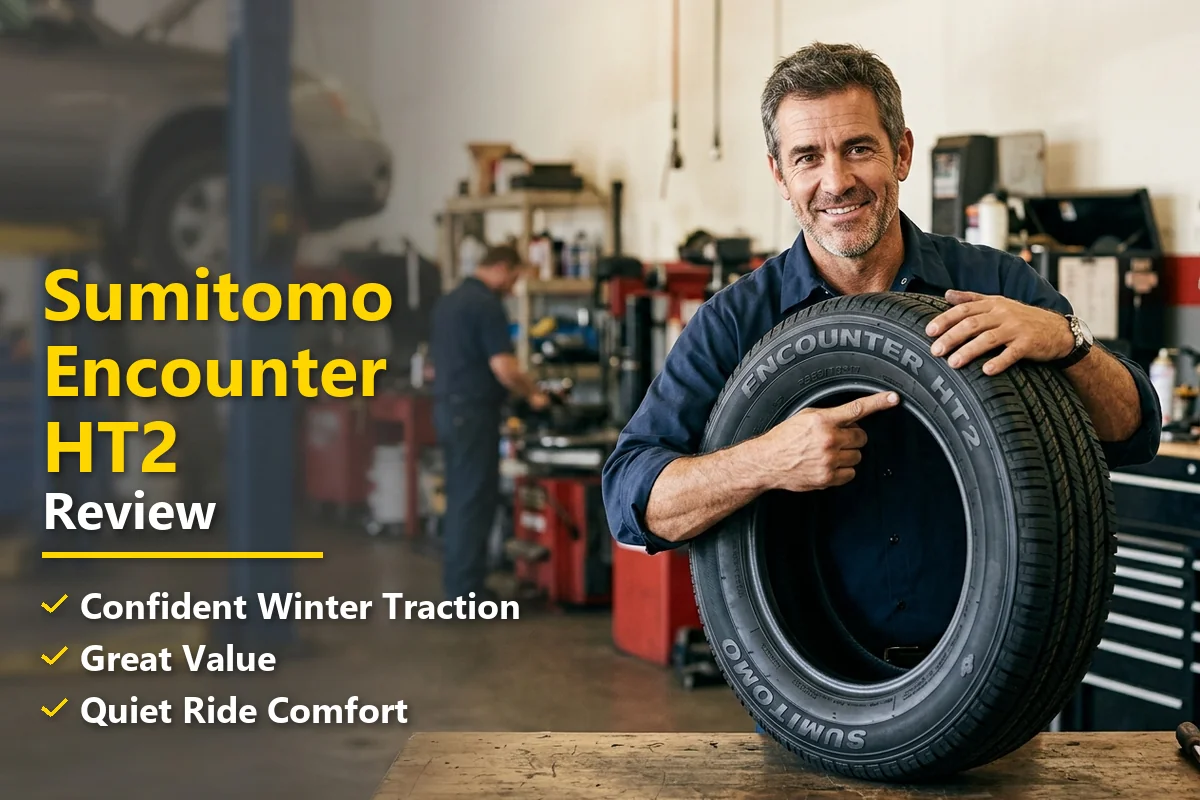
That’s exactly where I found myself when I started looking at the Sumitomo Encounter HT2 — a tire that promises highway comfort, decent longevity, and a price tag that won’t make you wince.
If you’ve been exploring affordable tire options, you may have also come across our Sailun Tires Review, which covers another popular value-oriented brand worth considering.
I installed a set of these on my half-ton pickup and put them through real-world driving conditions — highway commuting, rain-soaked backroads, loaded-up weekend hauling, and everything in between. Here’s exactly what I found.
- The Sumitomo Encounter HT2 is a solid budget highway terrain tire for trucks and SUVs that punches above its price class.
- Dry road performance is confident and predictable — I felt genuinely comfortable at highway speeds.
- Wet traction is adequate but not class-leading; heavy rain requires a bit more caution.
- Road noise is impressively low for a tire in this price range.
- Tread wear appears even and consistent after extended daily driving.
- Best suited for daily drivers, commuters, and light-duty truck owners who stick primarily to pavement.
- Not recommended for serious off-road use or heavy winter conditions.
Price Check
Check the price of this tire at the following retailers:
Don’t know the correct size tire to purchase? Start here!
What Is the Sumitomo Encounter HT2?
The Sumitomo Encounter HT2 is a highway terrain (HT) tire designed for light trucks, SUVs, and crossovers. It’s the successor to the original Encounter HT and represents Sumitomo’s effort to deliver a more refined, longer-lasting tire for everyday pavement driving.
Sumitomo is a Japanese tire brand with a long history — they’ve been manufacturing tires since 1909. In the US market, their tires are distributed through TBC Corporation (the same parent company behind brands like Falken). This isn’t some fly-by-night brand; there’s real engineering infrastructure behind these products.
The HT2 is available in a wide range of sizes, covering popular fitments from 16-inch to 20-inch wheels. That covers everything from midsize SUVs like the Toyota 4Runner to full-size trucks like the Ford F-150 and Chevrolet Silverado.
Key Specifications and Features
Before I get into my driving impressions, let me lay out what Sumitomo says this tire brings to the table. Understanding the engineering intent helps frame the real-world experience.
- Tire Type: Highway Terrain (HT)
- Vehicle Compatibility: Light trucks, SUVs, crossovers
- Speed Rating: T (118 mph) on most sizes, H (130 mph) on select sizes
- Load Range: SL and XL depending on size
- Treadwear Warranty: 70,000 miles
- UTQG Rating: 720 A B (varies by size)
- Sidewall Design: Available in blackwall
- Season Rating: All-season
A 70,000-mile treadwear warranty is notable at this price point. Many competing budget tires offer 50,000 to 60,000 miles, so Sumitomo is clearly signaling confidence in the HT2’s longevity.
Tread Design Highlights
The Encounter HT2 features a symmetric tread pattern with four wide circumferential grooves. These grooves are the primary channels for evacuating water, and they’re noticeably deep — I measured approximately 11/32nds of an inch of tread depth on my new set, which is solid.
Sumitomo incorporated a variable-pitch tread block design, which is intended to reduce harmonic road noise. There’s also full-depth siping across the tread blocks to maintain wet grip as the tire wears down over time.
The shoulder blocks feature chamfered edges and lateral notches that help with water channeling and add a subtle touch of stability during lane changes. It’s not an aggressive-looking tire by any means — this is a highway tire through and through — but the design is purposeful.
My Real-World Driving Experience
I installed the Sumitomo Encounter HT2 in a popular LT265/70R17 size on my pickup. The truck serves as my daily driver and occasional weekend hauler, so it sees a healthy mix of highway commuting, suburban errands, and the occasional trip down unpaved country roads.
Here’s how the tire performed across every condition I encountered.
Dry Road Performance
This is where the Encounter HT2 shines brightest. From the very first drive, I noticed how composed and planted the tires felt on dry pavement. Highway cruising at 65-75 mph was genuinely comfortable — the tires tracked straight, responded predictably to steering inputs, and felt confidence-inspiring during lane changes.
On my daily commute, which involves a mix of highway and suburban surface streets, the tires performed exactly as I’d want a highway tire to behave. Braking felt progressive and controlled, with no unexpected squirm or vagueness at the contact patch.
I also tested them under a moderately loaded bed — about 800 pounds of landscaping materials for a weekend project. The tires handled the additional weight without any noticeable wandering or sidewall flex that might concern you. They’re not rated for truly heavy commercial loads, but for typical truck-owner stuff, they’re perfectly capable.
Cornering grip on dry roads was adequate for an HT tire. I’m not carving canyons in a pickup truck, but the tires held their line confidently through highway on-ramps and sweeping curves without feeling like they were running out of grip prematurely.
Wet Road Performance
Wet traction is where I have to be a little more nuanced in my assessment. The Encounter HT2 performs competently in light to moderate rain. Those four circumferential grooves do their job evacuating water, and I didn’t experience any sudden loss of traction during normal driving in wet conditions.
However, during a particularly heavy downpour on the interstate, I did notice a slight reduction in feedback through the steering wheel. There was a hint of that floaty feeling that suggests the tires are working harder to maintain contact with the road surface. I backed off my speed by about 5-10 mph and the tires felt composed again.
I wouldn’t call the wet performance bad — it’s firmly in the “acceptable” category for a budget highway tire. But if you live somewhere with frequent heavy rain (I’m looking at you, Florida and Pacific Northwest drivers), you should know that premium tires from brands like Michelin or Continental will offer noticeably better wet grip. That said, those tires also cost nearly twice as much per tire.
Road Noise and Comfort
This is genuinely one of the Encounter HT2’s strongest selling points, and it caught me off guard. I’ve tested budget tires before that drone and hum on the highway to the point where you’re constantly reaching for the radio volume. The HT2 is not one of those tires.
At highway speeds, road noise is remarkably subdued. The variable-pitch tread design that Sumitomo touts in their marketing materials seems to actually work. I noticed a faint hum on coarser pavement surfaces, but on normal asphalt, the cabin stayed impressively quiet.
Ride comfort is also above average for this price category. The tires absorb small road imperfections — expansion joints, small potholes, rough patches — without transmitting harsh jolts into the cabin. Over the course of a long highway drive, I arrived feeling less fatigued than I expected, which speaks to the overall ride quality.
Off-Road and Gravel Performance
Let me be clear: this is a highway terrain tire, and it’s not pretending to be anything else. I took the truck down several miles of packed gravel roads and some hard-packed dirt paths, and the HT2 handled it fine. Traction was adequate, and the tires didn’t feel squirrely.
But the moment the surface got loose — deep gravel, soft dirt, or muddy patches — the limitations became obvious. The tread design simply isn’t aggressive enough to dig in and find grip in those conditions. If your driving involves regular unpaved surfaces beyond well-maintained gravel, you’ll want to look at an all-terrain (AT) tire instead.
For the occasional gravel road or well-maintained dirt path? The HT2 is perfectly acceptable. Just don’t expect to take it on any trail you’d see on an overlanding Instagram page.
Winter and Cold Weather Performance
The Encounter HT2 does not carry the Three-Peak Mountain Snowflake (3PMSF) symbol, which means it hasn’t been certified for severe snow performance. It does have the M+S (Mud and Snow) marking, but that’s a relatively low bar.
I did encounter some cold weather driving during my testing period, with temperatures dipping into the mid-30s (Fahrenheit) on several mornings. The tires performed normally in those conditions on dry roads. But I would not rely on these tires for regular snow driving.
If you live in the Snow Belt or any area that sees regular winter precipitation, you’ll either want a dedicated winter tire set or should consider an all-terrain tire with the 3PMSF rating for year-round use.
Tread Wear Observations
After several weeks of consistent daily driving — a mix of highway commuting and around-town errands — the tread wear on the Encounter HT2 looks very even and consistent. I didn’t observe any irregular wear patterns, cupping, or shoulder wear that might indicate issues with the tire’s construction or compound.
The 70,000-mile treadwear warranty suggests Sumitomo has used a harder, longer-lasting compound. In my experience so far, the wear rate seems consistent with that warranty figure. I’ll note that maintaining proper inflation pressure and getting regular alignments will be critical to actually achieving that kind of longevity — that’s true for any tire, but especially relevant with harder compounds that can show uneven wear more readily if alignment is off.
The tread depth gauge readings across the tire face were remarkably uniform after my testing period, which is encouraging. It suggests good weight distribution at the contact patch and a well-engineered tread profile.
Sumitomo Encounter HT2 vs. The Competition
No tire exists in a vacuum, so let me put the HT2 in context with some of its direct competitors in the budget to mid-range highway terrain segment.
| Feature | Sumitomo Encounter HT2 | Cooper Discoverer HTP II | Hankook Dynapro HT RH12 | Firestone Destination LE3 |
|---|---|---|---|---|
| Price Range (per tire)* | $110 – $170 | $140 – $200 | $120 – $190 | $145 – $220 |
| Treadwear Warranty | 70,000 miles | 70,000 miles | 70,000 miles | 70,000 miles |
| Dry Performance | Very Good | Very Good | Good | Excellent |
| Wet Performance | Good | Very Good | Good | Very Good |
| Road Noise | Very Quiet | Quiet | Moderate | Very Quiet |
| Ride Comfort | Very Good | Very Good | Good | Excellent |
| Snow/Winter | Poor | Fair | Poor | Fair |
*Prices are approximate for popular LT265/70R17 size as of publication and may vary by retailer.
Versus the Cooper Discoverer HTP II
The Cooper is probably the Encounter HT2’s closest competitor. It offers slightly better wet traction in my experience and has the backing of a more established brand name in the US truck tire market. However, it typically costs $20-$40 more per tire, and I found the road noise levels to be very similar between the two.
If wet performance is your top priority, the Cooper gets the edge. If you’re budget-conscious and primarily drive in dry conditions, the Sumitomo saves you money without a dramatic sacrifice.
Versus the Hankook Dynapro HT RH12
The Hankook Dynapro HT is a tire I’ve had experience with on a previous vehicle, and it’s a solid choice. However, it tends to be a bit noisier on the highway than the Encounter HT2, and the ride quality isn’t quite as refined. Pricing between the two is often very close, which actually makes the Sumitomo the better value in my opinion given its quieter ride.
Versus the Firestone Destination LE3
The Firestone is arguably the best-performing tire in this comparison group, particularly in wet conditions and overall ride comfort. But it’s also the most expensive, sometimes by a significant margin. If you can stretch your budget, the Firestone is excellent. If you can’t, the Sumitomo delivers roughly 85% of the experience for 70% of the cost.
Where to Buy and What to Expect on Price
The Sumitomo Encounter HT2 is widely available through major US tire retailers. I’ve seen it stocked at Tire Rack, Discount Tire, Walmart Auto Care, and various regional tire shops. Availability is generally good across popular sizes.
Pricing varies by size, but here’s a rough guide for some common fitments:
- P245/65R17 — approximately $120-$135 per tire
- LT265/70R17 — approximately $140-$160 per tire
- P275/55R20 — approximately $150-$170 per tire
- LT275/65R18 — approximately $145-$165 per tire
For a set of four, you’re typically looking at $480-$680 before installation, which puts the HT2 firmly in budget-friendly territory. Factor in the 70,000-mile warranty and the cost-per-mile math becomes even more attractive.
I’d recommend checking Tire Rack’s pricing and then comparing with your local shops. Many local installers will price-match online retailers, and you’ll save on shipping costs if you buy local.
Who Should Buy the Sumitomo Encounter HT2?
After extensive testing, I have a clear picture of who this tire is ideal for — and who should look elsewhere.
The HT2 Is Great For:
- Daily commuters with trucks or SUVs who spend 80%+ of their time on paved roads
- Budget-conscious buyers who want a reliable, quiet tire without paying premium prices
- Highway travelers who prioritize comfort and low road noise on long drives
- Fleet managers looking for affordable, long-wearing tires for work trucks that stay on pavement
- Drivers in Sun Belt states (Texas, Arizona, California, Florida) where dry performance matters most and winter weather is minimal
The HT2 Is NOT Ideal For:
- Off-road enthusiasts — even casual ones. Get an AT tire instead.
- Drivers in heavy snow regions — Minnesota, Wisconsin, Colorado mountains. You need a 3PMSF-rated tire or dedicated winters.
- Heavy towing applications — if you’re regularly towing near your truck’s max capacity, consider a load range E tire from a premium brand.
- Performance-oriented drivers who want razor-sharp handling feedback.
Installation and Break-In Period
My set of Encounter HT2 tires was installed at a local shop, and the process was completely standard. The tires balanced without issue — no excessive weight needed, which suggests good manufacturing consistency. The bead seated easily, and there were no concentricity issues.
I did notice that the tires needed a brief break-in period. During the first few days of driving, there was a very slight slickness to the tread surface — this is completely normal with new tires and is caused by mold release compounds used during manufacturing. After several days of regular driving, the tires felt fully broken in and the grip improved noticeably.
My advice: don’t push any new tire hard during the first few days. Drive normally, avoid hard braking and aggressive cornering, and let the tread surface scuff in naturally.
Maintenance Tips for Maximum Life
Getting the most out of the Encounter HT2 — or any tire — comes down to a few basic maintenance practices. Since the HT2 uses a harder compound to achieve that 70,000-mile warranty, proper care is even more important.
- Check tire pressure monthly. I use a quality digital gauge and check cold pressures every two to three weeks. Proper inflation is the single biggest factor in even tread wear.
- Rotate every 5,000-7,500 miles. I rotate my tires at every other oil change. This ensures all four tires wear evenly and maximizes your treadwear warranty eligibility.
- Get an alignment check annually. Or immediately if you hit a pothole hard enough to feel it. Misalignment will chew through any tire prematurely.
- Inspect for damage regularly. A quick visual check for sidewall bulges, embedded objects, or uneven wear takes 30 seconds and can catch problems before they become dangerous.
The Warranty: What’s Actually Covered?
Sumitomo backs the Encounter HT2 with a 70,000-mile treadwear warranty, which is their promise that the tires will last at least that long under normal driving conditions. If the tread wears out prematurely, you’re eligible for a prorated credit toward replacement tires.
There are conditions, of course. You need to maintain proof of purchase, demonstrate that you rotated the tires at recommended intervals, and show that the wear was uniform (not caused by alignment or inflation issues). Keep your receipts and rotation records — this is true for any tire warranty claim.
Sumitomo also offers a limited workmanship and materials warranty that covers defects for the first few years of ownership. I haven’t needed to make a claim, but the warranty structure is comparable to what you’d see from any major manufacturer.
My Overall Verdict on the Sumitomo Encounter HT2
After spending considerable time with the Sumitomo Encounter HT2 as my daily driver tires, I’m genuinely impressed with the value proposition. This is a tire that does exactly what it promises — delivers a quiet, comfortable highway ride with predictable dry performance — at a price point that undercuts most of the competition.
Is it perfect? No. Wet traction could be better, and it’s clearly not an option for off-road or winter driving. But for the vast majority of US truck and SUV owners who spend their time on paved roads in mild to moderate climates, the Encounter HT2 is a smart buy.
I’d rate it 4 out of 5 stars overall. It loses a point for wet weather limitations, but it earns high marks for ride comfort, low noise, dry traction, and overall value. If you’re looking for a highway tire that respects your budget without making you feel like you compromised on quality, the Sumitomo Encounter HT2 deserves a spot on your shortlist.
The bottom line: I’d recommend this tire to a friend, and I wouldn’t hesitate to buy another set when these wear out. That’s about as honest an endorsement as I can give.
Frequently Asked Questions
Is the Sumitomo Encounter HT2 a good all-season highway tire?
Yes, the Sumitomo Encounter HT2 is a solid all-season highway terrain tire designed for SUVs, crossovers, and light trucks. It delivers a comfortable, quiet ride on paved roads and handles light rain well thanks to its four wide circumferential grooves. For daily commuters and road-trip drivers across the US, it offers dependable performance at a budget-friendly price point compared to premium brands like Michelin or Bridgestone.
How long does the Sumitomo Encounter HT2 last in real-world driving?
The Sumitomo Encounter HT2 comes with a 65,000-mile treadwear warranty, which is competitive for its price class. In my experience and based on user reviews, most drivers report getting between 50,000 and 65,000 miles with proper tire rotation every 5,000–7,500 miles. Tread life can vary depending on driving habits, alignment, and whether you’re frequently hauling heavy loads.
How much does a set of Sumitomo Encounter HT2 tires cost?
A single Sumitomo Encounter HT2 tire typically costs between $100 and $180 depending on the size, with popular sizes like 265/70R17 and 245/65R17 falling in the $120–$150 range. A full set of four will usually run you $400–$700 before installation. This makes the Encounter HT2 one of the most affordable highway terrain options on the US market, often $200–$400 cheaper per set than comparable tires from Goodyear or Continental.
How does the Sumitomo Encounter HT2 perform in snow and winter conditions?
The Sumitomo Encounter HT2 is an all-season tire, but it is not rated with the Three-Peak Mountain Snowflake (3PMSF) symbol, so it’s not ideal for heavy snow or icy conditions. It can handle light snow and cold weather on plowed roads reasonably well thanks to its siping pattern. If you live in northern US states with harsh winters, I’d recommend switching to dedicated winter tires or considering an all-weather alternative with a 3PMSF rating.
What vehicles does the Sumitomo Encounter HT2 fit?
The Sumitomo Encounter HT2 is available in a wide range of sizes from 16 to 20 inches, fitting popular US vehicles like the Toyota RAV4, Ford Explorer, Chevy Silverado 1500, Jeep Grand Cherokee, and Honda CR-V. It’s designed for SUVs, crossovers, and half-ton pickup trucks used primarily on highways and paved roads. Check your vehicle’s door placard or owner’s manual to confirm the exact tire size before purchasing.
How does the Sumitomo Encounter HT2 compare to the Falken Wildpeak HT02?
Both the Sumitomo Encounter HT2 and the Falken Wildpeak HT02 are budget-friendly highway terrain tires, but there are key differences. The Falken Wildpeak HT02 tends to offer slightly better wet traction and carries a longer 70,000-mile treadwear warranty compared to the Encounter HT2’s 65,000 miles. However, the Sumitomo is often $10–$20 cheaper per tire, making it the better choice if you’re prioritizing value and primarily drive in dry conditions across the US.
Is the Sumitomo Encounter HT2 noisy on the highway?
One of the standout features of the Sumitomo Encounter HT2 is its relatively quiet ride for a tire in this price range. Its optimized tread block sequencing is designed to reduce road noise at highway speeds, and most drivers report a comfortable, low-noise experience up to 70–80 mph. It’s noticeably quieter than many all-terrain tires, making it a smart pick for US drivers who spend most of their time on interstates and paved roads.