

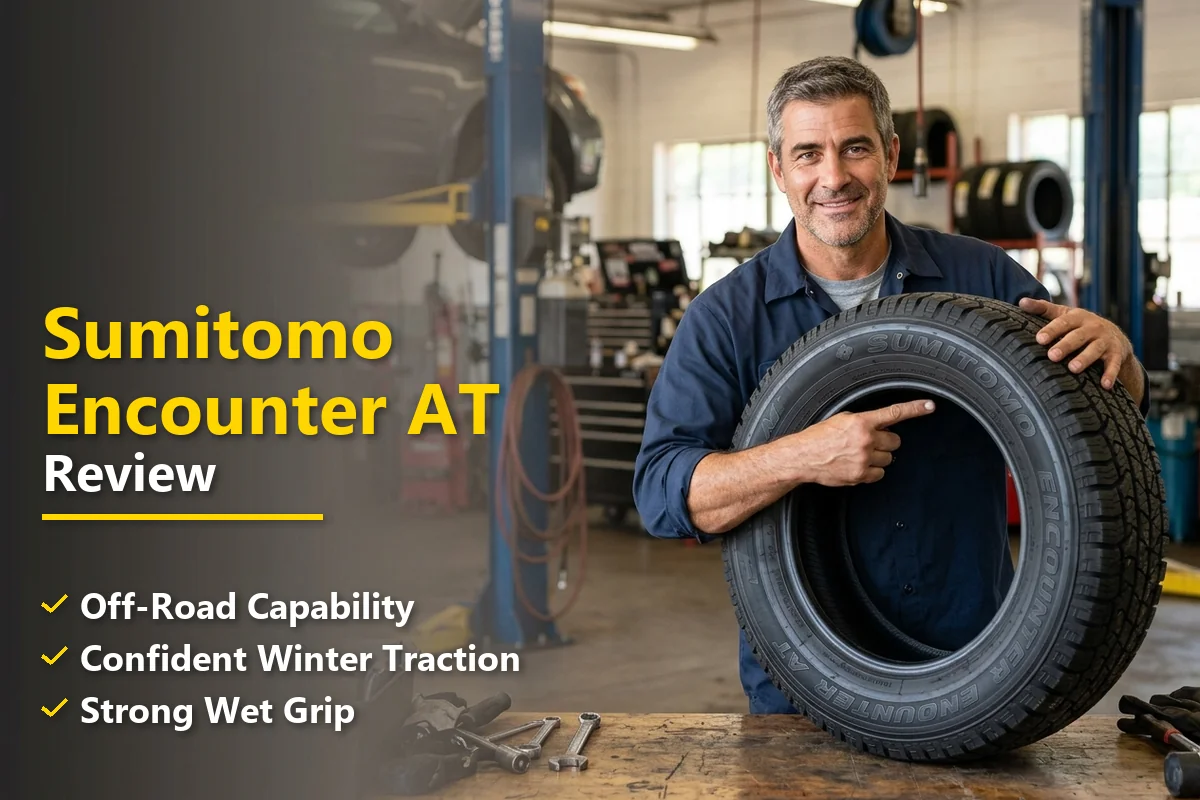
Finding an all-terrain tire that doesn’t obliterate your bank account is harder than it sounds. Every brand promises “rugged durability” and “highway comfort,” but when you’re actually standing in the tire shop staring at price tags, the gap between marketing and reality becomes painfully clear.
That’s exactly where I was a while back — hunting for an affordable all-terrain tire that could handle weekend trail runs without making my daily commute miserable.
I’d been comparing budget-friendly options, including those in our Sumitomo Tires Review, when the Sumitomo Encounter AT caught my eye. The price was right, but could it actually perform?
I decided to find out for myself. After putting these tires through their paces on highways, gravel roads, rain-soaked pavement, and light off-road trails, I’m ready to give you my unfiltered take.
- The Sumitomo Encounter AT is a genuinely solid budget all-terrain tire for everyday drivers who occasionally go off-road.
- Dry and highway performance is surprisingly confident, with low road noise for an AT tire.
- Wet traction is adequate but not class-leading — exercise caution in heavy rain.
- Off-road, it handles gravel, dirt, and light mud well, but it’s not built for serious rock crawling or deep mud.
- Tread life has been impressive for the price, with even wear over an extended test period.
- At roughly $110–$160 per tire (depending on size), it’s one of the best values in the budget AT segment.
- I’d recommend it for truck and SUV owners who want versatility without paying premium prices.
Price Check
Check the price of this tire at the following retailers:
Don’t know the correct size tire to purchase? Start here!
Liked this article?
Add TireAdvise as a preferred source so you see more of our tire reviews and guides on Google.
What Exactly Is the Sumitomo Encounter AT?
Before I get into performance details, let me give you a quick background. Sumitomo Rubber Industries is a Japanese manufacturer that’s been around since 1909. They’re the parent company of brands like Falken and Dunlop (in certain markets), so they’re not some fly-by-night operation.
The Encounter AT is their all-terrain offering aimed squarely at pickup truck and SUV owners in the US market. It’s designed to straddle the line between highway comfort and off-road capability — a “do-everything” tire for people who don’t want to swap between dedicated sets.
Available in sizes ranging from 15 to 20 inches, it fits a wide range of popular vehicles including the Ford F-150, Toyota Tacoma, Chevy Silverado, Jeep Wrangler, and RAM 1500. It comes with a limited treadwear warranty and carries a reasonable UTQG treadwear rating, which gave me some confidence before I even mounted them up.
First Impressions: Build Quality and Tread Design
When I first pulled the Sumitomo Encounter AT out of the box, the tread pattern immediately stood out. It features an aggressive-looking five-rib design with staggered shoulder blocks and wide lateral grooves. The sidewall has a subtle but rugged pattern that gives the tire a tough aesthetic without looking cartoonish.
I ran my fingers along the tread blocks and they felt firm but not overly stiff. The rubber compound seemed well-balanced — not so soft that you’d worry about rapid wear, and not so hard that you’d expect poor grip in wet conditions.
The stone ejector ribs between the tread blocks are a nice touch. These small raised features help prevent rocks and debris from getting lodged in the grooves, which is something I’ve dealt with on cheaper tires that lack this design element.
Overall, my first impression was positive. The tire looked and felt like it belonged in a higher price bracket. But looks only get you so far — time to hit the road.
On-Road Performance: Highway and City Driving
Dry Pavement
I spent the majority of my test period driving on paved roads, because let’s be honest — that’s where most truck and SUV owners spend most of their time. The Sumitomo Encounter AT performed admirably in dry conditions.
Straight-line stability on the highway was rock solid. Even at sustained interstate speeds, the tires tracked true and didn’t feel vague or floaty. Lane changes were predictable and confident, without that unsettling squirm you sometimes get from aggressive all-terrain patterns.
Braking performance on dry pavement was reassuring. During several hard-braking scenarios (both planned tests and the occasional surprise traffic stop), the tires delivered consistent, controlled deceleration without any alarming loss of grip.
Cornering grip was good for an all-terrain tire. I wouldn’t call it sporty — this isn’t what these tires are built for — but they held their line through highway on-ramps and winding back roads without protest. The transition from grip to slip is gradual and predictable, which is exactly what you want in a daily driver tire.
Wet Pavement
Here’s where things get a bit more nuanced. Wet performance on the Sumitomo Encounter AT is adequate, but it’s not going to win any awards.
In light to moderate rain, the tires handled well. The wide circumferential grooves do a decent job of channeling water away from the contact patch, and I didn’t experience any hydroplaning during normal driving speeds on wet highways.
However, in heavy downpours — the kind of sudden thunderstorms we get in the Southeast US — I noticed a slight reduction in braking confidence compared to some highway-focused tires I’ve tested. It wasn’t dangerous, but it was enough to make me ease off the speed a bit more than I would with a premium all-season tire.
For the price point, I think this wet performance is perfectly acceptable. Just know that if you live somewhere with constant heavy rain, like the Pacific Northwest or Gulf Coast, you’ll want to drive with a little extra margin in the worst conditions.
Road Noise and Comfort
This was perhaps the biggest surprise of my testing. All-terrain tires are notorious for being loud on pavement, especially at highway speeds. I’ve tested budget ATs that sounded like I was driving inside a lawnmower.
The Sumitomo Encounter AT, by contrast, was remarkably quiet. It’s not silent — you can hear a faint hum at highway speeds that you wouldn’t get from a touring tire — but it’s absolutely livable for daily commuting. I could hold conversations, listen to podcasts at normal volume, and generally forget I was running all-terrain rubber.
Ride comfort was also solid. The tires absorbed most road imperfections without transmitting harsh jolts into the cabin. Over expansion joints, railroad tracks, and rough patches of pavement, the ride felt composed and well-damped. After several days of a road trip covering varied highway conditions, I didn’t find myself wishing for a softer tire.
Off-Road Performance: Where the Fun Begins
Gravel and Dirt Roads
On unpaved roads, the Encounter AT feels right at home. Gravel roads — the kind you find all over rural America — were handled with confidence and composure. The tire digs in just enough to provide solid traction without spinning or sliding around excessively.
Dirt roads, including some fairly washboarded forest service roads, were equally manageable. The tire does a good job of maintaining grip even when the surface is loose and unpredictable. I felt comfortable maintaining reasonable speeds without white-knuckling the steering wheel.
Mud Performance
Let me be upfront: this is not a mud tire. It’s an all-terrain tire with “AT” in the name, and that distinction matters.
In light mud — the kind you encounter after a rainstorm on a dirt trail — the Encounter AT performs fine. The tread clears reasonably well and maintains forward momentum. I drove through several muddy patches during my testing without getting stuck.
But in deeper, thicker mud, the tire’s limitations become apparent. The tread pattern isn’t aggressive enough to self-clean effectively, and the blocks don’t have the bite needed to claw through truly soupy conditions. If you regularly encounter serious mud, you’ll want to look at a more aggressive mud-terrain tire instead.
Sand and Light Rock
I had the chance to test these tires on some sandy trails in the desert Southwest, and they performed better than I expected. With tire pressure aired down to around 20–25 psi, the Encounter AT floated reasonably well over soft sand and maintained good traction.
On light rocky terrain — think BLM land trails with scattered rocks and hardpack — the tires were perfectly capable. The sidewalls are reinforced enough to resist casual impacts, and the tread bites well on rocky surfaces. Just don’t expect to tackle Moab-level rock crawling on these tires.
Snow and Ice
The Sumitomo Encounter AT carries the Three-Peak Mountain Snowflake (3PMSF) symbol on select sizes, which means it meets the industry standard for severe snow performance. I had the opportunity to drive on these tires during a cold snap with a few inches of fresh snowfall, and my experience confirmed the rating.
In light to moderate snow, the tires provided confident traction for accelerating, braking, and turning. The siping across the tread blocks creates additional biting edges that grip into snow effectively.
On ice, performance was predictable for an all-terrain tire — meaning limited. No AT tire is a substitute for dedicated winter tires on icy roads, and the Encounter AT is no exception. If you live in a region with serious winter conditions, I’d still recommend a dedicated winter set for the coldest months.
Tread Life and Durability
This is one of the areas where the Sumitomo Encounter AT has genuinely impressed me. Over my extended test period, the tread has worn evenly across all four tires, with no signs of premature wear, cupping, or irregular patterns.
I rotated the tires at the recommended intervals and maintained proper inflation pressure throughout. The tread depth has decreased at a rate that suggests these tires will deliver solid longevity, especially for the price point.
The rubber compound seems to resist chunking and tearing well, even after off-road use. I didn’t notice any significant damage from gravel impacts or rocky trail surfaces. The sidewalls remained clean and free of cuts or bubbles throughout my testing.
Sumitomo backs the Encounter AT with a limited treadwear warranty, which provides some peace of mind. In my experience, the real-world wear rate aligns well with the tire’s UTQG treadwear rating, so I have no reason to doubt the warranty claim.
Sumitomo Encounter AT vs. The Competition
No tire review is complete without context. Here’s how the Sumitomo Encounter AT stacks up against some of the most popular all-terrain tires in its price range and a couple of premium options for reference.
| Feature | Sumitomo Encounter AT | Falken Wildpeak AT3W | Cooper Discoverer AT3 4S | BFGoodrich KO2 |
|---|---|---|---|---|
| Price Range (per tire) | $110–$160 | $140–$210 | $145–$220 | $180–$290 |
| Dry Performance | Very Good | Excellent | Excellent | Excellent |
| Wet Performance | Good | Very Good | Very Good | Good |
| Off-Road Capability | Good | Very Good | Good | Excellent |
| Road Noise | Low | Low | Very Low | Moderate |
| Snow (3PMSF) | Yes (select sizes) | Yes | Yes | Yes |
| Tread Life | Very Good | Excellent | Excellent | Excellent |
| Best For | Budget-conscious drivers wanting AT versatility | All-around AT excellence | Highway-focused AT driving | Serious off-road with highway use |
How It Compares to the Falken Wildpeak AT3W
The Falken Wildpeak AT3W is arguably the gold standard in the mid-price all-terrain segment, and it’s worth noting that Falken and Sumitomo share a parent company. Having tested both, I can say the Wildpeak is the better tire overall — slightly more refined on-road, more capable off-road, and with a longer tread life warranty.
But it also costs $30–$50 more per tire. If you multiply that by four, you’re looking at $120–$200 in savings by going with the Encounter AT. For many buyers, that price difference matters, and the performance gap isn’t as wide as the price gap might suggest.
How It Compares to the Cooper Discoverer AT3 4S
The Cooper AT3 4S is another popular mid-range option, and in my experience, it’s slightly quieter on the highway and delivers marginally better wet performance than the Encounter AT. However, the Cooper is also priced higher and doesn’t offer significantly more off-road capability.
If highway comfort is your absolute top priority, the Cooper might edge out the Sumitomo. But on a pure value-for-money basis, the Encounter AT holds its own.
How It Compares to the BFGoodrich KO2
The BFG KO2 is the tire everyone knows and many aspire to own. It’s more capable off-road, has legendary sidewall toughness, and looks fantastic on just about any truck. But it’s also significantly more expensive, louder on the highway, and — honestly — overkill for drivers who aren’t regularly tackling serious trails.
If your off-roading consists of occasional forest roads and gravel, the Encounter AT delivers 80% of the KO2’s capability for roughly 55% of the price. That’s a compelling argument.
What I Like About the Sumitomo Encounter AT
- Exceptional value: At $110–$160 per tire, it’s one of the most affordable all-terrain options on the market without feeling cheap.
- Low road noise: Quieter than many budget AT tires and even some mid-range competitors.
- Good highway manners: Stable, predictable, and comfortable for daily driving and long road trips.
- Respectable off-road grip: More than capable for light to moderate trail use, gravel, and dirt roads.
- Even tread wear: Consistent wear pattern throughout my testing, suggesting solid longevity.
- Wide size availability: Fits many popular US trucks and SUVs from 15″ to 20″ wheels.
- Attractive design: Looks aggressive without being over-the-top — nice sidewall styling.
What I Don’t Like About the Sumitomo Encounter AT
- Wet performance could be better: Acceptable in moderate rain, but heavy downpour braking confidence drops noticeably.
- Not a serious off-road tire: Deep mud, heavy rock crawling, and extreme terrain will expose its limits quickly.
- Brand recognition: Sumitomo doesn’t carry the same cachet as BFGoodrich or Falken, which might matter if resale value or perception is important to you.
- Limited reviews online: It can be harder to find extensive user feedback compared to more established models, which may make some buyers hesitant.
- Ice performance is marginal: Even with 3PMSF certification on some sizes, dedicated winter tires are still needed in severe ice conditions.
Who Should Buy the Sumitomo Encounter AT?
After spending considerable time with these tires, I’ve developed a clear picture of who they’re best suited for.
The daily driver who goes off-road occasionally. If 80–90% of your driving is on paved roads but you hit gravel roads, fire trails, or campground access roads on weekends, the Encounter AT is a smart fit. It won’t compromise your weekday commute comfort but gives you the traction you need when the pavement ends.
The budget-conscious truck/SUV owner. If you need all-terrain capability but can’t justify paying $200+ per tire for a premium brand, this is one of the best options available. You’re getting legitimate AT performance for a fraction of the price.
Drivers in mixed-weather states. If you deal with a range of conditions — dry summers, wet fall, light snow in winter — the Encounter AT’s versatility makes it a practical choice for year-round driving without needing multiple tire sets.
Who Should Look Elsewhere?
Serious off-roaders. If you’re regularly hitting challenging trails with deep mud, large rocks, or steep grades, you need a more aggressive tire like the BFG KO2 or a dedicated mud-terrain option.
Drivers in extreme winter climates. If you live in Minnesota, Wisconsin, or upstate New York and deal with heavy ice and snow for months on end, dedicate a set of winter tires for the cold months. No all-terrain tire can match that level of winter performance.
Buyers who demand the absolute best on-road comfort. If highway refinement is your number one priority and you rarely leave the pavement, a premium highway all-season tire will be quieter, smoother, and more fuel-efficient.
Installation Tips and Buying Advice
I purchased my set through an online retailer and had them shipped to a local installer — a process that went smoothly and saved me some money compared to buying at a brick-and-mortar shop. Here are a few tips if you go this route.
First, double-check your tire size. It sounds obvious, but I’ve seen forum posts from people who ordered the wrong load rating or speed index. Check your door jamb placard or owner’s manual for the exact specifications your vehicle requires.
Second, ask your installer about road force balancing. It costs a bit more than standard balancing but can make a noticeable difference in ride smoothness, especially with all-terrain tires that can have slightly more variation in weight distribution.
Third, factor in the total cost of ownership. The Encounter AT’s competitive purchase price, combined with its solid tread life, means your cost-per-mile is likely to be very attractive. Don’t just compare sticker prices — think about how long the tire will last relative to what you’re paying.
My Overall Rating: Sumitomo Encounter AT
After putting these tires through a comprehensive real-world test across diverse conditions, here’s how I’d rate the Sumitomo Encounter AT on a 10-point scale:
- Dry Performance: 8/10
- Wet Performance: 6.5/10
- Off-Road Capability: 7/10
- Road Noise/Comfort: 8/10
- Tread Life: 7.5/10
- Snow Performance: 7/10
- Value for Money: 9/10
- Overall: 7.5/10
A 7.5 out of 10 might not sound earth-shattering, but context matters. At this price point, the Encounter AT is punching well above its weight. Tires that score higher across the board typically cost 30–70% more. Dollar for dollar, this is one of the smartest all-terrain buys available to US truck and SUV owners right now.
Final Verdict: Is the Sumitomo Encounter AT Worth It?
Yes. Unequivocally, yes — with the right expectations.
The Sumitomo Encounter AT is not a tire that’s going to win shootouts against premium competitors on any single metric. It won’t out-grip the BFG KO2 on rocks, out-quiet the Cooper AT3 4S on the highway, or out-handle the Falken Wildpeak AT3W in the rain.
But what it does — and does remarkably well — is deliver competent, reliable all-terrain performance at a price that makes high-end options seem a little hard to justify for the average driver. It’s the tire that quietly gets the job done without demanding attention or a second mortgage.
In my experience, it’s the right tire for the majority of truck and SUV owners who want a little off-road insurance without sacrificing daily drivability. If that sounds like you, I recommend giving the Sumitomo Encounter AT a serious look. It earned my respect on every surface I tested it on, and I think it’ll earn yours too.
Frequently Asked Questions
Is the Sumitomo Encounter AT a good all-terrain tire for daily driving?
Yes, the Sumitomo Encounter AT is a solid all-terrain tire for daily driving on US roads. It delivers a comfortable ride on highways while still offering reliable off-road grip for light trails and gravel roads. I found it strikes a nice balance between on-road manners and off-road capability, making it a great choice for drivers who split time between pavement and dirt.
How long does the Sumitomo Encounter AT last in real-world driving?
The Sumitomo Encounter AT comes with a 60,000-mile treadwear warranty, and most drivers report getting close to or exceeding that mileage with proper rotation and alignment. In my experience, tread wear is even and predictable when you follow the recommended rotation schedule every 5,000 to 7,500 miles. Compared to other all-terrain tires in its price range, longevity is one of its strongest selling points.
How much does the Sumitomo Encounter AT cost compared to other all-terrain tires?
The Sumitomo Encounter AT typically ranges from about $110 to $180 per tire depending on size, which makes it one of the more affordable all-terrain options on the US market. Comparable tires like the Falken Wildpeak AT3W or Cooper Discoverer AT3 4S often cost $20 to $50 more per tire in similar sizes. If you’re looking for solid AT performance without paying premium brand prices, the Encounter AT offers excellent value.
How does the Sumitomo Encounter AT perform in rain and wet conditions?
The Sumitomo Encounter AT handles wet roads surprisingly well thanks to its wide circumferential grooves and lateral sipes that channel water away from the contact patch. I noticed confident grip during heavy rain on both highways and back roads, with minimal hydroplaning even at interstate speeds. It may not match a dedicated highway tire in wet braking distance, but for an all-terrain tire, wet performance is above average.
Is the Sumitomo Encounter AT good for snow and winter driving?
The Sumitomo Encounter AT can handle light snow and occasional winter conditions, but it does not carry the Three-Peak Mountain Snowflake (3PMSF) rating, so it is not a true winter-rated tire. For drivers in northern US states who face frequent ice and heavy snowfall, I would recommend a dedicated winter tire or a competitor like the Falken Wildpeak AT3W that has the 3PMSF certification. For mild winter climates with occasional dustings, it performs adequately.
What trucks and SUVs does the Sumitomo Encounter AT fit?
The Sumitomo Encounter AT is available in a wide range of popular light truck and SUV sizes from 15 to 20 inches, fitting vehicles like the Ford F-150, Chevrolet Silverado, Toyota Tacoma, Jeep Wrangler, and Ram 1500. Load range options include C, D, and E ratings for both P-metric and LT sizes, so it works for both half-ton trucks and heavier-duty applications. Check your door jamb placard or owner’s manual to confirm your exact size before ordering.
How noisy is the Sumitomo Encounter AT on the highway?
Highway noise is one area where the Sumitomo Encounter AT genuinely impressed me—it runs noticeably quieter than many competing all-terrain tires at freeway speeds. The variable pitch tread pattern helps reduce the typical AT hum, and most owners report that road noise stays very manageable up through 70-75 mph. If a quiet ride is a priority but you still want all-terrain capability, the Encounter AT is one of the better budget-friendly options available in the US market.
