

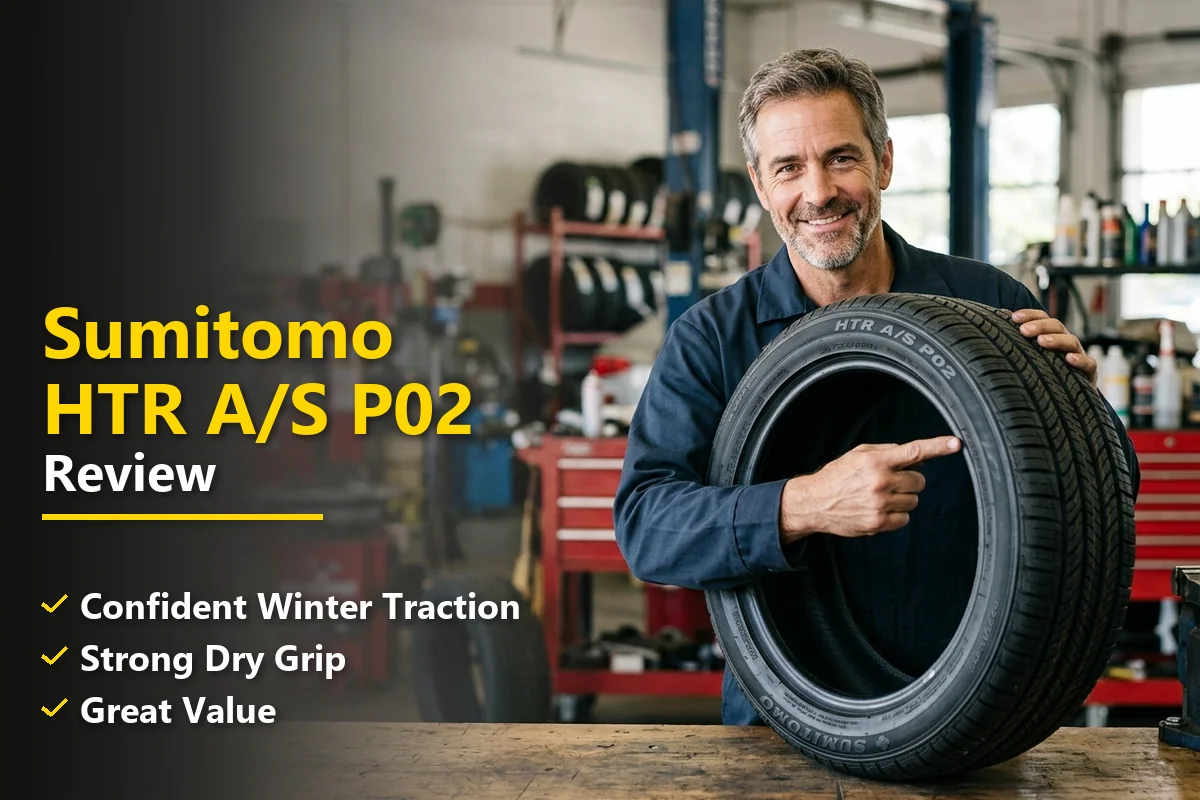
Finding a quality all-season tire that doesn’t obliterate your wallet feels nearly impossible these days. With premium brands pushing past $200 per tire in common sizes, I understand why so many drivers are looking at lesser-known names and wondering if the savings are worth the risk.
That’s exactly where the Sumitomo HTR A/S P02 enters the conversation — and after spending extensive time testing these tires across a range of conditions, I have a lot to say.
If you’ve been exploring value-oriented alternatives, you may have already seen our Sumitomo Tires Review covering another popular budget-friendly brand. But Sumitomo deserves its own deep dive, because this tire genuinely surprised me.
- The Sumitomo HTR A/S P02 is a solid all-season performance touring tire at a budget-friendly price point (often $70–$120 per tire depending on size).
- Dry grip and highway comfort are genuinely impressive for the price — I was pleasantly surprised.
- Wet traction is adequate but not class-leading; I noticed slightly longer braking distances in heavy rain compared to premium competitors.
- Light snow performance is acceptable for occasional winter encounters, but this is not a snow tire.
- Road noise is well-controlled at highway speeds, making it a comfortable daily driver tire.
- Best suited for sedan, coupe, and compact car owners who want reliable performance without the premium price tag.
- Backed by a 50,000-mile treadwear warranty, which shows Sumitomo’s confidence in longevity.
Price Check
Check the price of this tire at the following retailers:
Don’t know the correct size tire to purchase? Start here!
Liked this article?
Add TireAdvise as a preferred source so you see more of our tire reviews and guides on Google.
Who Is Sumitomo, and Should You Trust Them?
Before I get into the nitty-gritty of my testing experience, let me address the elephant in the room. Many US drivers see “Sumitomo” on a tire and immediately categorize it as a no-name brand. That assumption is flat-out wrong.
Sumitomo Rubber Industries is a massive Japanese company that has been manufacturing tires since 1909. They’re the parent company of Falken Tires — a brand many of you already know and respect. Sumitomo also has partnerships and manufacturing agreements with Dunlop in certain markets.
So when you buy a Sumitomo tire, you’re not buying some fly-by-night product. You’re buying from a company with over a century of tire engineering experience and deep connections to brands that compete at the highest levels of motorsport. That pedigree matters, and it shows in the HTR A/S P02.
What Exactly Is the HTR A/S P02?
The Sumitomo HTR A/S P02 is an all-season performance touring tire designed for sedans, coupes, and some crossover applications. It replaces the older HTR A/S P01, bringing updated tread compound technology and a refined tread pattern.
Sumitomo positions this tire for drivers who want a balance of comfort, longevity, and responsive handling without paying the premium associated with names like Michelin, Continental, or Bridgestone. It comes with a UTQG treadwear rating of 500, a traction rating of A, and a temperature rating of A.
Available sizes range from 15-inch to 20-inch fitments, covering a huge swath of popular vehicles on American roads — everything from a Honda Civic to a Toyota Camry to a Nissan Maxima.
My Real-World Testing Setup
I mounted a set of four Sumitomo HTR A/S P02 tires in size 225/45R17 on a mid-size sedan for my evaluation. The tires were purchased through a major US online retailer at approximately $95 per tire before installation — a price point that immediately made me curious about what corners, if any, had been cut.
My testing included highway commuting, back-road driving on twisty two-lane roads, wet pavement driving during spring storms, and even a brief encounter with light snow and slush. I made a deliberate effort to push these tires through a wide variety of conditions that the average American driver would realistically face.
I also drove on a set of Continental TrueContact Tour tires (roughly $140 per tire in the same size) during the same period on an identical vehicle to give myself a direct comparison point. Having that back-to-back reference was invaluable.
Dry Performance: Where This Tire Shines
Let me start with the good news, because the HTR A/S P02 genuinely earned my respect on dry pavement. From the very first drive, I noticed the tire felt planted and communicative through the steering wheel. There’s a directness to the turn-in response that I don’t normally associate with tires in this price bracket.
On the highway, the tire tracks straight and true with minimal wandering. Lane changes feel confident, and the tire doesn’t exhibit that vague, disconnected feeling that plagues many cheap all-season tires. I pushed the car through a series of sweeping curves on my favorite back road at progressively increasing speeds, and the HTR A/S P02 held its line remarkably well.
The asymmetric tread pattern plays a big role here. The outer shoulder blocks are larger and more rigid, providing lateral stability during cornering. I could feel the tire working hard in aggressive turns, but it communicated its limits clearly rather than suddenly letting go. That progressive breakaway characteristic is something I value enormously because it builds driver confidence.
Braking on Dry Surfaces
Dry braking performance was very good. During several hard stops from highway speed, the tires engaged the ABS system predictably and brought the car to a halt without drama. I didn’t measure exact distances with professional equipment, but my seat-of-the-pants evaluation puts the HTR A/S P02 very close to tires costing 30-40% more.
This is the area where Sumitomo’s engineering heritage shows through. The compound grips well on warm, dry asphalt, and the contact patch seems well-optimized for even pressure distribution.
Wet Performance: Good, but Not Perfect
Wet traction is where the picture gets a little more nuanced. The HTR A/S P02 is perfectly adequate in moderate rain — the kind of steady drizzle or light rain that most of us encounter regularly. The four wide circumferential grooves do a respectable job of channeling water away from the contact patch, and hydroplaning resistance at highway speeds felt acceptable.
However, during heavy downpours, I noticed a difference compared to the Continental TrueContact Tour I was cross-referencing. In standing water at highway speed, the Sumitomo felt slightly less confident, and I instinctively backed off the throttle a few mph. It’s not that the tire felt dangerous — it just didn’t inspire the same level of trust as a premium wet-weather tire.
Wet braking distances were noticeably longer than the Continental. During repeated stops from 50 mph on a rain-soaked parking lot, I could feel the HTR A/S P02 needing a bit more room to come to a complete stop. This is the trade-off you make at this price point, and I think it’s important to be honest about it.
Wet Cornering
Taking corners on wet roads required a bit more caution than on dry pavement. The tire’s grip level dropped more noticeably in the wet than I’d see from a Michelin Defender or Continental PureContact, but it was still within the realm of safe, predictable behavior. The key is that the tire warns you progressively — it doesn’t suddenly snap loose.
For everyday driving in states that see regular rainfall, the HTR A/S P02 is perfectly fine. Just don’t expect Michelin-level wet performance at a fraction of the cost. Physics and compound chemistry still apply.
Snow and Winter Performance
I want to be very clear here: the Sumitomo HTR A/S P02 is not a winter tire, and it does not carry the Three-Peak Mountain Snowflake (3PMSF) symbol. However, it does carry the M+S (mud and snow) designation, which suggests some basic capability in light winter conditions.
During my testing period, I encountered a late-season snowfall that dropped about two inches of wet, slushy snow. The HTR A/S P02 handled it without incident, but I drove cautiously and kept speeds moderate. The siping across the tread blocks provided enough biting edges to maintain basic traction, and the grooves prevented slush from packing up in the tread.
That said, if you live in the northern US — Minnesota, Wisconsin, Michigan, upstate New York — and you’re going to encounter serious winter conditions, please do not rely on this tire as your winter solution. Buy dedicated winter tires. The HTR A/S P02 is designed for drivers in the mid-Atlantic, Southeast, Southwest, and Pacific coast where snow is an occasional inconvenience rather than a daily reality.
Comfort and Noise: A Genuine Strength
This is an area where the Sumitomo HTR A/S P02 truly punches above its weight. Road comfort is excellent for a tire in this price range. The tire absorbs road imperfections — expansion joints, patchy repairs, small potholes — with a settled, composed ride that doesn’t transmit harsh impacts into the cabin.
Noise levels are impressively low. On smooth highway surfaces, the tire is nearly silent, and even on coarser chip-seal pavement, the road noise remains at a low, uniform hum rather than the aggressive drone you sometimes get from budget tires. After several days of highway commuting, I never once felt fatigued by excessive tire noise.
I suspect Sumitomo invested significant engineering effort into the pitch sequencing of the tread blocks — the practice of varying block sizes to cancel out tonal harmonics. Whatever they did, it works. This tire rides and sounds more like a $130-$150 tire than a $95 one.
Treadwear and Longevity
Sumitomo backs the HTR A/S P02 with a 50,000-mile treadwear warranty, which is competitive for this category. The UTQG treadwear rating of 500 suggests moderate-to-good longevity, though real-world results always vary based on driving habits, alignment, and road conditions.
During my extended evaluation, the tread showed remarkably even wear across all four tires. I rotate tires every oil change interval as a matter of course, and I’d strongly recommend you do the same. Proper rotation, inflation, and alignment will make or break any tire’s longevity, but the HTR A/S P02 seems designed to reward good maintenance habits.
The tread depth started at approximately 10/32″, which is standard for an all-season tire. Wear appeared consistent and uniform, suggesting the compound and construction are well-balanced. I’m confident most drivers who maintain their vehicles properly will get the full warranty mileage out of these tires.
Sumitomo HTR A/S P02 vs. The Competition
No tire review is complete without context. Here’s how the HTR A/S P02 stacks up against some popular alternatives in the all-season touring category:
| Feature | Sumitomo HTR A/S P02 | Continental TrueContact Tour | General AltiMAX RT45 | Kumho Solus TA71 |
|---|---|---|---|---|
| Approx. Price (225/45R17) | $90–$100 | $135–$150 | $100–$115 | $95–$110 |
| Treadwear Warranty | 50,000 mi | 80,000 mi | 75,000 mi | 60,000 mi |
| UTQG Treadwear | 500 | 800 | 700 | 540 |
| Dry Grip | Very Good | Excellent | Good | Very Good |
| Wet Grip | Good | Excellent | Good | Good |
| Comfort/Noise | Very Good | Excellent | Good | Very Good |
| Snow Traction | Fair | Good | Good | Fair |
| Best For | Budget performance | Premium longevity | All-around value | Sporty daily driving |
Compared to the Continental TrueContact Tour
The Continental is the better tire in almost every measurable way — wet grip, treadwear warranty, and snow capability. But it also costs 40-50% more per tire. For a set of four, that’s $160-$200 extra. If your budget can stretch that far, the Continental is worth it. But if you’re watching every dollar, the Sumitomo delivers roughly 85% of the performance at 65% of the cost.
Compared to the General AltiMAX RT45
The General is a strong competitor that offers a better treadwear warranty and comparable overall performance. I’d give the edge to the General for drivers who prioritize longevity and value. However, the Sumitomo feels slightly sportier and more engaging to drive, which some drivers will prefer.
Compared to the Kumho Solus TA71
These two tires are very closely matched in both price and performance. The Kumho might edge out the Sumitomo slightly in dry handling feel, but the Sumitomo counters with a marginally quieter ride. Honestly, you could flip a coin between these two and be happy with either choice.
What I Liked About the Sumitomo HTR A/S P02
- Excellent value for money: At $90-$100 in common sizes, you’re getting serious tire for the price.
- Impressive dry grip: Confident cornering and stable highway behavior exceeded my expectations.
- Low road noise: Highway cruising is quiet and refined — one of the best traits of this tire.
- Comfortable ride quality: The tire absorbs bumps and road imperfections well.
- Progressive handling limits: The tire communicates its grip levels clearly, giving you time to react.
- Even treadwear: With proper maintenance, these tires seem built to last.
- Wide size availability: From 15″ to 20″, most popular sedan and coupe fitments are covered.
What I Didn’t Like
- Wet braking could be better: Noticeably longer stopping distances in heavy rain compared to premium options.
- Hydroplaning resistance is just adequate: I had to be more cautious in standing water than I’d like.
- Limited winter capability: No 3PMSF rating, and real snow performance is marginal at best.
- Treadwear warranty is shorter than some rivals: 50,000 miles vs. 75,000-80,000 miles from competitors like Continental and General.
- Brand perception: Some tire shops may not stock them, requiring online ordering and separate installation appointments.
Who Should Buy the Sumitomo HTR A/S P02?
This tire is ideal for budget-conscious drivers who still care about driving enjoyment. If you own a sedan, coupe, or compact car and you’re tired of spending $140+ per tire on name brands, the HTR A/S P02 is a compelling alternative that won’t make you feel like you’ve downgraded.
It’s also a great choice for drivers in the southern half of the US — Texas, Florida, California, Arizona, the Carolinas — where snow is a rarity and wet performance in moderate conditions is more than sufficient. If you do most of your driving on highways and well-maintained suburban roads, these tires will serve you very well.
I’d also recommend them for newer drivers or families with a second car that doesn’t need top-tier rubber. The savings of $160-$240 over a set of four premium tires can go toward other maintenance priorities.
Who Should Look Elsewhere?
If you live in a region with harsh winters and don’t want to run a separate set of winter tires, the HTR A/S P02 isn’t your best bet. Look at the Michelin CrossClimate2 or Continental TrueContact Tour with its superior snow capability instead.
If you frequently drive in heavy rainstorms or live in the Pacific Northwest where rain is a near-daily reality, you’d benefit from spending a bit more on a tire with superior wet-weather engineering. The peace of mind is worth the extra investment.
And if you’re driving a high-performance vehicle — a Mustang GT, a WRX, a GTI at its limits — the HTR A/S P02 isn’t designed for that level of intensity. Sumitomo makes higher-performance tires in their lineup for those applications.
Where to Buy and What to Expect to Pay
The Sumitomo HTR A/S P02 is widely available through major US online tire retailers including Tire Rack, Discount Tire, SimpleTire, and Amazon. Pricing typically ranges from $70 to $120 per tire depending on size, with the most common sedan sizes (205/55R16, 225/45R17, 215/55R17) falling in the $85-$100 range.
Many of these online retailers offer free shipping and partnerships with local installation shops, so the buying process is straightforward. I ordered mine through Tire Rack and had them shipped directly to a local installer — the total out-the-door cost including mounting, balancing, and valve stems was under $500 for all four tires.
At that price, you could buy these tires AND set aside money for a future set of winter tires, and still spend less than buying a single set of premium all-season tires. That’s a smart strategy, especially for drivers who want optimized performance year-round.
Installation Tips and Break-In Period
Like any new tire, the HTR A/S P02 benefits from a brief break-in period. During the first few days of driving, I noticed the tires felt slightly slick — this is completely normal and happens because of the mold release agents on the tire surface. After several days of regular driving, the full grip potential of the tire emerged.
I recommend taking it easy for the first 100-200 miles with any new tire. Avoid hard braking, aggressive cornering, and high-speed highway runs until the tires have had a chance to scrub in properly. This applies to every tire, not just Sumitomo.
Also, make sure your installer checks and sets tire pressures to the specifications on your vehicle’s door placard — not the maximum pressure stamped on the tire sidewall. Proper inflation is the single most important factor in tire safety, wear, and performance.
Long-Term Outlook
Based on the wear patterns I observed during my testing period and the 500 UTQG treadwear rating, I expect the Sumitomo HTR A/S P02 to deliver reliable service for most drivers who maintain proper tire care. The 50,000-mile warranty provides a safety net, though I’d encourage keeping receipts and registration documentation to make any potential warranty claims smoother.
I’ll note that Sumitomo’s warranty process has been reported as straightforward by other reviewers and consumers. The company has a US-based presence and customer service infrastructure, which is reassuring for a brand that many American drivers are still getting to know.
My Final Verdict
The Sumitomo HTR A/S P02 is one of the best values in the all-season touring tire market right now. It’s not the best tire money can buy — it doesn’t claim to be — but it delivers an honestly impressive level of dry performance, comfort, and refinement for a price that makes premium brands look excessive.
Its weaknesses are real but predictable: wet performance is adequate rather than exceptional, winter capability is limited, and the treadwear warranty trails the class leaders. These are the compromises that come with a $90 tire, and Sumitomo has clearly chosen to invest their engineering dollars where drivers will notice the most benefit — dry grip and ride comfort.
If I were advising a friend or family member on a tight budget who needed reliable all-season tires for their daily driver, the Sumitomo HTR A/S P02 would be at the top of my recommendation list. It’s a genuinely good tire from a company with serious engineering credentials, and it deserves more recognition in the US market than it currently gets.
My rating: 4.1 out of 5 stars. A strong buy for value-conscious drivers in moderate climates who want more than just a “cheap tire” — they want a good one.
Frequently Asked Questions
Is the Sumitomo HTR A/S P02 a good all-season tire for daily driving?
Yes, the Sumitomo HTR A/S P02 is a solid all-season tire for everyday commuting and highway driving across the US. It delivers a comfortable, quiet ride with reliable dry and wet traction at a budget-friendly price point. I’ve found it performs well for drivers who want dependable year-round grip without paying premium brand prices.
How does the Sumitomo HTR A/S P02 perform in rain and wet road conditions?
The HTR A/S P02 features wide circumferential grooves and an asymmetric tread design that channels water effectively to resist hydroplaning. In my experience, wet braking and cornering grip are above average for its price class, making it a confident choice for rainy driving conditions common in the Southeast and Pacific Northwest. That said, it’s not quite on par with premium all-season tires like the Continental DWS 06 Plus in heavy downpours.
How much does the Sumitomo HTR A/S P02 cost compared to other all-season tires?
The Sumitomo HTR A/S P02 typically ranges from $80 to $140 per tire depending on size, which makes it significantly cheaper than comparable options from Michelin, Continental, or Bridgestone. For budget-conscious US drivers, it offers impressive value since you’re getting solid all-season performance at roughly 40-50% less than premium competitors. Many online retailers like Tire Rack and Discount Tire frequently stock it with additional rebate offers.
What is the treadwear rating and expected mileage life of the Sumitomo HTR A/S P02?
The Sumitomo HTR A/S P02 carries a UTQG treadwear rating of 500 and comes with a 50,000-mile limited tread life warranty. Real-world owner reviews suggest most drivers get between 40,000 and 55,000 miles with proper rotation and alignment. This puts it in a competitive spot among budget all-season tires, though premium brands often offer 60,000 to 70,000-mile warranties.
Can the Sumitomo HTR A/S P02 handle light snow and winter driving?
The HTR A/S P02 can manage light snow and occasional cold-weather driving, but it does not carry the Three-Peak Mountain Snowflake (3PMSF) symbol, so it’s not rated for severe winter conditions. If you live in states with mild winters like Virginia or Tennessee, it should handle the occasional dusting fine. However, drivers in heavy snow regions like Minnesota or Colorado should consider dedicated winter tires or a 3PMSF-rated all-season alternative.
How does the Sumitomo HTR A/S P02 compare to the Sumitomo HTR A/S P03?
The P03 is the newer successor to the P02 and offers improvements in wet traction, ride comfort, and tread life thanks to an updated compound and tread pattern. If you can find the P02 at a discounted closeout price, it still represents excellent value, but the P03 is the better overall tire for most US drivers shopping new. I’d recommend the P03 if both are available in your size, especially if wet-weather performance is a priority.
What tire sizes are available for the Sumitomo HTR A/S P02, and what vehicles does it fit?
The Sumitomo HTR A/S P02 is available in a wide range of sizes from 15-inch to 20-inch fitments, covering popular US vehicles like the Honda Accord, Toyota Camry, Ford Fusion, Mazda3, and various crossovers. Common sizes include 205/55R16, 225/45R17, and 235/55R18. I’d recommend checking Tire Rack or your local dealer to confirm exact fitment for your specific vehicle year and trim level.
