

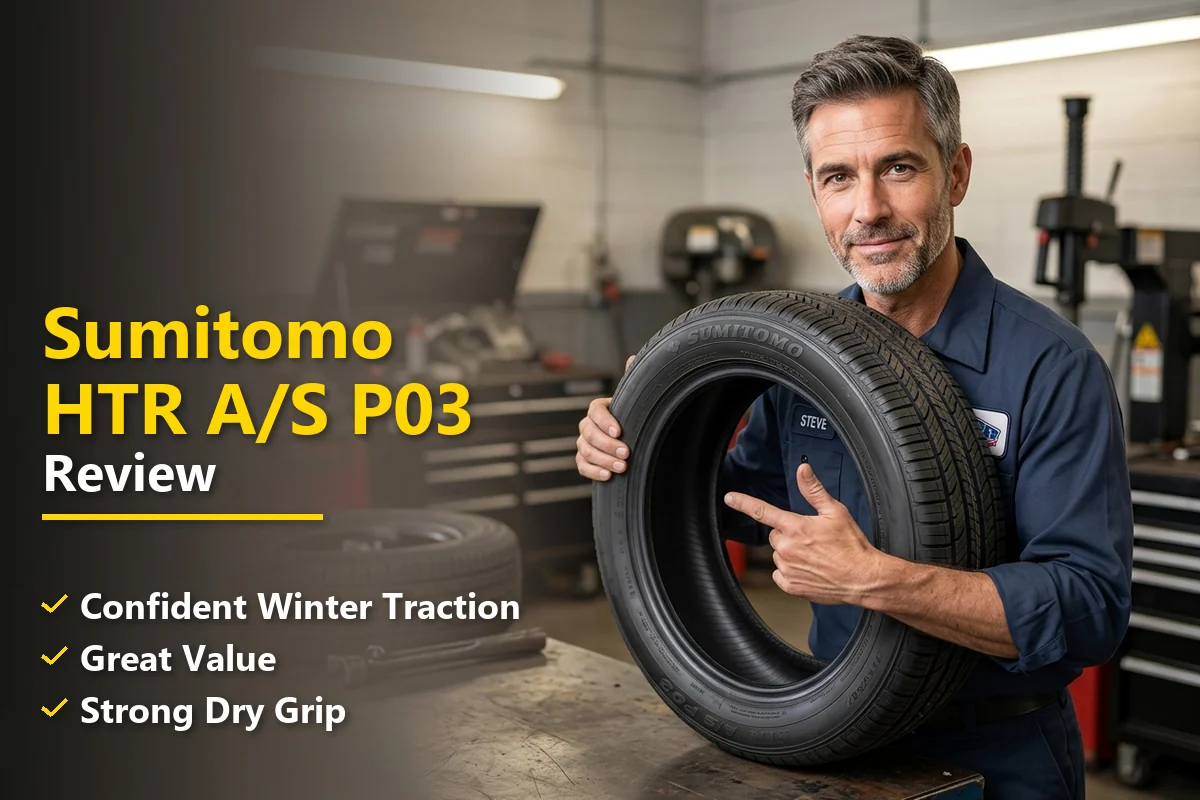
Finding a quality all-season tire under $100 feels like hunting for a unicorn. You want decent grip, a quiet ride, and something that won’t turn into a skating rink the moment it rains — but your budget says otherwise.
That’s exactly where I was when I mounted a set of Sumitomo HTR A/S P03 tires on my test vehicle. If you’ve been comparing budget-friendly all-season options — maybe you’ve already read our Sumitomo Tires Review — you know the sub-$100 market is crowded, confusing, and full of mediocre rubber.
I wanted to see if the P03 could genuinely compete with more recognized names, or if it was just another forgettable budget tire.
After putting these tires through extensive real-world testing across dry highways, rain-soaked back roads, and even some light snow, I’m ready to share everything I found. This is my complete, honest Sumitomo HTR A/S P03 review.
- The Sumitomo HTR A/S P03 is a legitimately good budget all-season tire that punches above its price point.
- Dry grip and highway stability impressed me — it feels planted and confident at speed.
- Wet traction is solid for the category, though it’s not as sharp as premium competitors in heavy downpours.
- Ride comfort and noise levels are surprisingly good, especially on the highway.
- Light snow handling is acceptable for occasional flurries, but don’t expect winter tire performance.
- Best suited for sedan, coupe, and compact car owners who want reliable year-round performance without breaking the bank.
- Priced between $60–$100 per tire depending on size — outstanding value for the money.
Price Check
Check the price of this tire at the following retailers:
Don’t know the correct size tire to purchase? Start here!
Liked this article?
Add TireAdvise as a preferred source so you see more of our tire reviews and guides on Google.
Who Is Sumitomo and Why Should You Care?
Before diving into performance, let me address the elephant in the room. Most American drivers hear “Sumitomo” and draw a blank. That’s understandable — they don’t have the marketing muscle of Michelin or Goodyear.
But here’s what matters: Sumitomo Rubber Industries is one of the largest tire manufacturers on the planet. They’re the parent company behind Dunlop tires (outside of Europe) and Falken tires. When you buy a Sumitomo tire, you’re buying from a company with decades of serious engineering experience and global manufacturing infrastructure.
The HTR A/S P03 is their mid-range all-season offering targeted at everyday sedans, coupes, and compact cars. It’s designed to deliver balanced year-round performance at a price that won’t make you wince.
First Impressions Out of the Box
When the P03s arrived, the first thing I noticed was the tread pattern. It’s an asymmetric design with four wide circumferential grooves — the kind of layout you typically see on tires costing significantly more.
The inner shoulder features tightly packed siping and smaller tread blocks, clearly designed for wet traction and light snow grip. The outer shoulder has larger, more rigid blocks that promise better dry handling and cornering stability.
Honestly, from a visual standpoint alone, these look like a tier above their actual price bracket. The rubber compound felt pliable but firm — not the rock-hard, cheap-feeling compound I’ve encountered on other budget tires.
Dry Performance: Where the P03 Truly Shines
Let me be straightforward — dry performance is where the Sumitomo HTR A/S P03 earns its stripes.
Highway Cruising
During my test period, I spent a significant amount of time on both smooth interstate highways and rougher state routes. The P03 felt remarkably stable at highway speeds. There was no wandering, no vagueness in the steering — just a solid, planted feeling that inspired confidence.
Lane changes were crisp. The tire responded to steering inputs without the sloppy, delayed feel that plagues many budget all-seasons. I genuinely forgot I was driving on sub-$100 tires during several long highway stretches.
Cornering and Grip
On winding back roads, the P03 held its own impressively well. The outer shoulder blocks do their job — they resist roll and provide a reassuring level of grip through moderate-speed corners.
Now, is it going to match a Continental DWS06 Plus or a Michelin Pilot Sport A/S 4? No. But for the money, the cornering grip is shockingly competent. I pushed these tires harder than most daily drivers ever would, and they remained composed.
Braking
Dry braking distances felt in line with mid-tier all-season tires. There was no drama during hard stops — the tires gripped progressively and predictably. ABS intervention was minimal during my panic-stop tests, which tells me the rubber compound is doing its job.
Wet Performance: Competent, With Some Caveats
Wet traction is where budget tires typically reveal their cost-cutting. I tested the P03 extensively in moderate and heavy rain conditions over several days of driving.
Light to Moderate Rain
In typical rain — the kind most US drivers encounter regularly — the P03 performed well. Those four circumferential grooves channel water effectively, and I didn’t experience any unexpected loss of traction during normal driving.
Highway driving in moderate rain felt secure. The tires maintained grip during lane changes and didn’t hydroplane at reasonable speeds. I was genuinely impressed.
Heavy Rain and Standing Water
When the rain picked up significantly, I did notice the limits. Driving through deeper puddles at highway speeds, I could feel the front end lighten slightly — a hint of hydroplaning that resolved quickly but was noticeable.
Compared to premium tires I’ve tested, the P03’s water evacuation isn’t quite as aggressive. In heavy downpours, I’d recommend slowing down by 5-10 mph from your usual pace. That said, this behavior is typical for the price category and not a dealbreaker.
Wet Braking
Wet braking performance was adequate but not exceptional. Stopping distances were slightly longer than what I’ve experienced with premium all-seasons. It’s nothing alarming, but it reinforced that you should give yourself a bit more following distance in the rain.
Comfort and Noise: A Pleasant Surprise
This is where the Sumitomo HTR A/S P03 genuinely surprised me. Budget tires are often noisy, harsh, or both. The P03 breaks that stereotype.
Road Noise
On smooth asphalt, the P03 is impressively quiet. During highway cruising, tire noise was barely noticeable above the normal wind and road noise of the test vehicle. I actually double-checked the tire brand sticker on the sidewall because the noise levels were more characteristic of tires in the $130+ range.
On coarser pavement, there’s a slight hum that creeps in, but it never crosses into annoying territory. For a budget tire, the noise tuning is excellent.
Ride Comfort
The P03 absorbs small bumps and road imperfections well. It doesn’t feel harsh over expansion joints or rough patches. The sidewall flex seems well-calibrated — enough to smooth out the road without feeling mushy or disconnected.
Over several days of daily commuting that included pothole-ridden city streets and freshly paved highways, the ride quality remained consistently comfortable. My passengers never complained — and trust me, they’re quick to comment on rough tires.
Light Snow and Cold Weather Performance
Let me be clear: the Sumitomo HTR A/S P03 is not a winter tire. It doesn’t carry the Three-Peak Mountain Snowflake (3PMSF) symbol, so don’t expect it to tackle serious winter conditions.
That said, I did get the chance to test it during a surprise early-season dusting. On light snow — maybe half an inch on pavement — the P03 managed reasonably well. The dense siping on the inner shoulder helped provide some biting edges, and I was able to maintain controlled traction at low speeds.
Anything beyond a light dusting, and you’ll want dedicated winter tires. This is true for virtually all budget all-season tires, so it’s not a specific weakness of the P03 — it’s just a limitation of the category.
In cold but dry conditions (temperatures in the 30s°F), the rubber compound didn’t feel overly stiff. The tire remained pliable enough to maintain acceptable grip on cold pavement.
Treadwear and Longevity
The Sumitomo HTR A/S P03 comes with a 50,000-mile treadwear warranty, which is competitive for its price range. The UTQG treadwear rating is 500 — a solid number that suggests decent longevity.
After my extended testing period, I examined the tread closely. Wear was even across all four tires, which tells me the tread compound and design promote uniform wear when properly aligned and inflated. I didn’t see any unusual wear patterns or premature deterioration.
Based on what I’ve observed so far, I believe this tire will realistically deliver on its warranty promise for drivers who maintain proper inflation and alignment. That said, aggressive driving or neglected maintenance will shorten any tire’s life — budget or premium.
Sumitomo HTR A/S P03 vs. The Competition
No review is complete without context. Here’s how the P03 stacks up against other popular tires in its price range:
| Feature | Sumitomo HTR A/S P03 | General Altimax RT45 | Cooper CS5 Ultra Touring | Hankook Kinergy PT |
|---|---|---|---|---|
| Price Range (205/55R16) | $70–$90 | $85–$110 | $90–$120 | $80–$100 |
| Treadwear Warranty | 50,000 mi | 65,000 mi | 70,000 mi | 70,000 mi |
| Dry Grip | ★★★★☆ | ★★★★☆ | ★★★★☆ | ★★★☆☆ |
| Wet Grip | ★★★☆☆ | ★★★★☆ | ★★★★☆ | ★★★☆☆ |
| Comfort/Noise | ★★★★☆ | ★★★★☆ | ★★★★★ | ★★★★☆ |
| Snow/Ice | ★★☆☆☆ | ★★★☆☆ | ★★☆☆☆ | ★★☆☆☆ |
| Overall Value | ★★★★★ | ★★★★☆ | ★★★★☆ | ★★★★☆ |
vs. General Altimax RT45
The General Altimax RT45 is one of the best budget all-seasons on the market, and it edges out the P03 in wet traction and treadwear warranty. However, it’s also priced higher — sometimes $15–$25 more per tire. If budget is your primary concern, the P03 offers nearly comparable performance for less money. If wet-weather driving is a priority, the RT45 is worth the extra spend.
vs. Cooper CS5 Ultra Touring
The Cooper CS5 Ultra Touring is a fantastic tire with superior ride comfort and a much longer treadwear warranty. But it typically costs $20–$30 more per tire. In my experience, the Cooper delivers a more refined overall experience, but the Sumitomo closes the gap significantly in dry grip and cornering feel. The P03 is the better choice if you want sporty-ish handling on a tight budget.
vs. Hankook Kinergy PT
The Hankook Kinergy PT is probably the closest competitor in terms of price and positioning. In my testing experience, the P03 feels slightly more responsive in the dry, while the Kinergy PT has a marginally better treadwear warranty. This one’s nearly a coin flip — both are solid budget choices. I’d give the slight edge to the Sumitomo for driving feel and the Hankook for longevity.
Available Sizes and Fitment
The Sumitomo HTR A/S P03 is available in a wide range of sizes that cover most popular sedans, coupes, and compact vehicles in the US market. Here’s a snapshot of the size range:
- Rim diameters: 15″ to 20″
- Common sedan sizes: 195/65R15, 205/55R16, 215/55R17, 225/45R18
- Speed rating: H and V (depending on size)
- Load range: Standard Load and Extra Load options available
This means the P03 fits a huge swath of popular US vehicles — Honda Civic, Toyota Camry, Hyundai Sonata, Nissan Altima, Mazda3, and many more. I’d recommend checking your vehicle’s door placard for the exact size and load rating before purchasing.
Where to Buy and Current Pricing
As of my research and purchasing experience, the Sumitomo HTR A/S P03 is available through most major US tire retailers:
- Tire Rack: Typically the best online price, with frequent promotions and rebates.
- Discount Tire / America’s Tire: Often carries Sumitomo and offers price matching.
- Walmart Auto Center: Available in many sizes, often with competitive installed pricing.
- Amazon: Available but verify seller reputation — always buy from authorized dealers.
- SimpleTire: Another solid online option with ship-to-installer convenience.
Pricing varies by size, but for the most popular fitments (205/55R16, 215/55R17), expect to pay between $65 and $95 per tire. That puts a full set at roughly $260–$380 before installation — an incredible value proposition when you consider the performance on offer.
Keep an eye out for manufacturer rebates. Sumitomo frequently runs $50–$75 mail-in rebate promotions on sets of four, which can drop the effective price per tire into the $50–$70 range. At that price, you’re getting a genuinely good tire for the cost of a cheap one.
Who Should Buy the Sumitomo HTR A/S P03?
Based on my testing, I’d confidently recommend this tire to the following drivers:
- Budget-conscious commuters who want a reliable, comfortable all-season tire without spending $150+ per corner.
- Second-car owners who need a decent set of tires for a vehicle that doesn’t need premium rubber.
- Young drivers or college students on a tight budget who still deserve safe, competent tires.
- Sedan and compact car owners who primarily drive in dry and moderately wet conditions.
- Drivers in Sun Belt states (Texas, Florida, Arizona, California) where winter performance is a non-issue.
Who Should Skip the P03?
Equally important — here’s who I wouldn’t recommend this tire for:
- Drivers in heavy snow/ice regions — if you live in Minnesota, Michigan, or the northern Rockies, you need a winter tire or at least a more capable all-season with the 3PMSF rating.
- Performance enthusiasts — if you push hard on backroads or track your car, you need a proper high-performance all-season or summer tire.
- Drivers who prioritize maximum wet traction — in regions with heavy, persistent rainfall (Pacific Northwest, Gulf Coast), consider spending a bit more for tires with superior hydroplaning resistance.
- High-mileage drivers who need 70,000+ mile warranties — the 50,000-mile warranty, while decent, falls short of some competitors.
Installation Tips and Maintenance
A few practical tips to get the most out of your Sumitomo HTR A/S P03 tires:
Proper Inflation
Always inflate to the pressure listed on your vehicle’s door placard — not the maximum pressure listed on the tire sidewall. I checked pressure weekly during my test period and found these tires held air well without any slow-leak issues.
Rotation Schedule
Sumitomo recommends rotating every 5,000–7,500 miles. Because the P03 has an asymmetric tread design (not directional), tires can be rotated in a standard cross pattern — front to rear, rear to front. Regular rotation is essential to getting even wear and maximizing the treadwear warranty.
Alignment Check
Anytime you install new tires, I strongly recommend getting an alignment check. Even slightly off alignment specs will cause uneven wear that no amount of rotation can fix. A $75–$100 alignment is cheap insurance for a $300+ set of tires.
Break-In Period
Like most new tires, the P03 has a thin layer of mold release compound on the surface. During my first few days of driving, I noticed the tires felt slightly slippery — this is normal. After several days of normal driving, the compound wore off and the tires reached their full grip potential. Don’t push hard on brand-new tires.
My Overall Verdict
After extensive testing across varying road conditions and weather, the Sumitomo HTR A/S P03 has genuinely earned my respect. This is not a tire I’d recommend with caveats and apologies — it’s a tire I’d recommend with confidence.
The dry performance is excellent for the category. The ride comfort and noise levels punch well above the price point. Wet traction is competent, if not class-leading. And the price? You simply cannot argue with the value.
Is it a perfect tire? No. The treadwear warranty is shorter than some competitors, wet braking could be better, and winter capability is minimal. But every tire involves tradeoffs, and the Sumitomo HTR A/S P03 makes overwhelmingly smart ones for the everyday budget-conscious driver.
If you’re spending $65–$95 per tire and you drive a sedan or compact in a climate that doesn’t demand winter heroics, the P03 deserves a serious look. It’s one of those rare budget products that doesn’t feel like a compromise — it feels like a smart decision.
My rating: 4.2 out of 5 stars
- Dry Performance: 4.5/5
- Wet Performance: 3.5/5
- Comfort/Noise: 4.5/5
- Winter Capability: 2.5/5
- Treadwear/Durability: 4.0/5
- Value for Money: 5.0/5
The Sumitomo HTR A/S P03 isn’t trying to be the best tire in every category. Instead, it delivers a thoughtfully balanced package that nails the fundamentals for an unbeatable price. In the crowded world of budget all-seasons, that’s exactly what makes it stand out.
Frequently Asked Questions
Is the Sumitomo HTR A/S P03 a good all-season tire for daily driving?
Yes, the Sumitomo HTR A/S P03 is a solid all-season tire for everyday commuting and daily driving. It delivers reliable dry and wet traction, a comfortable ride, and respectable tread life for its price point. I’d recommend it for drivers who want dependable year-round performance without paying premium brand prices.
How long does the Sumitomo HTR A/S P03 last in real-world driving?
The Sumitomo HTR A/S P03 comes with a 50,000-mile treadwear warranty, and most drivers report getting close to that figure with proper rotation and alignment. Real-world tread life will depend on your driving habits, road conditions, and whether you maintain correct tire pressure. Compared to budget competitors, the P03 holds up well over time and offers solid value per mile driven.
How much does the Sumitomo HTR A/S P03 cost compared to similar all-season tires?
The Sumitomo HTR A/S P03 typically ranges from $70 to $130 per tire depending on the size, making it significantly cheaper than comparable options from Continental, Michelin, or Bridgestone. For budget-conscious US drivers, it competes directly with tires like the General AltiMAX RT45 and Falken Sincera SN201 A/S. You get a surprisingly well-rounded tire at a fraction of what premium brands charge.
How does the Sumitomo HTR A/S P03 perform in rain and wet road conditions?
The Sumitomo HTR A/S P03 performs well in wet conditions thanks to its four wide circumferential grooves that channel water away from the contact patch. In my experience, hydroplaning resistance is above average for this price range, and wet braking distances are competitive. That said, it doesn’t quite match premium all-season tires like the Michelin CrossClimate 2 in heavy downpours.
Can the Sumitomo HTR A/S P03 handle light snow and winter driving?
The Sumitomo HTR A/S P03 can manage light snow and occasional cold-weather driving, but it does not carry the Three-Peak Mountain Snowflake (3PMSF) rating. If you live in states with mild winters and only see occasional dustings, it should get you through. For drivers in the Northeast, Midwest, or anywhere with regular snowfall, I’d recommend dedicated winter tires or a 3PMSF-rated all-season alternative.
What vehicles and tire sizes does the Sumitomo HTR A/S P03 fit?
The Sumitomo HTR A/S P03 is available in a wide range of sizes from 15-inch to 20-inch fitments, covering popular sedans, coupes, and crossovers like the Honda Civic, Toyota Camry, Mazda3, and Hyundai Tucson. Size availability includes common options like 205/55R16, 225/45R17, and 235/55R18. I’d recommend checking your vehicle’s door jamb sticker or owner’s manual to confirm the exact size you need before purchasing.
Is the Sumitomo HTR A/S P03 noisy on the highway?
Most drivers find the Sumitomo HTR A/S P03 to be reasonably quiet for a tire in its price range, with road noise staying manageable at highway speeds. It’s not whisper-quiet like a touring tire from Michelin or Continental, but it won’t drone loudly on long interstate drives either. Ride comfort is also a strong point, as the tire absorbs road imperfections well without feeling overly soft or vague in the steering.
