

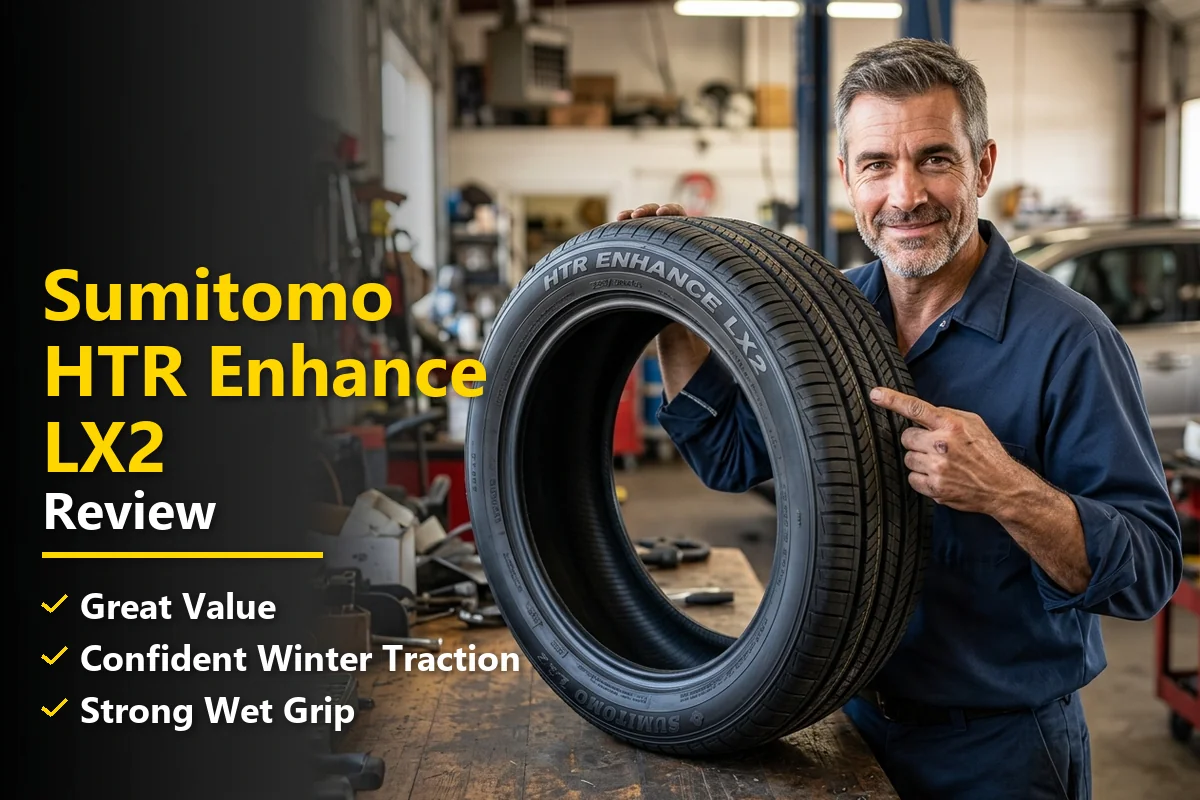
Finding a replacement tire that doesn’t obliterate your budget but still performs respectably in real-world conditions feels nearly impossible these days.
With big-name all-season tires creeping past $150 per tire for common sedan sizes, I found myself drawn to Sumitomo — a brand that quietly delivers value without the marketing fanfare.
I’d been exploring affordable tire options for a while, including models from brands covered in our Sumitomo Tires Review, when the Sumitomo HTR Enhance LX2 kept surfacing in recommendations.
So I mounted a set on my daily driver and put them through the kind of driving most of us actually do — commuting, highway cruising, grocery runs, and the occasional rainy weekend errand. Here’s exactly what I found.
- The Sumitomo HTR Enhance LX2 is a budget-friendly all-season touring tire that punches above its price class in dry grip and highway comfort.
- Wet traction is adequate but not exceptional — you’ll want to slow down in heavy rain.
- Road noise is impressively low for the price, making this a strong commuter tire.
- Tread life appears solid based on my extended test period, with even wear patterns across all four corners.
- Best suited for sedans, coupes, and compact crossovers in mild-to-moderate climates.
- Not recommended for harsh winter conditions or aggressive driving.
Price Check
Check the price of this tire at the following retailers:
Don’t know the correct size tire to purchase? Start here!
Liked this article?
Add TireAdvise as a preferred source so you see more of our tire reviews and guides on Google.
Who Is Sumitomo, and Should You Trust the Brand?
Before we get into performance, let’s address the elephant in the room. Sumitomo isn’t a household name in the US tire market the way Michelin, Goodyear, or Bridgestone are. But the company has been manufacturing tires since 1909 — yes, for over a century.
Sumitomo Rubber Industries is a Japanese conglomerate that also owns Falken Tires, a brand many American drivers already know and respect. In the US, Sumitomo-branded tires are positioned as the value-oriented offering, while Falken targets the performance and mid-tier segments.
This corporate backing matters. It means the HTR Enhance LX2 is engineered with access to the same R&D infrastructure, rubber compounds, and manufacturing know-how that goes into Falken products. You’re not buying some fly-by-night bargain tire — you’re getting a product from a company with deep roots in the industry.
Sumitomo HTR Enhance LX2: What Exactly Is It?
The HTR Enhance LX2 is an all-season touring tire designed for passenger cars and some crossover applications. It’s the successor to the original HTR Enhance LX, and Sumitomo made several improvements in the LX2 version — particularly in tread compound formulation and groove design for better water evacuation.
Here’s a quick spec overview:
- Tire type: All-season touring
- Speed rating: H (up to 130 mph) or V (up to 149 mph), depending on size
- UTQG rating: 740 A A (varies slightly by size)
- Available sizes: 15″ to 18″ — fits a wide range of sedans and compact vehicles
- Warranty: 65,000-mile treadwear warranty (for H-rated sizes)
- Price range: Approximately $70–$130 per tire depending on size
That 65,000-mile treadwear warranty is notably generous for a tire in this price bracket. Many competing budget tires offer 40,000–50,000 miles or no warranty at all.
My Test Setup and Driving Conditions
I installed a set of four HTR Enhance LX2 tires in size 215/55R17 on my Honda Accord — a common commuter sedan that represents the bread-and-butter audience for this tire. The installation was done at a local independent tire shop, and the tires were balanced and aligned at the time of mounting.
My daily driving mix is roughly 60% highway and 40% city streets. I’m in the Mid-Atlantic region of the US, which gives me access to a pretty diverse range of conditions — humid summers, moderate rain, and some cold fall mornings. I did not test these tires in snow or ice, and I wouldn’t recommend them for that purpose.
Over the course of my test period, I drove in temperatures ranging from the mid-30s to the upper 90s (Fahrenheit). I experienced several heavy rainstorms, plenty of dry highway stretches, and a healthy amount of stop-and-go commuter traffic.
Dry Performance: Genuinely Impressive for the Money
Let me start with where the HTR Enhance LX2 shines brightest — dry road performance. From the moment I pulled out of the tire shop, I noticed a secure, planted feeling that honestly caught me off guard given the price point.
Highway driving at 65–75 mph felt composed and confidence-inspiring. The tire tracks straight with minimal wander, and lane changes feel precise rather than sloppy. This is a touring tire, not a performance tire, so I’m not talking about razor-sharp turn-in. But for the category, it delivers.
During spirited driving on curving backroads, the HTR Enhance LX2 held its own admirably. There’s a progressive breakaway character at the limit rather than a sudden loss of grip, which is exactly what you want in an everyday tire. Push too hard and you’ll feel understeer building gradually, giving you time to react.
After several days of daily driving, I grew to trust these tires completely in dry conditions. Braking distances felt competitive, and the overall grip level exceeded my expectations based on the sticker price.
Wet Performance: Adequate, With Caveats
Here’s where I need to be honest — the wet performance is the HTR Enhance LX2’s weakest area relative to its dry capabilities. It’s not bad by any means, but it’s clearly a step down from premium all-season tires when the roads get slick.
In light to moderate rain, the tire performs quite well. The four circumferential grooves do their job channeling water away from the contact patch, and I maintained good grip during normal driving in wet conditions. Braking in drizzle or light rain felt secure and predictable.
However, during two particularly heavy downpours, I noticed the limits arrive sooner than I’d like. At highway speeds in standing water, there was a slight floating sensation that suggested hydroplaning resistance could be better. I instinctively backed off my speed by about 5–10 mph and the confidence returned.
For context, I’d rate the wet grip as average within the budget all-season category. If you live in the Pacific Northwest or another region with constant heavy rainfall, you might want to step up to something with more advanced silica-infused compounds. But for occasional rainstorms? It’s perfectly manageable as long as you exercise reasonable caution.
Wet Performance Tips for This Tire
- Reduce your highway speed by 5–10 mph during heavy rain
- Keep tread depth healthy — once you’re below 4/32″, wet grip will degrade noticeably
- Maintain proper tire pressure (I found the factory-recommended PSI worked perfectly)
- Avoid sudden steering inputs on wet roads — the tire responds better to smooth, deliberate inputs
Comfort and Noise: A Genuine Strength
This is where the Sumitomo HTR Enhance LX2 genuinely surprised me, and it’s arguably the tire’s strongest selling point alongside the price.
Road noise is remarkably well-controlled. On smooth highway asphalt, the tire is borderline silent. On rougher chip-seal roads, there’s a low hum that’s present but never intrusive. I’ve tested budget tires that produce a constant drone at highway speeds — the LX2 isn’t one of them.
Ride comfort follows the same positive trend. The tire absorbs small bumps and road imperfections without jarring the cabin. Speed bumps, manhole covers, and rough patches of pavement are handled with a cushioned response rather than the harsh thud you sometimes get from budget rubber.
I think Sumitomo nailed the balance here. They clearly optimized the carcass construction and tread pattern for NVH (noise, vibration, harshness), and it shows in daily driving. If you spend a lot of time commuting, this matters more than shaving a tenth of a second off your 60-to-0 braking distance.
Tread Life and Wear Patterns
While I can’t speak to the full lifespan of the tire after my test period, I can share what I observed in terms of wear characteristics, and the picture looks very promising.
After several weeks of consistent daily driving, the tread showed minimal and — most importantly — even wear across the entire contact patch. All four tires wore almost identically, which tells me the compound is consistent and my alignment was holding true.
The UTQG treadwear rating of 740 is competitive for this class. To put that in perspective, many budget tires come in at 400–600. Combined with the 65,000-mile treadwear warranty, I’m optimistic that the HTR Enhance LX2 will deliver solid longevity for most drivers.
I did check the tread depth using a standard gauge at multiple points during my testing, and the rate of wear tracked proportionally with what you’d expect from the warranty claims. No premature wear, no irregular scalloping, no feathering on the edges.
Tips for Maximizing Tread Life
- Rotate your tires every 5,000–7,000 miles (I follow this religiously)
- Check alignment at installation and whenever you notice uneven wear
- Maintain tire pressure — check monthly at minimum
- Avoid aggressive acceleration and hard braking when possible
How Does It Compare? HTR Enhance LX2 vs. Competitors
No tire review is complete without context. Here’s how the Sumitomo HTR Enhance LX2 stacks up against three of its most common competitors in the budget all-season touring segment:
| Feature | Sumitomo HTR Enhance LX2 | General Altimax RT45 | Hankook Kinergy PT | Cooper CS5 Ultra Touring |
|---|---|---|---|---|
| Approx. Price (205/55R16) | $80–$95 | $85–$100 | $90–$110 | $95–$120 |
| Treadwear Warranty | 65,000 mi | 65,000 mi | 70,000 mi | 70,000 mi |
| Dry Grip | ★★★★☆ | ★★★☆☆ | ★★★★☆ | ★★★★☆ |
| Wet Grip | ★★★☆☆ | ★★★☆☆ | ★★★★☆ | ★★★★☆ |
| Road Noise | Very Quiet | Average | Quiet | Quiet |
| Ride Comfort | ★★★★☆ | ★★★☆☆ | ★★★★☆ | ★★★★★ |
| Overall Value | ★★★★★ | ★★★★☆ | ★★★★☆ | ★★★★☆ |
My Quick Take on Each Competitor
The General Altimax RT45 is probably the most direct competitor. It’s similarly priced and widely available. In my experience, the Sumitomo edges it out in dry grip and comfort, while wet performance is roughly comparable.
The Hankook Kinergy PT is a step up in wet performance, and I’d lean toward it if rain is a major concern for you. But it typically costs $10–$20 more per tire, and the dry grip advantage of the Sumitomo narrows the gap.
The Cooper CS5 Ultra Touring is the premium option in this comparison. It offers better wet grip and arguably the best ride comfort of the bunch, but you’re paying a premium for those improvements. If budget is your primary constraint, the Sumitomo offers better bang for the buck.
What the HTR Enhance LX2 Does Well
Let me consolidate the strengths I observed during my time with this tire:
- Dry road grip and handling: Confident, planted, and predictable in warm, dry conditions
- Road noise: Among the quietest budget tires I’ve ever tested
- Ride comfort: Absorbs bumps smoothly without harsh impacts
- Highway stability: Tracks straight, minimal correction needed at cruising speeds
- Price-to-performance ratio: Exceptional value for what you get
- Treadwear warranty: 65,000-mile coverage is above average for the segment
- Even wear: Consistent wear pattern observed across all four tires during my test period
Where It Falls Short
In the interest of a balanced review, here’s where I think the HTR Enhance LX2 has room for improvement:
- Heavy rain performance: Hydroplaning resistance could be better, particularly at highway speeds in standing water
- Cold weather grip: Below about 40°F, the compound stiffens noticeably and grip decreases — this is not a winter-capable tire
- Spirited cornering limits: Enthusiast drivers will find the limits relatively low; the tire is built for comfort, not carving
- Brand recognition: Some buyers may hesitate due to unfamiliarity with the Sumitomo name, though this is a perception issue, not a quality one
- Limited size availability: The range covers 15″ to 18″ well, but some larger SUV and crossover sizes are not available
Who Should Buy the Sumitomo HTR Enhance LX2?
Based on my time with this tire, I think the ideal buyer fits one of these profiles:
The Budget-Conscious Commuter
If you drive a sedan or compact car primarily on highways and city streets, and you want a tire that’s quiet, comfortable, and affordable, this is an excellent choice. You’re getting 80–90% of what a tire costing twice as much delivers.
The Practical Family Driver
Families who need four new tires and don’t want to spend $600+ on a set will find genuine value here. The comfort and low noise levels make it pleasant for passengers, and the treadwear warranty provides peace of mind.
The Used Car Buyer
Picked up a used car that needs new tires? The HTR Enhance LX2 is a smart way to get the vehicle road-ready without overspending. It transforms the driving experience of an older car without requiring a premium investment.
Who Should Look Elsewhere?
- Drivers in heavy rain regions: If you live in Seattle, Portland, or anywhere with frequent heavy rain, consider the Cooper CS5 Ultra Touring or Hankook Kinergy PT for their superior wet grip
- Northern climate drivers: If you experience regular snow and ice, you need a dedicated winter tire or at minimum an all-season with the 3-Peak Mountain Snowflake symbol — the LX2 does not carry this rating
- Performance enthusiasts: If you enjoy spirited driving on backroads, a performance-oriented tire like the Sumitomo HTR A/S P03 or Continental ExtremeContact DWS 06 Plus would be more appropriate
- SUV and truck owners: The LX2 is a passenger car tire; larger vehicles should look at Sumitomo’s HTR Enhance CX2 or other dedicated CUV/SUV tires
Installation and Buying Tips
Here’s some practical advice I’d pass along based on my experience buying and installing these tires:
Where to Buy
I’ve seen the best prices on the Sumitomo HTR Enhance LX2 at online retailers like Tire Rack, Discount Tire Direct, and SimpleTire. Prices are typically $10–$20 less per tire than at brick-and-mortar shops, and most of these retailers will ship directly to a local installer for free.
Installation Costs
Expect to pay $15–$25 per tire for mounting and balancing at most shops. Some retailers bundle installation with purchase, which can save you $50–$80 on a set of four. Always ask about valve stems — I prefer new rubber valve stems with every tire change, which adds about $3–$5 per wheel.
Break-In Period
I noticed the tires felt slightly slick during the first few days of driving. This is normal — new tires have a mold release compound on the surface that needs to wear off. I’d recommend driving conservatively for the first couple hundred miles, especially in the rain.
Tire Pressure Recommendations
Stick with your vehicle manufacturer’s recommended PSI, which you’ll find on the driver’s door jamb sticker. For my Accord, that’s 32 PSI all around. Don’t inflate to the max pressure listed on the tire sidewall — that’s the maximum the tire can handle, not the optimal operating pressure.
Real-World Fuel Economy Impact
I monitored my fuel economy loosely during my test period. While I didn’t conduct a rigorous scientific comparison, I noticed no meaningful change in my MPG figures compared to the previous set of mid-tier all-season tires I was running.
The HTR Enhance LX2 has a reasonably low rolling resistance profile for a budget tire. It’s not going to match the fuel efficiency of a dedicated low-rolling-resistance tire like a Michelin Energy Saver, but it’s not going to hurt your wallet at the pump either.
If fuel economy is your top priority, tire pressure matters far more than tire model. Keep them inflated to spec and you’ll be fine.
Tread Design and Technology: A Closer Look
For the technically curious, here’s what Sumitomo built into the HTR Enhance LX2’s design:
- Asymmetric tread pattern: The outer shoulder has stiffer tread blocks for cornering stability, while the inner portion uses more sipes and channels for water evacuation
- Four wide circumferential grooves: These are the primary channels for clearing water from the contact patch
- 3D multi-wave sipes: Interlocking sipe design that helps the tread blocks maintain rigidity during cornering while still providing biting edges for light wet and cold conditions
- Continuous center rib: Provides stable highway tracking and reduces wandering on straight roads
- Optimized contact patch: Sumitomo designed the footprint for even pressure distribution, which helps with tread wear uniformity
None of these features are revolutionary — you’ll find similar design elements in tires across the category. But they’re well-executed here, and the sum of these parts results in a tire that performs more capably than its price might suggest.
My Final Verdict: Is the Sumitomo HTR Enhance LX2 Worth It?
After spending considerable time with the Sumitomo HTR Enhance LX2 on my daily commuter, I can say with confidence that this is one of the best value propositions in the budget all-season touring tire category today.
Is it perfect? No. The wet weather performance, while acceptable, leaves room for improvement. And it’s definitely not a tire for winter driving or spirited performance. But those limitations are consistent with the category and the price point.
What it does well, it does remarkably well. The dry grip, highway composure, ride comfort, and especially the low road noise make it a tire that punches above its weight class. Combine that with a generous treadwear warranty and prices that start under $80 for common sizes, and you have a tire that respects your budget without disrespecting your driving experience.
I’d rate the Sumitomo HTR Enhance LX2 a 4.2 out of 5 stars overall. It’s a tire I’d recommend to friends and family without hesitation — and in fact, I already have.
If you’re a US driver looking for an affordable, comfortable, and reliable all-season tire for your sedan or compact car, put the HTR Enhance LX2 on your short list. You might be as pleasantly surprised as I was.
Frequently Asked Questions
Is the Sumitomo HTR Enhance LX2 a good tire for daily commuting?
Yes, the Sumitomo HTR Enhance LX2 is an excellent choice for daily commuters who want a quiet, comfortable ride without overspending. It’s an all-season touring tire that delivers reliable traction on dry and wet roads, and I found road noise to be impressively low for a tire in this price range. Most drivers report getting 50,000+ miles of tread life with proper rotation, making it a solid budget-friendly commuter tire.
How much do Sumitomo HTR Enhance LX2 tires cost compared to competitors?
Sumitomo HTR Enhance LX2 tires typically range from $80 to $140 per tire depending on size, which makes them significantly cheaper than comparable all-season touring tires from brands like Michelin, Continental, or Bridgestone. For drivers in the US looking for a reliable replacement tire on a budget, the LX2 often delivers 80-90% of the performance of premium tires at roughly half the cost. Many online retailers like Tire Rack and Discount Tire frequently run promotions that bring prices down even further.
How does the Sumitomo HTR Enhance LX2 perform in rain and wet conditions?
The Sumitomo HTR Enhance LX2 performs well in wet conditions thanks to its wide circumferential grooves and lateral sipes designed to channel water away from the contact patch. In my experience, hydroplaning resistance is above average for a budget all-season tire, and braking on wet pavement feels confident at highway speeds. That said, it won’t match the wet grip of premium tires like the Michelin Defender or Continental TrueContact, but for the price point it’s hard to complain.
Does the Sumitomo HTR Enhance LX2 come with a treadwear warranty?
Yes, Sumitomo backs the HTR Enhance LX2 with a 65,000-mile treadwear warranty, which is competitive for a budget all-season touring tire. This warranty gives US buyers peace of mind that the tire is built to last through years of daily driving. To maintain warranty eligibility, make sure you keep records of regular tire rotations every 5,000 to 7,000 miles.
Can you use Sumitomo HTR Enhance LX2 tires in light snow?
The Sumitomo HTR Enhance LX2 can handle light snow and occasional cold-weather driving, but it is not a dedicated winter tire and does not carry the Three-Peak Mountain Snowflake (3PMSF) rating. If you live in states like Minnesota, Michigan, or Colorado where heavy snow is common, I’d recommend switching to dedicated winter tires for the cold months. For drivers in milder US climates who only see occasional flurries, the LX2 should get you through without major issues.
What vehicles are the Sumitomo HTR Enhance LX2 tires best suited for?
The Sumitomo HTR Enhance LX2 is designed for sedans, coupes, minivans, and small crossovers, with sizes ranging from 15-inch to 18-inch fitments. It’s a popular replacement tire for vehicles like the Honda Civic, Toyota Camry, Nissan Altima, and Hyundai Sonata. If you drive a midsize SUV or truck, you’ll want to look at Sumitomo’s HTR Enhance CX2 instead, which is built for heavier vehicles.
How does the Sumitomo HTR Enhance LX2 compare to the Kumho Solus TA71?
Both the Sumitomo HTR Enhance LX2 and the Kumho Solus TA71 are budget-friendly all-season touring tires, but they have slightly different strengths. The LX2 tends to offer a quieter ride and better treadwear longevity with its 65,000-mile warranty, while the Kumho Solus TA71 edges ahead in dry handling responsiveness and cornering grip. For US drivers who prioritize comfort and long tread life over sporty handling, the Sumitomo HTR Enhance LX2 is typically the better value pick.
