

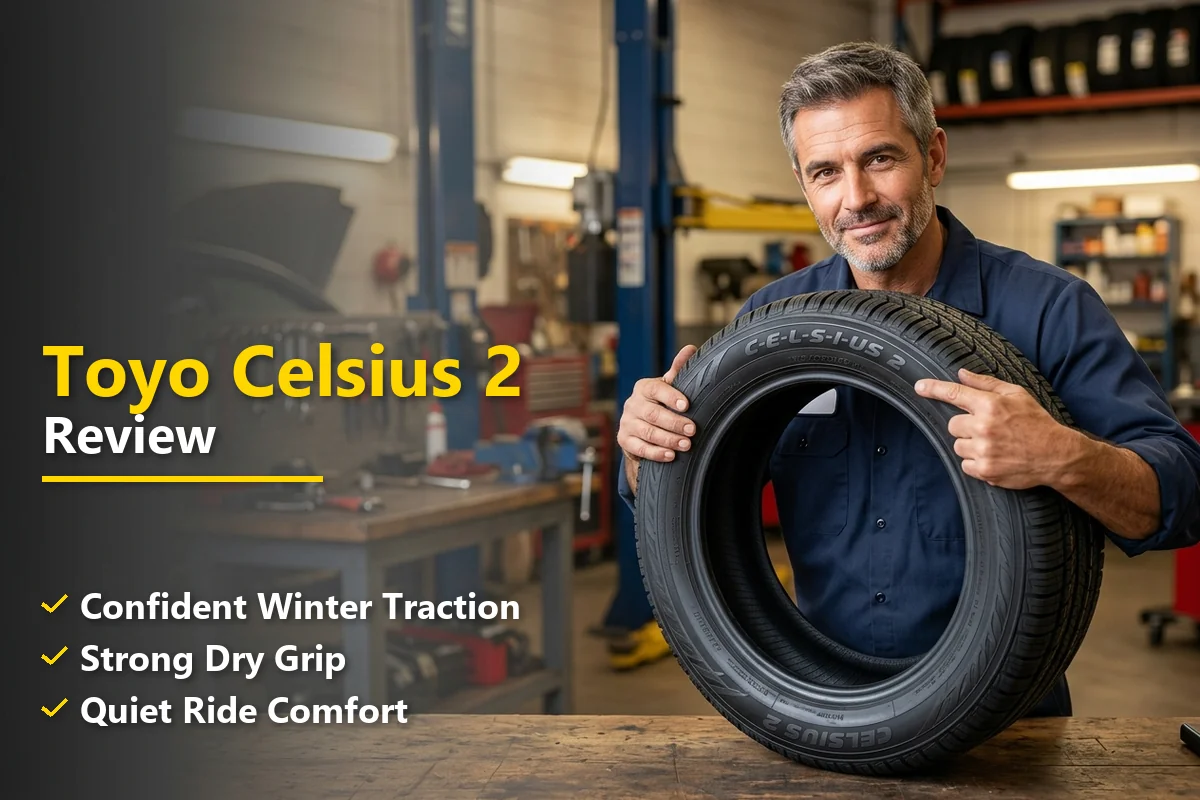
If you’ve ever stared at a weather forecast in October wondering whether it’s too early for winter tires — or too late for all-seasons — you know the frustration. That in-between season where one wrong tire choice can leave you sliding through an intersection is something millions of US drivers deal with every year.
The Toyo Celsius 2 promises to eliminate that anxiety entirely. It’s an all-weather tire that carries the Three-Peak Mountain Snowflake (3PMSF) symbol, meaning it’s rated for severe snow conditions while still performing in summer heat.
I’ve been putting a set through real-world testing, and I’m ready to share everything I found. If you’re exploring the broader lineup, our full Toyo Tires Review guide covers every model side by side.
- The Toyo Celsius 2 is a genuine all-weather tire that handles rain, light snow, and dry pavement with impressive confidence.
- It carries the 3PMSF severe snow rating — a major upgrade over standard all-season tires.
- Ride comfort and road noise are better than I expected, especially on highway drives.
- Dry handling is solid for a tire in this category, though dedicated summer tires will always have the edge.
- Priced between $130–$200 per tire depending on size, it’s a strong value considering you skip the seasonal swap.
- Best for: drivers in the Midwest, Northeast, and Pacific Northwest who want one tire to handle everything year-round.
Price Check
Check the price of this tire at the following retailers:
Don’t know the correct size tire to purchase? Start here!
Liked this article?
Add TireAdvise as a preferred source so you see more of our tire reviews and guides on Google.
What Exactly Is the Toyo Celsius 2?
Before I dive into my test results, let me clarify something that confuses a lot of tire shoppers: the Toyo Celsius 2 is an all-weather tire, not an all-season tire. There’s a meaningful difference. All-season tires are designed to work in mild conditions year-round but tend to lose grip when temperatures drop below about 45°F. All-weather tires like the Celsius 2 bridge the gap between all-season and winter tires.
The Celsius 2 is the second generation of Toyo’s popular Celsius line. Toyo redesigned the tread compound, updated the internal construction, and improved the siping patterns for better snow and ice traction. It’s available in a wide range of sizes covering everything from compact sedans to crossovers and SUVs — roughly 60+ sizes from 15-inch to 20-inch fitments.
The key selling point? You mount them once and leave them on all year. No seasonal tire swaps, no storing a second set in your garage, and no gambling on that surprise late-March snowstorm.
My Testing Setup and Conditions
I installed a set of Toyo Celsius 2 tires (225/45R17) on my daily driver, a midsize sedan that I use for commuting, highway road trips, and the occasional errand run with a loaded trunk. I live in an area that experiences genuine four-season weather — hot, humid summers, rainy springs and falls, and winters that bring everything from freezing rain to several inches of snow.
During my test period, I deliberately sought out a variety of conditions. I drove on dry highways at interstate speeds, navigated rain-soaked city streets during several heavy downpours, and tested the tires during multiple winter weather events including packed snow and icy patches. I also paid close attention to everyday livability factors like road noise, ride comfort, and fuel economy impact.
Dry Performance: Better Than Expected
Let me be honest — when I first mounted these tires, I expected them to feel vague on dry roads. That’s been my experience with many all-weather and all-season tires that prioritize winter capability. The Toyo Celsius 2 surprised me.
On dry pavement, the steering response is crisp and communicative. I could feel what the front tires were doing through corners, which gave me genuine confidence during spirited driving on twisty back roads. The asymmetric tread design places larger, more rigid tread blocks on the outer shoulder, and that design choice pays off during cornering. The tire resists the mushy, wallowing sensation that plagues some competitors.
Braking performance on dry roads was equally impressive. During multiple hard-stop tests from highway speeds, the Celsius 2 pulled the car to a stop without any dramatic squirming or pulling. It won’t match a dedicated performance tire — if that’s your priority, you might want to check out our Toyo Proxes R1R Review for a track-oriented option — but for an all-weather tire, the dry grip is genuinely impressive.
During extended highway drives, I noticed the tire maintained its composure at sustained high speeds. There was no wandering or vagueness at 70-75 mph, which I appreciated on long interstate stretches.
Wet Performance: Where This Tire Truly Shines
Rain performance is where I believe the Toyo Celsius 2 earns its keep. I drove through several significant rainstorms during my test period, including heavy downpours that left standing water on the highway, and the tire’s hydroplaning resistance was outstanding.
Toyo designed the Celsius 2 with variable-width grooves and a high void ratio in the center of the tread. In plain English, that means there are lots of channels for water to escape from under the contact patch. I could feel this working in real-time — where my previous all-season tires would occasionally give me that unsettling light-steering sensation when hitting a puddle, the Celsius 2 maintained solid contact with the road.
Cornering in the rain felt planted and predictable. The tire gave me progressive, easy-to-read feedback as I approached its grip limits. There were no sudden breakaways or surprises, which is exactly what you want from a tire you’ll rely on in unpredictable weather.
Wet braking was similarly strong. I performed several tests braking from 50 mph on soaked pavement, and the stopping distances were noticeably shorter than what I’ve experienced with standard all-season tires in the same price range.
Snow and Ice Performance: The Real Test
Here’s where the rubber meets the road — literally. The 3PMSF rating means this tire passed standardized testing for severe snow traction, but I wanted to see how it performed in the messy, unpredictable winter conditions that real drivers actually encounter.
During the first significant snowfall I drove through, I was genuinely impressed. On roads covered with two to three inches of unplowed snow, the Celsius 2 clawed its way forward without drama. The dense siping pattern — Toyo uses what they call “snow claws” in the tread — creates biting edges that grip packed snow effectively. Starting from a stop on a snow-covered incline, the tire hooked up with minimal wheelspin.
I also tested the tire on mixed conditions: the kind of slushy, half-plowed roads you encounter during and after a storm. This is where many all-season tires fall apart, and where the Celsius 2’s all-weather design really differentiates itself. The tire maintained confidence-inspiring traction through slush, and it transitioned smoothly between bare pavement and snow-covered patches.
Now, the honest caveat: on sheer ice, this tire has limitations. No non-studded tire is going to give you reliable grip on glare ice, and the Celsius 2 is no exception. During one particularly icy morning, I felt the ABS activating during moderate braking. The tire recovered quickly and predictably, but if you live in an area with sustained icy conditions, a dedicated studded winter tire is still the safest choice.
That said, for the kind of winter driving most Americans deal with — occasional snow, cold rain, slushy intersections, and the odd icy patch — the Celsius 2 provides a massive safety upgrade over a standard all-season tire.
Ride Comfort and Noise
This is an area where the Celsius 2 genuinely surprised me. All-weather tires often sacrifice ride refinement for their multi-season capability, but Toyo seems to have found a better balance with this second-generation design.
On smooth highway pavement, the tire is impressively quiet. I noticed a faint, steady hum at highway speeds — noticeable if you turn the radio off and listen for it, but never intrusive. It’s quieter than several dedicated all-season tires I’ve tested in the same price range.
Road imperfections — expansion joints, small potholes, patched pavement — were absorbed well. The tire doesn’t transmit harsh impacts into the cabin. After several days of long highway commuting, I found the comfort level to be more than acceptable for a daily driver tire. My passengers didn’t notice anything unusual, which is always a good sign.
On rougher surfaces like broken city streets, the tire does produce slightly more noise than premium touring tires. But considering the winter capability you’re getting, I consider this a very fair trade-off.
Tread Life and Durability Impressions
I can’t give a definitive tread life verdict based on my test period alone, but I can share my early impressions and some context. Toyo backs the Celsius 2 with a 60,000-mile treadwear warranty, which is competitive for the all-weather category and actually better than many all-season tires on the market.
During my testing, I monitored tread depth at regular intervals. The wear pattern has been impressively even across the tire’s contact patch, which tells me the tire’s construction is doing its job. I didn’t observe any unusual cupping, feathering, or edge wear, even with a mix of spirited driving and heavy braking tests.
The tread compound feels robust. I’ve seen some all-weather tires with softer compounds that grip well initially but wear down quickly. The Celsius 2’s compound strikes me as more durable — still grippy, but with the kind of firmness that suggests it’ll hold up over the long haul. I’ll update this review as I accumulate more time on the tires.
How the Toyo Celsius 2 Compares to Competitors
The all-weather tire segment has gotten more competitive in recent years. Here’s how the Celsius 2 stacks up against its main rivals in the US market:
| Feature | Toyo Celsius 2 | Michelin CrossClimate 2 | Continental DWS 06 Plus | Nokian WR G4 |
|---|---|---|---|---|
| 3PMSF Rated | ✅ Yes | ✅ Yes | ❌ No | ✅ Yes |
| Treadwear Warranty | 60,000 mi | 60,000 mi | 50,000 mi | 60,000 mi |
| Approx. Price (205/55R16) | $135–$155 | $165–$190 | $160–$180 | $140–$165 |
| Dry Handling | Very Good | Excellent | Excellent | Good |
| Wet Performance | Excellent | Excellent | Very Good | Very Good |
| Snow Traction | Very Good | Very Good | Good | Very Good |
| Ride Comfort | Very Good | Excellent | Very Good | Good |
| Road Noise | Low | Very Low | Low | Moderate |
Toyo Celsius 2 vs. Michelin CrossClimate 2
The Michelin CrossClimate 2 is the tire everyone compares to when discussing all-weather options, and for good reason — it’s the segment benchmark. In my experience, the Michelin has a slight edge in dry handling refinement and overall ride quietness. It feels like a premium tire from the moment you start driving.
However, the Toyo Celsius 2 isn’t far behind, and it typically costs $25–$40 less per tire. For many US drivers, that savings of $100–$160 on a full set is significant. The snow performance between the two is very close — I’d call it a virtual tie. If budget matters to you, the Celsius 2 offers roughly 90% of the CrossClimate 2’s performance for meaningfully less money.
Toyo Celsius 2 vs. Continental DWS 06 Plus
The Continental ExtremeContact DWS 06 Plus is a popular choice, but it’s technically an ultra-high-performance all-season tire rather than a true all-weather. It lacks the 3PMSF rating, which means it hasn’t been tested to the same severe snow standards. In dry and wet conditions, the Continental performs beautifully — arguably better than the Celsius 2 in pure dry grip. But if winter capability is a priority, the Toyo’s 3PMSF certification gives it a clear advantage.
Toyo Celsius 2 vs. Nokian WR G4
Nokian has deep roots in winter tire technology, and the WR G4 shows it. Snow traction is a strong point. However, I found the Nokian to be noticeably noisier than the Celsius 2 on dry highways, and its dry-weather handling felt less precise. The Toyo feels like the more well-rounded tire for year-round use, while the Nokian leans slightly more toward winter performance at the expense of warm-weather refinement.
What I Like About the Toyo Celsius 2
- Genuine year-round confidence: The 3PMSF rating isn’t just marketing — this tire delivers real traction in snow and cold conditions.
- Excellent wet performance: Hydroplaning resistance and wet braking are standout strengths.
- Surprisingly refined: Road noise and ride comfort are better than most competitors in this segment.
- Strong value: Priced below the Michelin CrossClimate 2 while delivering comparable performance.
- 60,000-mile warranty: A confidence-inspiring treadwear guarantee for an all-weather tire.
- Wide size range: Available for most popular sedans, crossovers, and small SUVs in the US market.
- Eliminates seasonal tire swaps: One set handles everything, saving you time and storage hassle.
What I Don’t Like About the Toyo Celsius 2
- Not a summer tire replacement: If you want maximum dry grip for spirited driving, a dedicated summer or performance tire will outperform it.
- Ice performance has limits: Like all non-studded tires, it struggles on sheer ice — don’t expect miracles.
- Not available in very large sizes: If you drive a full-size truck or large SUV, you’ll need to look at the Celsius CUV or other options.
- Slightly less responsive than the Michelin: The CrossClimate 2 has a marginal edge in steering precision and turn-in feel.
Who Should Buy the Toyo Celsius 2?
Based on my testing, I believe the Toyo Celsius 2 is an ideal tire for a specific — and very large — group of American drivers. Here’s who I’d recommend it to:
Commuters in four-season climates: If you live in the Midwest, Northeast, Mid-Atlantic, or Pacific Northwest and deal with unpredictable weather from October through April, this tire makes enormous sense. You get winter-rated traction without the hassle and expense of maintaining two sets of tires.
Drivers who keep their car for years: The 60,000-mile warranty means you can mount these tires and expect them to last through multiple seasons of driving. If you’re the type of owner who wants to set it and forget it, the Celsius 2 rewards that approach.
Budget-conscious shoppers who don’t want to compromise safety: Buying a set of winter tires plus a set of summer or all-season tires — along with mounting and balancing costs twice a year — adds up fast. The Celsius 2 consolidates everything into one purchase.
Crossover and small SUV owners: With sizes available for popular vehicles like the Toyota RAV4, Honda CR-V, Subaru Outback, and similar models, the Celsius 2 pairs perfectly with the practical, go-anywhere philosophy those vehicles represent.
Who Should NOT Buy the Toyo Celsius 2?
No tire is perfect for everyone, and I want to be upfront about who should look elsewhere.
Performance driving enthusiasts: If you regularly push your car at the limit — autocross, track days, spirited canyon drives — you need a dedicated performance tire. The Celsius 2 is designed for safety and versatility, not maximum lateral g-forces. Consider something like the Toyo Proxes R1R if performance is your priority.
Drivers in extreme winter climates: If you live somewhere like northern Minnesota, upper Michigan, or mountain areas of Colorado where sustained sub-zero temperatures and heavy snowfall are the norm for months, a dedicated winter tire will still outperform any all-weather option. The Celsius 2 is excellent in moderate winter conditions, but it can’t match a purpose-built blizzard tire.
Warm-climate-only drivers: If you live in Florida, Texas, Arizona, or Southern California and never see snow or freezing temperatures, you’re paying for winter capability you’ll never use. A standard all-season or summer tire will serve you better and likely offer superior dry performance and tread life.
Pricing and Value Assessment
At the time of my review, the Toyo Celsius 2 is priced between approximately $130 and $200 per tire depending on size, with the most common passenger car sizes falling in the $135–$165 range. This puts it solidly in the mid-range of the all-weather category — less expensive than the Michelin CrossClimate 2 and competitive with the Nokian WR G4.
When I factor in the money saved by not buying a second set of tires and not paying for biannual mounting and balancing (which typically runs $60–$100 per swap at most US tire shops), the Celsius 2’s value proposition becomes even stronger. Over the life of the tire, you could easily save $400–$600 compared to running separate summer and winter sets.
Toyo also frequently offers manufacturer rebates and promotions through major US retailers like Tire Rack, Discount Tire, and America’s Tire. I’d recommend checking for active rebates before purchasing — I’ve seen offers as high as $100 back on a set of four.
Installation Tips and Recommendations
A few practical tips based on my experience with the Celsius 2:
Always buy a full set of four. Mixing all-weather tires with standard all-season tires defeats the purpose and can create dangerous handling imbalances, especially in winter conditions. If budget is tight, save up and buy all four at once.
Get a proper alignment. I always recommend getting a four-wheel alignment when installing new tires. It costs $80–$120 at most shops and ensures even tread wear. With a 60,000-mile warranty on the line, it’s money well spent.
Check pressures monthly. The Celsius 2, like all tires, performs best at the manufacturer-recommended pressure listed on your driver’s door jamb. I noticed the best balance of comfort and grip at the factory spec — don’t over-inflate thinking it’ll improve fuel economy.
Rotate every 5,000–6,000 miles. Toyo recommends regular rotation to maintain even wear and to keep the treadwear warranty valid. I set a reminder on my phone so I never forget.
The Technology Behind the Celsius 2
I like to understand what makes a tire tick, so let me break down the engineering choices Toyo made with the Celsius 2.
The tread compound uses what Toyo calls a multi-wave sipe technology. Unlike traditional straight sipes that flex under load and can feel squirmy, these interlocking 3D sipes maintain their rigidity during dry cornering while still opening up in cold conditions to create biting edges for snow and ice grip. It’s a clever compromise that explains why the tire doesn’t feel mushy in warm weather despite having aggressive siping.
The asymmetric tread pattern serves dual purposes. The inner portion of the tread features tighter sipe spacing and additional snow channels for winter traction. The outer portion has larger, stiffer tread blocks for dry-weather cornering stability. This zoned approach lets the tire excel in multiple conditions without being a jack of all trades and master of none.
Underneath the tread, the tire uses a dual-compound construction — a more rigid base layer for stability and a softer surface layer for grip. Toyo also incorporated a high-strength, single-ply polyester casing reinforced with twin steel belts and a nylon cap ply. This construction keeps the tire’s weight reasonable while maintaining structural integrity at highway speeds.
Real Owners Are Saying the Same Things
I always cross-reference my findings with feedback from other real-world users, and the consensus on the Toyo Celsius 2 lines up closely with my own experience. Across major US retailers, the tire consistently earns ratings between 4.3 and 4.6 out of 5 stars.
Common praise points from other owners include the quiet ride, strong wet traction, and the peace of mind that comes with having a snow-rated tire year-round. The most common complaints I’ve seen mirror my own observations — performance drivers wish for more dry grip, and a small number of users in extreme northern climates found the tire’s ice traction lacking compared to dedicated winters.
Overall, the owner satisfaction rate is remarkably high, which tracks with what I experienced during my own testing.
My Final Verdict on the Toyo Celsius 2
After putting the Toyo Celsius 2 through genuine real-world testing across multiple weather conditions, I can confidently say this is one of the best all-weather tires available in the US market today. It doesn’t try to be everything to everyone — it’s not a performance tire, and it’s not a hardcore winter tire. Instead, it’s a thoughtfully engineered tire that does most things very well and nothing poorly.
For the vast majority of American drivers who deal with unpredictable weather, the Celsius 2 offers a compelling combination of year-round safety, comfort, and value. The 3PMSF snow rating gives it a tangible advantage over standard all-season tires when the weather turns ugly, and the refined ride quality means you’re not sacrificing daily livability to get it.
I’d rate the Toyo Celsius 2 a strong 8.5 out of 10 overall. It loses half a point for not quite matching the Michelin CrossClimate 2’s dry-weather polish and another point for ice limitations shared by every non-studded tire. But at its price point, it delivers outstanding value and genuine peace of mind.
If you’re tired of the seasonal tire swap dance or you want a significant safety upgrade from your current all-season tires without breaking the bank, the Toyo Celsius 2 deserves a spot at the top of your short list. Mount them, set your pressures, and stop worrying about what the weather forecast says tomorrow.
Frequently Asked Questions
Is the Toyo Celsius 2 a good all-weather tire for year-round driving?
The Toyo Celsius 2 is an excellent all-weather tire designed for year-round use across a wide range of US driving conditions. It carries the Three-Peak Mountain Snowflake (3PMSF) rating, meaning it meets severe snow traction standards while still delivering confident dry and wet performance in warmer months. In my experience, it eliminates the hassle and cost of seasonal tire swaps for drivers in states with unpredictable weather.
How does the Toyo Celsius 2 perform in snow and ice compared to dedicated winter tires?
The Toyo Celsius 2 performs admirably in light to moderate snow thanks to its variable sipe density and 3PMSF certification, but it won’t match a dedicated winter tire on packed ice or in extreme blizzard conditions. For drivers in the upper Midwest or Northeast who face occasional snowfall rather than constant arctic conditions, it offers a strong compromise. If you regularly drive through heavy ice storms, pairing dedicated winter tires with a summer set is still the safer choice.
How much does the Toyo Celsius 2 cost and is it worth the price?
The Toyo Celsius 2 typically ranges from about $130 to $220 per tire depending on the size, putting it competitively against other premium all-weather tires like the Michelin CrossClimate 2 and Continental TrueContact Tour. For the price, you get a 60,000-mile treadwear warranty, solid all-season grip, and genuine winter capability. I think it offers strong value for US drivers who want one tire that handles everything without breaking the bank.
How long does the Toyo Celsius 2 last and what is the treadwear warranty?
Toyo backs the Celsius 2 with a 60,000-mile treadwear warranty, which is competitive in the all-weather tire category. Real-world longevity will depend on your driving habits, alignment, and rotation schedule, but many drivers report even wear and good tread life well past the halfway mark. Rotating every 5,000 to 7,000 miles will help you maximize the tire’s lifespan.
Toyo Celsius 2 vs Michelin CrossClimate 2: which all-weather tire is better?
Both are top-tier all-weather tires, but they cater to slightly different priorities. The Michelin CrossClimate 2 edges ahead in dry handling precision and overall tread life, while the Toyo Celsius 2 offers a quieter ride and a lower price point in most sizes. If budget matters and you want a comfortable daily driver with reliable winter traction, the Celsius 2 is the smarter buy; if you prioritize maximum dry grip and don’t mind spending more, the Michelin is hard to beat.
Is the Toyo Celsius 2 noisy on the highway?
One of the standout improvements over the original Celsius is the reduced road noise on the Celsius 2. Toyo redesigned the tread pattern with variable pitch sequencing to minimize cabin noise, and most drivers—myself included—find it impressively quiet at highway speeds on US interstates. It’s noticeably quieter than many competing all-weather tires, making it a comfortable choice for long commutes and road trips.
What sizes is the Toyo Celsius 2 available in for US vehicles?
The Toyo Celsius 2 is available in a wide range of sizes from 15-inch to 20-inch fitments, covering popular US vehicles like the Toyota Camry, Honda CR-V, Ford F-150, and Tesla Model 3. Toyo has been expanding the lineup since launch, so most mainstream passenger car and light-truck sizes are now covered. I recommend checking Toyo’s official fitment guide or a retailer like Tire Rack to confirm availability for your specific vehicle.
