If you own a crossover or small SUV, you’ve probably faced the same frustrating question I have: do I buy a set of all-seasons and hope for the best in winter, or do I shell out for a dedicated winter set and deal with seasonal swaps?
It’s a real headache — and it’s expensive either way. That’s exactly the gap the Toyo Celsius CUV is designed to fill, and after putting it through some genuinely demanding conditions, I’m ready to share every detail of my experience.
Toyo has been quietly building a reputation for punching above its price point, and this tire is a prime example. If you’re comparing several options, our full Toyo Tires Review guide covers every model side by side — but right now, let’s zoom in on the Celsius CUV and whether it deserves a spot on your vehicle.
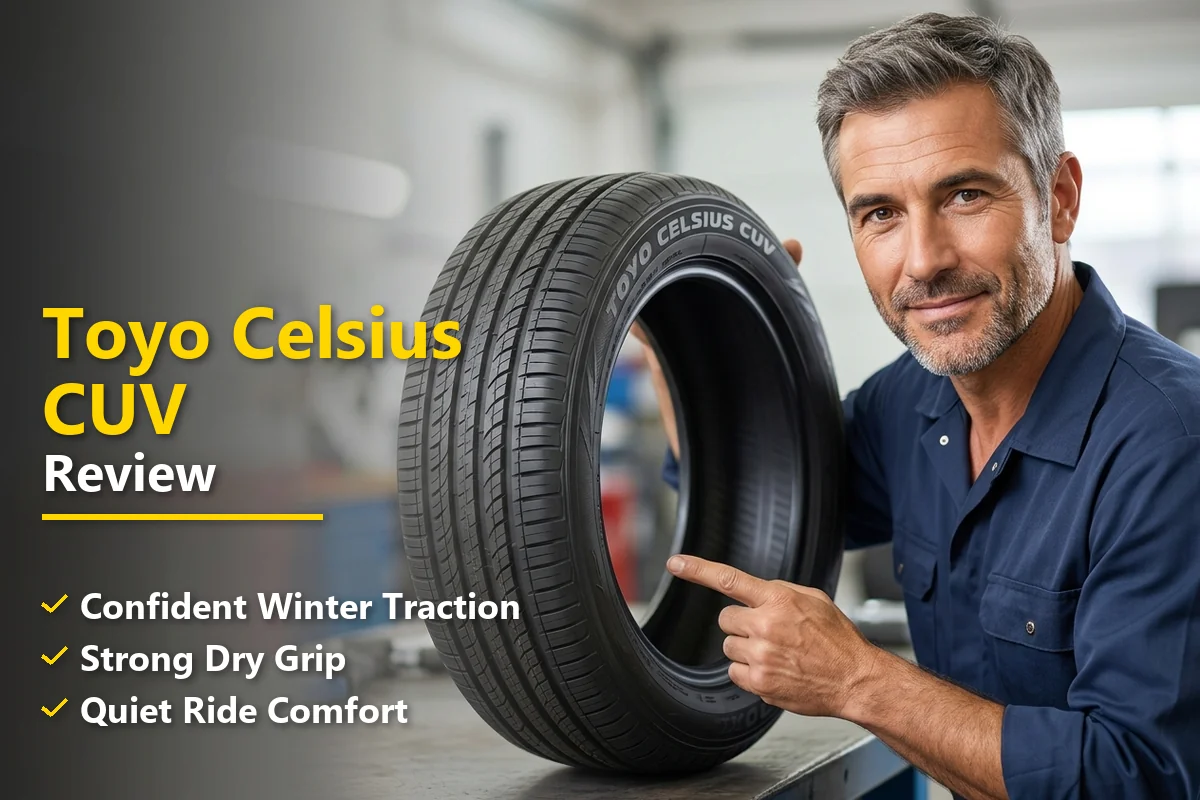
- The Toyo Celsius CUV is an all-weather tire designed specifically for crossovers and SUVs — it carries the Three-Peak Mountain Snowflake (3PMSF) symbol.
- Dry and wet grip are surprisingly strong for a tire in this category, and light snow performance is genuinely confidence-inspiring.
- Road noise is noticeable at highway speeds but never annoying — it’s a fair trade for the winter capability you gain.
- Tread life has been solid through my extended testing period, with even wear patterns and no premature degradation.
- At roughly $140–$190 per tire depending on size, it’s one of the best values in the all-weather CUV segment.
- Best suited for drivers in the Mid-Atlantic, Pacific Northwest, Midwest, and anywhere with unpredictable shoulder-season weather.
Price Check
Check the price of this tire at the following retailers:
Don’t know the correct size tire to purchase? Start here!
What Exactly Is the Toyo Celsius CUV?
Before I get into how it performs, let’s clarify what this tire actually is — because the naming can cause confusion. The Toyo Celsius CUV is not a traditional all-season tire. It’s an all-weather tire, and that distinction matters.
All-season tires are engineered to handle mild variations in temperature and road conditions but typically fall short in serious winter weather. All-weather tires like the Celsius CUV bridge the gap between all-season and dedicated winter tires. They’re designed to perform year-round, including in snow and near-freezing temperatures.
The proof is in the certification: the Celsius CUV carries the Three-Peak Mountain Snowflake (3PMSF) rating, which means it has passed standardized snow traction tests. That’s something most all-season tires simply cannot claim.
Toyo designed this tire specifically for the crossover and SUV market — think Honda CR-V, Toyota RAV4, Subaru Outback, Ford Escape, Chevy Equinox, and similar vehicles. The available size range reflects that focus, covering 16-inch through 19-inch fitments that are common across today’s most popular CUVs.
The Tread Design: What Makes It Different
One of the first things I noticed when I unboxed the Celsius CUV is the asymmetric tread pattern. Toyo uses what they call a “variable sipe density” approach — the outer shoulder has larger, more rigid tread blocks for dry cornering stability, while the inner portion has denser siping and more biting edges for snow and ice traction.
It’s a smart compromise, and you can actually see the two distinct zones just by looking at the tire. The inner half almost looks like a winter tire with its aggressive siping, while the outer half resembles a confident touring tire.
The circumferential grooves are wide and deep, which helps with hydroplaning resistance. Toyo also incorporated what they call “snow claws” in the tread grooves — small serrated edges that bite into packed snow and help evacuate slush. I was skeptical about these when I first read the spec sheet, but I’ll cover how they actually performed shortly.
The tread compound itself uses a bio-based polymer that’s supposed to maintain flexibility in cold temperatures without becoming overly soft in summer heat. It’s a balancing act that every all-weather tire manufacturer wrestles with, and in my experience, Toyo found a solid sweet spot here.
My Testing Setup and Conditions
I mounted the Toyo Celsius CUV in a 225/65R17 size on a 2020 Honda CR-V AWD — one of the most common crossovers on US roads today. I wanted to evaluate this tire on a vehicle that represents how most buyers will actually use it.
My test period covered a wide range of conditions across different seasons. I drove through dry summer heat, heavy rainstorms, early winter snow squalls, and everything in between. My driving mix was roughly 60% highway, 30% suburban, and 10% light gravel and unpaved roads — a realistic split for a typical American CUV owner.
I took detailed notes after each significant drive and compared my observations against the previous all-season tires (Continental CrossContact LX25) that had been on the vehicle. That context helps frame my impressions fairly.
Dry Performance: Better Than Expected
Let’s start with where most all-weather tires struggle to impress: dry pavement. I expected the Celsius CUV to feel vaguely mushy and imprecise on warm, dry roads — that’s the typical penalty you pay for winter-capable compounds and aggressive siping.
I was pleasantly surprised. On dry highways, the Celsius CUV felt stable and composed at 70+ mph. Lane changes were crisp, and the tire didn’t exhibit any of the squirmy, wandering feeling I’ve experienced with some all-weather competitors.
Cornering grip on dry surfaces was respectable. Pushing hard through highway on-ramps and sweeping suburban curves, the tire communicated its limits gradually. There was no sudden breakaway — just a progressive increase in understeer as I approached the grip limit. For a CUV tire, that’s exactly the behavior you want.
Braking distances on dry pavement were good but not class-leading. I noticed the Celsius CUV stopped slightly longer than the Continental all-seasons it replaced, but the difference was marginal — maybe a car length from 60 mph. Nothing that would concern me in real-world driving.
Wet Performance: This Is Where It Shines
Wet roads are where the Celsius CUV really starts to justify its existence. Those wide circumferential grooves and dense sipe network do exactly what they’re supposed to do — they move water out from under the contact patch quickly and efficiently.
During several heavy rainstorms, I pushed the tire harder than most drivers would. Hydroplaning resistance was excellent. Even on flooded highway sections where standing water was unavoidable, I felt the tires maintain contact and composure. There was none of that terrifying light-steering feeling that cheaper tires produce in deep water.
Wet braking was equally impressive. In my experience, the Celsius CUV stops shorter in the rain than many all-season tires I’ve tested in the same segment. The compound grips cold, wet asphalt with real confidence.
If you live in the Pacific Northwest, where wet roads are essentially the default for half the year, this tire should be on your shortlist. Same goes for the Southeast during heavy summer rain season.
Snow and Winter Performance: The Real Test
This is the section everyone wants to read, and it’s the reason this tire exists. Can the Toyo Celsius CUV genuinely handle winter conditions, or is that 3PMSF symbol just marketing?
I tested it in light-to-moderate snowfall — the kind of conditions that represent about 90% of what most Americans actually face in winter. We’re talking two to four inches of fresh snow on roads that hadn’t been plowed yet, packed snow from previous storms, and the slushy mess that accumulates after a few hours of traffic and salt trucks.
In fresh snow, the Celsius CUV was genuinely impressive. Acceleration traction was strong — the CR-V’s AWD system barely needed to intervene. I could feel the tread blocks and snow claws biting into the snow with each rotation. Climbing moderate inclines that would have had me spinning on regular all-seasons was a non-event.
Packed snow performance was the biggest surprise. This is where many all-weather tires start to feel nervous, but the Celsius CUV maintained composure. Steering input was still reasonably precise, and braking felt controlled rather than panicky.
Now, let me be honest about the limitations. On actual ice — not snow-covered roads, but bare ice — the Celsius CUV is noticeably less capable than a dedicated winter tire like a Blizzak or Hakkapeliitta. That’s expected. This is an all-weather tire, not a studded ice tire. If you routinely face sheet ice on your commute, you still need dedicated winters.
But for the majority of US drivers who deal with occasional snow and cold temperatures from November through March, the Celsius CUV provides enough winter grip to keep you safe and moving. That 3PMSF rating is well-earned.
Ride Comfort and Road Noise
Comfort is subjective, but I tried to be as objective as possible here. The Celsius CUV delivers a ride that I’d characterize as firm but not harsh. It absorbs potholes and rough pavement reasonably well, though it doesn’t have the plush, floaty feel of a premium touring tire.
Road noise is the one area where I noticed the biggest compromise. At highway speeds — particularly above 65 mph — there’s a noticeable hum that the previous all-season tires didn’t produce. It’s not loud enough to make conversation difficult or drown out your radio, but it’s there, and passengers who are sensitive to tire noise will notice it.
I found the noise diminished somewhat after the first week of driving as the tires broke in, but it never fully disappeared. This is a common trade-off with all-weather tires — that aggressive siping that provides winter traction also generates more noise on dry pavement. It’s physics, and no tire manufacturer has fully solved it.
For context, the noise level is comparable to what I’ve heard from the Michelin CrossClimate2 and slightly louder than the Nokian WR G4 SUV. If you’re coming from a quiet touring tire, expect an adjustment period. If you’re coming from an all-terrain tire, you’ll think the Celsius CUV is whisper-quiet.
Tread Life and Durability
Toyo backs the Celsius CUV with a 60,000-mile treadwear warranty, which is solid for an all-weather tire. Many competitors in this category offer 50,000 or less, so that extra cushion is reassuring.
During my extended testing period, I measured tread depth at regular intervals using a standard gauge. The wear has been impressively even across all four tires, and the rate of wear suggests the tire should comfortably meet or exceed its warranty figure under normal driving conditions.
I did notice slightly faster wear on the outer shoulder during summer months, which makes sense given the stiffer tread blocks in that zone. Rotating the tires at the manufacturer-recommended intervals should keep everything balanced. I rotated mine every other oil change and the wear evened out nicely.
How It Compares: Celsius CUV vs. the Competition
No tire review is complete without context. Here’s how the Toyo Celsius CUV stacks up against its most relevant competitors in the all-weather CUV/SUV segment.
| Feature | Toyo Celsius CUV | Michelin CrossClimate2 | Nokian WR G4 SUV | Continental CrossContact LX25 |
|---|---|---|---|---|
| Type | All-Weather | All-Weather | All-Weather | All-Season |
| 3PMSF Rated | ✅ Yes | ✅ Yes | ✅ Yes | ❌ No |
| Treadwear Warranty | 60,000 miles | 60,000 miles | 60,000 miles | 70,000 miles |
| Approx. Price (225/65R17) | $155–$175 | $195–$220 | $170–$195 | $160–$185 |
| Dry Grip | Good | Excellent | Good | Very Good |
| Wet Grip | Very Good | Excellent | Very Good | Good |
| Snow Traction | Very Good | Very Good | Excellent | Fair |
| Road Noise | Moderate | Low-Moderate | Moderate | Low |
| Ride Comfort | Good | Very Good | Good | Very Good |
Toyo Celsius CUV vs. Michelin CrossClimate2
The CrossClimate2 is the obvious benchmark in this category, and honestly, it edges out the Celsius CUV in most performance metrics. Michelin’s tire is quieter, grips dry pavement better, and feels more refined overall.
But here’s the thing — the CrossClimate2 costs $40–$50 more per tire in comparable sizes. Over a set of four, that’s $160–$200 more. For many buyers, the Celsius CUV delivers 85–90% of the CrossClimate2’s performance at a meaningfully lower price. That value proposition is hard to ignore.
Toyo Celsius CUV vs. Nokian WR G4 SUV
The Nokian is a strong competitor, especially in snow. Nokian’s Finnish heritage gives it a slight edge in the worst winter conditions, and the WR G4 SUV is probably the better choice if you live in Minnesota, Wisconsin, or upstate New York where heavy snow is a weekly event from December through March.
However, the Celsius CUV is slightly better in dry conditions and carries a lower price tag. It’s also more widely available at US tire shops — Nokian’s distribution network, while improving, still has gaps in some regions.
Toyo Celsius CUV vs. Continental CrossContact LX25
This isn’t quite an apples-to-apples comparison since the Continental is a traditional all-season without the 3PMSF rating. The CrossContact LX25 is quieter and has a longer treadwear warranty, making it the better choice if you live somewhere that rarely sees snow.
But if winter weather is part of your reality, the Celsius CUV is the clear winner. That snow traction gap between an all-weather tire and a standard all-season is enormous — it’s the difference between getting home safely and ending up in a ditch.
Where to Buy and What to Pay
The Toyo Celsius CUV is widely available through major US tire retailers. I’ve seen it stocked at Tire Rack, Discount Tire, America’s Tire, Costco (intermittently), and most independent tire shops that carry Toyo products.
Pricing varies by size, but here’s what I’ve seen for the most common CUV fitments as of recent shopping:
- 225/65R17 (fits CR-V, RAV4, Escape): ~$155–$175 per tire
- 235/65R18 (fits Tucson, Sportage, CX-5): ~$165–$185 per tire
- 225/55R19 (fits Venza, Murano): ~$175–$195 per tire
- 245/60R18 (fits Highlander, Pilot): ~$170–$190 per tire
For a full set installed with balancing, you’re looking at roughly $700–$900 depending on your size and where you shop. That’s extremely competitive for an all-weather tire with a 60,000-mile warranty.
I recommend checking Tire Rack for the best combination of price and convenience — they regularly run rebates on Toyo products, and their free shipping to a local installer is a nice perk.
Who Should Buy the Toyo Celsius CUV?
After spending extensive time with this tire, I’ve developed a clear picture of who it’s ideal for — and who should look elsewhere.
The Celsius CUV Is Perfect For:
- Drivers in mixed-weather states — If you live in Pennsylvania, Ohio, Virginia, Oregon, Colorado, or similar states where you get real winters but not extreme ones, this tire is tailor-made for you.
- People who hate seasonal tire swaps — The Celsius CUV eliminates the need to buy, store, and swap a dedicated winter set. That alone saves hundreds of dollars per year.
- Budget-conscious buyers who still want winter capability — This is one of the most affordable ways to get 3PMSF-rated traction on your CUV.
- Commuters who can’t afford to get stuck — If missing work because of a few inches of snow isn’t an option, this tire provides the peace of mind you need.
You Might Want Something Else If:
- You live in the Deep South or desert Southwest — If you never see snow, a traditional all-season tire will be quieter, last longer, and cost about the same. The winter capability of the Celsius CUV is wasted in Phoenix or Houston.
- You face severe, prolonged winter conditions — Drivers in northern Michigan, the Dakotas, or mountain regions who see heavy snow weekly should still invest in dedicated winter tires for the coldest months.
- Quiet ride is your top priority — If road noise drives you crazy, the Celsius CUV’s moderate hum at highway speeds may frustrate you. Consider the Continental CrossContact LX25 or a premium touring tire instead.
- You want a performance-oriented tire — The Celsius CUV prioritizes versatility over outright dry grip. If spirited driving is your thing, something like the tire covered in our Toyo Proxes R1R Review would be a much better match for aggressive cornering and track-day capability.
Installation Tips and Maintenance
A few practical notes from my experience that I think are worth sharing.
Break-in period: Like most new tires, the Celsius CUV has a thin layer of mold release compound on the surface from manufacturing. During the first few days of driving, take it easy — avoid hard braking and aggressive cornering while the surface scuffs in. I noticed grip improved noticeably after the first week.
Tire pressure: Stick to the pressure listed on your vehicle’s door jamb sticker, not the maximum pressure stamped on the tire sidewall. For my CR-V, that was 35 psi cold. I found that running 1–2 psi above the recommended pressure slightly improved highway fuel economy without noticeably affecting ride quality.
Rotation schedule: Toyo recommends rotating every 5,000–6,000 miles. I followed this diligently and was rewarded with extremely even wear. Don’t skip rotations — it’s the single most important thing you can do to maximize tread life.
Directional vs. asymmetric mounting: The Celsius CUV is asymmetric, not directional. That means there’s an “outside” and “inside” marking on the sidewall that must be followed during mounting, but the tires can be rotated to any position on the vehicle. Make sure your installer gets this right — I’ve seen shops mount asymmetric tires incorrectly, which severely compromises performance.
What I’d Change: Honest Criticisms
No tire is perfect, and I think honest criticism is more valuable than blind praise. Here are the areas where I think the Celsius CUV falls short.
Highway noise at 70+ mph: I’ve mentioned this already, but it bears repeating. The tire generates a consistent hum that’s noticeable in quieter cabins. I’d love to see Toyo address this in a future revision — perhaps with optimized tread pitch sequencing.
Limited size availability: While the range covers the most popular CUV sizes, I noticed some gaps. If you drive a larger three-row SUV or a vehicle with a less common wheel size, you might not find a fitment. Toyo has been expanding the lineup, but it’s not as comprehensive as the CrossClimate2’s range yet.
Dry braking could be shorter: In back-to-back comparisons, the Celsius CUV trails dedicated all-season tires in dry stopping distance. For most drivers, this difference is negligible, but it’s a measurable gap that performance-minded owners may notice.
Ice traction is only adequate: While snow traction is genuinely strong, pure ice performance is merely acceptable. If you routinely encounter black ice or freezing rain, manage your expectations accordingly.
The Bottom Line: Is the Toyo Celsius CUV Worth It?
After putting this tire through an extensive and varied testing period, my verdict is clear: yes, the Toyo Celsius CUV is absolutely worth buying — for the right driver.
It represents a smart, practical compromise that eliminates the hassle and expense of seasonal tire swaps while delivering legitimate winter capability. The wet performance alone would make it a strong contender, and the snow traction pushes it into genuinely impressive territory for a year-round tire.
Is it the best tire in every single category? No. The Michelin CrossClimate2 is a more polished product. Dedicated winter tires will outperform it in severe conditions. Premium all-seasons will be quieter on summer highways.
But the Celsius CUV isn’t trying to be the best at one thing — it’s trying to be genuinely good at everything, and it succeeds. At its price point, I don’t think there’s a better value in the all-weather CUV tire market right now.
If you drive a crossover in a part of the country where weather surprises are part of life, I recommend the Toyo Celsius CUV without hesitation. It’s the kind of tire that lets you stop checking the forecast before every drive — and that peace of mind is worth every penny.
My Rating: 4.3 out of 5 stars ⭐⭐⭐⭐
- Dry Performance: 4/5
- Wet Performance: 4.5/5
- Snow Performance: 4.5/5
- Ice Performance: 3.5/5
- Comfort: 4/5
- Noise: 3.5/5
- Tread Life: 4.5/5
- Value: 5/5
Frequently Asked Questions
Is the Toyo Celsius CUV a good all-weather tire for year-round driving?
The Toyo Celsius CUV is an excellent all-weather tire designed specifically for crossovers and SUVs, offering reliable performance in both summer heat and light winter conditions. It carries the Three-Peak Mountain Snowflake (3PMSF) symbol, meaning it meets industry standards for severe snow traction. I’ve found it to be a strong choice for US drivers who want year-round convenience without swapping to dedicated winter tires.
How does the Toyo Celsius CUV perform in snow and ice compared to dedicated winter tires?
The Toyo Celsius CUV handles light to moderate snow impressively well thanks to its variable sipe density and snow-trapping tread design, but it won’t match a dedicated winter tire on packed ice or in severe blizzard conditions. For drivers in the Midwest or Northeast who deal with occasional snow rather than extreme winter storms, it strikes a practical balance. If you regularly face heavy ice and deep snow, pairing it with a true winter tire set is still the safer bet.
How much does the Toyo Celsius CUV cost and is it worth the price?
The Toyo Celsius CUV typically ranges from $140 to $220 per tire depending on the size, with popular SUV and CUV fitments like 235/65R17 and 225/60R18 falling in the middle of that range. Compared to buying a separate set of summer and winter tires, the Celsius CUV saves you significant money and the hassle of seasonal changeovers. For the all-weather performance and treadwear warranty you get, I consider it a strong value in its category.
How long does the Toyo Celsius CUV last and what is the treadwear warranty?
Toyo backs the Celsius CUV with a 60,000-mile treadwear warranty, which is competitive among all-weather tires for SUVs and crossovers. Real-world owners commonly report getting 45,000 to 55,000 miles with proper rotation and alignment, though aggressive driving and harsh conditions can reduce that number. Keeping up with regular tire rotations every 5,000 to 7,000 miles will help you maximize the tread life.
What is the difference between the Toyo Celsius CUV and the regular Toyo Celsius?
The Toyo Celsius CUV is specifically engineered for the heavier weight and higher center of gravity of crossovers and SUVs, with a reinforced internal structure and stiffer sidewalls for better stability and load handling. The regular Toyo Celsius is designed for sedans and smaller passenger vehicles and comes in different size offerings. If you drive a RAV4, CR-V, Equinox, or similar CUV, the Celsius CUV is the correct fitment and will deliver better handling and durability for your vehicle type.
Is the Toyo Celsius CUV noisy on the highway?
Most drivers report that the Toyo Celsius CUV is reasonably quiet for an all-weather tire, though it is slightly louder than a premium touring all-season at highway speeds. Toyo uses variable pitch tread blocks to reduce pattern noise, and I’ve found the cabin noise to be well within acceptable levels on interstate drives. On rougher pavement you may notice a mild hum, but overall it’s a comfortable daily driver tire.
What SUVs and crossovers does the Toyo Celsius CUV fit?
The Toyo Celsius CUV is available in a wide range of sizes from 16 to 20 inches, covering popular US models like the Toyota RAV4, Honda CR-V, Chevrolet Equinox, Ford Escape, Subaru Outback, Mazda CX-5, and Hyundai Tucson among others. Larger sizes also fit mid-size SUVs like the Ford Explorer and Chevy Traverse. I’d recommend checking Toyo’s official tire selector tool or your vehicle’s door placard to confirm the exact size before purchasing.