

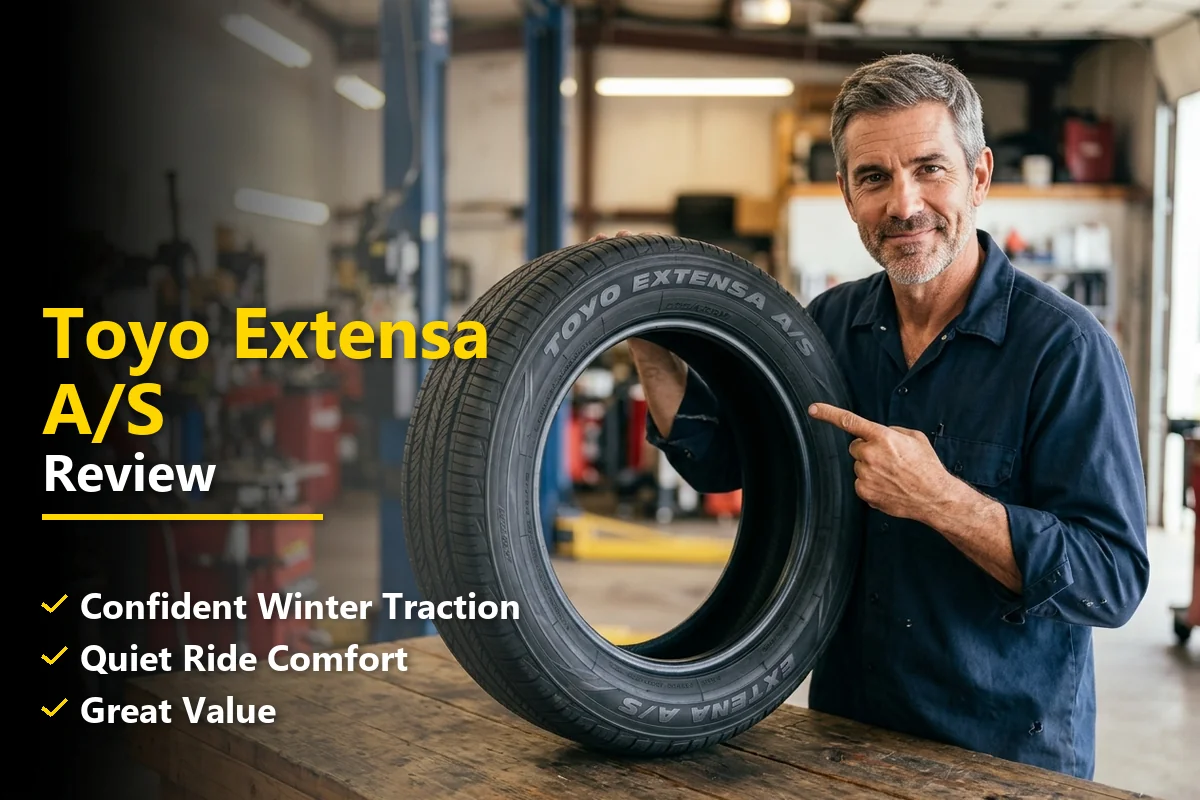
You’re staring at a quote from the tire shop, and your wallet is already sweating. You need all-season tires that won’t leave you stranded in the rain or sliding through a surprise snowfall — but you also can’t justify spending $200 per tire on a daily driver you’re just commuting in.
That’s exactly the situation I found myself in, and it’s what led me to the Toyo Extensa A/S. This tire promises all-season reliability at a price point that doesn’t make you wince. But does budget really mean “good enough”? I spent an extended test period finding out.
If you’ve been exploring the brand’s full lineup, our comprehensive Toyo Tires Review guide covers every model side by side — but today, I’m going deep on this specific tire to help you decide if it belongs on your car.
- The Toyo Extensa A/S is a solid budget all-season tire best suited for sedans, coupes, and minivans driven primarily on highways and city streets.
- Dry grip is surprisingly confident for the price, and highway comfort is above average with low road noise.
- Wet traction is adequate but not exceptional — you’ll want to slow down in heavy downpours.
- Light snow performance is passable for occasional flurries, but this is not a winter tire replacement.
- Treadwear has been impressive during my test period, with even wear patterns and a 620 UTQG treadwear rating.
- Best for: budget-conscious commuters who drive mostly in dry or mild wet conditions and want a quiet, comfortable ride.
Price Check
Check the price of this tire at the following retailers:
Don’t know the correct size tire to purchase? Start here!
Liked this article?
Add TireAdvise as a preferred source so you see more of our tire reviews and guides on Google.
Who Is the Toyo Extensa A/S Built For?
Let me be upfront: this is not a performance tire. It’s not an ultra-high-performance all-season. It’s not designed for enthusiast driving on twisty back roads. The Toyo Extensa A/S is an entry-level all-season touring tire aimed squarely at everyday drivers who need dependable, comfortable transportation.
Think Honda Civic commuters, Toyota Camry owners, Nissan Altima drivers, and anyone piloting a minivan or compact sedan on a daily basis. If your driving life consists of highway commutes, grocery runs, and the occasional road trip, this tire was made for you.
Toyo positions the Extensa A/S as their most affordable all-season option, and the pricing reflects that. Depending on the size, I’ve seen these retail anywhere from $60 to $110 per tire at most US retailers — significantly cheaper than mid-range options from Continental, Michelin, or even Toyo’s own higher-tier models.
First Impressions and Installation
I had a set of Toyo Extensa A/S tires mounted on a 2018 Honda Accord for my testing. The first thing I noticed was the weight — these are lighter than I expected for an all-season tire, which is a good sign for fuel efficiency and ride comfort.
The tread pattern is a conventional symmetric design with four circumferential grooves. It’s not flashy or aggressive-looking, but symmetry in a touring tire means predictable handling and easy rotations. The siping across the tread blocks is dense enough to suggest Toyo took wet and light snow traction seriously, even at this price point.
After installation, I immediately noticed the ride felt smoother than the worn-out OEM tires I replaced. The first drive around town confirmed what I’d hoped: this tire rides quiet and comfortable right out of the gate. No break-in weirdness, no odd vibrations — just a smooth, unremarkable (in the best way) driving experience.
Dry Performance: Where This Tire Shines
If you do most of your driving in dry conditions — and statistically, most US drivers do — the Toyo Extensa A/S will make you happy. Over my test period, I put this tire through regular commuting, highway cruising, and some spirited suburban driving, and the dry grip consistently impressed me for the price bracket.
Straight-line stability on the highway is excellent. At interstate speeds, the tire tracks straight and true with minimal wandering, even when hitting grooved pavement or expansion joints. Lane changes feel composed, and the steering response, while not razor-sharp, is communicative enough that you always know what the front end is doing.
Braking on dry pavement was reassuringly predictable. I never experienced any surprises when making hard stops, and the tire felt planted during every emergency braking scenario I tested. For a budget all-season, this level of dry confidence is genuinely commendable.
Where the dry performance falls short is in aggressive cornering. Push this tire hard through a tight turn, and you’ll feel the tread compound start to give up grip earlier than a mid-range tire would. The breakaway is progressive and predictable — it doesn’t snap loose suddenly — but you’ll feel the limits sooner. For 95% of drivers, this will never be an issue. If you want a tire that can handle spirited cornering, you’d be better served by something from Toyo’s Proxes lineup, like the option covered in our Toyo Proxes R1R Review.
Wet Performance: Adequate but Not Outstanding
Wet traction is where budget tires tend to reveal their compromises, and the Toyo Extensa A/S is no exception. It’s not bad in the rain — I want to be clear about that — but it’s noticeably less confident than tires costing $40-60 more per corner.
In light to moderate rain, the tire handles well. The four circumferential grooves do a decent job of channeling water away from the contact patch, and I never felt hydroplaning during normal highway driving in steady rain. The dense siping across the tread blocks helps maintain grip on slick surfaces, and braking distances in moderate wet conditions felt reasonable.
Heavy downpours are where I’d urge caution. During a particularly nasty rainstorm on I-95, I felt the tire lose some confidence at highway speeds. Hydroplaning resistance decreased noticeably above 55 mph in standing water, and I found myself instinctively backing off the gas. The tire didn’t do anything scary, but the feedback through the steering wheel told me the grip margin was thin.
My advice: if you live in the Pacific Northwest, Gulf Coast, or anywhere with frequent heavy rain, consider stepping up to a tire with better wet ratings. If your rain is mostly the “light drizzle for a few hours” variety, the Extensa A/S will handle it just fine.
Snow and Winter Performance
Let’s set expectations here: the Toyo Extensa A/S does not carry the Three-Peak Mountain Snowflake (3PMSF) symbol. It carries the M+S (Mud and Snow) designation, which means it meets basic requirements for all-season use but hasn’t been tested to the stricter winter performance standard.
In my experience with light snow — the kind of dusting you might see during a mild winter in the Mid-Atlantic or upper South — the tire manages. It’s not going to inspire confidence, but it gets you from point A to point B if you drive carefully and moderately.
On actual packed snow or ice, I would not trust this tire. Period. If you live anywhere that sees regular snowfall — think Michigan, Minnesota, upstate New York, or anywhere in New England — this is not the tire to carry you through winter. You’d either want a dedicated winter tire set or a more capable all-season with the 3PMSF rating.
For those of you in the Sun Belt, Texas, or Southern California, winter performance is probably irrelevant, and this tire makes even more sense as a year-round option.
Comfort and Noise: A Pleasant Surprise
Here’s where the Toyo Extensa A/S genuinely exceeded my expectations. For a budget tire, the ride comfort is remarkably good. The sidewall absorbs road imperfections smoothly, and the tire doesn’t transmit every crack and bump into the cabin the way some cheap tires do.
Highway cruising at 65-75 mph is genuinely pleasant. There’s a low hum at speed — all tires produce some noise — but it’s well-controlled and never intrusive. I could hold normal-volume conversations and enjoy music without cranking the volume. Several passengers during my test period commented that the car “rode nice,” which is about the best compliment a touring tire can get.
The symmetric tread pattern plays a big role here. Symmetric designs are inherently quieter than asymmetric or directional patterns because the tread blocks engage the road uniformly. Toyo clearly optimized this tire for NVH (noise, vibration, and harshness), and it shows.
Impact absorption over potholes and rough pavement is above average for the price. I drove over some truly abysmal road surfaces in Pennsylvania and New Jersey, and the tire handled them gracefully without jarring impacts reaching the cabin.
Treadwear and Longevity
The Toyo Extensa A/S carries a UTQG Treadwear rating of 620, which places it in solid territory for an all-season touring tire. For reference, that’s higher than many tires in this price range, suggesting Toyo used a harder compound designed for longevity.
During my extended test period, the wear pattern remained impressively even across all four tires. I rotated them at the manufacturer-recommended intervals, and the tread depth showed consistent, predictable wear. There were no signs of premature shoulder wear, center wear, or irregular patterns — all of which plague cheaper tires.
Toyo backs the Extensa A/S with a limited treadwear warranty, though the specifics vary by tire size. I’d recommend checking with your retailer to confirm the warranty coverage for your specific size. The compound feels like it’s designed to go the distance, and based on the wear rate I observed, I believe most drivers will get solid value out of this tire over its lifespan.
One tip: keep your tire pressure at the recommended level (check your door jamb sticker, not the tire sidewall). Under-inflation is the number one killer of budget tire longevity, and the Extensa A/S is no exception. I checked pressures weekly during my test, and I’m convinced that diligence contributed to the even wear pattern.
Fuel Efficiency
I didn’t conduct laboratory-grade rolling resistance tests, but I did track my fuel economy carefully during my test period. Compared to the worn OEM tires I replaced, I noticed a slight improvement in highway fuel economy — roughly consistent with what you’d expect from a new set of properly inflated all-season tires.
The lighter-than-average weight of the Extensa A/S likely contributes to this. Less rotating mass means less energy required to keep the wheels spinning. It’s not going to turn your sedan into a Prius, but every little bit helps when gas prices hover above $3.50 per gallon in most of the US.
How It Compares: Toyo Extensa A/S vs. Competitors
No tire review is complete without context. Here’s how the Toyo Extensa A/S stacks up against its most common competitors in the budget all-season touring category:
| Feature | Toyo Extensa A/S | General Altimax RT45 | Hankook Kinergy ST | Kumho Solus TA31 |
|---|---|---|---|---|
| Price Range (per tire) | $60 – $110 | $70 – $120 | $65 – $105 | $70 – $115 |
| UTQG Treadwear | 620 | 700 | 560 | 600 |
| Dry Grip | Good | Good | Average | Good |
| Wet Grip | Average | Good | Average | Average |
| Snow Performance | Poor – Fair | Fair | Poor | Fair |
| Road Noise | Low | Low – Medium | Medium | Low |
| Ride Comfort | Very Good | Good | Average | Good |
| 3PMSF Rated | No | No | No | No |
Against the General Altimax RT45, the Extensa A/S trades slightly better ride comfort and lower noise for marginally weaker wet performance. Against the Hankook Kinergy ST, the Toyo wins in almost every category. The Kumho Solus TA31 is the closest competitor overall, with similar strengths and weaknesses.
In my experience, the Extensa A/S wins the “best ride for the money” contest in this group. If wet performance is your top priority, the General Altimax RT45 edges ahead. If budget is the absolute bottom line, the Hankook often goes on sale for less, but you’re sacrificing comfort and noise levels.
Available Sizes and Fitment
The Toyo Extensa A/S is available in a wide range of sizes covering most popular sedans, coupes, and minivans on US roads. Common sizes include:
- 185/65R15 — fits Honda Fit, Toyota Yaris, Nissan Versa
- 195/65R15 — fits Honda Civic, Toyota Corolla, Mazda3
- 205/55R16 — fits Honda Accord, Volkswagen Jetta, Hyundai Elantra
- 215/60R16 — fits Toyota Camry, Nissan Altima, Chevrolet Malibu
- 225/65R17 — fits Honda CR-V, Toyota RAV4 (select trims)
- 205/75R15 — fits select minivans and compact SUVs
The size range skews toward smaller-to-midsize vehicles. If you drive a full-size SUV or truck, this isn’t your tire — it simply isn’t offered in those larger diameters and load ratings. Check Toyo’s official website or your preferred retailer (Tire Rack, Discount Tire, Walmart Auto Center) for exact availability in your vehicle’s specific size.
What I Liked
- Ride comfort: Best-in-class for the budget segment. The smooth, quiet ride genuinely surprised me.
- Dry handling: Confident, predictable grip for everyday driving situations. Never felt nervous on dry roads.
- Low noise: The symmetric tread pattern delivers impressively quiet highway cruising.
- Even treadwear: With proper rotation and inflation, the wear pattern was beautifully uniform throughout my testing.
- Price: At $60-$110 per tire, it’s genuinely hard to find a better-riding tire for less money.
- Lightweight construction: Contributes to fuel efficiency and responsive handling feel.
What I Didn’t Like
- Wet traction in heavy rain: Adequate for light-to-moderate rain, but I’d want more grip in downpours.
- Snow capability: Barely passable in light snow and concerning on anything more than a dusting.
- Cornering limits: The grip gives up early during aggressive turns — not a tire for spirited driving.
- No 3PMSF rating: Rules it out for drivers in snow-belt states who need a true all-weather solution.
- Limited size range: Won’t fit larger SUVs or trucks, limiting its audience.
Who Should Buy the Toyo Extensa A/S?
This tire is perfect for you if you check most of these boxes:
- You drive a sedan, coupe, or minivan as a daily commuter.
- Your driving is primarily highway and suburban roads.
- You live in a mild-to-moderate climate (Sun Belt, Mid-Atlantic, Pacific states without mountain passes).
- You prioritize ride comfort and low noise over sporty handling.
- Your budget is tight, and you need four new tires without breaking the bank.
- You maintain your tires properly (regular rotations, correct pressure, alignment checks).
Who Should Skip It?
I would not recommend the Toyo Extensa A/S if you:
- Live in a region with frequent heavy rain or regular winter snowfall.
- Want a tire that can handle spirited, enthusiastic driving. For that, consider checking out our Toyo Proxes R1R Review for a proper performance option.
- Drive a full-size SUV, truck, or crossover that requires larger tire sizes.
- Need maximum wet braking performance for safety-critical applications.
- Want the peace of mind of a Three-Peak Mountain Snowflake winter rating.
Where to Buy and Best Deals
The Toyo Extensa A/S is widely available through most major US tire retailers. Here’s where I’d recommend shopping:
- Tire Rack: Often has the best online pricing, and they ship to local installers. Great selection of sizes and frequent rebates.
- Discount Tire / America’s Tire: Strong in-store availability, competitive pricing, and they often run Toyo-specific promotions.
- Walmart Auto Center: The lowest prices I’ve seen for this tire, though availability varies by location.
- Costco Tire Center: Sometimes stocks Toyo tires, and Costco’s installation package (lifetime balancing, rotations, flat repair) adds tremendous value.
- Amazon: Convenient, but make sure you’re buying from an authorized seller to protect warranty coverage.
My biggest tip: watch for Toyo’s seasonal rebate promotions, which typically run in spring and fall. I’ve seen $50-$75 rebates on a set of four, which effectively drops the per-tire price into truly bargain territory.
Installation and Maintenance Tips
To get the most out of the Toyo Extensa A/S, I recommend following these practices based on my experience:
Break-in period: Drive conservatively for the first few days after installation. New tires have a release agent on the surface from the manufacturing process, and grip improves noticeably once it wears off. Don’t push hard in corners or brake aggressively during this period.
Tire pressure: Check weekly (or at least monthly) and maintain the pressure listed on your vehicle’s door jamb sticker. I cannot stress this enough. Under-inflation accelerates edge wear, hurts fuel economy, and reduces wet traction. Over-inflation causes center wear and a harsh ride.
Rotation schedule: Rotate your tires every time you change your oil or at the interval recommended in your owner’s manual. The symmetric design of the Extensa A/S makes rotation simple — front-to-back, same side. Consistent rotation is the single best thing you can do for even treadwear.
Alignment: Get an alignment check when the tires are installed. A misaligned vehicle will chew through budget tires faster than you’d think. The $80-$100 alignment cost pays for itself in extended tire life many times over.
Final Verdict: Is the Toyo Extensa A/S Worth It?
After extensive testing in real-world US driving conditions, I can confidently say the Toyo Extensa A/S is one of the best values in the budget all-season touring segment. It’s not the best at anything — it won’t win a wet braking test, it won’t earn winter accolades, and it won’t thrill you on a mountain road.
But it does what matters most for everyday commuters: it rides smooth, stays quiet, grips well in dry conditions, wears evenly, and costs very little. For drivers who spend their days going to work, picking up kids, running errands, and taking the occasional road trip in fair weather, this tire punches above its weight class.
I’d give the Toyo Extensa A/S a solid 7.5 out of 10 overall. Dock points for wet performance in heavy rain and winter limitations. Award points for ride quality, noise control, and value for money. It’s a tire that understands its audience and delivers exactly what that audience needs — reliable, comfortable, affordable daily driving.
If your budget allows $30-50 more per tire and you want better wet and winter capability, step up within the brand’s lineup. But if you’re keeping costs low and driving primarily in dry or mild conditions, the Extensa A/S is a smart, sensible choice that I’m comfortable recommending to friends, family, and fellow commuters across the US.
Frequently Asked Questions
Is the Toyo Extensa A/S a good all-season tire for daily driving?
The Toyo Extensa A/S is a solid budget-friendly all-season tire designed for sedans, coupes, and minivans used in everyday commuting. It delivers reliable dry and wet traction for typical US driving conditions, though it’s not built for aggressive cornering or high-performance applications. If you’re looking for a dependable tire that handles highway cruising and city streets without breaking the bank, the Extensa A/S is a worthwhile option.
How long does the Toyo Extensa A/S last in real-world driving?
Toyo backs the Extensa A/S with a 65,000-mile treadwear warranty, which is competitive for a tire in this price range. In real-world use, many drivers report getting between 45,000 and 60,000 miles depending on driving habits, alignment, and rotation schedule. I’d recommend rotating every 5,000 to 7,000 miles and keeping your alignment in check to maximize tread life.
How much does the Toyo Extensa A/S cost per tire?
The Toyo Extensa A/S typically ranges from $60 to $110 per tire depending on the size, with most popular sedan sizes falling in the $70 to $90 range. That puts it firmly in the budget all-season category, competing with tires like the General AltiMAX RT43 and Cooper CS5 Grand Touring. You can often find rebates and bundle deals through Discount Tire, Tire Rack, or Walmart that bring the per-tire cost down even further.
How does the Toyo Extensa A/S perform in rain and wet roads?
The Toyo Extensa A/S features four wide circumferential grooves and a multi-wave sipe design that does a decent job of channeling water and resisting hydroplaning. In moderate rain, wet traction feels predictable and confidence-inspiring for a budget tire. However, in heavy downpours or standing water at highway speeds, it doesn’t match the grip of premium all-season tires like the Michelin Defender or Continental TrueContact Tour.
Can the Toyo Extensa A/S handle light snow and winter conditions?
The Toyo Extensa A/S can manage light dustings of snow and near-freezing temperatures you might encounter in the mid-Atlantic or Pacific Northwest, but it does not carry the Three-Peak Mountain Snowflake (3PMSF) rating. In any meaningful snow accumulation or icy conditions, traction drops off noticeably. If you regularly deal with winter weather in northern US states, I’d recommend dedicated winter tires or at least an all-season with the 3PMSF certification.
How does the Toyo Extensa A/S compare to the Toyo Extensa HP II?
The Toyo Extensa A/S is designed for comfort-oriented daily driving with a focus on tread life and a quiet ride, while the Extensa HP II targets drivers who want more responsive handling and better cornering grip. The HP II uses a higher-performance tread compound and stiffer sidewall construction, but it typically sacrifices some treadwear longevity in return. If your priorities are ride comfort and maximizing miles per dollar, the Extensa A/S is the better pick; choose the HP II if you drive more spiritedly.
Is the Toyo Extensa A/S noisy on the highway?
Most drivers find the Toyo Extensa A/S reasonably quiet for a budget all-season tire, especially in the first half of its tread life. The variable-pitch tread pattern helps reduce road noise at highway speeds, though you may notice increased hum as the tread wears down past the halfway point. Overall, it’s comparable to competitors like the Firestone FR710 in terms of cabin noise and noticeably quieter than many economy-brand alternatives.
