

If you’ve ever been axle-deep in mud, spinning your all-terrains and going absolutely nowhere, you know the sinking feeling — literally and figuratively. That moment is exactly what made me start looking at serious mud-terrain tires.
The Toyo Open Country M/T kept showing up in every forum thread and recommendation list I read. As someone who covers tire performance in depth for our comprehensive Toyo Tires Review guide, I knew I had to get behind the wheel and find out if the hype was justified.
After spending considerable time testing this tire across desert trails, muddy backroads, rocky terrain, and yes — daily highway commutes — I can say it’s one of the most capable mud-terrain tires in the market. But it’s not for everyone, and I’ll explain exactly why.
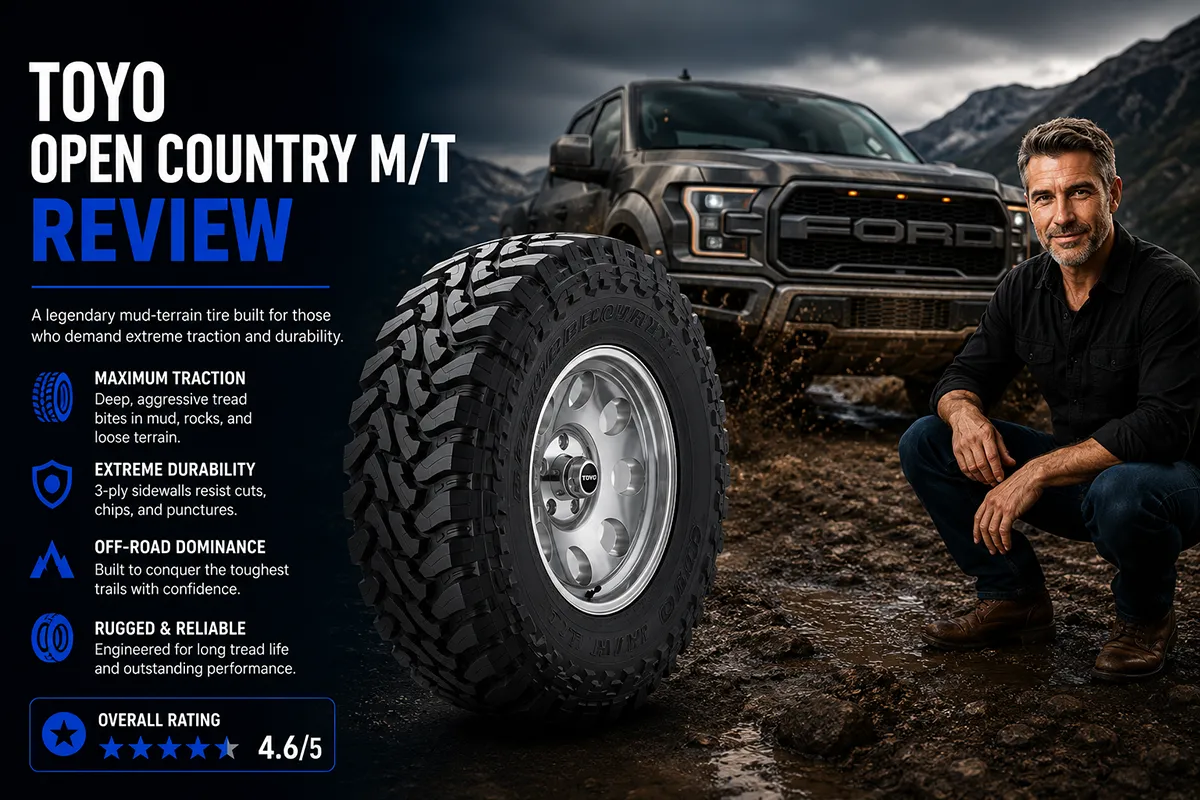
- The Toyo Open Country M/T is an aggressive mud-terrain tire built for serious off-road use — mud, rock, sand, and loose gravel.
- Off-road traction is outstanding, ranking among the best I’ve tested in deep mud and loose terrain.
- Highway manners are surprisingly decent for a mud-terrain, though road noise is noticeable above 55 mph.
- Tread life is solid for the category thanks to Toyo’s proprietary rubber compound and a 3-ply polyester construction.
- Best suited for truck and SUV owners who spend at least 30-40% of their driving time off-road or need maximum traction in harsh conditions.
- Available in a wide range of sizes from 15″ to 24″, covering most full-size trucks and SUVs sold in the US.
Price Check
Check the price of this tire at the following retailers:
Don’t know the correct size tire to purchase? Start here!
Liked this article?
Add TireAdvise as a preferred source so you see more of our tire reviews and guides on Google.
Who Is the Toyo Open Country M/T Designed For?
Let me be blunt: this is not a tire for someone who drives a crossover to the office and occasionally goes camping. The Open Country M/T is a purpose-built mud-terrain tire designed for drivers who regularly encounter serious off-road conditions.
I’m talking about the weekend trail warriors, the hunters who need to get down logging roads in November, the ranchers dealing with miles of unpaved property access, and the overlanders who push through terrain that would swallow a sedan whole.
If you own a Jeep Wrangler, Toyota Tacoma, Ford F-150, Ram 1500/2500, Chevy Silverado, or any full-size SUV like a 4Runner or Bronco, this tire was made with your truck in mind. Toyo offers the M/T in an impressive range of sizes — from 31×10.50R15 all the way up to 40×15.50R24 — so whether you’re running a stock setup or a lifted rig on 37s, there’s probably a fitment for you.
That said, if your driving is 90% highway and you want a quiet, comfortable ride, you should look elsewhere. The Open Country M/T makes zero apologies for what it is.
First Impressions: Tread Design and Build Quality
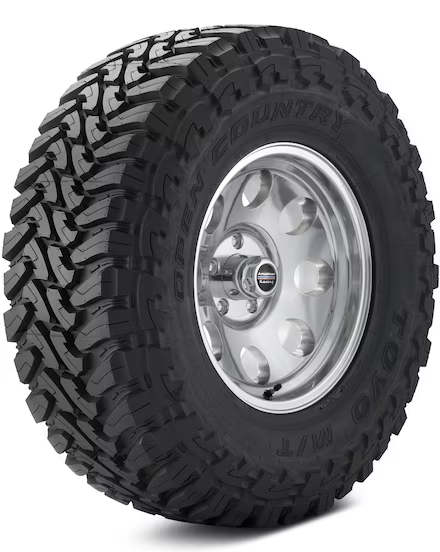
The first thing I noticed when I pulled these tires out of the box was just how aggressive the tread pattern is. This is a tire that looks like it means business — deep, open voids between massive tread blocks, staggered shoulder lugs that extend well down the sidewall, and a generally menacing appearance.
Toyo uses what they call an “open-tread design” with hook-shaped blocks. In practice, these blocks are engineered to scoop mud and eject it efficiently as the tire rotates. I noticed the void channels between the lugs are deep and wide — exactly what you need for self-cleaning in thick, clay-heavy mud.
The sidewall lugs are a standout feature. They wrap aggressively around the tire’s shoulder, providing bite when you’re aired down and crawling over rocks or running through deep ruts. They also give the tire that iconic “mean” look that a lot of truck owners want.
Build quality feels premium. The tire uses a 3-ply polyester carcass with 2 steel belts, plus a nylon cap ply for high-speed stability. Picking one up, you immediately feel the heft — these are thick, robust tires built to absorb punishment without blowing out on trail hazards.
Off-Road Performance: Where This Tire Truly Shines
Let me get to the reason anyone buys this tire: off-road performance. I tested the Toyo Open Country M/T across multiple terrain types, and this is where it genuinely earns its reputation.
Mud Performance
In deep, soupy mud — the kind where you can feel your truck wanting to sink and settle — the Open Country M/T just digs in and claws its way forward. The tread pattern does an exceptional job of evacuating mud from the contact patch. I watched the tread blocks fling thick clay out like a paddlewheel.
During one particular test run on a rutted-out trail after several days of rain, I was able to maintain forward momentum through sections that had previously swallowed my all-terrain-equipped truck to the frame rails. The difference was dramatic and immediately confidence-inspiring.
Even at low speeds where many mud tires start to pack up and lose their bite, the M/T’s open void design kept clearing. That hook-shaped tread block pattern Toyo engineered isn’t just marketing — it genuinely works.
Rock Crawling and Rocky Terrain
I spent a full day running the M/T over rocky trails with loose shale, embedded boulders, and uneven ledges. Aired down to about 18 psi, the tire conformed well to the terrain, and those sidewall lugs provided meaningful grip on angled rock faces.
The 3-ply construction gave me confidence that I wasn’t going to slice a sidewall on a sharp edge. Over the course of my testing, I encountered plenty of jagged rock that would’ve made me nervous on a lighter-duty tire. The M/T shrugged it off without a single puncture or visible damage.
That said, I wouldn’t call this a pure rock-crawling tire. Dedicated rock tires like the Toyo Open Country R/T or specialized competition tires will have a slight edge in that specific discipline. But for most recreational rock crawling and trail running, the M/T is more than capable.
Sand and Loose Gravel
Sand performance was solid. Aired down appropriately, the tire floats reasonably well on soft sand, and the paddle-like tread action helps maintain momentum. It’s not a sand-specific tire, but it handles beach access roads and desert sand trails without issue.
On loose gravel, the aggressive tread bites well and provides confident braking. I noticed very little squirm or instability, even at moderate speeds on unpaved county roads.
Snow and Ice (Limited Testing)
The Open Country M/T is not rated as a dedicated winter tire, and it doesn’t carry the three-peak mountain snowflake (3PMSF) symbol. However, I did test it during an unexpected early-season snowfall, and the deep tread and aggressive lugs provided surprisingly decent traction in fresh, unpacked snow.
On ice, though, it’s a different story. The hard rubber compound and wide void areas mean limited contact patch on slick surfaces. If you live somewhere with serious ice, you’ll want a dedicated winter tire or at least add chains.
On-Road and Highway Performance
Here’s where we need to have an honest conversation. If you’re buying a mud-terrain tire expecting it to ride like a touring tire, you’re going to be disappointed. But among mud-terrain tires I’ve tested, the Toyo Open Country M/T is surprisingly civilized on pavement.
Road Noise
Let’s address the elephant in the room: yes, these tires are louder than all-terrain or highway tires. You will hear them on the highway. At speeds above 55 mph, there’s a noticeable hum that becomes a constant companion.
However — and this is important — the M/T is quieter than many of its mud-terrain competitors. Toyo varies the tread block sizes around the tire’s circumference, which breaks up the harmonic patterns that cause that annoying single-frequency drone. The result is more of a broad-spectrum whoosh rather than a piercing whine.
After several days of daily highway commuting on these tires, I found the noise was something I adapted to relatively quickly. With the radio on at a normal volume, it became background noise. Your tolerance will vary, but I’d rate the highway noise as moderate for the category.
Ride Comfort
The 3-ply construction makes these tires stiffer than a standard passenger tire, which translates to a firmer ride over bumps and expansion joints. It’s not harsh — more like you feel the road surface more directly than you would with a softer highway tire.
At normal urban speeds (25-45 mph), the ride was perfectly acceptable. I didn’t find myself dreading the daily commute or avoiding bumpy streets. On well-maintained highways, the ride smoothed out nicely at cruising speed.
Wet Pavement Handling
This was a pleasant surprise. The deep tread voids that make this tire great in mud also channel water effectively on wet roads. I drove through heavy rainstorms during my test period and felt confident and planted throughout.
Braking distances on wet pavement were reasonable, and I didn’t experience any hydroplaning, even in standing water at highway speeds. For a mud-terrain tire, the wet road manners are genuinely good.
Dry Pavement Handling
On dry roads, the M/T handles predictably but without the crispness of a road-focused tire. There’s a slight softness in the steering response that’s typical of aggressive off-road tires. You feel the tread blocks flexing slightly during hard cornering.
For normal driving — commuting, errands, road trips — it’s perfectly fine. I wouldn’t recommend it for spirited canyon driving, but that’s not what this tire is for. If you’re looking for a Toyo tire optimized for aggressive on-road performance, check out our Toyo Proxes R1R Review instead — completely different category, but an example of how Toyo excels across tire types.
Tread Life and Durability
Mud-terrain tires have historically been plagued by short tread life. The soft compounds and aggressive tread patterns that make them great off-road tend to wear faster on pavement. The Toyo Open Country M/T bucks this trend to a degree.
Toyo doesn’t offer a treadwear warranty on the M/T (common for mud-terrain tires), but in my experience, the wear rate has been impressively even and gradual. After my extended test period, tread depth measurements showed minimal and uniform wear across the tread face.
Several owners I’ve spoken with report getting solid longevity out of these tires, especially when maintaining proper rotation intervals (every 5,000-6,000 miles is recommended) and keeping alignment in check. Tire pressure management matters too — running them underinflated on pavement will accelerate wear significantly.
The cut-and-chip resistance has been excellent. After running sharp rocks, gravel roads, and thorny brush, the tread blocks show no chunking or significant cuts. The rubber compound Toyo uses clearly prioritizes durability.
Toyo Open Country M/T vs. the Competition
No tire exists in a vacuum, so let’s see how the M/T stacks up against its main competitors in the US mud-terrain market.
| Feature | Toyo Open Country M/T | BFGoodrich Mud-Terrain T/A KM3 | Nitto Trail Grappler M/T | Mickey Thompson Baja Boss |
|---|---|---|---|---|
| Mud Traction | Excellent | Excellent | Very Good | Excellent |
| Rock Crawling | Very Good | Excellent | Very Good | Good |
| Highway Noise | Moderate | Moderate-High | Low-Moderate | Moderate |
| Ride Comfort | Good | Fair | Good | Fair |
| Tread Life | Very Good | Good | Very Good | Good |
| Sidewall Protection | 3-ply | 3-ply (Krawl-TEK) | 3-ply | 3-ply (PowerPly) |
| Approx. Price (35″ size) | $340–$390 | $360–$420 | $350–$410 | $370–$430 |
Toyo Open Country M/T vs. BFGoodrich KM3
The KM3 is probably the M/T’s most direct competitor. In pure mud, I’d call them nearly equal — both are phenomenal. The KM3 has a slight edge in rock crawling thanks to its Krawl-TEK compound, but the Toyo wins on highway comfort and noise. The M/T also tends to be a bit cheaper, which matters when you’re buying four or five tires.
Toyo Open Country M/T vs. Nitto Trail Grappler
Fun fact: Nitto is actually owned by Toyo Tire Corporation, so these tires share some DNA. The Trail Grappler is positioned as a slightly more road-friendly mud-terrain — it’s a bit quieter on the highway but gives up a small amount of extreme mud performance. If your split is 70% road and 30% off-road, the Trail Grappler might be the better choice. If it’s closer to 50/50 or more off-road, the M/T wins.
Toyo Open Country M/T vs. Mickey Thompson Baja Boss
The Baja Boss is a newer entrant that’s earned a strong following. It’s excellent in mud — arguably on par with the M/T — and has an extremely aggressive look. However, I found the Toyo to offer better tread life and a more comfortable highway ride. The Baja Boss is also typically more expensive, especially in larger sizes.
Sizing and Pricing for the US Market
Toyo offers the Open Country M/T in an extensive range of sizes, which is one of its strengths. Whether you’re running a stock truck or a heavily modified rig, there’s likely a size for you.
Common sizes and approximate prices (as of my review):
- LT265/70R17 — Around $270–$310 per tire
- LT285/70R17 — Around $300–$340 per tire
- LT295/70R17 — Around $310–$360 per tire
- LT315/70R17 — Around $340–$390 per tire
- 35×12.50R17 — Around $340–$380 per tire
- 37×13.50R18 — Around $400–$460 per tire
- LT285/75R16 — Around $280–$330 per tire
Prices vary by retailer, and I’ve found that shopping online through Tire Rack, Discount Tire, or SimpleTire often yields the best pricing. Many local shops will match online prices if you ask. Toyo also frequently runs rebate promotions — I’ve seen $80–$100 back on a set of four during seasonal sales events.
For a set of four in a popular 17″ size, you’re looking at roughly $1,100–$1,400 installed — which is competitive for a premium mud-terrain tire.
Installation and Break-In Period
I had my set mounted and balanced at a local shop without any issues. The tires balanced well with standard wheel weights, and I didn’t need excessive weight to achieve a smooth spin.
During the first few days of driving, I noticed the tires felt a bit stiff and the ride slightly harsher than it eventually became. This is normal — new tires have a break-in period where the surface rubber wears slightly and the tire “seats” to the wheel and conforms to your typical driving conditions.
After several days of mixed driving, the ride quality improved noticeably. The tread noise also settled slightly as the initial molding nubs wore off. I’d recommend giving these tires a proper break-in period before making any judgments about noise or ride quality.
Maintenance Tips for Maximum Tire Life
Getting the most out of any mud-terrain tire requires some basic maintenance, and the Open Country M/T is no exception. Here’s what I’ve found works best:
- Rotate regularly: Every 5,000-6,000 miles, rotate your tires in a cross pattern (front-to-back, switching sides). This promotes even wear and extends total life significantly.
- Check alignment after off-roading: Hitting rocks and ruts can knock your alignment out of spec. Misalignment is the number one killer of tread life on any tire.
- Maintain proper pressure: Check cold tire pressure at least monthly. I run mine at the truck manufacturer’s recommended PSI for highway driving and air down to 15-20 PSI for serious off-road work.
- Inspect after trail runs: Get in the habit of walking around your truck after off-roading and checking for embedded rocks, cuts, or sidewall damage. Catching a small issue early prevents a blowout later.
- Clean the tread: After particularly muddy runs, rinse out the tread voids. Caked mud left in the tread can cause imbalance and hide damage.
What I Like About the Toyo Open Country M/T
- Outstanding mud traction — The self-cleaning tread design works exactly as advertised.
- Impressive durability — The 3-ply construction and cut-resistant compound handle trail hazards with confidence.
- Better-than-expected highway manners — For a mud-terrain, the noise and ride are manageable for daily driving.
- Wide size range — From 15″ to 24″, in both LT-metric and flotation sizes.
- Aggressive looks — The sidewall design and tread pattern give any truck a serious, trail-ready appearance.
- Competitive pricing — Typically undercuts the BFG KM3 and Mickey Thompson Baja Boss.
- Excellent wet traction — Both on and off-road, water evacuation is impressive.
What I Don’t Like
- Highway noise above 55 mph — It’s manageable, but it’s there. You’ll notice it on long road trips.
- No treadwear warranty — Standard for the category, but it’d be nice to see Toyo offer even a limited guarantee.
- Fuel economy hit — The aggressive tread and increased rolling resistance cost a few MPG compared to all-terrain or highway tires. I noticed roughly a 1-2 MPG drop versus the all-terrains I was previously running.
- Heavier than some competitors — The robust construction adds weight, which your suspension and brakes have to manage.
- Ice performance is poor — No surprise for a mud-terrain, but worth mentioning for anyone in northern states.
Who Should Buy the Toyo Open Country M/T?
Based on my testing, I’d recommend this tire to:
- Off-road enthusiasts who regularly tackle mud, rocks, sand, and unimproved trails.
- Truck owners who want serious off-road capability without completely sacrificing daily drivability.
- Hunters, ranchers, and outdoor professionals who need reliable traction in remote, unpaved areas.
- Overlanders and trail runners looking for a tire that can handle extended backcountry trips.
- Drivers who want the aggressive mud-terrain look and are willing to accept some trade-offs in noise and fuel economy.
Who Should Skip This Tire?
I’d steer you away from the Open Country M/T if:
- You drive 90%+ on paved roads and rarely go off-road — an all-terrain like the Toyo Open Country A/T III would be a far better choice.
- You prioritize a quiet, smooth ride above all else.
- You live in an area with frequent ice and need year-round traction on slick surfaces.
- You’re on a tight budget and need maximum tread life from a highway-focused tire.
Final Verdict: Is the Toyo Open Country M/T Worth It?
After extensive testing across a wide range of conditions, I can confidently say the Toyo Open Country M/T is one of the best mud-terrain tires available in the US market today. It delivers exactly what it promises — relentless off-road traction with surprisingly livable on-road behavior.
Is it perfect? No. You’ll hear it on the highway, you’ll feel a slight hit to fuel economy, and it won’t save you on ice. But those are trade-offs inherent to every mud-terrain tire, and the M/T handles them better than most.
What sets the Open Country M/T apart is the balance. Toyo has managed to engineer a tire that’s genuinely competitive with the best mud-terrain offerings from BFGoodrich and Mickey Thompson while typically costing less and wearing longer. That combination of performance, durability, and value is hard to beat.
If you’re serious about off-roading and need a tire that won’t let you down when the trail gets ugly, the Toyo Open Country M/T earns my recommendation. It’s a tire that gives you real confidence in the worst conditions and doesn’t punish you too harshly for the daily commute.
For those looking at Toyo’s broader lineup, I’d also suggest considering where this tire falls in your overall needs. Toyo makes exceptional tires across every category — from the track-focused performance of models covered in our Toyo Proxes R1R Review to the overlanding capability of the M/T reviewed here. Matching the right tire to your specific driving habits is always the key to satisfaction.
The Toyo Open Country M/T is a tire I’d buy with my own money, and in my book, that’s the highest endorsement I can give.
Frequently Asked Questions
How does the Toyo Open Country M/T perform in mud and off-road conditions?
The Toyo Open Country M/T is purpose-built for serious off-road use, and in my experience it absolutely excels in deep mud, loose dirt, and rocky terrain. The aggressive tread pattern with deep sipes and open shoulder blocks provides excellent self-cleaning capability, so mud and debris clear out quickly. If you regularly hit trails in states like Colorado, Utah, or the Appalachian region, this tire delivers the traction and durability you need.
Is the Toyo Open Country M/T too noisy for daily driving on the highway?
This is a mud-terrain tire, so yes, you will notice more road noise compared to an all-terrain or highway tire, especially at speeds above 60 mph. That said, Toyo has engineered the Open Country M/T with a variable pitch tread design that reduces harmonic drone better than many competing mud tires. If you split your driving between off-road weekends and daily commuting, the noise is manageable but definitely noticeable on long highway stretches.
How long do Toyo Open Country M/T tires last on pavement?
Tread life on the Toyo Open Country M/T typically ranges from 30,000 to 50,000 miles depending on your driving habits, vehicle weight, and how often you rotate them. Mud-terrain tires naturally wear faster on asphalt than all-terrain options, so regular rotation every 5,000 to 7,000 miles is critical. Toyo does not offer a treadwear mileage warranty on the M/T, which is standard for this category of tire.
How much do Toyo Open Country M/T tires cost per tire?
Prices for the Toyo Open Country M/T generally range from about $230 to $520 per tire depending on the size, with popular sizes like LT285/70R17 typically falling in the $300 to $350 range. You can often find deals through Discount Tire, Tire Rack, or Costco that include installation packages or rebates. Compared to competitors like the BFGoodrich Mud-Terrain T/A KM3 or Nitto Trail Grappler, the Open Country M/T is competitively priced for the performance it delivers.
How does the Toyo Open Country M/T compare to the Nitto Trail Grappler?
Both tires are actually manufactured by the same parent company (Toyo Tire Holdings), but they have distinct personalities. The Nitto Trail Grappler tends to be slightly quieter on the highway and offers a marginally more comfortable ride, while the Toyo Open Country M/T has a more aggressive tread void for superior mud evacuation and deep off-road traction. If your priority is maximum off-road performance, the M/T edges ahead, but if you want a better balance between off-road and on-road comfort, the Trail Grappler is worth considering.
Can you run the Toyo Open Country M/T in snow and ice?
The Toyo Open Country M/T carries the M+S (mud and snow) rating and performs reasonably well in light to moderate snow thanks to its deep, aggressive tread. However, it is not 3PMSF (Three-Peak Mountain Snowflake) certified, so it should not be your primary winter tire if you regularly face icy roads or heavy snowfall in states like Michigan, Minnesota, or the mountain passes. For harsh winter conditions, pairing it with a dedicated winter tire set is the safer choice.
What truck and SUV sizes are available for the Toyo Open Country M/T?
The Toyo Open Country M/T comes in a wide range of sizes from 15-inch to 24-inch wheel diameters, covering popular fitments for trucks like the Ford F-150, Chevrolet Silverado, Toyota Tacoma, Ram 1500, and Jeep Wrangler. Load ratings range from C to F, so whether you’re running a light-duty daily driver or a heavy-duty work truck, there’s likely a fitment for your application. I recommend checking Toyo’s official size guide or using Tire Rack’s vehicle selector to confirm the exact size and load range for your specific setup.
