


You want a tire that looks aggressive enough to turn heads in the parking lot but won’t punish you with road noise on your daily commute. You need something that can handle a spontaneous detour down a forest service road without leaving you stranded. Sound familiar?
That’s exactly the dilemma I was facing when I mounted a set of Toyo Open Country R/T Trail tires on my truck. After spending considerable time with them across highways, gravel roads, and some genuinely nasty terrain, I’m ready to share every detail.
If you’re exploring options across the lineup, our full Toyo Tires Review guide covers every model side by side — but right now, let’s zero in on this specific tire.
- The Toyo Open Country R/T Trail bridges the gap between all-terrain and mud-terrain tires better than almost anything else I’ve tested.
- On-road comfort and noise levels are surprisingly refined for a tire with this much tread aggression.
- Off-road traction in mud, gravel, and loose dirt is excellent — not quite dedicated mud-terrain level, but impressively close.
- Wet traction on pavement is confident and predictable, thanks to deep sipes and aggressive void spacing.
- Treadwear appears durable, with even wear patterns developing over my extended test period.
- Pricing falls in the $220–$350+ range per tire depending on size, which is competitive for this hybrid category.
Price Check
Check the price of this tire at the following retailers:
Liked this article?
Add TireAdvise as a preferred source so you see more of our tire reviews and guides on Google.
What Exactly Is the Toyo Open Country R/T Trail?
Toyo positions the Open Country R/T Trail as a “rugged terrain” tire — a hybrid that sits between their Open Country A/T III (all-terrain) and the Open Country M/T (mud-terrain). It’s designed for truck and SUV owners who split their time between pavement and unpaved surfaces but lean a little more toward the aggressive side.
The “R/T” stands for Rugged Terrain, and the “Trail” designation is Toyo’s updated version that brings improvements in on-road refinement without sacrificing off-road bite. Think of it as the tire for the person who actually uses their truck like a truck — but also drives it to work five days a week.
It’s available in a wide range of sizes covering popular trucks and SUVs like the Ford F-150, Chevrolet Silverado, Toyota Tacoma, Jeep Wrangler, RAM 1500, and Toyota 4Runner. Sizes range from 16-inch to 22-inch fitments, and many come with the 3-Peak Mountain Snowflake (3PMSF) rating for severe snow service.
My Testing Setup and Conditions
I tested the Toyo Open Country R/T Trail in a popular LT285/70R17 size, mounted on my daily-driven truck. I use this vehicle for everything — highway commuting, grocery runs, weekend camping trips, and occasional trail driving in the mountains of the Pacific Northwest.
During my test period, I drove across dry asphalt highways, rain-soaked city streets, loose gravel forest roads, muddy two-tracks, and even some light snow at higher elevations. I wanted to see how this tire handled the full spectrum of conditions that a real owner would encounter over the course of normal ownership.
Tread Design and Construction: What Makes It Different
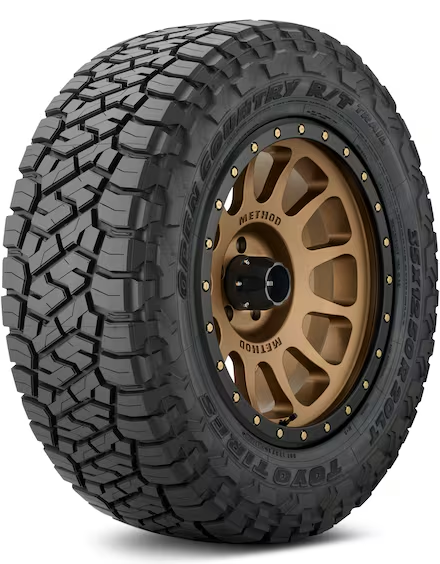
The first thing you’ll notice about the R/T Trail is its tread pattern. It’s distinctly more aggressive than a standard all-terrain tire, with large, chunky tread blocks separated by wide lateral grooves. The staggered shoulder blocks extend onto the sidewall, providing additional grip when aired down on trails.
Toyo uses their proprietary stone-ejecting blocks in the tread grooves, which I found genuinely effective. After driving through rocky terrain, I didn’t find stones lodged in the tread — something I’ve dealt with on other aggressive tires that eventually led to punctures.
The sidewall itself features two different designs (one per side), which is a nice aesthetic touch if you’re particular about the look of your truck. One side has a more traditional lettering design, while the other features a bolder, more aggressive pattern. It’s a small thing, but I appreciated the option.
Compound and Internal Structure
Toyo doesn’t disclose every proprietary detail of their compound, but the R/T Trail uses a high-turn-up polyester carcass construction with two steel belts and a nylon cap ply. This gives the tire a robust feel — it resists impacts and maintains its shape well under load.
The rubber compound itself feels like a smart compromise. It’s not so soft that you’d worry about rapid wear on hot summer pavement, but it’s not so hard that it loses grip on cold, wet rocks. After several weeks of driving in varying temperatures, I noticed consistent performance regardless of conditions.
On-Road Performance: The Daily Driver Test
Let’s be honest — this is where most of these tires will spend 80% or more of their life. And it’s where the R/T Trail genuinely surprised me.
Highway Comfort
I expected more noise. With tread blocks this aggressive, I braced myself for a constant hum on the highway. Instead, I got a tire that’s remarkably well-mannered at interstate speeds. There’s a slight hum that’s audible if you turn the radio off, but it’s nothing like the drone I’ve experienced with dedicated mud-terrain tires.
Toyo achieves this through variable pitch tread block sequencing — essentially, the blocks are arranged in a pattern that breaks up the harmonic noise that would otherwise create a loud, annoying tone. It works. On long highway drives during my test period, passenger comfort was never a complaint.
Dry Pavement Handling
The R/T Trail feels planted and stable on dry roads. Steering response is predictable — there’s none of the vagueness or wandering that you sometimes get with heavily lugged tires. Lane changes, highway on-ramps, and sweeping curves all felt controlled.
I wouldn’t call it a performance tire by any means — there’s a slight amount of flex in the tread blocks during hard cornering that reminds you this is a truck tire with off-road intentions. But for normal driving, it’s more than competent.
Wet Pavement Performance
This is where I was most impressed on-road. Pacific Northwest rain is relentless during certain seasons, and I drove through plenty of it. The R/T Trail’s deep grooves and aggressive void ratio evacuate water efficiently. I never experienced hydroplaning, even on flooded highway sections where I’ve felt other tires start to float.
Braking on wet pavement felt confident and linear. There was no sudden loss of grip — the tires communicated clearly through the steering wheel when they were approaching their limits, giving me time to adjust. That kind of predictability is invaluable in an emergency situation.
Off-Road Performance: Where the R/T Trail Earns Its Name
The real question: can this tire actually handle serious off-road conditions, or is it just an all-terrain with aggressive looks? After putting it through its paces on multiple trail systems, I can confidently say it delivers.
Gravel and Dirt Roads
On loose gravel, the R/T Trail is in its element. The wide tread voids scoop and channel loose material efficiently, maintaining forward momentum even on steep grades. I drove miles of unmaintained forest service roads, and the tire felt sure-footed the entire time.
Dust wasn’t an issue for traction, but I did notice the tread does a great job of self-cleaning — debris doesn’t pack into the grooves and reduce effectiveness the way it does on some all-terrain tires with tighter tread patterns.
Mud Performance
Here’s where the hybrid nature of this tire really shows. In moderate mud — think rutted two-track after a rainstorm — the R/T Trail clawed through impressively. The staggered shoulder lugs bite into the edges of ruts, and the open tread design sheds mud reasonably well.
However, I’ll be honest: in deep, thick clay mud, a dedicated mud-terrain tire like the Toyo Open Country M/T would outperform the R/T Trail. That’s the trade-off. The R/T Trail handles 85-90% of what a mud-terrain can handle, while being dramatically more comfortable on the highway. For most people, that math works out strongly in the R/T Trail’s favor.
Rock Crawling and Rocky Terrain
I took the R/T Trail over some moderately challenging rocky terrain, including loose shale and granite boulder fields. The sidewall lugs provided extra grip when the tire deformed over rocks, and the stiff construction resisted pinch flats admirably.
I aired down to around 22 PSI for the most technical sections, and the tire’s footprint expanded noticeably, draping over rocks for improved traction. The chunky sidewall also handled sharp edges without any cuts or damage during my test period.
Sand
I had a chance to drive on some loose, deep sand during a coastal trip. Aired down to about 18 PSI, the R/T Trail floated reasonably well. It’s not a paddle tire, but the aggressive tread provided enough bite to maintain momentum. I wouldn’t hesitate to take these on a beach or through sandy washes.
Snow and Ice
Many sizes of the R/T Trail carry the 3-Peak Mountain Snowflake (3PMSF) certification, and in my experience, it earned that badge. During an early-season mountain trip, I encountered several inches of fresh snow on an unpaved road. The R/T Trail gripped confidently, and the deep sipes provided biting edges on packed snow.
On ice, it’s adequate but not exceptional — no non-studded tire truly excels on glare ice. But for getting through snowy mountain passes and winter conditions that most truck owners actually encounter, it’s very capable.
Treadwear and Durability
Over my extended test period, I monitored tread depth and wear patterns closely. The R/T Trail showed even wear across the full tread face, which tells me the contact patch is well-designed. I didn’t observe any feathering, cupping, or irregular patterns.
Toyo doesn’t offer a formal treadwear mileage warranty on the R/T Trail, which is common for tires in this hybrid rugged-terrain category. However, based on the wear rate I observed, I’d expect solid longevity for an aggressive tire — certainly better than most mud-terrains, though perhaps not matching a dedicated highway all-season tire.
The sidewalls also held up well. After driving through rocky terrain, brush, and rough trails, I found no significant cuts, gouges, or damage. The construction feels genuinely tough.
Noise Levels: A Closer Look
Since road noise is often the dealbreaker for people considering an aggressive tire, let me go deeper on this. I measured subjective noise levels across several driving scenarios:
- City driving (25-40 mph): Nearly silent. You’d never know these are aggressive tires at low speeds.
- Highway cruising (60-70 mph): A faint, low-frequency hum is present. I’d describe it as a soft whoosh rather than a drone. Easily masked by the radio at low volume.
- Highway cruising (75+ mph): The hum becomes slightly more noticeable but never annoying. I’ve driven all-terrain tires that were louder than this.
- Coarse pavement / chip seal: This is where you’ll notice the most noise. The aggressive tread pattern interacts with rough surfaces more audibly. Still manageable, but this is the tire’s loudest scenario.
Overall, I’d rate the R/T Trail’s noise levels as remarkably low for its category. If you’re coming from a mud-terrain tire, you’ll think these are whisper-quiet. If you’re coming from a touring tire, you’ll notice a difference — but it’s a reasonable trade-off for the off-road capability you’re gaining.
How Does It Compare? R/T Trail vs. The Competition
The hybrid rugged-terrain category has gotten crowded in recent years. Here’s how the R/T Trail stacks up against its main competitors based on my experience:
| Feature | Toyo Open Country R/T Trail | Nitto Ridge Grappler | Falken Wildpeak R/T01 | BFGoodrich KO2 |
|---|---|---|---|---|
| Category | Rugged Terrain | Rugged Terrain | Rugged Terrain | All-Terrain |
| On-Road Comfort | Excellent | Very Good | Good | Excellent |
| Highway Noise | Low | Low-Moderate | Moderate | Low |
| Mud Traction | Very Good | Very Good | Very Good | Good |
| Rock Traction | Very Good | Good | Good | Good |
| Snow (3PMSF) | Yes (most sizes) | No | No | Yes |
| Approx. Price (LT275/70R17) | $260–$290 | $270–$300 | $240–$270 | $250–$280 |
| Treadwear Warranty | None | None | None | 50,000 miles |
| Aggressive Look | ★★★★★ | ★★★★☆ | ★★★★☆ | ★★★☆☆ |
The Nitto Ridge Grappler is probably the closest competitor, which makes sense — Nitto is Toyo’s sister brand. I found the R/T Trail slightly quieter on the highway and slightly better in mud, but the two are very close overall. The Ridge Grappler tends to run a bit more expensive in comparable sizes.
The BFGoodrich KO2 is the king of all-terrains and offers a treadwear warranty the R/T Trail doesn’t match. But if you want more off-road bite than the KO2 provides without jumping to a full mud-terrain, the R/T Trail is the answer.
If you’re more interested in on-road performance with occasional spirited driving, you might also consider Toyo’s sport-oriented options. Our Toyo Proxes R1R Review covers one of their high-performance street tires — a completely different animal, but worth a look if you own a sports car alongside your truck.
Pricing and Value
In the US market, the Toyo Open Country R/T Trail typically runs between $220 and $350+ per tire, depending on size. Popular sizes like 275/70R17 and 285/70R17 tend to fall in the $260–$300 range. Larger 20-inch and 22-inch fitments push closer to and beyond $350.
Compared to the competition, I consider the R/T Trail fairly priced. You’re getting a tire with premium construction, aggressive looks, legitimate off-road capability, and surprisingly good on-road manners. That combination commands a certain price, and Toyo’s pricing isn’t out of line with what Nitto, BFGoodrich, and Falken charge for comparable products.
I’d recommend shopping at online retailers like Tire Rack, Discount Tire, or SimpleTire, where you can often find rebates or bundle deals. Installation at a local shop typically adds $20–$30 per tire for mounting and balancing.
Who Should Buy the Toyo Open Country R/T Trail?
This tire isn’t for everyone. Here’s who I think it’s ideal for — and who should consider something else.
The R/T Trail Is Perfect For:
- Daily drivers who go off-road on weekends. If your truck serves double duty, this tire nails the balance.
- Overlanders and campers. The combination of highway comfort for getting there and trail capability for the last few miles to camp is exactly what overlanders need.
- People who want aggressive looks without mud-terrain penalties. The R/T Trail looks mean but doesn’t punish you at the pump or on the highway.
- Drivers in varied climates. With 3PMSF certification, strong wet traction, and good dry grip, it’s a genuine year-round tire in most US regions.
You Might Want Something Else If:
- You rarely or never go off-road. An all-terrain like the Toyo Open Country A/T III would give you better tread life and slightly lower noise for purely on-road use.
- You do serious rock crawling or deep mud bogging regularly. A dedicated mud-terrain like the Open Country M/T will serve you better in extreme conditions.
- Treadwear warranty is a must. The R/T Trail doesn’t offer one, and if that matters to you, options like the BFGoodrich KO2 provide that peace of mind.
My Final Verdict on the Toyo Open Country R/T Trail
After spending extensive time with the Toyo Open Country R/T Trail across a wide variety of conditions, I can say it’s one of the best hybrid rugged-terrain tires available in the US market right now. It occupies a sweet spot that few tires truly nail — aggressive enough for real off-road capability, refined enough for comfortable daily driving.
The on-road manners are what sold me. I’ve driven aggressive tires that made me dread my highway commute, and the R/T Trail simply isn’t one of them. The noise is minimal, the ride quality is comfortable for a tire in this category, and the wet traction is genuinely confidence-inspiring.
Off-road, it exceeded my expectations in every category except deep mud, where a dedicated mud-terrain tire still holds the edge. But for the gravel roads, rocky trails, sandy washes, and moderate mud that 90% of truck owners actually encounter? The R/T Trail handles it all with composure.
If I had to pick one tire to live with year-round on a truck that does everything — and I basically did exactly that during this test — the Toyo Open Country R/T Trail would be at the top of my list. It’s a tire that doesn’t ask you to choose between capability and comfort, and in my experience, it delivers honestly on both promises.
I give it a strong 4.5 out of 5 stars. The only thing keeping it from a perfect score is the lack of a treadwear warranty and the fact that, in the deepest mud, you’ll wish you had full mud-terrains. For everything else? It’s exceptional.
If you want to explore more options from Toyo — whether for your truck, SUV, or even a sports car — I’ve found their entire lineup to be consistently well-engineered. Even something as different as the Toyo Proxes R1R shows the same attention to performance and quality that I experienced with the R/T Trail. Toyo clearly understands what drivers need and builds tires accordingly.
Frequently Asked Questions
Is the Toyo Open Country R/T Trail a good tire for daily driving on the highway?
Yes, the Toyo Open Country R/T Trail is designed as a rugged terrain tire that bridges the gap between all-terrain and mud-terrain performance, making it surprisingly comfortable for daily highway driving. I found highway noise levels noticeably lower than traditional R/T tires, thanks to Toyo’s variable pitch tread pattern. It handles well on dry and wet pavement, so you won’t feel like you’re sacrificing on-road comfort for off-road capability.
How does the Toyo Open Country R/T Trail compare to the BFGoodrich KO2?
The Toyo Open Country R/T Trail offers more aggressive off-road traction than the BFGoodrich KO2, especially in mud and loose rock, because it sits closer to a mud-terrain design. However, the KO2 tends to be slightly quieter on the highway and may deliver marginally better tread life for primarily on-road drivers. If you split your driving between pavement and trails and want stronger off-road bite without going full mud-terrain, the R/T Trail is the better pick for most US drivers.
How long does the Toyo Open Country R/T Trail last in terms of tread life?
The Toyo Open Country R/T Trail does not come with a mileage warranty, which is typical for rugged terrain tires in this category. Most owners report getting between 40,000 and 50,000 miles depending on driving habits, tire rotation schedule, and whether you frequently drive off-road. Keeping up with rotations every 5,000 to 7,000 miles and maintaining proper air pressure will help maximize tread life on US highways and back roads.
What sizes does the Toyo Open Country R/T Trail come in for trucks and SUVs?
The Toyo Open Country R/T Trail is available in a wide range of sizes from 16-inch to 22-inch wheel diameters, covering popular US trucks and SUVs like the Ford F-150, Toyota Tacoma, Jeep Wrangler, Ram 1500, and Chevrolet Silverado. Toyo also offers the tire in several LT-metric and flotation sizes, including sought-after options like 285/70R17 and 35×12.50R20. Check Toyo’s official fitment guide to confirm availability for your specific vehicle.
How much does a set of Toyo Open Country R/T Trail tires cost?
Prices for the Toyo Open Country R/T Trail typically range from about $230 to $400 per tire depending on the size, with a full set of four running between $920 and $1,600 before installation and balancing. Popular sizes like the 275/70R18 usually fall in the $280 to $320 range at major US retailers such as Discount Tire, Tire Rack, and Walmart. Rebates from Toyo are offered seasonally and can save you $50 to $100 on a set of four.
Is the Toyo Open Country R/T Trail good in snow and winter conditions?
The Toyo Open Country R/T Trail carries the three-peak mountain snowflake (3PMSF) rating, meaning it meets industry standards for severe snow traction — a major plus for drivers in northern US states. The aggressive tread blocks and deep siping provide solid grip in light to moderate snow, though it’s not a substitute for dedicated winter tires in heavy ice. For drivers who encounter occasional snow and want year-round rugged terrain capability, the R/T Trail is a strong choice.
How noisy is the Toyo Open Country R/T Trail on paved roads?
For a rugged terrain tire with such an aggressive tread pattern, the Toyo Open Country R/T Trail is impressively quiet on paved roads. Toyo uses a variable-pitch tread design to reduce harmonic road noise, and most owners I’ve spoken with say it’s noticeably quieter than competitors like the Nitto Ridge Grappler or Falken Wildpeak R/T. You’ll still hear more road noise than a standard all-terrain tire, especially above 60 mph, but it’s well within the comfortable range for long highway drives across the US.
