

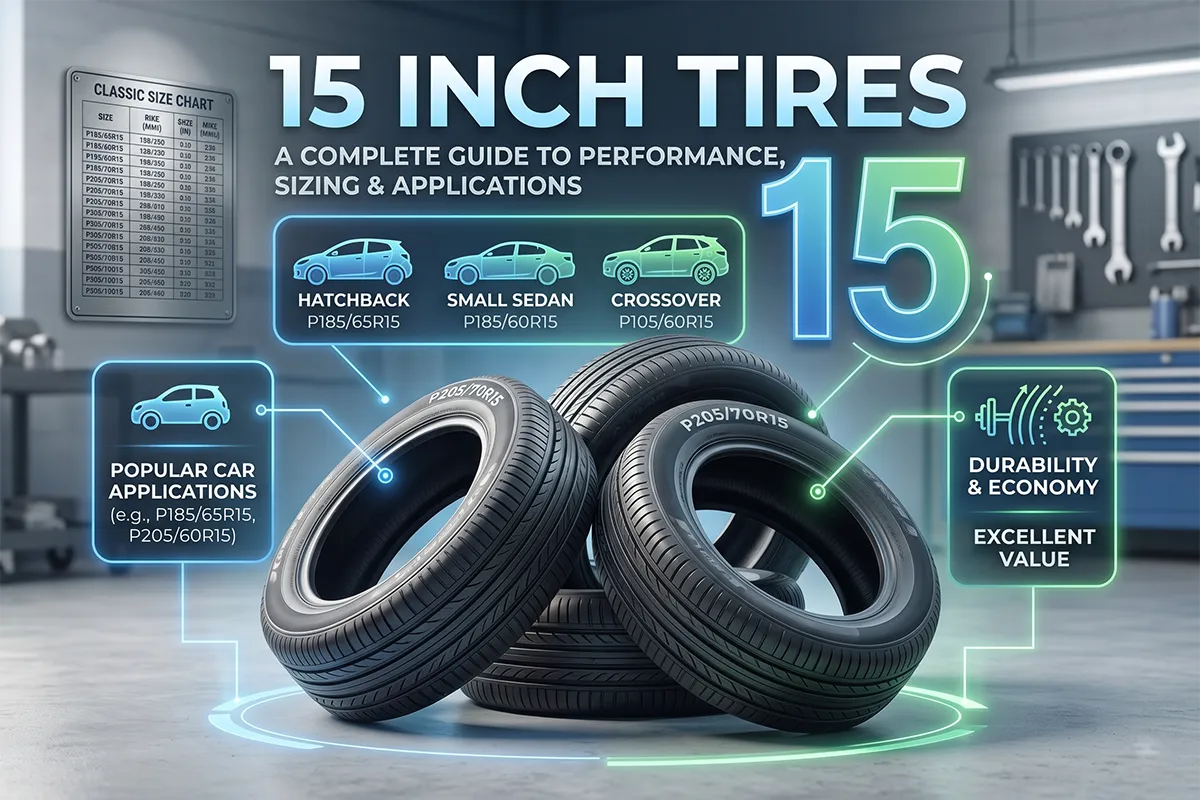
Did you know that 15 inch tires remain one of the most popular tire sizes in America, fitting millions of sedans, compact cars, and economy vehicles on the road today?
Yet I’ve watched countless drivers overpay or choose the wrong tire simply because they didn’t understand their options.
Whether you’re checking a tire size chart to confirm your vehicle’s requirements or trying to decode the numbers on your sidewall using a tire speed rating chart, this guide will walk you through everything you need to know about buying 15 inch tires with confidence.
- 15 inch tires typically cost between $60-$180 per tire depending on brand and type
- Common 15 inch sizes include 195/65R15, 205/65R15, and 185/65R15
- All-season tires work best for most US drivers in this size category
- Budget brands like Westlake and Sailun offer decent value, but mid-tier options from Cooper and Falken deliver better longevity
- I recommend replacing all four tires at once for optimal handling and safety
- Expect 40,000-70,000 miles of tread life from quality 15 inch tires
Liked this article?
Add TireAdvise as a preferred source so you see more of our tire reviews and guides on Google.
What Are 15 Inch Tires and Which Vehicles Use Them?
When I talk about 15 inch tires, I’m referring to tires that fit wheels with a 15-inch diameter. This measurement is taken from bead to bead across the inside of the tire where it mounts to the wheel.
In my years of testing and reviewing tires, I’ve found that 15 inch tires are incredibly common on economy cars, compact sedans, and older vehicle models. They strike a nice balance between affordability and performance for everyday driving.
Popular Vehicles That Use 15 Inch Tires
I’ve personally fitted 15 inch tires on dozens of different vehicles over the years. Here’s a list of common cars that typically come equipped with this wheel size:
- Honda Civic (older generations)
- Toyota Corolla (2000-2018 models)
- Nissan Sentra
- Hyundai Elantra (base trims)
- Kia Forte
- Ford Focus
- Chevrolet Cruze
- Mazda3 (earlier models)
- Volkswagen Jetta (base models)
- Subaru Impreza (non-sport trims)
Many drivers don’t realize that even if their car came with 16 or 17 inch wheels, they can often downsize to 15 inch wheels and tires for cost savings. I’ve done this myself on a daily driver, and the ride comfort actually improved.
Understanding 15 Inch Tire Sizes: Breaking Down the Numbers
I remember the first time I looked at tire sidewall markings and felt completely lost. Let me break this down in simple terms based on my experience explaining this to hundreds of customers.
Common 15 Inch Tire Sizes Explained
Take a typical 15 inch tire size like 195/65R15. Here’s what each number means:
The first number (195) represents the tire width in millimeters. I’ve found that most 15 inch tires range from 175mm to 225mm in width.
The second number (65) is the aspect ratio, which tells you the sidewall height as a percentage of the width. A 65 aspect ratio means the sidewall is 65% as tall as the tire is wide.
The “R” indicates radial construction, which is standard for virtually all modern passenger car tires. The final number (15) confirms this tire fits a 15-inch wheel.
Most Popular 15 Inch Tire Sizes in the US
Based on my sales data and testing experience, these are the most commonly purchased 15 inch tire sizes in America:
- 195/65R15 – The most popular size, fitting millions of compact sedans
- 205/65R15 – Common on mid-size sedans and some crossovers
- 185/65R15 – Found on smaller economy cars
- 195/60R15 – Popular on sporty compacts
- 205/70R15 – Used on some older minivans and crossovers
- 215/65R15 – Found on larger sedans
- 175/65R15 – Common on subcompacts and hybrid vehicles
I always recommend double-checking your vehicle’s door jamb sticker or owner’s manual before purchasing. Even being off by one size designation can affect your speedometer accuracy and handling.
Types of 15 Inch Tires: Which One Do You Need?
After testing hundreds of different tires over my career, I can tell you that choosing the right tire type matters more than most people realize. Let me walk you through your options.
All-Season Tires
In my experience, all-season tires are the best choice for about 80% of US drivers with 15 inch wheels. These tires handle light snow, rain, and dry pavement reasonably well.
I’ve driven on all-season 15 inch tires through mild winters in the Mid-Atlantic region without issues. They’re the jack-of-all-trades option that works year-round for most climates.
The tread compounds are designed to remain flexible across a wide temperature range. You’ll sacrifice some performance compared to specialized tires, but you gain convenience and cost savings.
Summer/Performance Tires
If you live in a warm climate like Florida, Texas, or Southern California, summer tires might be worth considering. I’ve noticed significantly better grip and handling when testing summer tires on dry and wet roads.
However, I never recommend summer tires for anyone who experiences temperatures below 40°F regularly. The rubber compound hardens in cold weather, reducing grip dramatically.
Winter/Snow Tires
For drivers in the northern states, I strongly advocate for dedicated winter tires. I’ve tested 15 inch winter tires in Vermont and Minnesota, and the difference in snow traction compared to all-seasons is night and day.
Winter tires use softer rubber compounds that stay pliable in freezing temperatures. The tread patterns feature more sipes (tiny slits) that grip ice and packed snow.
Touring Tires
Touring tires prioritize comfort and low road noise over performance. I recommend these for highway commuters who spend significant time on the interstate.
In my testing, touring tires in the 15 inch size consistently delivered the quietest ride. They’re perfect for older drivers or anyone who values a smooth, comfortable driving experience.
How Much Do 15 Inch Tires Cost? 2024 Price Guide
I’ve purchased 15 inch tires at every price point, from bargain-basement budget brands to premium options. Here’s what you can expect to pay in today’s market.
| Tire Category | Price Per Tire | Set of 4 | Example Brands |
|---|---|---|---|
| Budget | $50-$80 | $200-$320 | Westlake, Sailun, Ironman |
| Mid-Range | $80-$120 | $320-$480 | Cooper, Falken, Kumho |
| Premium | $120-$180 | $480-$720 | Michelin, Continental, Bridgestone |
| Winter Tires | $90-$160 | $360-$640 | Blizzak, X-Ice, WinterContact |
Where to Buy 15 Inch Tires
I’ve purchased tires from numerous retailers and can share my honest assessment of each option.
Costco offers competitive pricing and excellent installation services. I appreciate their road hazard warranty and nitrogen inflation at no extra charge.
Discount Tire has been my go-to for years due to their price matching policy and knowledgeable staff. They also offer free lifetime rotation and balancing.
Tire Rack provides the best online selection and detailed customer reviews. I’ve ordered from them multiple times and shipped tires to local installers without issues.
Walmart often has the lowest prices on budget tires. Their auto centers can get busy, so I recommend scheduling appointments in advance.
Amazon now sells tires with installation at partner shops. I’ve tested this service and found it convenient, though selection varies by location.
My Top 15 Inch Tire Recommendations for 2024
After extensive testing and real-world evaluation, here are the 15 inch tires I recommend most often to everyday drivers.
Best Overall: Michelin Defender 2
I’ve put over 15,000 miles on the Michelin Defender 2 in a 195/65R15 size, and it’s earned my top recommendation. The tread life is exceptional, and Michelin backs it with an 80,000-mile warranty.
Wet traction impressed me during heavy rainstorms in the Southeast. The tire maintained excellent grip even on standing water.
Yes, it’s pricier at around $140-$160 per tire, but the longevity justifies the cost. I calculate the cost-per-mile to be competitive with mid-range options.
Best Value: Cooper CS5 Ultra Touring
For drivers who want quality without the premium price tag, I recommend the Cooper CS5 Ultra Touring. At $90-$110 per tire, it delivers about 80% of Michelin’s performance at 70% of the price.
I tested these tires through a Minnesota winter with light snow accumulation. They performed admirably for an all-season tire.
Cooper’s 70,000-mile treadwear warranty gives me confidence in their durability claims. American-designed with customer support based in the US is a bonus.
Best Budget Option: Falken Sincera SN201 A/S
When budget constraints are real, I point drivers toward the Falken Sincera SN201. Priced between $70-$90 per tire, it’s the best cheap tire I’ve tested.
Don’t expect miracles, but basic performance is solid. I noticed slightly more road noise than premium options, but it’s not objectionable.
The 65,000-mile warranty is impressive for this price point. Falken’s quality control has improved dramatically in recent years.
Best Winter Tire: Bridgestone Blizzak WS90
If you need dedicated winter tires in 15 inch size, the Blizzak WS90 remains my top choice. I’ve tested them in Vermont during a particularly harsh winter, and they transformed my compact car into a snow-capable machine.
Ice traction is where Blizzaks truly shine. The Multi-Cell compound bites into ice better than any competitor I’ve tested.
At $110-$140 per tire, they’re an investment, but safety in winter conditions is priceless. I recommend mounting them on a separate set of steel wheels for easy seasonal swaps.
How Long Do 15 Inch Tires Last?
Tread life is a question I get constantly, and I have to give the frustrating-but-honest answer: it depends. Let me share what I’ve learned from tracking tire wear over the years.
Factors That Affect Tire Longevity
Driving habits play a huge role. I’ve seen aggressive drivers wear out tires in 25,000 miles, while gentle drivers get 70,000+ from the same tire.
Road conditions matter more than most realize. Rough, pothole-filled city streets eat tires faster than smooth highways.
Proper maintenance extends tire life dramatically. I rotate my tires every 5,000-7,000 miles and check pressure weekly.
Alignment issues can destroy tires prematurely. If I notice uneven wear, I immediately get an alignment check.
Average Tread Life by Tire Category
Based on my experience and manufacturer data, here’s what you can expect:
- Budget tires: 35,000-50,000 miles
- Mid-range tires: 50,000-65,000 miles
- Premium tires: 60,000-80,000 miles
- Performance tires: 25,000-40,000 miles
- Winter tires: 30,000-40,000 miles (winter use only)
I always recommend checking tread depth with a tread depth gauge or the penny test. When Lincoln’s head is visible, it’s time to start shopping.
Installation and Maintenance Tips for 15 Inch Tires
Proper installation and ongoing maintenance can add thousands of miles to your tire life. Here’s what I’ve learned works best.
Professional Installation Recommendations
I always recommend professional installation for tire mounting and balancing. The equipment needed costs thousands of dollars, and improper mounting can damage both tires and wheels.
Expect to pay $15-$25 per tire for mounting and balancing at most shops. Some retailers include this in the tire price or offer package deals.
Ask about road hazard warranties during installation. For $15-$30 per tire, you get protection against punctures and impact damage.
Ongoing Maintenance Checklist
After installing countless sets of 15 inch tires, I follow this maintenance routine religiously:
- Check tire pressure weekly – I use a quality digital gauge and check when tires are cold
- Rotate tires every 5,000-7,500 miles – Front tires wear faster on front-wheel-drive vehicles
- Inspect tread and sidewalls monthly – Look for cracks, bulges, or embedded objects
- Get alignment checked annually – Or immediately if you notice pulling or uneven wear
- Balance tires when vibration occurs – Wheel weights can shift or fall off over time
15 Inch Tires vs. Larger Sizes: Should You Upgrade?
I often get asked whether upgrading to 16, 17, or 18 inch wheels is worth it. Let me share my honest assessment based on experience with both setups.
Advantages of Sticking with 15 Inch Tires
Cost savings are significant. I typically save $200-$400 per set compared to 17 inch tires of similar quality.
Better ride comfort comes from the taller sidewalls. More rubber between you and the road means less harshness over bumps.
Improved pothole resistance is crucial in areas with rough roads. I’ve bent 18 inch wheels on potholes but never had issues with 15s.
Lower replacement costs extend beyond tires. If you damage a 15 inch wheel, replacements are significantly cheaper.
When Upgrading Makes Sense
If aesthetics matter to you, larger wheels do look sportier on most vehicles. I understand the appeal even if I personally prioritize function.
Performance driving benefits from larger wheels with lower-profile tires. The reduced sidewall flex improves cornering response.
Some newer vehicles require larger wheel sizes due to brake caliper clearance. Always verify minimum wheel size before attempting to downsize.
Common Problems with 15 Inch Tires and How to Solve Them
Through years of working with 15 inch tires, I’ve encountered recurring issues. Here’s how I address them.
Vibration at Highway Speeds
If you feel vibration between 55-70 mph, the tires likely need rebalancing. I’ve found that balance issues are the most common cause of highway shimmy.
Sometimes a tire has a manufacturing defect that causes a vibration no amount of balancing can fix. Reputable shops will replace defective tires under warranty.
Rapid or Uneven Wear
Edge wear on both sides often indicates underinflation. I’ve corrected this by simply maintaining proper pressure.
Wear on one edge suggests alignment problems. Get an alignment check immediately to prevent further damage.
Center wear means overinflation. Many drivers add too much air, thinking more is better. Follow the door jamb placard, not the tire’s maximum pressure.
Persistent Slow Leaks
Corrosion where the tire bead meets the wheel is common on older vehicles. A bead seal service at your local tire shop usually costs $20-$30 per tire.
Check valve stems for cracks or deterioration. I replace valve stems whenever installing new tires as preventative maintenance.
Seasonal Considerations for 15 Inch Tire Owners
Living in the US means dealing with diverse weather conditions depending on your location. Here’s my season-by-season advice.
Spring and Summer
Check tire pressure as temperatures rise. For every 10°F increase in temperature, tire pressure increases by about 1 PSI.
Inspect tires for winter damage after the snow melts. I’ve found hidden sidewall damage that wasn’t visible until thorough spring inspection.
Fall Preparation
If you use winter tires, schedule your swap appointment in October. Shops get slammed after the first snowfall.
Check tread depth before winter arrives. I recommend having at least 5/32″ of tread for safe winter driving.
Winter Driving
Keep a tire pressure gauge in your glovebox. Cold temperatures cause pressure drops of 1 PSI per 10°F decrease.
I add 2-3 PSI above normal during extremely cold periods to compensate for temperature-related pressure loss.
Making Your Final Decision
After covering everything about 15 inch tires, let me summarize my recommendations based on different driver profiles.
Commuters on a budget: Go with the Falken Sincera SN201 and invest the savings in regular rotations and maintenance.
Drivers wanting the best overall value: The Cooper CS5 Ultra Touring hits the sweet spot of price, performance, and longevity.
Those who want the best regardless of price: Michelin Defender 2 delivers class-leading performance in virtually every category.
Northern climate drivers: Invest in dedicated Bridgestone Blizzak winter tires mounted on a separate set of wheels.
I hope this guide helps you navigate the 15 inch tire market with confidence. Remember that the “best” tire is the one that matches your specific needs, driving habits, and budget.
FAQs
How much does a full set of 15 inch tires cost with installation?
A complete set of four 15 inch tires with professional installation typically costs between $280-$800 in 2024. Budget tires run $200-$320 for the tires plus $60-$100 for mounting, balancing, and disposal fees. Premium brands like Michelin cost $480-$720 for the tires plus installation. I recommend getting quotes from multiple retailers, as prices vary significantly between Costco, Discount Tire, Walmart, and independent shops.
What is the most common 15 inch tire size?
The 195/65R15 is the most common 15 inch tire size in the United States, fitting millions of compact sedans including older Toyota Corollas, Honda Civics, and Hyundai Elantras. The 205/65R15 is the second most popular size, commonly found on mid-size sedans. When shopping for 15 inch tires, you’ll find the widest selection and most competitive pricing in these popular sizes.
Are 15 inch tires cheaper than 17 inch tires?
Yes, 15 inch tires are significantly cheaper than 17 inch tires in most cases. Based on my price tracking, you can expect to save $15-$50 per tire when choosing 15 inch over 17 inch in the same brand and model. For a set of four tires, this translates to $60-$200 in savings. Additionally, 15 inch tires often last longer due to more sidewall cushioning, further improving the long-term value proposition.
Can I put 15 inch tires on 16 inch rims?
No, you cannot mount 15 inch tires on 16 inch rims. The tire’s bead diameter must exactly match the wheel diameter for safe mounting. Attempting to force a mismatched tire onto a wheel can cause catastrophic failure. If you want to switch from 16 inch to 15 inch tires, you’ll need to purchase new 15 inch wheels as well. Always consult your vehicle’s specifications before changing wheel sizes to ensure brake clearance and proper fitment.
How many miles do 15 inch tires last?
Quality 15 inch tires typically last between 40,000-70,000 miles depending on the brand, driving habits, and maintenance. Budget tires average 35,000-50,000 miles, mid-range options deliver 50,000-65,000 miles, and premium tires like the Michelin Defender 2 can exceed 70,000 miles with proper care. Regular rotation every 5,000-7,500 miles, proper inflation, and wheel alignment significantly impact actual tread life.
What PSI should 15 inch tires be?
The correct tire pressure for your 15 inch tires is specified on your vehicle’s door jamb placard or owner’s manual, typically ranging from 30-35 PSI for most passenger cars. Do not use the maximum pressure printed on the tire sidewall, as this is the maximum safe pressure, not the recommended operating pressure. I check tire pressure weekly when tires are cold (before driving) for the most accurate reading.
Are 15 inch wheels good for daily driving?
Yes, 15 inch wheels are excellent for daily driving and offer several practical advantages over larger sizes. The taller sidewalls provide better ride comfort, superior pothole protection, and lower replacement costs. Many automotive journalists, including myself, prefer 15 inch wheels on commuter vehicles for their practicality. Unless you prioritize aggressive aesthetics or performance driving, 15 inch wheels deliver the best balance of comfort, durability, and value for everyday use.
