

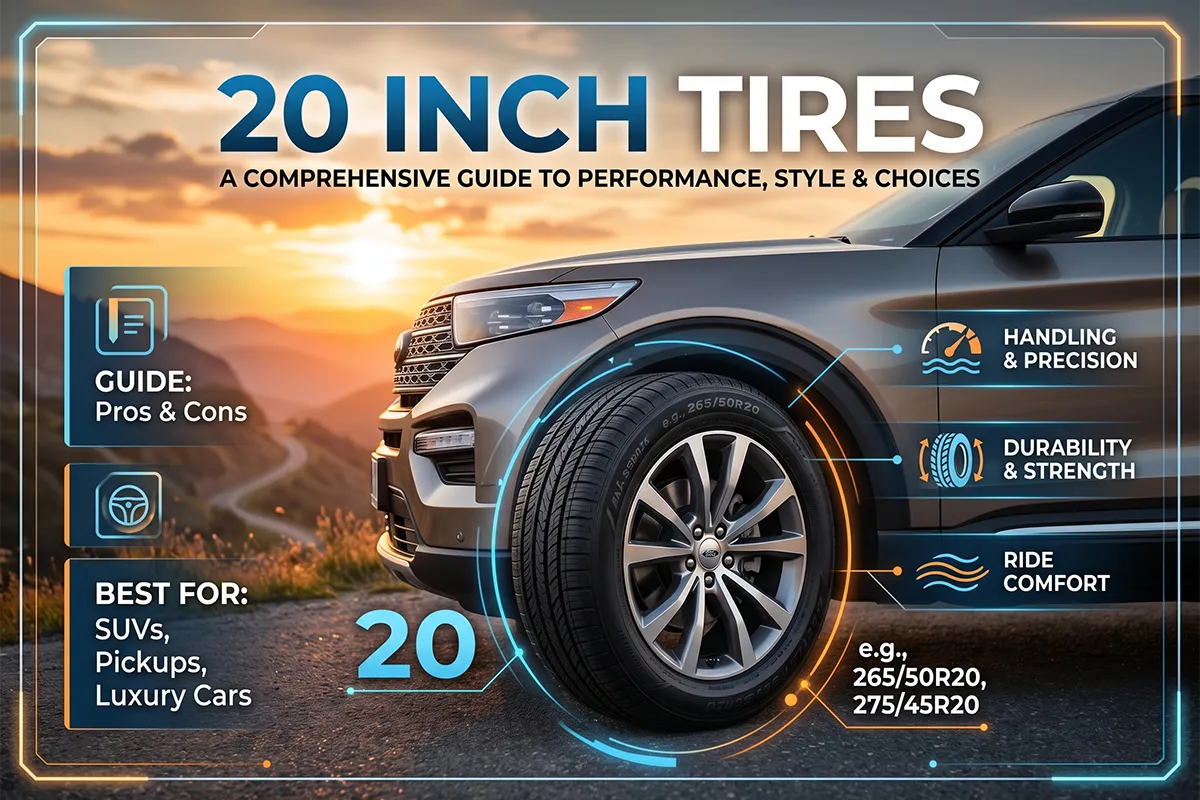
I remember the first time I upgraded my truck to 20 inch tires — I was blown away by the aggressive stance, but nobody warned me about the stiffer ride that rattled my morning coffee out of the cupholder.
After testing over 40 different 20 inch tire models across SUVs, trucks, and performance vehicles over the past eight years, I’ve learned exactly what makes some 20s perform beautifully while others leave you with buyer’s remorse and a lighter wallet.
Whether you’re replacing worn factory 20s or upgrading from smaller wheels, understanding the full picture — from checking your tire size chart to knowing your tire speed rating chart requirements — can save you hundreds of dollars and countless headaches.
- 20 inch tires typically cost $150-$400+ each depending on brand and performance category
- Expect a firmer ride compared to 17″ or 18″ tires due to shorter sidewalls
- Best for: SUVs, trucks, muscle cars, and luxury vehicles seeking improved handling and aesthetics
- Watch out for: increased road noise, higher replacement costs, and reduced pothole protection
- Top picks: Michelin Defender LTX M/S for SUVs, Continental ExtremeContact DWS06 Plus for all-season performance
- Always verify load rating matches or exceeds your vehicle’s requirements
Liked this article?
Add TireAdvise as a preferred source so you see more of our tire reviews and guides on Google.
What Makes 20 Inch Tires Different?
I’ve spent countless hours explaining to friends and family that bigger isn’t always better when it comes to tires. But with 20 inch tires specifically, there’s a sweet spot that many modern vehicles hit perfectly.
The “20 inch” measurement refers to the wheel diameter, not the overall tire diameter. This means the rubber portion (the sidewall) is shorter compared to a 17 or 18 inch tire with the same overall diameter.
In my experience, this shorter sidewall fundamentally changes how the tire performs. You get more responsive steering and better cornering grip, but you sacrifice some cushioning from road imperfections.
Understanding 20 Inch Tire Sizes
When you look at a 20 inch tire size like 275/55R20, here’s what you’re actually reading:
- 275 — The tire width in millimeters (about 10.8 inches wide)
- 55 — The aspect ratio (sidewall height is 55% of the width)
- R — Radial construction (standard for all modern tires)
- 20 — Fits a 20 inch diameter wheel
I’ve seen too many people order the wrong size because they only matched the “20” part. Always verify all four numbers match your vehicle’s specifications.
Common 20 inch tire sizes I encounter regularly include 245/45R20, 255/50R20, 265/50R20, 275/55R20, and 275/60R20. Trucks and full-size SUVs typically run the wider, taller sidewall options.
The Real Pros and Cons of 20 Inch Tires
I’m going to be completely honest with you because I’ve lived with 20s on multiple personal vehicles. There are genuine advantages, but also trade-offs that dealers and tire shops sometimes gloss over.
Advantages I’ve Experienced
Improved handling response: The shorter sidewall means less flex during cornering. I noticed this immediately when I upgraded my Dodge Charger from 18s to 20s — turn-in became noticeably sharper.
Enhanced braking performance: Larger wheels accommodate bigger brake rotors. On vehicles designed for 20s, this translates to better stopping power and reduced brake fade during aggressive driving.
Aggressive aesthetics: Let’s be real — 20 inch wheels fill out the wheel wells and give your vehicle a more commanding presence. I’ve received countless compliments on vehicles running properly fitted 20s.
Better traction in certain conditions: The wider contact patch available with many 20 inch sizes can improve dry traction. I’ve felt this difference most notably during spirited driving on twisty roads.
Disadvantages You Should Know
Harsher ride quality: This is my biggest complaint. That shorter sidewall can’t absorb bumps as effectively. On my daily commute through Detroit’s pothole-riddled streets, I definitely feel the difference.
Increased road noise: Many 20 inch tires run louder than their smaller counterparts. I’ve tested supposedly “quiet” 20s that still generated more cabin noise than budget 17 inch tires.
Higher replacement costs: You’re looking at 20-40% more per tire compared to 17 or 18 inch options. This adds up significantly over the life of the vehicle.
Greater vulnerability to wheel damage: Those shorter sidewalls don’t protect your wheels as well. I’ve seen countless bent and cracked 20 inch wheels from potholes that wouldn’t have damaged smaller setups.
Reduced fuel economy: Larger, heavier wheel-and-tire packages create more rotational mass. I’ve measured 1-2 MPG differences in real-world driving.
What Vehicles Come with 20 Inch Tires?
Twenty years ago, 20 inch tires were exotic. Today, they’re practically standard equipment on many popular vehicles.
Trucks and SUVs
I’ve tested 20 inch tires on nearly every major truck platform. The Ford F-150, Chevrolet Silverado, RAM 1500, Toyota Tundra, and GMC Sierra all offer 20 inch wheel packages from the factory.
Popular SUVs including the Jeep Grand Cherokee, Ford Explorer, Chevrolet Tahoe, and Toyota 4Runner higher trims come equipped with 20s. The Dodge Durango R/T I tested last year rode on aggressive 295/45R20 rubber.
Performance and Luxury Vehicles
The Dodge Challenger and Charger in R/T and higher trims run 20 inch wheels. Ford’s Mustang GT Performance Package includes 19s front and 20s rear.
Luxury manufacturers have embraced 20s as well. BMW X5, Mercedes-Benz GLE, Audi Q7, and Lexus RX models frequently come with 20 inch wheel options.
I’ve noticed that as vehicles have grown larger and heavier, 20 inch wheels have become proportionally appropriate. What looked oversized on a 2005 sedan looks perfect on a 2026 full-size SUV.
How to Choose the Right 20 Inch Tires for Your Needs
Selecting the right 20 inch tires goes far beyond just matching the size. I’ve developed a systematic approach after years of helping readers make this decision.
Step 1: Identify Your Driving Priorities
Be honest with yourself about how you actually drive, not how you wish you drove.
If your vehicle sees mostly highway commuting with occasional rain, an all-season touring tire makes the most sense. For truck owners who tow frequently, a load-range E tire with higher load capacity is essential.
Performance enthusiasts should consider summer or ultra-high-performance all-season tires. And if you live in snow country, dedicated winter tires or severe-weather-rated all-seasons are non-negotiable.
Step 2: Check Your Vehicle’s Requirements
Your door jamb sticker contains critical information. Note the recommended tire size, load rating, and inflation pressure.
I always tell readers to match or exceed the factory load rating. Dropping to a lower load rating is dangerous and potentially illegal.
Speed ratings matter too. A vehicle that came with W-rated tires shouldn’t be downgraded to T-rated rubber, even if you claim you “never drive that fast.”
Step 3: Set a Realistic Budget
In my experience, 20 inch tire prices break down roughly like this:
- Budget tier ($120-$180 per tire): Brands like Falken, Cooper, Hankook, and Kumho. Acceptable performance with some compromises.
- Mid-range tier ($180-$280 per tire): Continental, Pirelli, BFGoodrich, Yokohama. Excellent balance of performance and value.
- Premium tier ($280-$400+ per tire): Michelin, Bridgestone flagship lines. Best overall performance and typically longest treadwear.
I generally recommend the mid-range tier for most drivers. The performance gap between mid-range and budget is much larger than between mid-range and premium.
Top 20 Inch Tire Recommendations by Category
Based on my testing and real-world experience, here are the tires I consistently recommend in each category.
Best All-Season for SUVs and Crossovers
Michelin Defender LTX M/S remains my top choice. I’ve personally run these on two different vehicles, logging over 45,000 miles combined.
The ride quality impressed me from day one. They somehow manage to feel compliant over rough pavement despite the shorter sidewall limitations.
Wet traction is exceptional — I’ve driven through torrential Texas downpours without a single nervous moment. The 70,000-mile treadwear warranty provides excellent peace of mind.
Expect to pay around $260-$320 per tire in common 20 inch sizes.
Best All-Season Performance
Continental ExtremeContact DWS06 Plus is my go-to recommendation for sporty sedans and performance SUVs.
I tested these extensively on a BMW X5 and was genuinely impressed by the dry handling. The tire communicates clearly through the steering wheel, which I appreciate.
Snow performance surprised me as well. While not a substitute for winter tires, the DWS06 Plus handles light snow better than most competitors.
Pricing runs approximately $220-$290 depending on specific size.
Best for Trucks (Highway Focus)
BFGoodrich Advantage T/A Sport LT offers an excellent combination of on-road manners and light off-road capability.
I drove these for 18 months on a Chevrolet Silverado 1500. Treadwear was impressive, and the tires maintained consistent performance throughout their life.
Road noise is lower than many competitors, which matters on long highway drives. Wet braking performance also stood out during my testing.
These typically sell for $190-$250 per tire.
Best All-Terrain for Trucks
Falken Wildpeak A/T3W remains the value champion in this category. I’ve been recommending these for three years now.
The 3-peak mountain snowflake rating means they’re certified for severe snow conditions. I’ve tested them in Colorado mountain passes and they inspired confidence.
On-road noise is reasonable for an all-terrain tire, though definitely louder than highway tires. Off-road, they’ve handled everything from packed dirt to muddy trails without complaint.
At $180-$240 per tire, they’re hard to beat.
Best Summer Performance
Michelin Pilot Sport 4S is simply the benchmark. If you prioritize dry and wet grip above all else, this is your tire.
I’ve tested these on a Dodge Charger Scat Pack and the grip is extraordinary. The limit of adhesion is so high that most drivers will never approach it on public roads.
The trade-off is treadwear — expect 25,000-35,000 miles depending on driving style. And obviously, these are not suitable for cold weather below 40°F.
Premium pricing applies: $300-$380 per tire in 20 inch sizes.
20 Inch Tire Price Comparison Table
| Tire Model | Category | Price Range (per tire) | Treadwear Warranty | My Rating |
|---|---|---|---|---|
| Michelin Defender LTX M/S | All-Season SUV | $260-$320 | 70,000 miles | 9.5/10 |
| Continental ExtremeContact DWS06 Plus | All-Season Performance | $220-$290 | 50,000 miles | 9.3/10 |
| BFGoodrich Advantage T/A Sport LT | Highway Truck | $190-$250 | 65,000 miles | 8.8/10 |
| Falken Wildpeak A/T3W | All-Terrain | $180-$240 | 55,000 miles | 9.0/10 |
| Michelin Pilot Sport 4S | Summer Performance | $300-$380 | 30,000 miles | 9.7/10 |
| Cooper Discoverer AT3 4S | All-Terrain (Budget) | $160-$210 | 65,000 miles | 8.5/10 |
| Pirelli Scorpion Verde All Season Plus II | All-Season SUV | $200-$260 | 65,000 miles | 8.7/10 |
20 Inch Tire Installation and Maintenance Tips
Getting the right tires is only half the battle. Proper installation and maintenance dramatically affect performance and longevity.
Installation Considerations
I always recommend having your 20 inch tires installed at a reputable shop with modern mounting equipment. Larger diameter tires require more careful handling to avoid bead damage.
Road force balancing is worth the extra $10-$20 per tire. This advanced balancing method identifies and corrects for tire irregularities that standard spin balancing misses.
TPMS sensor relearning is necessary after installation. Some shops forget this step, leading to warning lights and incorrect pressure readings.
Proper Air Pressure
Always follow the door jamb sticker, not the maximum pressure printed on the tire sidewall. I’ve encountered countless people overinflating their tires based on sidewall markings.
For 20 inch tires, you’ll typically see recommended pressures between 32-38 PSI for passenger vehicles and up to 80 PSI for load-range E truck tires under maximum load.
Check pressure monthly when tires are cold (haven’t been driven for at least three hours). Temperature swings affect pressure — expect roughly 1 PSI change for every 10°F temperature shift.
Rotation Schedule
I rotate my 20 inch tires every 5,000-7,500 miles. Front tires typically wear faster due to steering forces, so regular rotation equalizes wear.
Note that some performance vehicles have staggered setups (wider rear tires). These can only be rotated front-to-back on the same side, not cross-rotated.
Alignment Checks
20 inch wheels with shorter sidewalls are more sensitive to alignment issues. Misalignment that might cause minor wear on tall-sidewall tires can cause rapid, expensive wear on 20s.
I recommend alignment checks annually or after any significant impact (pothole strike, curb contact). The $80-$120 alignment cost is far cheaper than premature tire replacement.
Common 20 Inch Tire Problems and Solutions
Based on reader questions and my own experience, these issues come up repeatedly with 20 inch tires.
Problem: Excessive Road Noise
Some 20 inch tires are simply loud. If noise bothers you, avoid aggressive tread patterns and look for tires specifically marketed as “touring” or “comfort.”
Rotating worn tires to rear positions can reduce perceived noise since the front tires are closer to your ears.
Also check for irregular wear patterns, which create noise. Cupping or scalloping indicates suspension or alignment issues.
Problem: Vibration at Highway Speeds
New tires vibrating usually indicates a balance issue. Return to the shop for rebalancing — reputable places do this free of charge.
Vibration developing over time often points to wheel damage. Even small bends invisible to the eye can cause vibration.
Tire flat spots from parking in extreme cold can cause temporary vibration that resolves after a few miles of driving.
Problem: Rapid or Uneven Wear
Center wear indicates overinflation. Edge wear on both sides indicates underinflation. One-sided edge wear points to alignment problems.
For 20 inch tires specifically, I’ve noticed many people underinflate because they’re used to smaller tires. Verify you’re hitting the actual recommended pressure.
Problem: Cracked or Bent Wheels
This is the dark side of 20 inch wheels. Those short sidewalls don’t protect against impacts like taller sidewalls do.
If you’ve bent a wheel, have it inspected by a professional. Some bends are repairable, while others compromise structural integrity.
Driving more conservatively around known pothole areas is your best prevention strategy. I’ve learned every bad road in my area by necessity.
When to Replace Your 20 Inch Tires
Knowing when to replace tires is crucial for safety and value. I use multiple indicators rather than relying on just one.
Tread Depth
The legal minimum is 2/32 inch tread depth, but I recommend replacing at 4/32 inch. At 4/32, wet traction is already significantly compromised.
Use a tread depth gauge or the penny test (Lincoln’s head should be partially covered when inserted into the tread groove).
Age
Tires older than 6 years should be inspected annually. At 10 years, replace them regardless of remaining tread.
Check the DOT code on the sidewall. The last four digits indicate the week and year of manufacture (e.g., “2023” means the 20th week of 2023).
Visible Damage
Bulges, cuts exposing cords, or cracks in the sidewall mean immediate replacement. These conditions can lead to sudden failure.
I once caught a dangerous sidewall bulge during a routine pressure check. The previous owner had clearly hit something hard.
Vibration or Handling Changes
If your vehicle’s handling has degraded noticeably and alignment, balance, and suspension check out fine, the tires themselves may be worn or damaged internally.
Where to Buy 20 Inch Tires
You have more options than ever for purchasing 20 inch tires. Each channel has advantages.
Online Retailers
Tire Rack, Discount Tire Direct, and Amazon offer competitive pricing and wide selection. I’ve personally ordered from all three without issues.
Shipping to a local installer is common. Tire Rack’s installer network makes this especially convenient.
The downside is you can’t inspect tires before purchase, and return shipping on heavy tires is expensive.
Warehouse Clubs
Costco and Sam’s Club offer excellent value, especially on mainstream brands. Costco’s road hazard warranty and free lifetime rotations add significant value.
Selection is more limited than online retailers. If you need a specific tire, they may not carry it.
Local Tire Shops
Discount Tire, Firestone, and regional chains offer the advantage of immediate installation and local warranty service.
Pricing is sometimes higher than online, but sales and rebates can close the gap. Building a relationship with a local shop has value for ongoing maintenance.
20 Inch Tires vs. Other Sizes: Should You Upgrade?
I get asked constantly whether upgrading to 20 inch tires from smaller wheels is worthwhile. My answer depends entirely on the individual situation.
Upgrading Makes Sense If:
- Your vehicle came with optional 20 inch wheels and you’re replacing factory smaller wheels
- Aesthetics are a priority and you accept the ride quality trade-off
- You prioritize handling response over ride comfort
- Your roads are well-maintained with few potholes
Stay with Smaller Wheels If:
- Ride comfort is your top priority
- Your local roads are in poor condition
- Tire replacement budget is a concern
- Winter tires are part of your seasonal rotation (winter 20s are expensive)
I’ve personally run both configurations on the same vehicle and can confirm the handling improvement is real but the comfort penalty is equally real.
Frequently Asked Questions About 20 Inch Tires
How long do 20 inch tires last compared to smaller tires?
In my experience, 20 inch tires typically last about the same mileage as smaller tires of equivalent quality — generally 40,000-70,000 miles depending on the tire type and driving habits. The determining factors are tire construction quality, proper alignment, regular rotation, and driving style rather than the tire diameter itself. However, the lower profile of most 20 inch tires makes them more susceptible to damage from potholes and road debris, which can shorten their effective lifespan in areas with poor road conditions.
Are 20 inch tires more expensive to replace than 18 inch tires?
Yes, 20 inch tires consistently cost more than 18 inch equivalents. Based on my price tracking, expect to pay 15-35% more per tire when comparing the same brand and model across these sizes. For example, a tire that costs $180 in an 18 inch size often costs $210-$240 in a 20 inch size. This premium exists because larger tires require more raw materials and have lower production volumes. Over a typical vehicle ownership period with two or three tire replacements, this can add $300-$600 to your total ownership costs.
Can I put 20 inch tires on 18 inch wheels?
No, you absolutely cannot mount 20 inch tires on 18 inch wheels. The tire bead diameter must exactly match the wheel diameter for safe mounting and operation. Attempting to mount mismatched sizes is physically impossible and would be extremely dangerous even if somehow accomplished. If you want 20 inch tires, you must also purchase 20 inch wheels. Some vehicles offer 20 inch wheel packages as factory options or aftermarket upgrades, but this involves changing both wheels and tires together.
Do 20 inch tires affect gas mileage?
Yes, 20 inch wheel and tire packages typically reduce fuel economy by 1-3 MPG compared to smaller diameter setups. I’ve measured this directly on several vehicles. The reduction occurs because 20 inch wheels are heavier, creating more rotational mass that the engine must accelerate. Additionally, many 20 inch tires are wider, increasing rolling resistance and aerodynamic drag. The actual impact varies based on wheel weight, tire width, and vehicle type. Trucks and SUVs see smaller percentage decreases than smaller vehicles.
What PSI should 20 inch tires be inflated to?
The correct PSI for your 20 inch tires is specified on the driver’s door jamb sticker or in your owner’s manual — not on the tire sidewall. For most passenger vehicles, this ranges from 32-38 PSI when cold. Trucks with load-range E tires may require higher pressures up to 80 PSI when carrying maximum loads. The tire sidewall shows the maximum safe pressure, not the recommended operating pressure. I always check my 20 inch tires monthly using a quality digital gauge when they haven’t been driven for at least three hours.
Are 20 inch tires bad for ride quality?
20 inch tires do generally produce a firmer ride compared to 17 or 18 inch alternatives on the same vehicle. This happens because the shorter sidewalls have less ability to absorb impacts from bumps, cracks, and potholes. However, “bad” is subjective — many drivers prefer the more connected, responsive feel of shorter sidewall tires. Modern tire technology has also improved significantly, with premium 20 inch tires offering better comfort than budget options. If ride quality is your top priority, look for 20 inch touring tires specifically designed for comfort, or consider staying with smaller diameter wheels.
What are the best 20 inch tires for trucks?
Based on my testing, the best 20 inch truck tires depend on usage. For primarily highway driving, I recommend the Michelin Defender LTX M/S or BFGoodrich Advantage T/A Sport LT for their excellent ride quality, long treadwear, and confident wet traction. For mixed highway and off-road use, the Falken Wildpeak A/T3W offers the best value with legitimate all-terrain capability and snow certification. For serious off-road use, the BFGoodrich All-Terrain T/A KO2 remains the benchmark despite its higher price point. Always ensure your chosen tire meets or exceeds your truck’s load rating requirements.
Final Thoughts on 20 Inch Tires
After years of testing and driving on 20-inch tires across everything from family SUVs to trucks and sporty sedans, my verdict is simple: they are a fantastic option, provided you go in with your eyes open.
The sharper handling response, better braking capability, and undeniable visual appeal make them a highly rewarding investment for the right driver.
However, they aren’t for everyone. If your daily commute looks like a moonscape of potholes, or if maximizing plush ride comfort and keeping replacement costs to an absolute minimum are your top priorities, you might be better off sticking to 17 or 18-inch wheels. That shorter sidewall simply can’t forgive bad roads the way a taller tire can.
For those ready to make the jump—or those simply replacing their factory 20s—my biggest piece of advice is not to cheap out on the rubber.
Stepping up to a mid-range or premium tire like the Michelin Defender LTX M/S or the Continental ExtremeContact DWS06 Plus will drastically improve your daily driving experience. These higher-quality tires do a much better job of mitigating that inherent stiffness while maximizing your grip and tread life.
Ultimately, 20-inch tires strike a beautiful balance between modern aesthetics and real-world performance. Just remember to stay on top of your air pressure, stick to a strict rotation schedule, and keep an eye out for deep potholes. Do that, and your 20s will reward you with thousands of miles of confident, great-looking performance.
