

I’ve driven on bald tires in the rain. It was one of the most terrifying experiences of my life — the car just didn’t respond the way it should, and for about 200 feet on a wet Tennessee highway, I genuinely wasn’t sure I was going to stay in my lane.
That day, I vowed I’d never let it happen again, and I’ve since spent years studying, testing, and writing about tires so you don’t have to learn the same lesson the hard way.
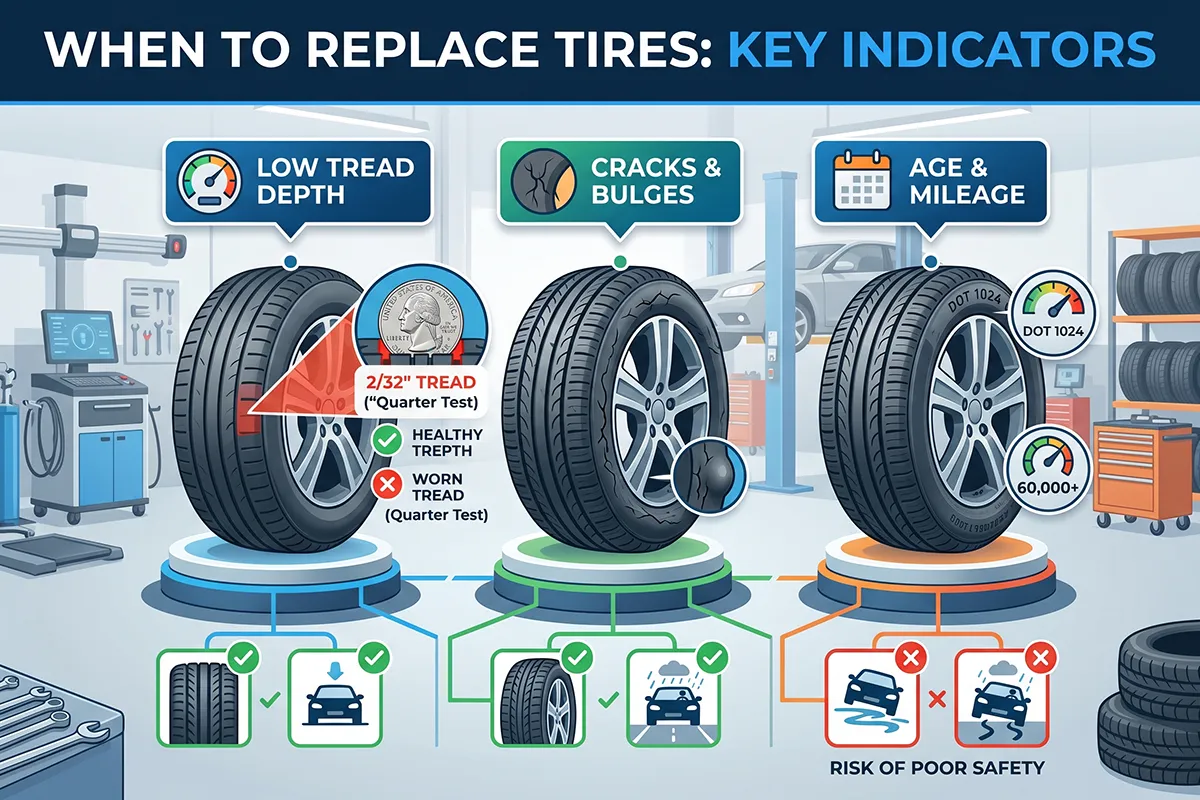
Replace your tires when tread depth hits 2/32″, but strongly consider swapping them at 4/32″ — especially if you drive in rain or snow. Tires older than 6 years should be inspected annually regardless of tread; replace at 10 years no matter what. Watch for sidewall cracking, visible cords, uneven wear, bulges, and persistent vibration as additional red flags.
Liked this article?
Add TireAdvise as a preferred source so you see more of our tire reviews and guides on Google.
Why Knowing When to Replace Tires Actually Matters
Most drivers think about tire replacement the same way they think about a dentist appointment — only when something hurts. But by the time your tire failure is obvious, you’re already in dangerous territory.
Tires are the only part of your car that touches the road. Every steering input, every brake application, every cornering force runs through a contact patch about the size of your hand.
When that contact patch is compromised by worn rubber, dry rot, or internal damage, your 4,000-pound vehicle becomes significantly harder to control.
The U.S. National Highway Traffic Safety Administration (NHTSA) estimates that tire-related issues contribute to roughly 11,000 car crashes annually. That number is almost entirely preventable. Here’s how to make sure you’re not part of it.
Sign #1: Tread Depth Below 2/32″ (The Legal Minimum)
Tread depth is the most objective measure you have. In the U.S., a tire is considered legally worn out at 2/32 of an inch of remaining tread depth. Most tires come from the factory with 10/32″ to 11/32″ of tread (performance tires sometimes start lower, around 8/32″).
The classic test is the penny test: stick a penny into the tread groove with Lincoln’s head pointing down. If you can see the top of Lincoln’s head, you’re at or below 2/32″ — replace immediately.
But here’s what the penny test won’t tell you: 2/32″ is the legal floor, not the safe floor.
In my experience testing all-season and all-terrain tires, the wet braking performance of a tire degrades significantly well before it hits the legal limit.
Independent testing from Consumer Reports and Tire Rack has repeatedly shown that tires at 4/32″ can add 100+ feet of stopping distance on wet roads compared to new tires. On a highway at 60 mph, that’s the difference between stopping before an obstacle and hitting it at 25 mph.
The Quarter Test: My Preferred Field Check
Use a quarter instead of a penny. Insert it into the groove with Washington’s head pointing down. If you can see the top of his head, you’re at 4/32″ or less. That’s when I personally start budgeting for new tires — even if I’m not replacing them that day.
Tread Depth Reference Chart
| Tread Depth | Condition | Action |
|---|---|---|
| 10/32″ – 8/32″ | Like new | No action needed |
| 7/32″ – 5/32″ | Good to fair | Monitor regularly |
| 4/32″ | Approaching wear | Plan replacement; avoid wet/snowy roads |
| 3/32″ | Worn | Replace soon — wet performance is degraded |
| 2/32″ | Legally worn out | Replace immediately |
| Below 2/32″ | Illegal in most states | Do not drive — replace now |
Sign #2: Tire Age (Even If the Tread Looks Fine)
This one catches a lot of drivers off guard. A tire can look perfectly fine — plenty of tread, no visible damage — and still be dangerous. Rubber compounds age and degrade even when the tire is just sitting there, a process called oxidation or thermal degradation.
The rubber dries out, loses elasticity, and becomes prone to cracking and sudden failure — particularly at highway speeds where heat buildup accelerates the breakdown.
The industry standard guidance:
- 6 years: Have tires inspected annually by a professional
- 10 years: Replace all tires regardless of remaining tread or appearance
Finding your tire’s age is easy. Every tire manufactured since 2000 has a DOT code molded into the sidewall. The last four digits tell you the manufacture date — two digits for the week, two for the year.
For example: DOT XXXX XXXX **2319** means the tire was made in the 23rd week of 2019.
I’ve personally inspected tires that were 9 years old with 6/32″ of tread remaining — and the sidewalls were showing spider-web cracking that made them genuinely unsafe. The owner had no idea. Always check the DOT date when buying used vehicles or when you haven’t replaced tires in a while.
Sign #3: Visible Sidewall Cracking or Dry Rot
Even if the tread looks fine, run your eyes and fingers along the tire sidewall. What you’re looking for is any network of small surface cracks — often called dry rot or weather checking.
Minor surface crazing (tiny, barely visible lines) is mostly cosmetic on a newer tire. But when the cracks start looking deep, spidery, or run into the tread grooves — that tire is compromised. It can fail catastrophically with no warning, especially in hot weather or at highway speeds.
I’ve seen this most often on:
- Vehicles that sit for months at a time (weekend cars, RVs, stored vehicles)
- Tires that have been over or under-inflated for extended periods
- Older tires exposed to UV light without any tire dressing protection
If you see cracking that’s more than superficial — replace the tires. There’s no repair for dry rot.
Sign #4: Bulges or Blisters on the Sidewall
A sidewall bulge is the tire’s way of telling you its internal structure has already failed. The steel belts or fabric cords inside the tire have been damaged — usually from hitting a pothole, curb, or road debris hard enough to pinch the tire — and the air pressure is literally pushing through the outer rubber layers.
This is a tire that can explode at any time. No exaggeration.
If you see any bulge or blister on the sidewall, do not drive on that tire. Mount your spare, drive to a tire shop, and replace it. There is no repair for this type of damage.
I’ve found bulges during routine pre-trip inspections on vehicles that had hit bad potholes the previous week. The driver had no idea — the tire hadn’t lost air and drove seemingly fine. But a bulge like that on a highway trip at 75 mph is a blowout waiting to happen.
Sign #5: Uneven Tread Wear Patterns
Not all wear is created equal. How your tires wear down tells a story about your vehicle’s alignment, inflation, and suspension health — and some patterns signal when replacement is urgent.
Center Wear (Over-Inflation)
The center of the tread is more worn than the edges. Your tires are running overinflated.
Edge Wear (Under-Inflation)
Both outer edges are more worn than the center. Your tires have been chronically underinflated.
One-Sided Wear
One edge is dramatically more worn than the other. Classic sign of a camber alignment issue.
Cupping or Scalloping
Uneven, wavy, or “scooped” patches around the circumference. Usually caused by worn shocks or struts, or wheel imbalance. This pattern creates vibration and noise — and the underlying cause needs to be fixed before you put new tires on, or the same pattern will repeat.
Patchy or Flat Spot Wear
Flat spots from hard braking (before ABS activates) or from a tire that locked up. Can also occur if a vehicle sits stationary for a long period.
My rule: Any time I see wear that’s visibly uneven from one side to the other or from edge to center, I get an alignment check before buying replacement tires. There’s no point spending $600+ on new rubber only to chew it up unevenly again.
Sign #6: Persistent Vibration or Handling Changes
Some vibration at highway speeds is normal — but if it’s new, has gotten worse, or is accompanied by a pulling sensation to one side, your tires may be the cause.
Common tire-related causes of vibration include:
- Out-of-balance tires — the cheapest fix, a simple balance job
- Belt separation inside the tire — the steel belts inside are shifting; the tire needs to be replaced
- Cupping from worn suspension components — fix the suspension first, then replace the tire
I always start with a balance and rotation when vibration shows up. If the vibration persists after that, it’s time to look harder at the tires themselves. A separated belt will often feel like a rhythmic thump or wobble that gets worse at higher speeds — and that tire needs to come off immediately.
Sign #7: After a Significant Impact or Puncture
Not every nail in a tire means replacement. A small puncture in the central tread area (not the shoulder, not the sidewall) that’s less than 1/4″ can often be repaired with a proper plug-and-patch from the inside.
But there are situations where replacement is the only safe answer:
- Puncture in the sidewall or shoulder — these areas flex constantly and a repair won’t hold
- Multiple punctures — structural integrity is compromised
- Run-flat damage — if you drove on a flat even briefly, internal damage may not be visible
- Any impact that caused a visible bulge — as covered above
Before I reinstall any tire that’s had a puncture repaired, I ask the shop to dismount it and inspect from the inside. A reputable shop will do this as standard practice. If they just plug it from the outside without dismounting — find a different shop.
How Often Should You Replace Tires? (The Timeline Question)
Rather than a fixed mileage interval, I think about tire replacement as a combination of factors:
Typical tire lifespan: 25,000 to 75,000 miles depending on the tire type, driving style, and road conditions. Most all-season tires for everyday cars are rated 50,000–70,000 miles under normal conditions.
Reality check: Most people get 40,000–60,000 miles out of a standard all-season tire if they rotate every 5,000–6,000 miles, maintain proper inflation, and drive reasonably. Performance tires and off-road tires wear faster.
The 5-year check-in: Even if your tires haven’t hit their tread wear indicators, have them inspected by a professional at the 5-year mark, and then annually after that.
The 10-year hard limit: Replace no matter what. No exceptions.
A Quick Note on Buying in Sets
When you do replace tires, try to replace all four at once. Mismatched tires — different tread depths, different brands, different constructions — create uneven handling that your car’s stability control and traction control systems aren’t designed to work around. If budget is a real constraint, replace at minimum the axle set (both front or both rear), and put the newer tires on the rear axle regardless.
For a deeper look at finding the right replacement, check out my tire buying and maintenance guide which covers everything from tire types to decoding the sidewall markings.
Frequently Asked Questions
How do I know if my tires need to be replaced?
Check tread depth with the quarter test — if you can see the top of Washington’s head when inserted into the tread groove, you’re at 4/32″ or less and should plan for replacement. Also inspect for sidewall cracking, bulges, uneven wear, and check the DOT code to confirm tires aren’t older than 6–10 years.
Is it safe to drive on tires that are 5 years old?
Generally yes, provided they still have adequate tread depth and show no signs of cracking, bulging, or other visible damage. Tires between 5 and 6 years old should be inspected by a professional. After 6 years, have them checked annually. After 10 years, replace them regardless of appearance.
Can I replace just one or two tires instead of all four?
You can, but it’s not ideal. Mismatched tread depths between front and rear axles — especially on AWD vehicles — can cause drivetrain stress and uneven handling. If replacing just two, always put the newer tires on the rear axle to reduce the risk of oversteer. For AWD vehicles, check your owner’s manual — some require all four tires to be within a specific tread depth range.
What is the penny test for tires?
The penny test involves inserting a U.S. penny into a tire tread groove with Lincoln’s head facing down. If you can see the top of his head, the tread is at or below 2/32″ — the legal minimum in most U.S. states. The quarter test (using a U.S. quarter in the same way) gives you a 4/32″ reading, which is a better practical threshold for safety in wet conditions.
How long do tires typically last in years?
Most tires last 4–6 years under normal driving conditions, depending on mileage, climate, and maintenance. The rubber compound degrades over time regardless of use — industry guidance says to inspect annually after 5 years and replace no later than 10 years from the manufacture date (found in the DOT code on the sidewall).
Do I need to replace tires after hitting a big pothole?
Not necessarily, but you should inspect the tires immediately. Look for bulges or blisters on the sidewall, and get an alignment check. If a sidewall bulge is present — even a small one — the tire must be replaced. If the tire looks fine but you notice new vibration after the impact, have it inspected and balanced.
What causes tires to wear unevenly?
Uneven wear is most commonly caused by improper tire inflation, misaligned wheels, or worn suspension components (shocks, struts, or control arm bushings). Regular tire rotations every 5,000–6,000 miles help equalize wear. If you notice uneven wear, address the root cause before installing new tires to avoid repeating the pattern.
The Bottom Line
Replacing tires isn’t the most exciting car expense, but it’s one of the most consequential safety investments you’ll make. The seven signs I’ve covered — tread depth below 4/32″, tires older than 6–10 years, sidewall cracking, bulges, uneven wear, persistent vibration, and impact damage — cover the vast majority of situations where a tire needs to come off.
My personal habit: I do a quick visual inspection every time I fill up with gas. It takes about 90 seconds and has caught everything from a slow leak to the beginnings of dry rot on a barely-used spare. The cost of new tires is real, but it’s a fraction of the cost of what bald tires can do to you.
Drive safe out there.
Have questions about a specific tire brand or type for your replacement? Browse the full tire buying and maintenance guide or check out the individual tire reviews on the site.
