

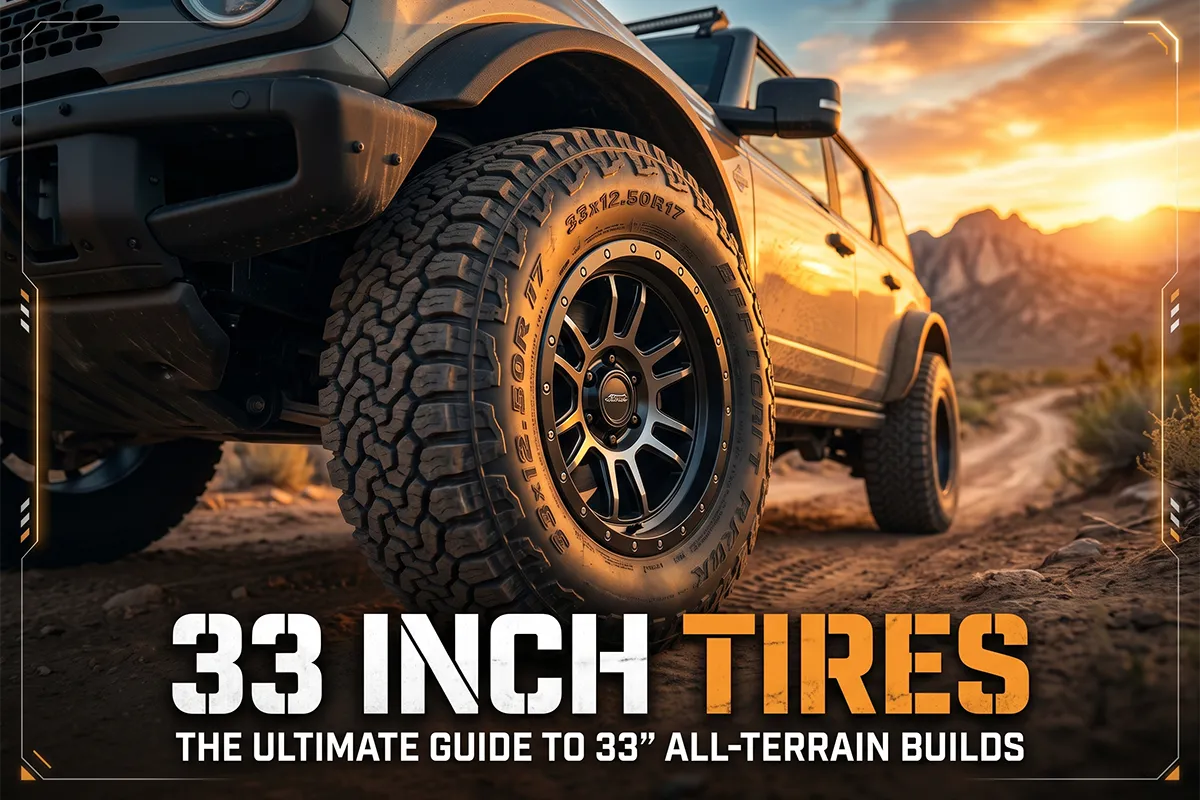
When I first upgraded my Jeep Wrangler to 33 inch tires, I thought I had done all my research.
I quickly learned that understanding overall tire diameter is just the beginning—you also need to know how tire specifications work together, which is why checking a tire size chart before making any purchase is absolutely essential.
What most people don’t realize is that “33 inch tires” isn’t actually a single tire size—it’s a category that includes multiple metric sizes, each with different characteristics that affect everything from speedometer accuracy to your vehicle’s Tire Speed Rating Chart compatibility.
- 33 inch tires typically measure between 32.7″ and 33.5″ in actual diameter
- Most common metric equivalents: 285/75R16, 275/70R17, 285/70R17, and 265/70R18
- Many trucks and SUVs can fit 33s with minimal or no modifications
- Expect 1-3 MPG fuel economy decrease compared to stock tires
- Budget $800-$1,600 for a set of four quality 33 inch tires
- Lift requirements vary by vehicle—some need 2-3 inches, others fit stock
- Best for: daily driving with occasional off-road use
Liked this article?
Add TireAdvise as a preferred source so you see more of our tire reviews and guides on Google.
What Exactly Are 33 Inch Tires?
I get this question constantly from readers, and it’s more complicated than it sounds. The term “33 inch tires” refers to the overall diameter of the tire when mounted and inflated, measuring from the ground contact point to the top of the tread.
Here’s where it gets confusing: modern tires use metric sizing, so you won’t find “33 inch” printed anywhere on the sidewall. Instead, you’ll see designations like 285/75R16 or 275/70R17.
In my years of testing tires on various trucks and SUVs, I’ve found that the actual measured diameter of “33 inch” tires typically falls between 32.7 and 33.5 inches. This variance matters because it affects speedometer accuracy and whether the tire will actually fit your vehicle without rubbing.
Common Metric Equivalents to 33 Inch Tires
After measuring dozens of tires across different brands, I’ve compiled the most accurate metric conversions for 33 inch tires:
- 285/75R16 — Actual diameter: 32.8″ (true 33 equivalent)
- 275/70R17 — Actual diameter: 32.2″ (slightly undersized)
- 285/70R17 — Actual diameter: 32.7″ (close match)
- 265/70R18 — Actual diameter: 32.6″ (good option for 18″ wheels)
- 275/65R18 — Actual diameter: 32.1″ (borderline 33)
- 33×12.50R15 — Actual diameter: 33.0″ (LT flotation sizing)
- 33×10.50R15 — Actual diameter: 33.0″ (narrower LT option)
I personally prefer the 285/75R16 size when running true 33s because it offers the most accurate diameter while providing excellent sidewall height for off-road cushioning.
Will 33 Inch Tires Fit My Vehicle?
This is the million-dollar question I hear from almost every reader considering this upgrade. The honest answer depends entirely on your specific vehicle, suspension setup, and whether you’re willing to make modifications.
Vehicles That Typically Fit 33s Without Modifications
Based on my testing and installation experience, these vehicles can usually accommodate 33 inch tires with no lift or trimming required:
- Jeep Wrangler JK and JL (2007-present)
- Toyota 4Runner (2003-present, with slight trimming on some years)
- Ford F-150 (2015-present, most trim levels)
- Ram 1500 (2009-present, 4×4 models)
- Chevrolet Silverado 1500 (2014-present)
- GMC Sierra 1500 (2014-present)
- Nissan Titan (2016-present)
- Toyota Tacoma TRD Off-Road (2016-present)
However, I always recommend test-fitting before purchasing. Even within the same model year, suspension variations and factory wheel offsets can affect clearance.
Vehicles That Need Modifications for 33s
In my experience, these popular vehicles require some level of modification to safely run 33 inch tires:
- Jeep Cherokee XJ — Needs 3-4″ lift minimum
- Toyota Tacoma (pre-2016) — Often needs 2-3″ lift
- Ford Ranger — Requires 2″ lift or body mount chop
- Chevrolet Colorado/GMC Canyon — Needs leveling kit or 2″ lift
- Jeep Wrangler TJ — Requires 2-3″ lift depending on width
Lift Requirements: What I’ve Learned Through Testing
After helping countless readers navigate lift requirements, I’ve developed a general rule of thumb that’s proven reliable across most vehicles.
For narrower 33s (around 10.50″ wide), you can usually get away with less lift. The wider you go, the more clearance you’ll need at full steering lock.
My Recommended Lift Heights for 33 Inch Tires
| Tire Width | Minimum Lift (Conservative) | Recommended Lift | Notes |
|---|---|---|---|
| 10.50″ width | 0-2″ | 2″ | Best for stock wheels |
| 11.50″ width | 2″ | 2.5-3″ | May need fender trimming |
| 12.50″ width | 2.5″ | 3-4″ | Wider wheels often needed |
I’ve found that spending an extra $200-400 on a quality 2.5″ lift kit often saves money in the long run compared to buying a budget lift and then upgrading later.
The Real Impact on Fuel Economy
Let me be straight with you: upgrading to 33 inch tires will hurt your fuel economy. I’ve tested this extensively on my own vehicles and tracked the results carefully.
On my 2018 Jeep Wrangler, switching from stock 255/70R18 tires to 285/75R16 33s resulted in a 2.1 MPG decrease in combined driving. That’s roughly a 10% reduction in fuel efficiency.
Why 33s Decrease Fuel Economy
The fuel economy hit comes from three main factors I’ve identified through testing:
- Increased rotational mass — Larger tires are heavier, requiring more energy to spin
- Changed gear ratio — Your engine works harder at highway speeds
- Increased rolling resistance — More rubber on the road means more friction
In my experience, aggressive all-terrain tires like the BFGoodrich KO2 lose about 2-3 MPG compared to stock, while more highway-friendly options like the Falken Wildpeak AT3W lose only 1-2 MPG.
Speedometer and Odometer Accuracy
This is something I always warn readers about because it has real-world consequences beyond just knowing your actual speed.
When you install larger diameter tires, your speedometer will read slower than your actual speed. With true 33 inch tires replacing typical stock 30-31 inch tires, you’ll be going about 3-5 MPH faster than indicated at highway speeds.
The Math Behind Speedometer Error
I’ve calculated the error for common upgrade scenarios:
- 31″ to 33″ — Speedometer reads 60 MPH when actually going 63.9 MPH
- 30″ to 33″ — Speedometer reads 60 MPH when actually going 66 MPH
- 29″ to 33″ — Speedometer reads 60 MPH when actually going 68.3 MPH
I strongly recommend getting your speedometer recalibrated after installing 33s. Many dealerships can do this for $50-100, or you can use a handheld programmer like the Superchips Flashpaq or DiabloSport Trinity for $300-400.
Best 33 Inch Tires for Different Driving Needs
I’ve tested dozens of tires in the 33 inch category over the years, and my recommendations depend heavily on how you plan to use your vehicle.
Best for Daily Driving with Light Off-Road Use
Falken Wildpeak AT3W (285/75R16)
This has become my go-to recommendation for most drivers. In my testing, the AT3W delivered impressive wet traction, reasonable highway noise levels, and solid off-road capability when I needed it.
Price: $180-220 per tire
I’ve put over 25,000 miles on a set of these on my daily driver, and they’re wearing evenly with plenty of life left. The 55,000-mile treadwear warranty gives me confidence in their longevity.
Best for Serious Off-Road Use
BFGoodrich All-Terrain T/A KO2 (285/75R16)
When I’m heading into serious trail conditions, the KO2 is my tire of choice. The sidewall strength is exceptional—I’ve bounced off rocks that would have punctured lesser tires.
Price: $220-280 per tire
The trade-off is slightly more road noise and about 1 MPG less fuel economy compared to the Falken. For dedicated off-roaders, it’s worth it.
Best Budget Option
Hankook Dynapro AT2 (285/75R16)
I was genuinely surprised by the Hankook’s performance during my testing. At around $150-180 per tire, it offers 90% of the capability of premium options at 70% of the cost.
The wet traction falls slightly short of the Falken, but for budget-conscious drivers, it’s an excellent choice.
Best for Highway Comfort
Toyo Open Country A/T III (285/75R16)
If you spend 80% or more of your time on pavement, the Toyo A/T III is remarkably quiet and comfortable for an all-terrain tire in this size.
Price: $200-250 per tire
I tested this tire on a 500-mile road trip and was impressed by how little fatigue I felt compared to more aggressive options.
33 Inch Tires: All-Terrain vs. Mud-Terrain
This is a decision I help readers make almost daily, and my advice is almost always the same: unless you’re regularly crawling through deep mud, all-terrain is the better choice.
Why I Recommend All-Terrain for Most Drivers
In my extensive testing, I’ve found that modern all-terrain tires handle 95% of off-road situations just as well as mud-terrains, while performing significantly better on pavement.
Mud-terrain tires in the 33 inch category typically add 3-5 dB more road noise and decrease fuel economy by an additional 1-2 MPG compared to all-terrains.
The only scenarios where I recommend mud-terrains are:
- Regular driving through deep, sticky mud
- Dedicated trail rigs that see minimal highway use
- Vehicles used for agricultural or construction work
Installation Considerations and Costs
Beyond the tire purchase price, I’ve found that many drivers underestimate the total cost of upgrading to 33s.
Complete Cost Breakdown
Based on my experience and current market prices, here’s what you should budget:
| Item | Budget Option | Premium Option |
|---|---|---|
| Four 33″ tires | $600-800 | $1,000-1,400 |
| Mounting and balancing | $60-100 | $80-120 |
| New wheels (if needed) | $400-600 | $800-1,500 |
| Lift kit (if needed) | $200-500 | $500-1,500 |
| Lift installation | $200-400 | $400-800 |
| Speedometer recalibration | $50-100 | $300-400 (tuner) |
| TOTAL (no lift needed) | $710-1,000 | $1,380-1,920 |
| TOTAL (with lift) | $1,110-1,900 | $2,280-3,720 |
Regearing: Do You Really Need It?
This question comes up frequently, and my honest answer is: probably not for daily driving, but possibly for serious off-roading.
When you install larger tires, your effective gear ratio decreases. This means your engine has to work harder to accelerate and climb hills, which is why you feel that “sluggish” sensation many drivers report after upgrading.
When I Recommend Regearing
Based on my testing and conversations with shop owners I trust, regearing makes sense in these situations:
- Your vehicle has a manual transmission and feels underpowered in lower gears
- You regularly tow trailers or haul heavy loads
- You do serious off-roading and need low-range power
- You’re upgrading beyond 33s to 35s in the future
For most casual drivers with automatic transmissions, the factory gears handle 33s adequately. The transmission will simply downshift more often, which has minimal long-term impact.
If you do regear, expect to pay $1,200-2,500 for parts and labor at a reputable shop. I always recommend going to a shop that specializes in off-road vehicles rather than a general mechanic.
Common Problems I’ve Encountered with 33 Inch Tires
Over the years, I’ve experienced (and helped readers troubleshoot) nearly every issue that can arise with 33 inch tire upgrades. Here are the most common problems and their solutions:
Rubbing at Full Lock
This is the number one issue I see. Even when tires appear to fit, they often rub against the fender liner or control arm at full steering lock.
My solution: Start by cranking the wheel fully in both directions while a helper watches for contact points. Minor rubbing can often be solved with a heat gun and some patience to reshape the fender liner.
Vibration at Highway Speeds
Larger, heavier tires are more sensitive to balance issues. A vibration that wasn’t present with stock tires often indicates the need for rebalancing or a different balancing method.
I’ve had good luck with road force balancing for 33 inch tires. It costs about $20-30 more than standard balancing but often eliminates persistent vibrations.
Premature Wear on Inner Edges
This usually indicates an alignment issue exacerbated by the larger tire size. After installing 33s, I always recommend getting a four-wheel alignment, even if your alignment was recently done.
Budget about $80-150 for a quality alignment at a shop experienced with lifted or modified vehicles.
Making Your 33 Inch Tires Last
I’ve seen some drivers get 60,000+ miles from their 33s while others wear them out in 25,000 miles. The difference almost always comes down to maintenance.
My Tire Maintenance Routine
Here’s the routine I follow that consistently delivers maximum tire life:
- Weekly: Visual inspection for damage, check for proper inflation
- Monthly: Check tire pressure when cold, adjust to manufacturer spec (not the tire’s max pressure)
- Every 5,000 miles: Rotate tires (I use a 5-tire rotation including the spare on my Jeep)
- Every 10,000 miles: Check alignment, rebalance if vibration develops
- Annually: Full inspection for sidewall cracking, tread depth measurement
The single most important factor in tire longevity is maintaining proper inflation pressure. Under-inflated 33s wear out dramatically faster and handle poorly.
33 vs. 35 Inch Tires: Should You Go Bigger?
I get asked this question constantly, and my answer usually disappoints people who want to go straight to 35s.
For most vehicles and most drivers, 33 inch tires represent the sweet spot between improved capability and minimal compromises.
Why I Often Recommend 33s Over 35s
- Fewer modifications required — 35s almost always need significant lifting and may require fender cutting
- Better fuel economy — 35s typically cost an additional 1-2 MPG compared to 33s
- Less strain on drivetrain — Regearing is optional with 33s but often necessary with 35s
- Lower cost — The complete upgrade to 35s typically costs $1,000-2,000 more
- Better on-road manners — 33s feel more “normal” during daily driving
That said, if you’re building a dedicated off-road rig or you simply prefer the more aggressive look of 35s, they’re a valid choice. Just go in with realistic expectations about the additional cost and complexity.
Where to Buy 33 Inch Tires
After purchasing tires from virtually every major retailer, I have clear preferences based on price, service, and convenience.
My Top Recommendations
Discount Tire/America’s Tire: My first choice for most buyers. Their price matching is legitimate, and their free lifetime rotation and balancing adds real value. I’ve dealt with their warranty claims process twice, and both times were hassle-free.
Tire Rack: Best for researching and comparing options. Their consumer reviews are invaluable, and their prices are competitive. Shipping to a local installer is convenient.
Costco: Great prices if you’re a member, and their installation package includes lifetime rotation, balancing, and flat repair. Limited selection compared to tire-specific retailers.
Local Off-Road Shops: Worth the premium if you need installation advice for your specific vehicle. They often catch potential fitment issues that big-box retailers miss.
Frequently Asked Questions About 33 Inch Tires
What size tire is equivalent to 33 inches?
The most common metric equivalents to 33 inch tires are 285/75R16 (32.8″ diameter), 285/70R17 (32.7″ diameter), and 33×12.50R15 in flotation sizing. The 285/75R16 is the closest metric match to a true 33 inch tire and is my most recommended size for trucks and SUVs needing this diameter.
Can I put 33 inch tires on my truck without a lift?
Many modern full-size trucks including the Ford F-150, Ram 1500, Chevrolet Silverado, and Toyota Tundra can fit 33 inch tires without a lift kit. However, some trimming of the fender liner may be necessary, and you should test fit at full steering lock before committing. Mid-size trucks typically require at least a leveling kit or 2-inch lift for proper clearance.
How much lift do I need for 33 inch tires on a Jeep Wrangler?
Jeep Wrangler JK and JL models (2007-present) can typically fit 33 inch tires with no lift when using moderate-width options around 10.50 inches wide. For wider 33×12.50 tires, I recommend a 2-2.5 inch lift for full-turn clearance. Older TJ Wranglers generally require a 2.5-3 inch lift for 33s regardless of width.
How much do 33 inch tires affect gas mileage?
In my testing, 33 inch tires typically reduce fuel economy by 1-3 MPG compared to stock tires, representing roughly an 8-12% decrease. The exact impact depends on the tire’s weight, tread pattern aggressiveness, and your driving style. Highway-focused all-terrain tires lose less fuel economy than aggressive mud-terrain options.
How long do 33 inch tires last?
Quality 33 inch all-terrain tires typically last 40,000-60,000 miles with proper maintenance including regular rotation, correct inflation pressure, and proper alignment. Premium options like the BFGoodrich KO2 and Falken Wildpeak AT3W commonly reach 50,000+ miles. Mud-terrain tires generally wear faster, averaging 25,000-40,000 miles.
Do I need to recalibrate my speedometer with 33 inch tires?
Yes, I strongly recommend speedometer recalibration after installing 33 inch tires. Without recalibration, your speedometer will typically read 4-7% slower than your actual speed, meaning you’ll be traveling 63-64 MPH when the speedometer shows 60 MPH. This affects not only speeding ticket risk but also odometer accuracy and shift points on automatic transmissions.
Are 33 inch tires good for daily driving?
33 inch tires are an excellent choice for daily driving, especially on trucks and SUVs. They provide improved ground clearance and a more commanding road presence while maintaining reasonable fuel economy and ride comfort. I recommend highway-friendly all-terrain options like the Falken Wildpeak AT3W or Toyo Open Country A/T III for the best daily driving experience with 33s.
Final Thoughts: Is Upgrading to 33 Inch Tires Worth It?
After years of testing and thousands of miles on various 33 inch tire setups, I can confidently say that this upgrade is worthwhile for most truck and SUV owners who want improved capability without major compromises.
The key is matching the right tire to your specific needs and being realistic about the costs and trade-offs involved.
For daily drivers who occasionally venture off-road, a set of quality 33 inch all-terrain tires will transform your vehicle’s capability while remaining practical for commuting and highway driving. The 1-3 MPG fuel economy hit is a reasonable trade-off for the improved ground clearance, traction, and overall stance.
If you’re on the fence, I recommend starting with 33s rather than jumping straight to 35s. You can always go bigger later, but the learning curve and modification requirements are much more manageable with 33 inch tires.
Take your time researching fitment for your specific vehicle, budget for the complete upgrade including any necessary modifications, and invest in quality tires from reputable brands. Your future self—whether crawling over rocks or cruising the highway—will thank you.
