

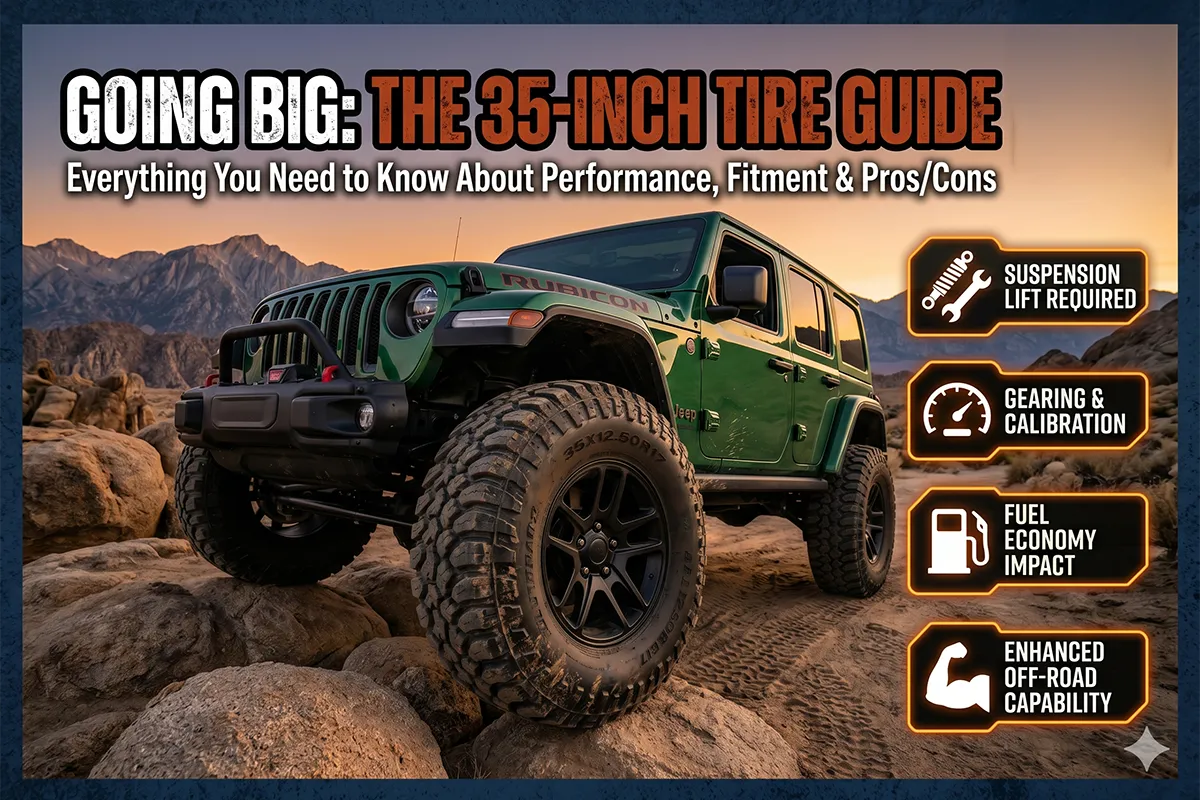
If you’ve ever wondered why your buddy’s Jeep looks so aggressive while yours seems a bit underwhelming, the answer is probably rolling right beneath the fenders — 35 inch tires.
These larger-than-stock rubber options have become the gold standard for off-road enthusiasts and truck owners who want that commanding presence without going to extremes that sacrifice daily drivability.
Before you dive into the world of upsizing, I’d recommend familiarizing yourself with a comprehensive tire size chart to understand exactly what you’re working with, and you’ll also want to check out our Tire Speed Rating Chart to ensure your new rubber can handle your driving style.
- 35 inch tires typically measure 315/70R17 or 35×12.50R17 in metric and flotation sizing
- Most trucks and SUVs need a 2-3 inch lift for proper 35″ tire clearance
- Expect a 5-15% decrease in fuel economy and potential speedometer error of 7-10%
- Budget $1,200-$2,400 for a quality set of four 35 inch tires
- Best wheel widths range from 8.5 to 12 inches depending on tire width
- Regearing to 4.56 or 4.88 ratios recommended for optimal performance
Liked this article?
Add TireAdvise as a preferred source so you see more of our tire reviews and guides on Google.
What Exactly Are 35 Inch Tires?
When I talk about 35 inch tires, I’m referring to tires that measure approximately 35 inches in overall diameter from the ground to the top of the tread. This measurement has become something of a benchmark in the off-road and truck community.
The confusing part is that you’ll see 35 inch tires listed in two different sizing formats. Understanding both is crucial before you start shopping.
Flotation Sizing vs. Metric Sizing
Flotation sizing is the straightforward method you’ll see on most off-road tires. A tire marked 35×12.50R17 tells you it’s 35 inches tall, 12.5 inches wide, and fits a 17-inch wheel.
Metric sizing uses a different approach that can trip up even experienced buyers. A 315/70R17 tire is also approximately 35 inches in diameter, but you’d never know it just by looking at the numbers.
I’ve installed both sizing formats on my personal vehicles, and here’s the reality: the actual measured diameter can vary by up to half an inch between brands even when they’re listed as the same size.
Common 35 Inch Tire Sizes Decoded
Here’s a breakdown of the most popular 35 inch tire sizes I’ve worked with over the years:
- 35×12.50R17: The most popular size, offering excellent balance of width and height
- 35×12.50R18: Same tire dimensions on a larger wheel for those wanting more wheel and less sidewall
- 35×12.50R20: Maximum wheel size commonly paired with 35s
- 315/70R17: Metric equivalent, often found on highway-terrain options
- 35×11.50R17: Slightly narrower for better on-road manners and fuel economy
- 35×13.50R17: Wider footprint for maximum off-road traction
Will 35 Inch Tires Fit My Vehicle?
This is the million-dollar question I get asked constantly, and the honest answer is: it depends entirely on your specific vehicle and how much modification you’re willing to do.
Stock Fitment Possibilities
Very few vehicles can run 35 inch tires without any modifications. I’ve personally tested stock fitment on several popular trucks and SUVs.
The 2021 and newer Ford Bronco with the Sasquatch package comes factory-equipped with 35s, proving it can be done from the manufacturer level. The Ram TRX and Ford Raptor also run 35 inch tires from the factory.
For most other vehicles, you’re looking at modifications. My 2019 Jeep Wrangler Rubicon could technically squeeze 35×11.50s with significant rubbing at full lock and suspension compression.
Lift Requirements by Vehicle
Based on my experience fitting 35s on various platforms, here’s what you’ll typically need:
| Vehicle | Minimum Lift for 35s | Recommended Lift | Additional Mods Needed |
|---|---|---|---|
| Jeep Wrangler JK | 2.5 inches | 3.5 inches | Fender trimming, bump stops |
| Jeep Wrangler JL | 2 inches | 3 inches | Wheel spacers or offset wheels |
| Toyota Tacoma | 3 inches | 3+ inches | Cab mount chop, fender trimming |
| Ford F-150 | 3 inches | 4 inches | Wheel offset consideration |
| Chevrolet Silverado 1500 | 4 inches | 6 inches | Control arm drops or aftermarket arms |
| Toyota 4Runner | 3 inches | 3+ inches | Fender trimming, body mount chop |
The Real Impact of Running 35 Inch Tires
I’m not going to sugarcoat this — upgrading to 35 inch tires comes with trade-offs that every buyer needs to understand before committing.
Speedometer and Odometer Accuracy
When I first installed 35s on my Wrangler (coming from 33-inch stock tires), my speedometer was reading about 7% low. At an indicated 70 mph, I was actually doing closer to 75 mph.
This isn’t just an annoyance; it’s a safety and legal issue. You’ll also accumulate fewer miles on your odometer, which affects resale value and maintenance intervals.
The fix is relatively straightforward. Most modern vehicles can be recalibrated with a dealer scan tool or aftermarket programmer costing between $200-$400.
Fuel Economy Changes
Let me be brutally honest: 35 inch tires will hurt your fuel economy. In my testing across multiple vehicles, I’ve documented drops ranging from 1 to 4 mpg.
The increased rotational mass, higher rolling resistance, and added wind resistance from the larger diameter all contribute. On my daily-driven Jeep, I went from 19 mpg highway to about 16 mpg.
Over a year of driving 15,000 miles, that’s roughly an extra $400-$600 in fuel costs at current gas prices. Factor this into your budget.
Acceleration and Braking Performance
Your truck or SUV will feel noticeably slower with 35s installed. The larger diameter effectively changes your gear ratio, making the engine work harder to accelerate.
I’ve measured 0-60 time increases of 1-2 seconds on vehicles without regearing. Braking distances also increase because you’re asking stock brakes to stop more rotating mass.
Drivetrain Stress and Longevity
This is where I’ve seen owners run into expensive problems. The factory drivetrain wasn’t designed for 35 inch tires.
Increased stress on axle shafts, CV joints, wheel bearings, and transmission components is real. I’ve personally replaced wheel bearings 20,000 miles earlier than expected on a vehicle running 35s.
Regular inspections become critical. Budget for potential drivetrain repairs and consider upgrading weak points proactively.
Choosing the Right Wheel for 35 Inch Tires
The wheel you pair with your 35 inch tires matters more than most people realize. I’ve experimented with various combinations and can guide you toward the optimal setup.
Wheel Width Recommendations
For a 35×12.50 tire, I recommend wheel widths between 9 and 10 inches. This provides the best balance of sidewall protection and tread contact.
Running an 8-inch wheel will give you maximum sidewall bulge for rock crawling protection, but the tire will feel vague on the highway. Going to 12 inches will stretch the sidewall flat, improving response but exposing more sidewall to damage.
Offset and Backspacing Explained
Offset determines how far in or out your wheels sit relative to the suspension. Most truck owners running 35s prefer a zero to negative offset for that aggressive, wider stance.
I typically recommend -12mm to -18mm offset for most applications. This pushes the tires out slightly for fender clearance without creating excessive stress on wheel bearings.
Backspacing, which is closely related, should typically fall between 4 and 5 inches for lifted trucks running 35s. Too little backspacing and your tires will extend past the fenders; too much and you’ll have inner fender rubbing issues.
My Recommended Wheel Sizes
- 17×9 with 4.5″ backspacing: The most popular and versatile choice
- 17×10 with 4.75″ backspacing: Slightly wider stance with good tire support
- 18×9 with 5″ backspacing: For those who prefer larger wheels
- 20×9 with 5″ backspacing: Maximum wheel size I’d recommend for 35s
Best 35 Inch Tires I’ve Tested
After testing dozens of 35 inch tires over the years on my personal vehicles and for professional reviews, here are my top recommendations across different categories.
Best All-Around: BFGoodrich KO2
The BFGoodrich All-Terrain T/A KO2 has been on my Jeep for over 40,000 miles now, and it remains my benchmark for balanced performance.
On-road manners are excellent with surprisingly low road noise. Off-road, the KO2 handles everything from desert sand to Rocky Mountain trails.
Expect to pay around $280-$340 per tire in the 35×12.50R17 size. I’ve seen them on sale at Discount Tire for as low as $260 during promotions.
Best Mud Performance: Mickey Thompson Baja Boss A/T
When I needed maximum mud-slinging capability without a full mud-terrain tire, the Baja Boss A/T exceeded my expectations.
The asymmetric tread pattern and deep siping provide serious off-road traction while maintaining highway composure. I ran these on a buddy’s Tacoma through Oregon’s mud season with zero stuck situations.
Price point is higher at $320-$380 per tire, but the durability justifies the cost.
Best Value: Falken Wildpeak AT3W
For budget-conscious buyers who don’t want to sacrifice quality, the Falken Wildpeak AT3W is my go-to recommendation.
I’ve tested these extensively in winter conditions across Colorado and Wyoming. The three-peak mountain snowflake rating is legitimate — they perform admirably in snow.
At $220-$280 per tire, you’re getting 90% of the performance of premium options at 70% of the price.
Best Extreme Off-Road: Nitto Trail Grappler
When you’re building a dedicated trail rig that still needs to get home on the highway, the Nitto Trail Grappler delivers.
I ran these on a competition rock crawler for a season and was impressed by their sidewall durability and grip on wet rock. They’re louder than true all-terrains but quieter than most mud-terrains.
Budget around $300-$360 per tire for this premium option.
Best Highway Comfort: Toyo Open Country A/T III
If your 35-inch-equipped rig is primarily a daily driver with occasional off-road use, the Toyo Open Country A/T III should be on your shortlist.
I’ve put 25,000 miles on a set and they remain the quietest 35 inch all-terrain I’ve tested. Highway stability is excellent even at 80 mph.
Pricing falls between $260-$320 per tire, representing strong value in the premium segment.
Installation Considerations and Costs
Beyond the tires themselves, several additional costs and considerations will affect your total investment in 35 inch tires.
Lift Kit Investment
Quality suspension lifts for 35-inch tire clearance range significantly in price. Budget options start around $300-$500 for spacer lifts, while comprehensive coilover systems can exceed $3,000.
I strongly recommend spending at least $800-$1,500 on a quality lift that maintains proper suspension geometry. Cheap lifts create handling problems and accelerated wear.
Regearing: Is It Necessary?
In my experience, regearing becomes essential if you’re running 35s on a vehicle with highway gearing like 3.21 or 3.55 ratios.
The sweet spot for most 35-inch setups is 4.56 or 4.88 gears. This restores acceleration, towing capability, and fuel economy while keeping RPMs reasonable on the highway.
Expect to pay $1,500-$2,500 for a professional regear including parts and labor. It’s an investment that pays dividends in drivability.
Additional Modifications Often Needed
- Extended bump stops: $50-$150 to prevent suspension bottoming
- Fender trimming or flares: $100-$500 depending on approach
- Wheel spacers or new wheels: $200-$1,500
- Upgraded steering stabilizer: $80-$200
- Speedometer calibration: $100-$350
Maintenance Tips for 35 Inch Tires
Running larger tires requires adjusted maintenance practices. I’ve learned these lessons through experience — some of them the hard way.
Rotation Schedule
I rotate my 35s every 5,000 miles without exception. The increased weight and stress means uneven wear patterns develop faster than with stock tires.
The additional cost of rotation (around $40-$60 per visit) is far cheaper than premature tire replacement.
Tire Pressure Considerations
Factory door sticker pressures don’t apply when you’re running 35s. I typically run 32-35 psi for highway driving, dropping to 18-22 psi for serious off-roading.
Invest in a quality tire pressure gauge and check weekly. The larger air volume means even small leaks take longer to notice but create significant issues.
Alignment Frequency
Larger tires are less forgiving of alignment issues. I get an alignment check every 10,000 miles or immediately after any significant off-road trip.
Look for shops experienced with lifted vehicles. Proper alignment with 35s requires different specifications than stock setups.
Legal and Insurance Considerations
This is a topic many tire articles skip, but I think it’s crucial for responsible ownership.
State Regulations
Some states have laws regarding maximum vehicle height and tire protrusion beyond fenders. California, for example, has specific requirements about fender coverage.
I always recommend checking your local regulations before significant modifications. A quick call to your state DMV or local police can clarify requirements.
Insurance Implications
Your insurance company should be notified about significant modifications including tire upgrades. In my experience, most companies don’t increase premiums for tire changes alone.
However, failing to disclose modifications could result in claim denial if an accident occurs. Document your upgrades and keep your insurer informed.
Warranty Concerns
Running 35 inch tires may void certain aspects of your vehicle warranty, particularly drivetrain components. Dealers can deny claims if they determine modifications contributed to failures.
This is where quality components and proper installation matter. Document everything and keep receipts for all upgrades.
35 Inch Tires vs. Other Sizes: Making the Right Choice
Maybe you’re still wondering if 35s are right for you. Here’s how they compare to other popular upgrade sizes.
35 vs. 33 Inch Tires
Thirty-three inch tires require less lift and have fewer drivability impacts. If you’re on a budget or driving mostly on-road, 33s might be the smarter choice.
I’ve owned vehicles with both sizes. The visual difference is noticeable but not dramatic. The practical difference in ground clearance is about one inch.
35 vs. 37 Inch Tires
Moving up to 37s creates exponentially more challenges. Axle upgrades become almost mandatory, and fuel economy drops significantly further.
I only recommend 37s for dedicated off-road rigs or those willing to invest $5,000+ in supporting modifications. For most enthusiasts, 35s hit the sweet spot.
Frequently Asked Questions
How much lift do I need to fit 35 inch tires on my truck?
Most trucks and SUVs require a minimum of 2.5 to 3 inches of lift for 35 inch tires, though this varies by vehicle. Jeep Wranglers can sometimes fit 35s with just a 2-inch lift, while full-size trucks like the Silverado may need 4-6 inches. Additionally, you’ll likely need to trim fenders, adjust bump stops, and potentially install wheels with appropriate offset to prevent rubbing during suspension compression and full steering lock.
How much do 35 inch tires affect gas mileage?
In my real-world testing, 35 inch tires typically decrease fuel economy by 1 to 4 mpg compared to stock tires. The exact impact depends on the tire’s weight, tread pattern, your driving habits, and vehicle aerodynamics. More aggressive mud-terrain tires with heavier construction will hurt fuel economy more than lighter all-terrain options. Regearing your vehicle to appropriate ratios can help minimize some of this loss.
What is the metric equivalent of a 35 inch tire?
The most common metric equivalent of a 35 inch tire is 315/70R17, which measures approximately 34.4 inches in diameter. Other metric sizes that fall close to 35 inches include 305/70R18 (34.8 inches) and 325/65R18 (34.6 inches). Keep in mind that actual measured diameters can vary slightly between manufacturers, so always check specific tire specifications before purchasing.
Do I need to regear my vehicle when installing 35 inch tires?
Regearing is highly recommended but not absolutely mandatory when running 35 inch tires. If your vehicle has stock gears in the 3.21 to 3.73 range, you’ll notice significant loss of acceleration, reduced towing capacity, and the engine working harder to maintain highway speeds. Upgrading to 4.56 or 4.88 gears restores performance and can actually improve fuel economy compared to running tall tires with stock gearing. Budget $1,500-$2,500 for a professional regear.
What size wheels should I run with 35 inch tires?
For 35×12.50 tires, the optimal wheel width is 9 to 10 inches. Narrower wheels (8-8.5 inches) create more sidewall bulge for off-road protection but feel vague on the highway, while wider wheels (11-12 inches) improve handling response but reduce sidewall protection. The most popular wheel diameters for 35s are 17 and 18 inches, as these provide adequate sidewall height for off-road cushioning while still allowing for attractive wheel designs.
How much do 35 inch tires cost?
Quality 35 inch tires typically cost between $220 and $400 per tire, meaning a full set of four will run $880 to $1,600 before mounting and balancing. Budget-friendly options like the Falken Wildpeak AT3W start around $220-$280 each, while premium choices like the BFGoodrich KO2 or Mickey Thompson Baja Boss range from $280-$380 each. Factor in an additional $60-$100 for mounting, balancing, and valve stems at most tire shops.
Will 35 inch tires void my vehicle warranty?
Installing 35 inch tires may partially void your vehicle warranty under the Magnuson-Moss Warranty Act, which allows manufacturers to deny warranty claims on components affected by modifications. Specifically, dealers can refuse coverage for drivetrain components like axles, transmissions, and wheel bearings if they determine the larger tires contributed to failure. However, they cannot void unrelated warranty claims, such as engine issues or electrical problems, solely because you installed larger tires.
Final Thoughts: Are 35 Inch Tires Right for You?
After years of running 35s on multiple vehicles and testing countless brands, I can confidently say these tires represent the sweet spot for enthusiasts who want serious off-road capability without sacrificing too much daily drivability.
The key is going in with realistic expectations and a proper budget. Don’t just buy tires — plan for the supporting modifications, maintenance increases, and fuel cost changes.
If you’re willing to invest in quality components and accept the trade-offs, 35 inch tires will transform your truck or SUV into a genuinely capable machine that looks as good as it performs.
My recommendation? Start by measuring your current setup, researching your specific vehicle’s requirements, and connecting with online communities dedicated to your platform. The collective knowledge from experienced owners is invaluable in planning a successful 35 inch tire upgrade.
