

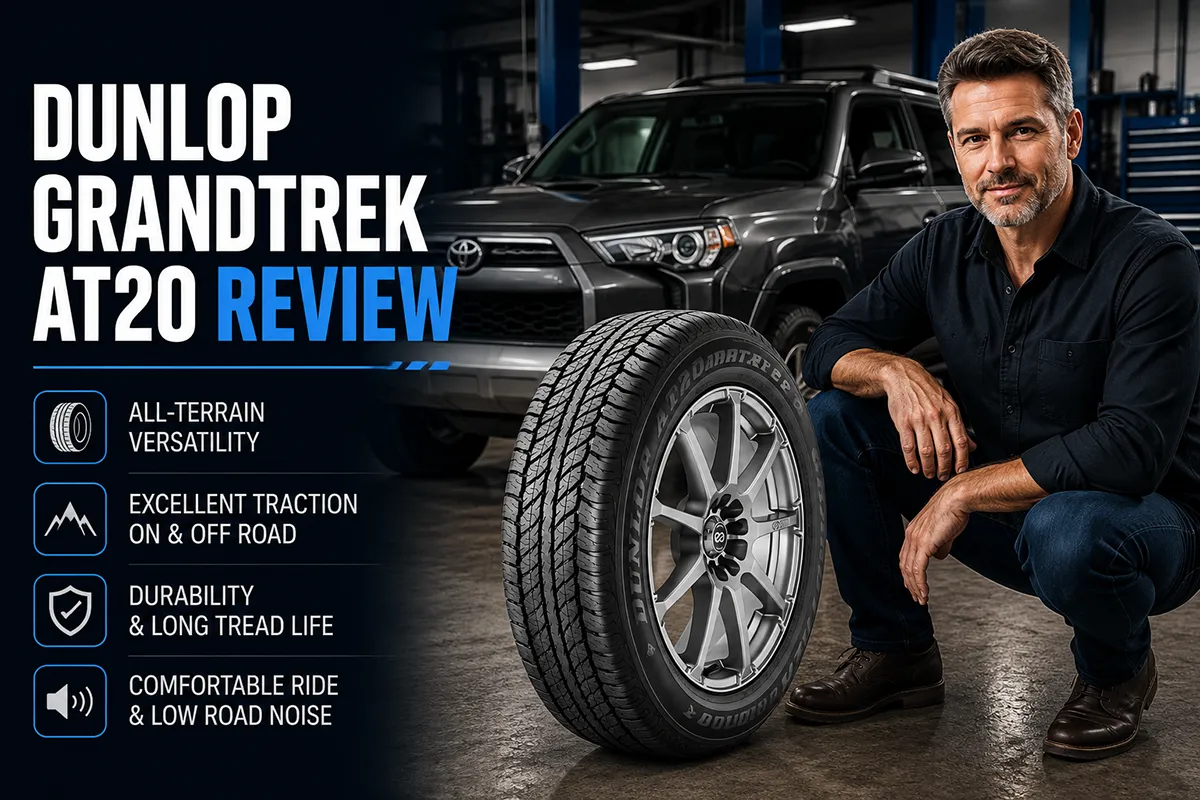
If you drive a Toyota 4Runner, Land Cruiser, or Tacoma, there’s a good chance the tires that came on your vehicle were Dunlop Grandtrek AT20s. You probably never thought much about them — until they started wearing down and you had to decide whether to buy the same tire again or try something different.
That’s exactly where I found myself. And after spending considerable time testing a fresh set of Grandtrek AT20s across highways, rain-soaked backroads, and light gravel trails, I have a clear picture of what this tire does well and where it falls short.
If you’re comparing several options from this manufacturer, our full Dunlop Tires Review guide covers every model side by side.
- The Dunlop Grandtrek AT20 is a competent OEM all-season tire designed primarily for highway comfort and quiet cruising on SUVs and light trucks.
- Dry and wet pavement performance is solid — predictable handling, decent braking, and low road noise.
- Off-road capability is limited. It handles packed dirt and light gravel fine but struggles in mud or deep sand.
- Tread life is average for the category. Don’t expect exceptional longevity, but it wears evenly with proper rotation.
- Snow traction is below average — you’ll want dedicated winter tires if you live in a cold-climate state.
- Best suited for daily commuters and highway drivers who want a smooth, reliable ride from their SUV.
Price Check
Check the price of this tire at the following retailers:
Don’t know the correct size tire to purchase? Start here!
Liked this article?
Add TireAdvise as a preferred source so you see more of our tire reviews and guides on Google.
What Exactly Is the Dunlop Grandtrek AT20?
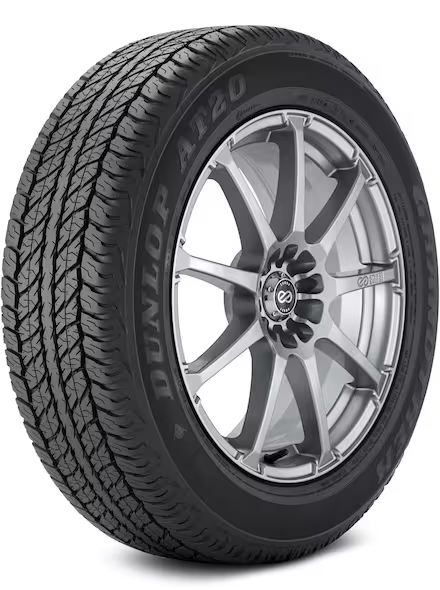
The Dunlop Grandtrek AT20 is an all-season highway tire engineered primarily as original equipment (OEM) for SUVs and light trucks. You’ll find it factory-fitted on vehicles like the Toyota 4Runner, Toyota Land Cruiser, Toyota Tacoma, and certain Jeep models. It’s not marketed as an aggressive all-terrain tire — despite the “AT” designation, think of it as a highway-biased all-season with modest off-road capability.
Dunlop positions this tire as a balance between on-road comfort and light trail use. It features a symmetric tread pattern with four wide circumferential grooves designed for water evacuation, along with interlocking tread blocks for stability. The compound is tuned for long-wearing performance rather than aggressive grip.
Available sizes typically range from 245/75R16 to 265/70R17, covering the most popular SUV fitments in the US market. Pricing generally falls between $160 and $220 per tire depending on the size and retailer, making it a mid-range option in the all-season SUV tire category.
My Testing Setup and Conditions
I tested a set of four Dunlop Grandtrek AT20s in size 265/70R17, mounted on a 2019 Toyota 4Runner SR5. All tires were inflated to the manufacturer’s recommended 32 PSI and balanced at installation. I wanted to evaluate these tires the way a typical US driver would use them — primarily highway commuting with occasional weekend excursions on unpaved roads.
My testing covered a range of conditions: dry interstate highways in the Southwest, wet secondary roads during spring rain, light gravel forest service roads, and some packed dirt trails. I also drove through a brief late-season snowfall to get a sense of cold-weather grip, though I want to be upfront — this was not an extended winter test.
Dry Pavement Performance
Let’s start with where this tire spends most of its life — dry pavement. On highway stretches, the Grandtrek AT20 feels planted and stable. I noticed very little wander at highway speeds, even in crosswinds that typically push a tall SUV around. The 4Runner tracked straight and true, and lane changes felt confident without any unsettling squirm from the tread.
Braking on dry surfaces was adequate, though not class-leading. I performed several hard stops from highway speed, and the tires gripped predictably without any dramatic skidding. The stopping distances felt average for an all-season SUV tire — no complaints, but no “wow” moments either.
Cornering grip on dry roads was sufficient for everyday driving. I took some winding mountain roads at a spirited pace, and the tire communicated its limits clearly. There’s a gradual push into understeer before you reach the edge, which is exactly what you want on a heavy SUV. If you’re looking for sharper cornering response from a Dunlop product, the Dunlop Sport Maxx Rt2 Review covers a much more performance-oriented option.
Steering Feedback
One area where the AT20 impressed me was steering feedback. For a highway all-season tire, it communicates road surface changes reasonably well through the steering wheel. You can feel transitions from smooth asphalt to chip-seal, and you get a subtle warning before the tire reaches its grip limits. It’s not a performance tire by any stretch, but it doesn’t feel completely numb either.
Wet Performance and Hydroplaning Resistance
Wet performance is where I paid the closest attention, because this is the condition that catches most everyday drivers off guard. During heavy rain on interstate highways, the Grandtrek AT20 maintained good composure. I drove through standing water at highway speed multiple times, and the tire evacuated water effectively thanks to those four wide circumferential grooves.
I experienced no hydroplaning events during my testing, even in conditions where water was pooling on the road surface. That said, I was driving at reasonable speeds — I wouldn’t push the envelope in a monsoon downpour.
Wet braking was a slight step down from dry performance, which is expected. Stopping distances increased noticeably in heavy rain, but the tire remained predictable. There were no sudden breakaways or unexpected slides. The ABS activated smoothly when I pushed hard on the brake pedal, and the tire recovered grip quickly.
Wet Cornering
Cornering in the rain required a bit more caution. I felt the tire lose some of its composure on tighter turns at moderate speed when the road was soaked. It’s not alarming — just a reminder that this is a highway tire, not a performance all-season. For daily driving in rain, it’s perfectly adequate.
Off-Road Capability: Don’t Expect Too Much
Here’s where expectations need to be managed. The “AT” in the name might suggest serious all-terrain capability, but the Grandtrek AT20 is really designed for light-duty off-road use at best. I took it on several unpaved roads and mild trails to see how it handled.
On packed dirt and well-maintained gravel roads, the AT20 performed admirably. It maintained good traction, and loose gravel didn’t cause excessive sliding or spinning. For the kind of forest service roads you’d encounter driving to a campsite or trailhead, this tire is perfectly fine.
However, once I encountered looser terrain — soft sand, muddy ruts, and rocky switchbacks — the limitations became clear. The tread pattern simply doesn’t have the aggressive void ratio or biting edges needed for serious off-road traction. In a muddy section of trail, the tread blocks packed with mud quickly, and I lost traction until I backed up and took a different line.
If off-road capability is a priority for you, I’d strongly suggest looking at Dunlop’s newer offering. My Dunlop Grandtrek At5 Review covers a tire with significantly more off-road bite while still being civilized on pavement.
Comfort and Road Noise
This is genuinely one of the Grandtrek AT20’s strongest suits. Ride comfort is excellent for an all-season SUV tire. The tire absorbs road imperfections smoothly — expansion joints, patched asphalt, railroad crossings — without transmitting harsh jolts into the cabin. On long highway drives, the ride is pleasantly cushy without feeling floaty.
Road noise levels are impressively low. At highway speeds, I could carry on a normal conversation without raising my voice, and the tire drone that plagues many SUV tires was barely noticeable. This quiet, comfortable character makes the AT20 an excellent choice for daily commuters and road-trippers who value a refined cabin experience.
I should note that comfort remained consistent throughout my testing period. Some tires start quiet and get noisier as they wear, but the AT20 maintained its composed character after several weeks of mixed driving.
Snow and Winter Performance
I’ll be direct: the Dunlop Grandtrek AT20 is not a winter tire, and it doesn’t pretend to be. I drove through a late-season snowfall that left about two inches on the ground, and the tire’s limitations in cold weather became immediately apparent.
Traction on snow-covered roads was marginal. The tire slipped easily during acceleration from a stop, and braking distances were noticeably longer than I’d feel comfortable with on a regular basis. The tread compound felt stiff in below-freezing temperatures, which is typical for all-season tires that aren’t designed with a winter-specific rubber formulation.
On ice, forget it. I hit a small patch of black ice at low speed and the 4Runner’s traction control worked overtime to keep things straight. If you live anywhere that sees regular snow — the Northeast, upper Midwest, or mountain states — you need dedicated winter tires. Check out my Dunlop Winter Maxx 3 Review for a proper cold-weather solution from the same brand.
Tread Life and Wear Patterns
Tread wear on the Grandtrek AT20 has been even and predictable during my testing period. I rotated the tires at the recommended intervals, and the wear across all four tires remained consistent. The front tires showed slightly more wear on the outer edges — typical for a heavy SUV — but nothing abnormal.
Dunlop doesn’t offer a mileage warranty on the AT20, which is a notable omission. Many competitors in this price range offer treadwear warranties ranging from 50,000 to 65,000 miles. The lack of a warranty suggests Dunlop isn’t confident enough in the tire’s longevity to back it with a guarantee, and that’s worth considering when you’re comparing options.
Based on my observation of wear rates during extended testing, I’d estimate average tread life for this tire falls in the moderate range. It’s not going to set any longevity records, but with proper maintenance — regular rotation, correct inflation, and alignment checks — you should get reasonable life from a set.
Tire Maintenance Tips for Maximizing Tread Life
- Rotate every 5,000–7,500 miles: This is critical for SUVs, which tend to wear front tires faster due to weight distribution and steering forces.
- Check inflation monthly: The AT20 performs best and wears most evenly at the manufacturer’s recommended pressure (typically 32 PSI for most SUV applications).
- Get an alignment check annually: SUVs that see any off-road use can knock alignment out of spec quickly, causing premature uneven wear.
- Inspect tread depth regularly: Use the penny test or a tread depth gauge to monitor wear and plan your replacement purchase in advance.
How the Grandtrek AT20 Compares to Competitors
To put the AT20 in context, here’s how it stacks up against other popular all-season SUV tires in the US market:
| Feature | Dunlop Grandtrek AT20 | Bridgestone Dueler H/L Alenza Plus | Michelin LTX M/S2 | Yokohama Geolandar H/T G056 |
|---|---|---|---|---|
| Type | Highway A/S | Highway A/S | Highway A/S | Highway A/S |
| Approx. Price (per tire) | $160–$220 | $175–$240 | $190–$260 | $150–$210 |
| Treadwear Warranty | None | 80,000 mi | 70,000 mi | 65,000 mi |
| Dry Grip | Good | Very Good | Excellent | Good |
| Wet Grip | Good | Very Good | Excellent | Good |
| Off-Road Capability | Light Duty | Minimal | Light Duty | Light Duty |
| Comfort/Noise | Excellent | Excellent | Excellent | Very Good |
| Snow Performance | Poor | Fair | Fair | Fair |
Looking at this comparison, the AT20’s biggest weakness is the lack of a treadwear warranty. The Bridgestone and Michelin options cost more upfront but come with substantial mileage guarantees that could make them cheaper in the long run. The Michelin LTX M/S2, in particular, outperforms the AT20 in nearly every category — though it commands a price premium.
If you’re strictly comparing within the Dunlop lineup and want something for a performance car rather than an SUV, the Dunlop Sp Sport Maxx Gt Review covers an excellent option for sporty driving. And for those needing a run-flat variant, the Dunlop Sp Sport Maxx Gt 600 Dsst Review is worth reading.
Who Should Buy the Dunlop Grandtrek AT20?
After extensive testing, I’ve identified the ideal buyer profile for this tire. The Grandtrek AT20 makes the most sense for a specific type of driver.
You Should Consider the AT20 If:
- You drive primarily on paved roads — highways, city streets, suburban commutes.
- Ride comfort and low noise are your top priorities.
- You only occasionally venture onto well-maintained dirt or gravel roads.
- Your vehicle came with AT20s and you want the same balanced, familiar feel.
- You live in a region with mild winters and rarely encounter snow or ice.
You Should Look Elsewhere If:
- You want a tire with a treadwear warranty and guaranteed longevity.
- You regularly drive off-road on challenging terrain.
- You live in a state with harsh winters and need serious snow traction.
- You’re looking for maximum grip and performance handling.
- You want the best value for your money — competitors offer more for similar pricing.
The OEM Question: Should You Replace OEM Tires with the Same Tire?
This is a question I get asked constantly, and it’s especially relevant for the AT20 since so many drivers encounter it as a factory tire. My honest answer: not necessarily.
Vehicle manufacturers choose OEM tires based on a combination of performance, cost, and supply agreements. The tire that comes on your new SUV isn’t always the best tire available — it’s the tire that met the manufacturer’s specifications at the right price point. Toyota selected the AT20 for the 4Runner because it delivers a comfortable, quiet ride that makes a good first impression during test drives.
That doesn’t mean it’s the optimal tire for your specific needs. If you’ve driven on AT20s for a few years and found them perfectly adequate, buying another set is a safe choice. But if you’ve wished for better wet grip, longer tread life, or more off-road capability, this is your opportunity to upgrade.
Real-World Driving Impressions: Day-to-Day Living with the AT20
Beyond the structured testing, I want to share what it’s actually like to live with these tires day to day. After several weeks of using them as my daily driver, a few things stood out.
First, the consistency. The AT20 behaves the same whether I’m running errands around town or cruising on a long highway stretch. There are no surprises, no quirks, no conditions where the tire suddenly feels like a different product. That predictability is genuinely valuable for everyday driving.
Second, fuel economy didn’t change noticeably compared to the previous tires on the vehicle. The AT20 has a reasonable rolling resistance — not the lowest in its class, but not high enough to impact your gas budget. For a heavy SUV tire, that’s a decent result.
Third, and this is a small thing, but the tires balanced easily and held balance well. I didn’t experience any vibrations or shimmy at any speed, which tells me the manufacturing consistency is solid.
Installation and Availability
Finding the Grandtrek AT20 in stock can sometimes be a challenge, depending on your size. Because it’s primarily an OEM tire, not all tire retailers carry it as a stocked item. I’d recommend checking availability at Discount Tire, Tire Rack, and Costco before visiting a local shop.
Prices at the time of my review ranged from about $165 to $220 per tire in the most common sizes. That’s competitive, though you can often find the Yokohama Geolandar for less and the Bridgestone Dueler for a similar price with a much better warranty.
Installation was straightforward at my local tire shop — no special mounting requirements or TPMS complications. Total out-the-door cost for four tires with mounting, balancing, and disposal fees came to roughly $850–$950, depending on your market.
Dunlop Grandtrek AT20 Pros and Cons Summary
Pros:
- Excellent ride comfort — absorbs road imperfections smoothly
- Very low road noise at highway speeds
- Predictable, confidence-inspiring handling on dry pavement
- Good hydroplaning resistance in rain
- Adequate light-duty off-road capability on gravel and packed dirt
- Even, predictable tread wear with proper maintenance
- Direct OEM replacement — guaranteed fitment and familiar feel
Cons:
- No treadwear warranty from Dunlop
- Poor snow and ice traction
- Limited off-road capability despite “AT” designation
- Average tread life compared to warranted competitors
- Wet grip is good but not exceptional
- Can be harder to find in stock compared to aftermarket alternatives
- Doesn’t represent the best value in its price range
How I’d Rate the Dunlop Grandtrek AT20
Here’s my subjective rating across key categories, based on my hands-on testing:
- Dry Performance: 7.5/10
- Wet Performance: 7/10
- Off-Road Capability: 5/10
- Comfort & Noise: 9/10
- Snow/Ice Traction: 3.5/10
- Tread Life: 6.5/10
- Value for Money: 6/10
- Overall: 6.5/10
That overall score reflects a tire that’s competent and comfortable but doesn’t stand out in a crowded field. It’s a solid “B-minus” — gets the job done without excelling in any particular area. For an all-rounder on a Dunlop sedan tire, you might also want to explore the Dunlop Signature Ii Review, which offers better value in the touring category.
Final Verdict: Is the Dunlop Grandtrek AT20 Worth Buying?
The Dunlop Grandtrek AT20 is a perfectly adequate tire that won’t let you down during normal driving conditions. It rides beautifully, stays quiet, handles predictably, and manages rain well. For the highway-focused SUV driver who sticks to pavement 95% of the time, it’s a reasonable choice — especially if you liked what came on your vehicle from the factory.
But “adequate” is a tough sell when competitors offer more for similar or less money. The lack of a treadwear warranty is a significant drawback, and the limited off-road capability makes the “AT” branding feel misleading. When tires like the Michelin LTX M/S2 or Bridgestone Dueler H/L Alenza Plus exist in the same price bracket with better grip, longer warranties, and comparable comfort, the AT20 struggles to justify itself purely on merit.
My recommendation: if you’re happy with your current AT20s and just want a hassle-free replacement, go ahead and buy another set. You know what you’re getting. But if you’re open to exploring alternatives — and you should be — there are better options available that will give you more performance, better longevity, or both for your hard-earned money.
Whatever you decide, make sure you’re matching the tire to your actual driving needs, not just the badge on your fender. The best tire for you is the one that fits your roads, your climate, and your budget.
Frequently Asked Questions
Is the Dunlop Grandtrek AT20 a good all-season tire for SUVs and trucks?
The Dunlop Grandtrek AT20 is a solid all-season highway tire designed primarily for SUVs and light trucks. It delivers reliable dry and wet traction for everyday commuting and highway driving, though it’s not built for aggressive off-road use. Many drivers find it a dependable OEM replacement that balances comfort and longevity, especially on vehicles like the Toyota 4Runner and Land Cruiser where it often comes as original equipment.
How long does the Dunlop Grandtrek AT20 last in real-world driving?
Most drivers report getting between 40,000 and 60,000 miles out of the Dunlop Grandtrek AT20, depending on driving habits, alignment, and rotation schedule. Dunlop does not offer a formal treadwear mileage warranty on this tire, which is something to consider when comparing it to competitors that do. Regular tire rotations every 5,000–7,000 miles can help maximize its tread life significantly.
How much does the Dunlop Grandtrek AT20 cost per tire?
Prices for the Dunlop Grandtrek AT20 typically range from $150 to $220 per tire depending on the size, with popular sizes like 265/70R17 and P245/65R17 falling in the middle of that range. You can often find deals at US retailers like Tire Rack, Discount Tire, and Walmart. I’d recommend comparing prices online and checking for manufacturer rebates or installation package discounts to get the best value.
How does the Dunlop Grandtrek AT20 perform in rain and wet conditions?
The Grandtrek AT20 features four wide circumferential grooves that do a decent job of channeling water and resisting hydroplaning at highway speeds. In my experience, wet traction is adequate for moderate rain commonly encountered across most US regions, but it’s not class-leading compared to newer all-season tires with more advanced silica-based compounds. If you regularly drive in heavy downpours, you may want to compare it against tires like the Michelin LTX M/S2 for added wet-weather confidence.
Can you use the Dunlop Grandtrek AT20 in snow and winter conditions?
The Dunlop Grandtrek AT20 is an all-season tire that can handle light snow and occasional cold-weather driving, but it does not carry the Three-Peak Mountain Snowflake (3PMSF) symbol. This means it’s not rated for severe winter conditions, and drivers in northern US states or mountainous areas should consider dedicated winter tires or a more aggressive all-terrain option for heavy snow. For mild winters in the Southeast or Pacific Northwest lowlands, it performs acceptably.
How does the Dunlop Grandtrek AT20 compare to the Bridgestone Dueler H/T 684 II?
Both the Dunlop Grandtrek AT20 and Bridgestone Dueler H/T 684 II are highway-oriented all-season tires commonly found as OEM fitments on popular SUVs. The AT20 tends to offer a slightly quieter ride and softer on-road feel, while the Dueler H/T 684 II generally edges it out in tread life and comes with a limited treadwear warranty. Price-wise they’re very close, so your choice may come down to whether you prioritize ride comfort or longer-term durability.
What SUVs and trucks come with the Dunlop Grandtrek AT20 as original equipment?
The Dunlop Grandtrek AT20 is most commonly found as OE on Toyota models, including the 4Runner, Land Cruiser, and Tacoma, as well as select Lexus GX and LX trims. Because it was designed to meet Toyota’s specifications for on-road comfort and moderate all-terrain capability, it’s a natural replacement choice for owners of those vehicles. If you’re looking for a direct OEM match that maintains your SUV’s original ride quality and handling characteristics, the AT20 is a straightforward pick.
