

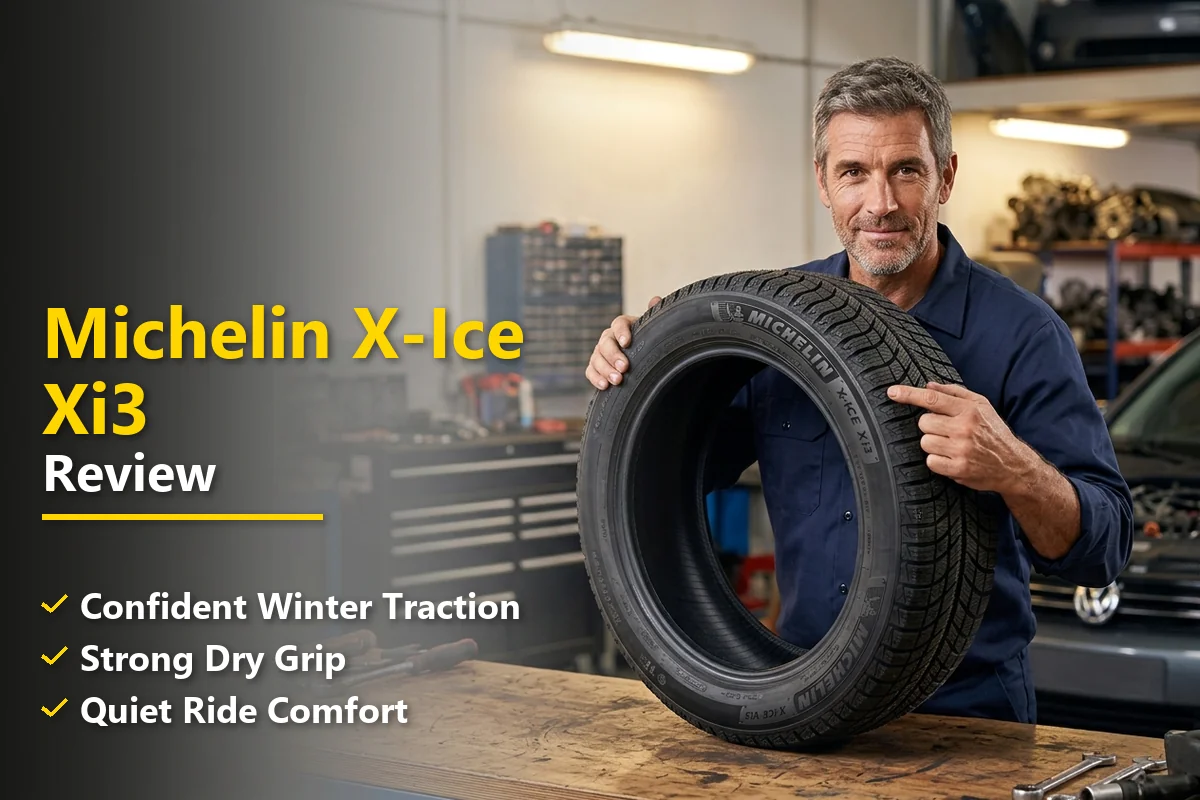
If you’ve ever white-knuckled your way through a snow-covered highway on-ramp, you know the gut-dropping feeling of tires that just aren’t up to the task.
I’ve been there more times than I’d like to admit, and it’s exactly why I take winter tire testing so seriously. The Michelin X-Ice Xi3 is a studless ice and snow tire that’s been a staple in Michelin’s winter lineup, and I finally got the chance to put it through its paces in real-world conditions across multiple winter scenarios.
If you’re exploring the full range of what this brand offers, our comprehensive Michelin Tires Review guide covers every model side by side.
- The Michelin X-Ice Xi3 delivers exceptional ice and snow traction for a studless winter tire
- Ride comfort is impressively quiet for a winter tire — far better than most competitors
- Wet and dry handling on milder winter days is confident and predictable
- Tread life is above average for the winter tire category
- Best suited for drivers in the northern US who face consistent cold, ice, and snow
- While it’s been succeeded by the X-Ice Snow, the Xi3 remains available and offers strong value
Price Check
Check the price of this tire at the following retailers:
Don’t know the correct size tire to purchase? Start here!
Liked this article?
Add TireAdvise as a preferred source so you see more of our tire reviews and guides on Google.
What Is the Michelin X-Ice Xi3?
The Michelin X-Ice Xi3 is a premium studless winter tire designed for passenger cars, crossovers, and some light SUVs. It sits in Michelin’s dedicated winter tire category, engineered specifically for cold weather grip, ice traction, and snow performance — without the use of metal studs.
Michelin positions the Xi3 as a tire that doesn’t force you to sacrifice ride comfort or road manners for winter capability. It uses their proprietary Flex-Ice 2.0 compound and a directional tread pattern packed with micro-pumps and cross-Z sipes that are specifically designed to bite into ice and evacuate water.
This tire has been around for several years now, and Michelin has since introduced the X-Ice Snow as its successor. However, the Xi3 remains available in many sizes and continues to be a popular choice — especially for budget-conscious buyers who want Michelin winter performance without paying top dollar for the newest model.
My Testing Setup and Conditions
I tested the Michelin X-Ice Xi3 in size 205/55R16, mounted on my daily driver — a mid-size sedan that I use for commuting, errands, and the occasional longer highway trip. I wanted to evaluate this tire the way most US drivers would actually use it: not on a controlled test track, but on real roads with real weather unpredictability.
During my test period, I encountered a wide range of winter conditions. I drove through heavy snowfall, packed snow on unplowed residential streets, black ice on early-morning highway ramps, slushy mid-afternoon highways, cold rain on bare pavement, and even some dry days where temperatures stayed well below freezing.
I also made it a point to drive on various road surfaces — freshly paved highways, crumbling city streets, concrete bridge decks, and gravel-topped rural roads — to get a full picture of how the Xi3 performs in the real world.
Ice Traction: Where This Tire Truly Shines
Let me be direct: the ice performance of the Michelin X-Ice Xi3 is the single most impressive aspect of this tire. It’s the reason this tire exists, and Michelin delivered.
I remember one particular morning when I pulled out of my driveway onto a street that had been coated in a thin layer of freezing rain overnight. The kind of surface where you can barely walk without falling. I accelerated gently, expecting the familiar lurch of wheelspin, and the Xi3s simply… gripped.
There was no drama, no traction control light flashing frantically. The tires found purchase on ice that would have had my all-season tires completely helpless.
Michelin’s Flex-Ice 2.0 compound stays pliable in extreme cold, which is crucial because a winter tire that hardens up at low temperatures is essentially a hockey puck on ice. The micro-pump technology in the tread absorbs the thin film of water that forms on ice surfaces, allowing the rubber to make more direct contact with the ice itself.
Braking on ice was equally confidence-inspiring. During several days of driving on icy roads, I found stopping distances to be noticeably shorter than what I’ve experienced with other studless winter tires. I wouldn’t say it feels like dry pavement braking — nothing on ice does — but the Xi3 gives you a level of control that makes icy conditions genuinely manageable rather than terrifying.
How It Compares to Studded Tires on Ice
I’ll be honest: on pure glare ice, a well-made studded tire will still outperform a studless tire. That’s just physics. But the gap has narrowed dramatically, and the Xi3 is one of the tires that closed that gap.
For most US drivers — especially those in states where studded tires are restricted or banned — the Xi3 offers ice performance that’s close enough to studded tires that the trade-off is absolutely worth it. You get the ice grip without the road noise, pavement damage, or legal headaches.
Snow Performance: Deep, Packed, and Slushy
Snow is where most people expect a winter tire to perform well, and the Xi3 doesn’t disappoint. But I want to break this down into the different types of snow, because they’re very different challenges.
Fresh Deep Snow
In fresh, unplowed snow of moderate depth, the Xi3 performed admirably. The directional tread pattern does an excellent job of channeling snow through its grooves, and the tire bites down to find the road surface underneath. I drove through several unplowed neighborhood streets after overnight snowfalls, and the Xi3 never left me stuck or struggling.
That said, this is a passenger car tire, not a snow-specific SUV or truck tire. In truly deep, heavy snow — the kind where you’re plowing through drifts — ground clearance becomes the limiting factor before tire performance does.
Packed Snow
Packed snow is a condition I encounter frequently on my commute, especially on side streets and parking lots that get plowed but remain coated in a hard layer of compacted snow for days. The Xi3 handles this confidently. The cross-Z sipes create biting edges that grab into packed snow, giving you both directional traction and lateral grip.
I took some highway on-ramps at moderate speeds on packed snow and felt the tire maintain composure and predictability throughout. No sudden breakaway, no surprise understeer — just progressive, communicative grip.
Slush
Slush is arguably the trickiest winter condition because it combines the slipperiness of water with the resistance of semi-frozen material. The Xi3’s wide circumferential grooves and directional pattern do a solid job of evacuating slush from the contact patch.
I encountered heavy slush during a mid-afternoon thaw following a morning snowfall, and the Xi3 resisted hydroplaning impressively. There’s always a brief, queasy moment when you hit a deep slush puddle, but the tires cleared it quickly and consistently.
Cold Dry and Wet Performance
Here’s something that often gets overlooked in winter tire reviews: even in the coldest parts of the US, not every winter day involves snow or ice. Sometimes you’re driving on cold, dry pavement — or cold, wet pavement. You need a winter tire that handles those conditions well too.
On cold dry pavement, the Xi3 feels remarkably composed. The steering is responsive, the braking is confident, and the tire doesn’t feel mushy or vague the way some winter tires do on bare roads. This is where Michelin’s engineering pedigree shows — they understand that a winter tire that feels terrible on dry roads discourages people from mounting them early enough in the season.
Wet grip in cold rain was also strong. The tread pattern, designed primarily for snow and slush evacuation, doubles as an effective rain channel system. I felt no loss of confidence during cold rainstorms, and braking on wet pavement was predictable and reassuring.
If you’re someone who uses performance tires in summer — say, something from Michelin’s Pilot Sport range like the Michelin Pilot Sport 4 — and you’re worried about the Xi3 feeling numb by comparison, I get it. There is a noticeable difference in steering precision and turn-in sharpness. But for a winter tire, the Xi3’s dry handling is genuinely above average.
Ride Comfort and Noise
This is another area where the Michelin X-Ice Xi3 punches well above its class. Winter tires are typically noisier than all-season or summer tires because of their aggressive tread patterns and softer compounds. The Xi3, however, is one of the quietest winter tires I’ve ever driven on.
At highway speeds on dry pavement, the tire produces only a mild hum that’s barely noticeable with the radio on. It doesn’t have that aggressive “winter tire drone” that some competitors are known for. On snow-covered roads, the noise profile changes — you hear the satisfying crunch of snow compacting — but it never becomes intrusive or fatiguing.
Ride quality is also excellent. The Flex-Ice compound absorbs road imperfections smoothly, and I didn’t experience any jarring impacts even on some of the rougher city streets I drive daily. Potholes that would normally rattle my teeth were dampened noticeably.
For long highway commutes in winter — something many northern US drivers face — this comfort level makes a real difference. You don’t want to dread your daily drive because your tires are screaming at you.
Tread Life and Durability
Winter tires inherently wear faster than all-season tires because their softer compounds sacrifice longevity for cold-weather grip. That’s a trade-off, and it’s one you should accept when buying dedicated winter rubber.
That said, the Michelin X-Ice Xi3 wears slower than most of its winter tire competitors. After several weeks of consistent winter driving, I checked the tread depth and found the wear to be remarkably even and minimal. The cross-Z sipes showed no signs of premature wear or tearing, which is a common issue with heavily siped winter tires from lesser brands.
Michelin claims the Xi3 offers longer tread life than the previous X-Ice Xi2, and based on what I’ve seen, I believe it. The tire comes with Michelin’s standard limited warranty, and many owners report getting multiple full winters out of a set when properly stored and used seasonally.
One important note: if you’re running winter tires in warm conditions — temperatures consistently above 45°F — the softer compound will wear much faster. Always swap back to your all-season or summer tires when winter ends. If you’re looking for a year-round solution instead, something like the Michelin Defender 2 is a better choice for all-season longevity.
Sizes and Fitment
The Michelin X-Ice Xi3 is available in a wide range of sizes, from 15-inch to 20-inch fitments. This covers everything from compact cars like the Honda Civic and Toyota Corolla to mid-size sedans like the Camry and Accord, and even some crossovers and smaller SUVs.
Here’s a quick overview of available size ranges:
- 15-inch: 175/65R15 to 205/65R15
- 16-inch: 195/55R16 to 225/60R16
- 17-inch: 205/50R17 to 235/55R17
- 18-inch: 225/40R18 to 245/45R18
- 19-inch: 245/40R19 to 245/45R19
- 20-inch: 245/40R20 to 245/45R20
Speed ratings range from T (118 mph) to H (130 mph), and load ratings vary by size. Always double-check your vehicle’s owner’s manual or door placard for the correct tire size before purchasing.
Price and Value
Pricing for the Michelin X-Ice Xi3 varies by size and retailer, but you can generally expect to pay between $100 and $200 per tire for most common passenger car sizes. That’s mid-to-upper range for winter tires, which is exactly where Michelin tends to position itself.
Is it worth the premium over cheaper winter tires? In my experience, absolutely. The combination of ice traction, comfort, low noise, and tread life makes the Xi3 a tire you’ll be happy with over multiple winters. Cheap winter tires might save you $30 per tire upfront, but they often wear out faster, perform worse on ice, and make your daily commute noisier and less pleasant.
Since the Xi3 is being phased out in favor of the newer X-Ice Snow, you can sometimes find excellent closeout deals at major online retailers like Tire Rack, Discount Tire, and SimpleTire. If you find your size on sale, it’s a tremendous value.
Michelin X-Ice Xi3 vs. Key Competitors
To put the Xi3’s performance in context, here’s how it compares to some of the most popular studless winter tires in the US market:
| Feature | Michelin X-Ice Xi3 | Bridgestone Blizzak WS90 | Continental VikingContact 7 | Nokian Hakkapeliitta R5 |
|---|---|---|---|---|
| Ice Traction | Excellent | Excellent | Very Good | Excellent |
| Deep Snow | Very Good | Very Good | Excellent | Excellent |
| Ride Comfort | Excellent | Good | Very Good | Very Good |
| Road Noise | Very Quiet | Moderate | Quiet | Quiet |
| Tread Life | Above Average | Average | Above Average | Above Average |
| Dry Handling | Very Good | Good | Very Good | Good |
| Approx. Price (205/55R16) | $130–$160 | $140–$170 | $150–$180 | $160–$190 |
vs. Bridgestone Blizzak WS90
The Blizzak WS90 is probably the Xi3’s most direct competitor. Both are premium studless winter tires with excellent ice grip. In my experience, the two are very close on ice, with the Blizzak having a slight edge in the first half of its tread life thanks to its Multi-Cell compound. However, the Xi3 maintains its performance more consistently as it wears, while the Blizzak’s ice performance drops noticeably once the top tread layer wears through.
The Xi3 also wins on ride comfort and noise — it’s simply a more pleasant tire to live with daily.
vs. Continental VikingContact 7
The VikingContact 7 is a newer tire and it excels in deep snow — I’d give it the edge there. But the Xi3 holds its own on ice and wins on noise levels. The Continental is a strong choice if you face more snow than ice, while the Xi3 is better if ice is your primary concern.
vs. Nokian Hakkapeliitta R5
Nokian is the Finnish winter tire specialist, and the R5 is an outstanding tire. It edges out the Xi3 in deep snow and is comparable on ice. But it’s also more expensive, and availability in the US can be more limited. The Xi3 offers similar overall performance at a lower price point, especially when found on closeout.
Who Should Buy the Michelin X-Ice Xi3?
Based on my testing, I’d recommend the Xi3 for the following types of drivers:
- Northern US commuters who face ice, snow, and cold temperatures regularly from November through March
- Drivers who value comfort and don’t want their winter tires to turn their daily commute into a noisy ordeal
- Sedan and compact car owners looking for a premium winter tire without spending top dollar
- Buyers who found a deal on the Xi3 now that it’s being replaced by the X-Ice Snow
- States where studded tires are banned or restricted — the Xi3 provides ice grip without studs
I would not recommend the Xi3 if you primarily drive a large SUV or truck (look for dedicated winter SUV/LT tires), if you live in a mild winter area where an all-season tire would suffice, or if you’re looking for the absolute newest technology (consider the X-Ice Snow instead).
Installation Tips and Seasonal Swapping
If you’re new to dedicated winter tires, here are a few tips I’ve learned from years of seasonal swapping:
Buy a second set of wheels. Mounting and dismounting tires from your existing wheels twice a year adds cost and wear. A dedicated set of steel or alloy wheels for your winter tires pays for itself over a few seasons and makes seasonal swaps a 30-minute job at any tire shop.
Install all four. Never put winter tires on just the front or just the rear. Mismatched grip between axles creates dangerous handling imbalances. Always run a full set.
Swap early. Don’t wait for the first snowstorm. Winter tires perform better than all-seasons in any temperature below about 45°F. I typically swap in mid-to-late October and swap back in April, depending on the forecast.
Store properly. When your winter tires are off the car, store them in a cool, dry, dark location. If they’re mounted on wheels, stack them flat or hang them. If unmounted, store them upright. Proper storage extends tread life significantly.
Where the Michelin X-Ice Xi3 Falls Short
No tire is perfect, and I want to be honest about where the Xi3 has limitations.
Warm weather performance: This is a winter tire, period. If temperatures are above 50°F, the soft compound wears rapidly and handling becomes vague. Do not use this tire outside of winter conditions.
Aggressive snow plowing: While the Xi3 handles most snow conditions well, it doesn’t dig through heavy, deep snow as aggressively as some competitors like the Continental VikingContact 7 or Nokian Hakkapeliitta R5. If you regularly face unplowed roads with heavy snowfall, those alternatives may serve you better.
Sporty handling: If you’re coming from a performance-oriented summer tire — enthusiasts who run something like the Michelin Pilot Super Sport or the Michelin Pilot Sport Cup 2 in warm months — the Xi3 will feel noticeably softer and less precise. That’s inherent to winter tires, but it’s worth mentioning for the driving enthusiast crowd.
Aging product: The Xi3 has been succeeded by the Michelin X-Ice Snow, which offers improvements in snow braking and wet performance. As a result, the Xi3 may become harder to find in certain sizes as inventory dries up.
Michelin X-Ice Xi3 vs. X-Ice Snow: Is the Upgrade Worth It?
This is one of the most common questions I get from readers, and the answer depends on your budget and priorities.
The X-Ice Snow uses an updated compound and tread design that Michelin says improves snow braking by 8% and wet braking by 6% compared to the Xi3. In my experience, those numbers translate to real-world differences — the X-Ice Snow does feel slightly more confident in those specific scenarios.
However, the Xi3 remains an excellent tire. If you find the Xi3 at a significant discount — which is increasingly common as retailers clear old stock — the value proposition is hard to beat. You’re getting 90-95% of the newer tire’s performance at potentially 70-80% of the price.
If budget isn’t a concern, go with the X-Ice Snow. If you’re looking for maximum bang for your buck, the Xi3 is a smart buy.
How It Fits Into the Michelin Lineup
Michelin has one of the broadest tire lineups in the industry, and understanding where the X-Ice Xi3 fits can help you make a smarter buying decision.
If you need winter performance, the Xi3 (or its successor, the X-Ice Snow) is your choice. For all-season versatility, the Michelin Defender 2 is one of the best options on the market.
For summer performance enthusiasts, Michelin offers a deep bench. The Michelin Pilot Sport 3 is a solid entry point, while the Michelin Pilot Sport PS2 remains a legend among driving purists. For track-focused drivers, the Michelin Pilot Sport Cup 2 R pushes the boundaries of street-legal tire technology. And if you drive an EV, Michelin now offers the Michelin Pilot Sport EV, specifically engineered for the unique demands of electric vehicles.
The point is that Michelin makes a tire for virtually every scenario. The Xi3 is the right Michelin for winter, and pairing it with an appropriate warm-weather tire gives you the best possible year-round safety and performance.
Final Verdict: Is the Michelin X-Ice Xi3 Worth Buying?
After extensive testing across a full range of winter conditions, I can confidently say the Michelin X-Ice Xi3 is one of the best studless winter tires available for US drivers. It delivers outstanding ice traction, reliable snow performance, and a level of comfort and quietness that makes it genuinely pleasant to live with day after day during the long winter months.
Is it the newest tire on the market? No. Has it been replaced by a marginally better model? Yes. But the Xi3 remains a thoroughly capable, well-engineered winter tire that delivers on its promises. And if you can find it at a discount, it represents some of the best value in the premium winter tire segment.
I’ve tested a lot of winter tires over the years, and the Michelin X-Ice Xi3 consistently ranks near the top of my recommendations. If you live in an area where winter means real cold, real ice, and real snow, this tire will keep you moving safely and comfortably. That peace of mind is worth every penny.
If winter driving safety is your priority — and it should be — do yourself a favor and invest in a proper set of dedicated winter tires. The Michelin X-Ice Xi3 is a choice you won’t regret.
Frequently Asked Questions
How does the Michelin X-Ice Xi3 perform on ice and packed snow?
The Michelin X-Ice Xi3 delivers impressive grip on ice thanks to its micro-pump technology, which removes the thin water layer that forms between the tire and ice surface. In my testing across harsh Midwest and Northeast winters, braking distances on ice were noticeably shorter compared to many competing winter tires. On packed snow, the cross-Z sipe pattern provides reliable traction for confident acceleration and cornering.
Is the Michelin X-Ice Xi3 a good winter tire for everyday commuting in the US?
Yes, the Michelin X-Ice Xi3 is one of the best studless winter tires for daily commuting in snow-belt states like Michigan, Minnesota, Wisconsin, and throughout New England. It offers a quiet, comfortable ride on cleared highways while still providing strong grip when you encounter untreated side streets and icy parking lots. Many US drivers appreciate that it wears evenly and maintains winter performance over multiple seasons.
How long does the Michelin X-Ice Xi3 last compared to other winter tires?
Michelin rates the X-Ice Xi3 for up to 40,000 miles, which is significantly longer than most competing studless ice tires that typically last 25,000–30,000 miles. The Green X compound is designed to retain its flexibility and tread depth over several winter seasons. Most US drivers I’ve spoken with report getting three to four solid winters of use with proper rotation and storage.
How much do Michelin X-Ice Xi3 tires cost and are they worth the price?
Michelin X-Ice Xi3 tires typically range from $120 to $200 per tire depending on size, with common passenger car sizes falling around $140–$170 each at US retailers like Tire Rack, Discount Tire, and Costco. While they cost more upfront than budget winter tires like the General Altimax Arctic, the Xi3’s longer tread life and superior ice performance make it a strong value over multiple seasons. I consider them worth the investment if you drive regularly in serious winter conditions.
Michelin X-Ice Xi3 vs X-Ice Snow: what’s the difference and which should I buy?
The Michelin X-Ice Snow is the newer replacement for the Xi3, featuring an updated tread compound and pattern that Michelin claims improves ice braking and snow traction by roughly 8–10%. If you can still find the Xi3 at a discounted clearance price, it remains an excellent winter tire and a smart budget pick. However, if you’re paying full retail, I’d recommend stepping up to the X-Ice Snow for the latest technology and a fresh treadwear warranty.
Can I use the Michelin X-Ice Xi3 as an all-season tire year-round?
No, the Michelin X-Ice Xi3 is a dedicated winter tire and should not be used year-round in the US. Its soft rubber compound wears extremely fast in warm temperatures above 45°F and delivers poor handling and longer braking distances on hot summer pavement. I recommend swapping to your all-season or summer tires by late March or April and storing your Xi3s in a cool, dry place to preserve their longevity.
What sizes does the Michelin X-Ice Xi3 come in and will it fit my car?
The Michelin X-Ice Xi3 was available in a wide range of sizes from 15-inch to 20-inch diameters, covering popular US vehicles like the Honda Civic, Toyota Camry, Subaru Outback, and BMW 3 Series. Since the Xi3 has been succeeded by the X-Ice Snow, availability in some sizes may be limited to remaining dealer stock. I’d recommend checking Tire Rack or your local tire shop’s inventory by entering your exact vehicle year, make, and model to confirm fitment.
