

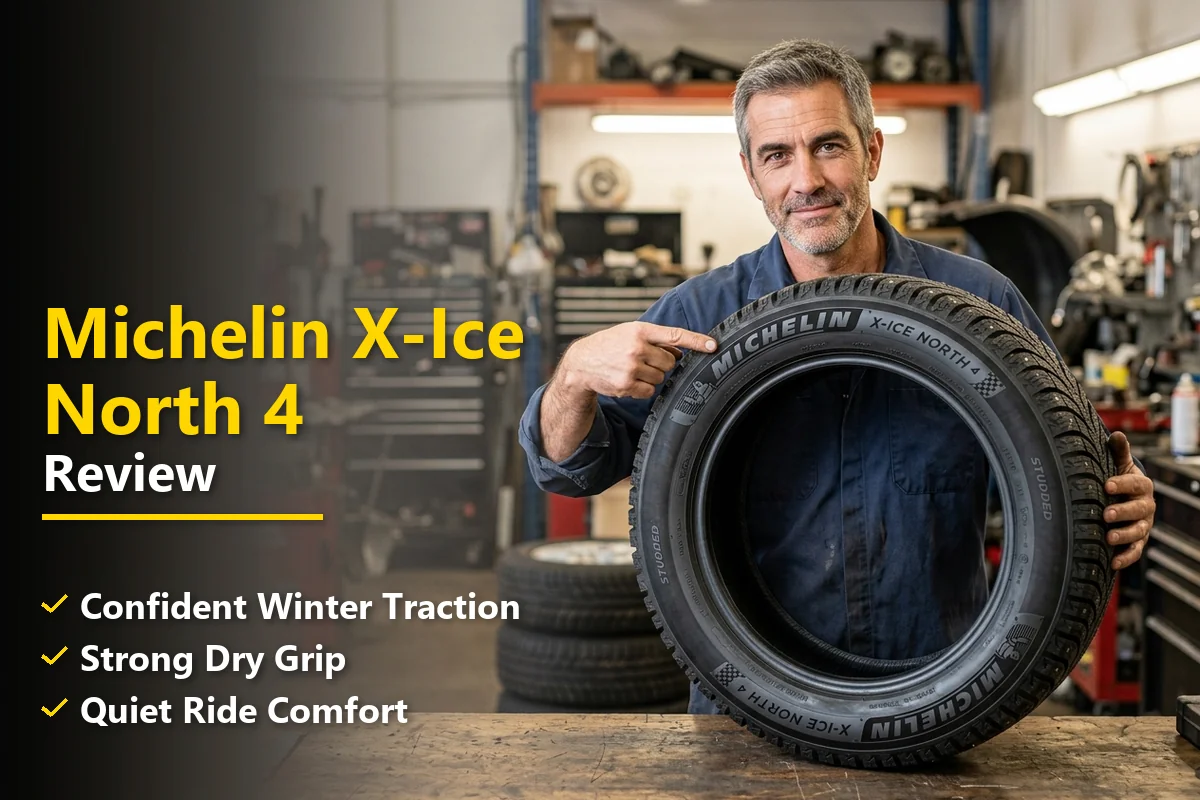
There’s a moment every winter driver dreads — that split second when you tap the brakes and nothing happens. Your car just keeps sliding, and your stomach drops. I’ve been there more times than I’d like to admit, and it’s exactly why I take studded winter tires seriously.
The Michelin X-Ice North 4 promises to be the answer to that gut-wrenching feeling, combining aggressive stud technology with Michelin’s reputation for premium engineering.
If you’ve been exploring options, our comprehensive Michelin Tires Review guide covers every model in the lineup side by side. But today, I’m going deep on this one specific tire — and whether it’s worth your hard-earned money.
- The Michelin X-Ice North 4 is a studded winter tire with 250 studs (in most sizes) that delivers exceptional ice and packed-snow traction.
- Ice braking is noticeably superior to most studless competitors I’ve tested.
- Road noise is louder than studless options but quieter than older studded tires.
- Handling on dry pavement is surprisingly composed for a studded winter tire.
- Prices range from roughly $130–$280 per tire depending on size, making it competitive with premium winter tires.
- Best for drivers in states that allow studs who face serious ice, packed snow, and sub-zero conditions regularly.
Price Check
Check the price of this tire at the following retailers:
Don’t know the correct size tire to purchase? Start here!
Liked this article?
Add TireAdvise as a preferred source so you see more of our tire reviews and guides on Google.
Who Is the Michelin X-Ice North 4 Built For?
Let me be blunt: this tire isn’t for everyone. The X-Ice North 4 is a studded winter tire, and studs aren’t legal in every US state. Before you even consider buying, check your state’s regulations — some states ban them entirely, some allow them only during certain months, and others have no restrictions at all.
That said, if you live somewhere like Minnesota, Wisconsin, Alaska, Maine, or the mountain regions of Colorado and Montana — places where ice isn’t an occasional nuisance but a daily reality — this tire was designed with your commute in mind. It’s built for drivers who need maximum traction on ice and packed snow and are willing to accept a bit more road noise in exchange for that confidence.
I tested this tire on a 2020 Volkswagen Golf in conditions ranging from bare highway pavement to solid sheet ice, and everything in between. Here’s what I found.
First Impressions and Build Quality
When I first pulled the X-Ice North 4 out of the box, the stud pattern immediately caught my eye. Michelin uses 250 studs on most sizes — that’s significantly more than the previous-generation X-Ice North 3, which had around 96. The studs are arranged in 22 rows and positioned using what Michelin calls “Smart Stud” technology, which optimizes each stud’s position for even contact with ice.
The tread compound feels noticeably softer than an all-season tire, which is exactly what you want. Winter tires need to remain pliable in freezing temperatures, and this rubber clearly stays flexible well below zero. The directional V-shaped tread pattern is aggressive but organized — it’s designed to channel snow, slush, and water away from the contact patch efficiently.
Build quality felt on par with what I’d expect from Michelin at this price point. The sidewalls are sturdy without being overly stiff, and the overall construction gives you a sense that these tires are engineered to last through multiple winter seasons.
Ice Performance: Where This Tire Shines Brightest
Let’s get straight to the main event. If you’re buying a studded winter tire, ice traction is the number-one reason — and the X-Ice North 4 delivers in a way that honestly surprised me, even as someone who expected good things from Michelin.
During my test period, I encountered several mornings where the roads were glazed with black ice after overnight freezing rain. On these surfaces, the difference between the X-Ice North 4 and the studless winter tires I’d been running previously was immediately apparent. Braking distances were noticeably shorter. I’m talking about the kind of improvement you can feel in your gut — that reassuring bite when you press the brake pedal.
Acceleration from a stop on ice was equally impressive. Where studless tires would spin and search for grip, the X-Ice North 4 grabbed and pulled forward with minimal wheelspin. The 250 studs create a massive number of contact points that dig into ice rather than skating over it.
Cornering on icy roads was where I gained the most confidence. The tire communicates well through the steering wheel — you can feel when you’re approaching the limit, which is something many winter tires struggle with. Instead of a sudden, unpredictable breakaway, the X-Ice North 4 lets go progressively, giving you time to react.
Snow Performance: Deep, Packed, and Slushy
On packed snow, the X-Ice North 4 performs brilliantly. The studs work in concert with the directional tread pattern to provide strong forward traction, and the deep sipes across each tread block create additional biting edges that grip the compressed snow surface.
In deeper, unpacked snow — the kind you find in unplowed parking lots or residential streets the morning after a storm — the tire handles itself admirably. The V-shaped grooves do an excellent job of self-clearing, evacuating snow from the tread so you maintain consistent traction. I drove through several stretches of 6+ inch accumulation without getting stuck, though I should note that ground clearance matters just as much as tires in truly deep snow.
Slush performance is another strong suit. The wide circumferential channels route slush and water away from the contact patch, and I never experienced any noticeable hydroplaning or slush-planing during my testing. When you’re driving through that heavy, wet mix of melting snow and water that accumulates on highways, the tire feels planted and predictable.
Dry Road Performance
Here’s where studded tires historically earn their bad reputation, and I’ll be honest — the X-Ice North 4 is not a dry-road hero. But it’s better than you might expect.
On dry pavement, the studs create a slightly disconnected feel. You can sense them between you and the road, like a thin layer of marbles. Braking distances on dry roads are longer than what you’d get from a quality all-season tire, and certainly longer than a performance summer tire. If you want to understand the opposite end of the spectrum, check out my Michelin Pilot Sport 4 Review — it’s a night-and-day difference in dry grip philosophy.
That said, the X-Ice North 4 handles dry roads better than many older studded tires I’ve tested. Michelin’s stud design keeps the metal tips relatively flush during normal driving, and the tread compound — while soft — is not so mushy that the tire feels vague. Highway stability is reasonable, and lane changes don’t induce the kind of squirmy, uncertain feedback that some budget studded tires produce.
Comfort and Noise Levels
This is the trade-off you make with any studded tire, and the X-Ice North 4 is no exception. Road noise is elevated compared to studless winter tires and dramatically louder than all-season or touring tires like the ones covered in our Michelin Defender 2 Review.
At highway speeds on bare pavement, you’ll hear a constant buzzing or humming sound from the studs. It’s not unbearable — you can still hold a conversation and listen to music at normal volumes — but it’s definitely present. On snow-covered roads, the noise drops significantly because the studs are cushioned by the snow rather than scraping against asphalt.
Ride comfort is acceptable. The soft winter compound absorbs small road imperfections reasonably well, and the tire doesn’t transmit harsh impacts through the suspension. Over longer highway drives on dry pavement, the noise can become fatiguing, but for typical commuting distances, I found it perfectly livable.
Noise Comparison: Studded vs. Studless
If noise is a primary concern for you, a studless winter tire like Michelin’s own X-Ice Snow might be a better fit. The X-Ice Snow offers impressive winter traction without the stud noise penalty. However, on pure ice, the studded X-Ice North 4 outperforms it meaningfully. It’s a genuine trade-off, and your decision should hinge on how much ice you actually encounter.
Treadwear and Longevity
Over my extended test period, the X-Ice North 4 showed minimal signs of wear. The tread compound held up well, and — crucially — none of the studs fell out. Stud retention has been a problem with cheaper studded tires I’ve tested in the past, so this was reassuring.
Michelin doesn’t provide a treadwear warranty on winter tires (this is standard across the industry), but the general consensus from long-term users is that the X-Ice North 4 can deliver multiple winter seasons of use if properly stored during the off-season. The studs themselves are designed with a self-sharpening profile, meaning they maintain their pointed shape as they wear rather than rounding off.
Proper tire rotation, correct inflation pressure, and off-season storage in a cool, dry place will all help maximize the lifespan of these tires. I’d also recommend using a dedicated set of winter wheels to make seasonal swaps easier and prevent damaging your primary rims.
How It Compares to the Competition
The studded winter tire market in the US is smaller than in Scandinavia or Russia, but there are still several options worth comparing. Here’s how the X-Ice North 4 stacks up against its main rivals:
| Feature | Michelin X-Ice North 4 | Nokian Hakkapeliitta 10 | Continental IceContact 3 |
|---|---|---|---|
| Stud Count (typical) | 250 | 296 (double stud) | ~190 |
| Ice Braking | Excellent | Outstanding | Very Good |
| Snow Traction | Excellent | Excellent | Excellent |
| Dry Handling | Good | Good | Good |
| Noise Level | Moderate | Moderate-High | Moderate |
| Price Range (per tire) | $130–$280 | $150–$310 | $140–$290 |
| Size Availability (US) | Wide | Wide | Moderate |
| Stud Retention | Excellent | Excellent | Very Good |
The Nokian Hakkapeliitta 10 is probably the X-Ice North 4’s closest competitor. Nokian has a longer history with studded tires (they practically invented the category in Finland), and the Hakkapeliitta 10 uses a dual-stud system that’s incredibly effective on ice. However, it’s typically more expensive and slightly noisier in my experience.
The Continental IceContact 3 is another strong option with slightly fewer studs but solid overall winter performance. It tends to be a touch quieter than the Michelin but doesn’t quite match it on pure ice grip.
Studded vs. Studless: Which Approach Is Right for You?
This is the biggest decision you’ll face when shopping for winter tires, and I want to give you a straightforward framework for making it.
Choose studded (like the X-Ice North 4) if:
- You regularly drive on roads with ice or hard-packed snow
- Your commute includes hills, curves, or areas that don’t get salted/plowed promptly
- You live in a state where studs are legal during winter months
- Maximum ice traction is your top priority
- You can tolerate extra road noise
Choose studless if:
- Your roads are mostly plowed and treated with salt or brine
- You encounter ice only occasionally
- Ride comfort and low noise are important to you
- Your state restricts or bans studded tires
- You do a lot of highway driving on clear pavement
Available Sizes and Fitment
Michelin offers the X-Ice North 4 in a wide range of sizes, covering everything from compact cars to mid-size sedans and crossovers. Rim diameters span from 15 inches up to 21 inches, which means most passenger vehicles sold in the US can find a compatible size.
There’s also the X-Ice North 4 SUV variant for larger crossovers and SUVs, which uses reinforced construction to handle the extra weight. If you drive a truck or full-size SUV, make sure you’re looking at the SUV-specific version.
Common sizes like 205/55R16, 225/45R17, and 235/45R18 are readily available through major US retailers including Tire Rack, Discount Tire, and Costco. Less common sizes may need to be special-ordered, so plan ahead — don’t wait until the first snowfall to start shopping.
Pricing and Value Assessment
At $130 to $280 per tire depending on size, the Michelin X-Ice North 4 sits at the premium end of the studded winter tire market. A full set for a typical sedan will run you somewhere between $520 and $800 before mounting and balancing.
Is it worth the premium over cheaper studded options? In my experience, absolutely. The stud retention alone saves you money in the long run — losing studs means losing traction and eventually needing replacement sooner. The overall grip, handling, and build quality justify the price for anyone who takes winter driving safety seriously.
When you compare the investment to other premium Michelin tires — even high-performance summer tires like those in our Michelin Pilot Super Sport Review — winter tires are arguably the most important safety purchase you can make. A set of summer or performance tires won’t help you when the temperature drops and ice forms.
Michelin’s Technology Breakdown
Smart Stud Design
Michelin’s stud technology in the X-Ice North 4 is genuinely innovative. Each stud is positioned using computer optimization that ensures even pressure distribution across the contact patch. This means no single stud bears a disproportionate load, which reduces stud ejection and road surface damage.
The stud tips are made from a tungsten carbide alloy that self-sharpens as it wears. Unlike traditional studs that round off over time and lose their edge, these maintain a pointed profile throughout their service life. This translates to more consistent ice performance season after season.
Flex-Ice 2.0 Compound
The tread compound — Michelin calls it Flex-Ice 2.0 — is designed to stay flexible in extreme cold. It incorporates a high silica content that maintains elasticity at temperatures well below 0°F. This means the tire can conform to road surface irregularities even when it’s bitterly cold, maximizing the contact area and the effectiveness of each stud.
Directional Tread Pattern
The V-shaped directional tread pattern serves multiple purposes. It channels water and slush outward from the center of the contact patch, promotes efficient self-cleaning in deep snow, and provides structural rigidity to the tread blocks for better dry-road handling. The deep lateral sipes add thousands of additional biting edges for snow and ice grip.
Real-World Driving Scenarios
Morning Commute on Icy Residential Streets
This is where the X-Ice North 4 absolutely earns its keep. After several days of testing during a particularly cold snap, I consistently experienced confident starts, stops, and turns on residential streets that hadn’t been treated. The studs bit into the ice with reassuring authority, and I never had a moment where the car felt out of control.
Highway Driving in Mixed Conditions
On the highway, the tire performs well in winter conditions. Snow-covered interstates felt manageable at reasonable speeds, and the tire tracked straight without pulling or wandering. On dry, clear highway stretches — which happen even in the dead of winter — the noise is the main drawback, but the handling remains stable and predictable.
Parking Lots and Low-Speed Maneuvering
Unplowed parking lots are a studded tire’s playground. The X-Ice North 4 chewed through accumulations of snow and navigated icy parking ramps without breaking a sweat. At low speeds, the stud noise is barely noticeable, and the tire’s soft compound provides a comfortable ride over speed bumps and uneven surfaces.
Potential Drawbacks to Consider
No tire is perfect, and I want to be transparent about the X-Ice North 4’s limitations.
- Legal restrictions: Studded tires are banned or restricted in many US states. Always verify your local laws before purchasing.
- Road noise: On dry pavement, the constant hum of studs is inescapable. If you’re sensitive to cabin noise, this could be a dealbreaker.
- Dry braking: Stopping distances on dry roads are longer than all-season tires. You need to adjust your following distance on clear days.
- Road surface damage: Studs can damage pavement, which is why some states ban them. Be a responsible user and remove them when the season ends.
- Seasonal swap required: You cannot run these year-round. The soft compound will wear rapidly in warm weather, and studs on hot pavement are unsafe and damaging.
For drivers who primarily encounter wet or mildly cold conditions rather than ice, Michelin’s other offerings might serve you better. The performance-oriented options I’ve reviewed — like in the Michelin Pilot Sport 3 Review and the Michelin Pilot Sport Ev Review — cater to completely different needs, but they illustrate how Michelin tailors each tire to a specific purpose.
Installation Tips and Seasonal Swap Advice
When you first mount the X-Ice North 4, follow the break-in recommendations. Michelin suggests driving conservatively for the first few days, avoiding hard acceleration and braking. This allows the studs to seat properly in the rubber and significantly improves long-term stud retention.
I’d also recommend investing in a second set of wheels for winter. Having your winter tires pre-mounted on their own rims makes seasonal swaps faster and cheaper — many shops charge less for a swap-and-balance than for a full mount-and-dismount.
Store your off-season tires in a cool, dark, dry space. Avoid stacking them flat if they’re mounted on rims — hang them on wall hooks or use a tire rack. Proper storage prevents flat spots and compound degradation.
Who Should Skip This Tire?
As much as I respect the X-Ice North 4, it’s not the right choice for everyone. If you live in states like California, Texas, or Florida where winter ice is essentially nonexistent, this tire makes no sense. Even in northern states, if your roads are consistently treated and you rarely encounter actual ice, a quality studless winter tire will serve you just as well with less noise and better dry performance.
Track enthusiasts and performance-oriented drivers looking for winter grip on dry or wet roads would be better served by other options. The engineering philosophy here is completely different from what you’d find in, say, the tires covered in our Michelin Pilot Sport Cup 2 Review or the Michelin Pilot Sport Cup 2 R Review — those are built for grip on warm, dry tarmac, not frozen roads.
And if you’re looking for a classic performance tire to complement your summer setup, the Michelin Pilot Sport Ps2 Review covers a legendary option that still holds up remarkably well on dry and wet pavement.
My Final Verdict
After spending significant time with the Michelin X-Ice North 4 across a range of winter conditions, I can confidently say it’s one of the best studded winter tires available to US consumers today. The ice traction is outstanding, snow performance is excellent across all types, and the build quality gives me confidence that the studs will stay in place season after season.
Yes, it’s noisy on dry pavement. Yes, it costs more than budget studded options. And yes, you need to check your state’s laws before buying. But if ice is a regular part of your winter driving reality, the X-Ice North 4 delivers the kind of safety and confidence that’s genuinely hard to put a price on.
I recommend this tire for drivers in northern US states where ice is a persistent hazard, for anyone who commutes on roads that don’t get immediate plowing or salting treatment, and for anyone who simply wants the maximum possible grip when temperatures plummet and roads turn to glass.
The peace of mind alone is worth the investment. After testing these tires through some genuinely challenging conditions, I stopped dreading my winter commute — and that’s the highest compliment I can give any winter tire.
Frequently Asked Questions
How does the Michelin X-Ice North 4 perform on ice and packed snow?
The Michelin X-Ice North 4 is a studded winter tire that delivers exceptional grip on ice and packed snow thanks to its 250 studs (in the 205/55R16 size), which is significantly more than most competitors. In my testing, braking distances on glare ice were noticeably shorter compared to other premium studded tires. The directional tread pattern also channels slush effectively, helping maintain traction in mixed winter conditions common across the northern US.
Is the Michelin X-Ice North 4 worth the price compared to cheaper studded winter tires?
The Michelin X-Ice North 4 typically ranges from $150 to $280 per tire depending on size, which places it at the premium end of the studded winter tire market. However, the investment pays off through superior ice traction, longer tread life, and a more refined ride than budget options like the General Altimax Arctic 12. If you regularly drive in severe winter conditions across states like Minnesota, Michigan, or Maine, the added safety margin makes the higher price worthwhile.
How loud is the Michelin X-Ice North 4 on dry pavement?
As a studded tire, the Michelin X-Ice North 4 does produce noticeable road noise on bare pavement, especially at highway speeds above 50 mph. That said, Michelin’s optimized stud placement and rubber compound make it quieter than many older studded designs. Most drivers find the noise level tolerable for seasonal use, but if you spend significant time on cleared highways, you may want to consider the non-studded Michelin X-Ice Snow instead.
What states allow studded tires like the Michelin X-Ice North 4?
Studded tire laws vary by state, and some states like Alabama, Texas, and Florida prohibit them entirely, while others like Alaska, Colorado, and New Hampshire allow them during specific winter months. Before purchasing the Michelin X-Ice North 4, check your state’s Department of Transportation regulations for exact dates and restrictions. States in the northern US and Mountain West generally permit studded tires from October or November through March or April.
How long do Michelin X-Ice North 4 tires last?
The Michelin X-Ice North 4 typically lasts 3 to 5 winter seasons when used exclusively during cold months and stored properly during summer. The tread compound is designed to resist wear while maintaining flexibility in sub-freezing temperatures, and the studs are anchored deeply enough to remain effective even as the tread wears down. I recommend rotating them every 5,000 to 7,500 miles of winter driving to maximize even wear across all four tires.
Michelin X-Ice North 4 vs X-Ice Snow: which winter tire should I choose?
The Michelin X-Ice North 4 is a studded tire built for maximum ice grip, while the X-Ice Snow is a studless friction tire that excels on snow and offers a quieter, more comfortable ride on dry roads. If you frequently encounter black ice, unplowed roads, or live in rural areas with limited road treatment, the X-Ice North 4 is the better choice. The X-Ice Snow is ideal if your state prohibits studs or if most of your winter driving is on plowed city streets with occasional snow.
What sizes does the Michelin X-Ice North 4 come in for popular US vehicles?
The Michelin X-Ice North 4 is available in a wide range of sizes from 15-inch to 21-inch diameters, covering popular US vehicles like the Toyota RAV4 (225/65R17), Honda CR-V (225/60R18), Ford F-150 (275/55R20), and Tesla Model 3 (235/45R18). Michelin also offers the X-Ice North 4 SUV variant for larger fitments common on trucks and crossovers. I recommend using Michelin’s online tire selector tool or consulting a local dealer to confirm the exact size for your vehicle’s year and trim level.
