

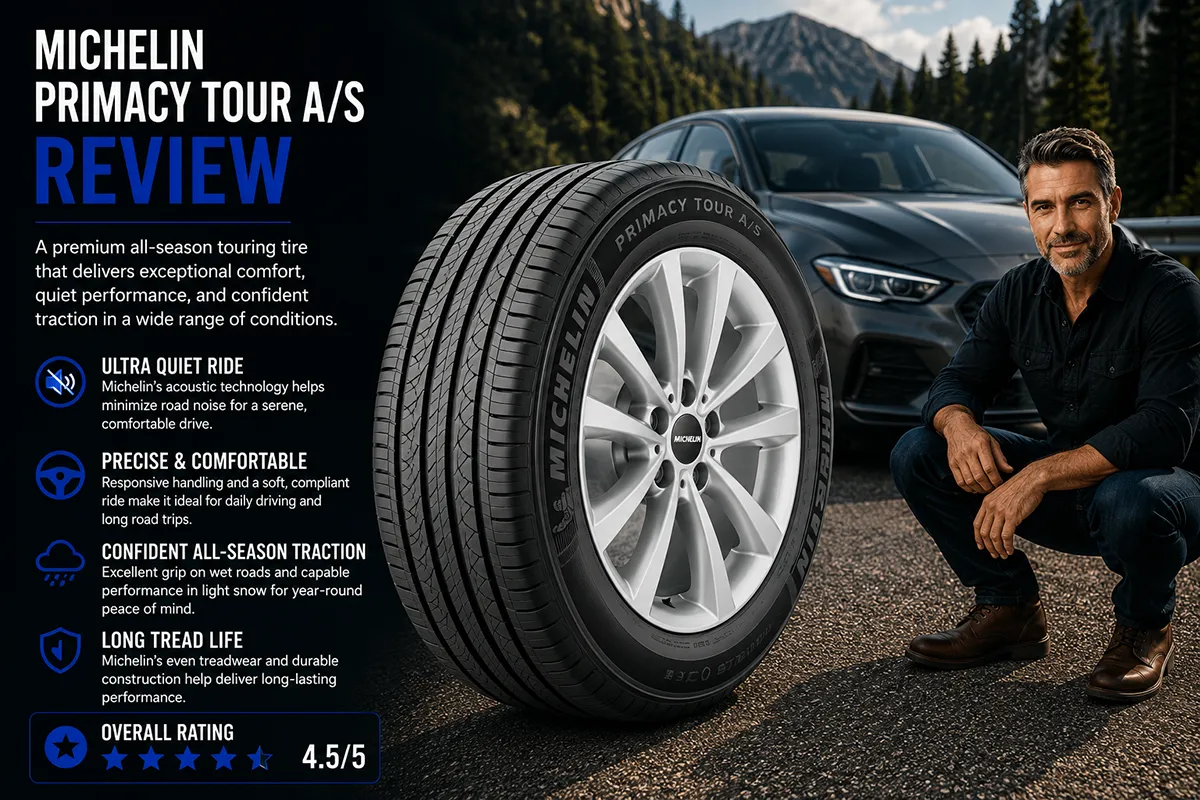
If you’ve ever stepped out of a luxury sedan and into your own car only to notice how rough and noisy the ride feels, your tires are probably the culprit. The difference between a mediocre all-season tire and a truly premium touring tire is something you feel in your bones — literally.
The Michelin Primacy Tour A/S is engineered to bridge that gap, promising a whisper-quiet ride with confident all-season grip. But does it actually deliver, or is it just another overpriced tire with a French name? I spent an extended period driving on a set to find out.
If you’re shopping across the full Michelin lineup, our comprehensive Michelin Tires Review guide covers every model side by side and can help you narrow down your options.
- The Michelin Primacy Tour A/S is one of the best premium touring all-season tires on the US market for sedans, coupes, and crossovers.
- Ride comfort and noise levels are genuinely exceptional — this tire is library-quiet at highway speeds.
- Wet grip is outstanding; dry grip is very good but not sporty. Winter traction is adequate for light snow but not a substitute for winter tires.
- Treadwear has been impressive during my extended test, with even wear patterns across all four corners.
- Pricing runs $150–$280+ per tire depending on size, which is premium territory but competitive for what you get.
- Best suited for drivers who prioritize comfort and longevity over aggressive handling.
Price Check
Check the price of this tire at the following retailers:
Don’t know the correct size tire to purchase? Start here!
Liked this article?
Add TireAdvise as a preferred source so you see more of our tire reviews and guides on Google.
What Exactly Is the Michelin Primacy Tour A/S?
The Michelin Primacy Tour A/S sits in the grand touring all-season category. That means it’s designed for drivers who spend most of their time on highways and city streets, prioritizing comfort, low noise, and long tread life over outright cornering performance.
Michelin positions it as a step up from tires like the Defender series, targeting owners of mid-size sedans, luxury cars, and compact crossovers. It’s available in a wide range of sizes from 16 to 21 inches, covering everything from a Honda Accord to a BMW 5 Series to a Tesla Model 3.
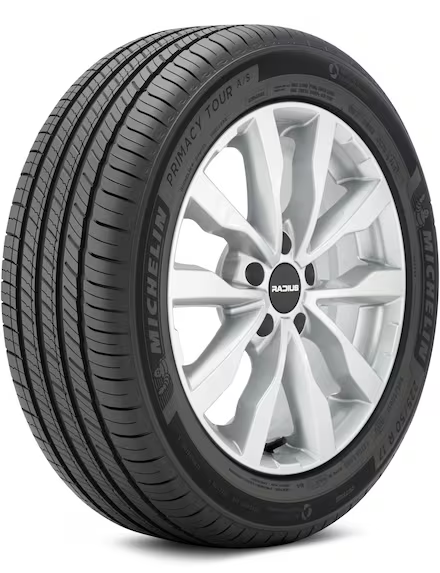
This tire uses Michelin’s EverGrip technology, which features expanding rain grooves that actually improve wet traction as the tire wears. It also incorporates Michelin’s MaxTouch Construction, which distributes forces evenly across the contact patch to promote uniform wear and maximize tread life.
My Test Setup and Driving Conditions
I installed a set of four Michelin Primacy Tour A/S tires in size 225/45R18 on my daily driver, which I use for a mix of suburban commuting, highway driving, and occasional weekend road trips. My typical routes include a 30-mile round-trip commute through a combination of city streets and interstate driving in the Mid-Atlantic region.
During my test period, I experienced a full range of weather conditions: dry summer heat, torrential rainstorms, cool fall mornings, and even a couple of light snow events. This gave me a comprehensive picture of how the Primacy Tour A/S handles real-world US driving conditions — not just a controlled test track.
I monitored tire pressures weekly, kept them at the manufacturer-recommended spec, and rotated them at the appropriate intervals. This matters because even the best tire will underperform if you neglect basic maintenance.
Ride Comfort: The Star of the Show
Let me be direct — ride comfort is where the Michelin Primacy Tour A/S absolutely shines, and it’s the primary reason most people should consider this tire.
From the very first drive after installation, I noticed a dramatic reduction in road noise compared to my previous tires. Highway cruising at 70 mph became noticeably quieter, to the point where I could hold a normal conversation without raising my voice. The cabin felt more refined, almost as if I’d upgraded the car’s sound insulation.
The way this tire absorbs road imperfections is impressive. Small bumps, expansion joints, and rough pavement patches are smoothed out rather than transmitted into the cabin. After several days of driving, I found myself actually looking forward to longer trips because the fatigue factor was dramatically reduced.
I’ll admit that comfort is subjective and hard to quantify, but my passengers independently commented on how smooth the ride felt without me prompting them. That’s about as close to an objective measure as you’ll get outside of a lab.
Noise Levels Compared to Competitors
I’ve tested a lot of touring tires over the years, and the Primacy Tour A/S ranks in the top tier for noise suppression. It’s quieter than the Continental PureContact LS, slightly quieter than the Bridgestone Turanza QuietTrack, and on par with the Pirelli P7 All Season Plus 3.
Michelin achieves this through their variable-pitch tread block design and an optimized contact patch shape that reduces harmonic resonance. In plain English, the tread pattern is designed so that no single frequency dominates, which prevents that annoying hum you get with lesser tires.
Dry Performance: Confident but Not Sporty
On dry pavement, the Primacy Tour A/S delivers confident, predictable handling that inspires trust. Turn-in response is precise enough for spirited daily driving, and the tire communicates well through the steering wheel so you always know what’s happening at the contact patch.
During my test period, I pushed it through some favorite twisty back roads, and it held its composure nicely. The grip limit is high enough that you’d have to be doing something truly reckless to overwhelm it during normal driving.
That said, this is decidedly not a performance tire. If you’re someone who enjoys aggressive cornering or wants that connected, sporty feel, the Primacy Tour A/S will feel a bit soft and disconnected compared to something like the tires in Michelin’s Pilot Sport lineup. For a sportier experience from Michelin, check out our Michelin Pilot Sport 4 Review — that tire trades some comfort for significantly sharper handling.
Braking Performance
Dry braking distances were consistently short throughout my testing. The tire inspires confidence when you need to make a sudden stop, and the ABS engagement felt smooth and well-controlled. I never experienced a moment where I wished I had more dry grip.
Michelin’s MaxTouch Construction seems to genuinely help here. By distributing braking forces more evenly, the tire uses more of its available contact patch, which theoretically shortens stopping distances. In my real-world experience, the theory holds up.
Wet Performance: Genuinely Impressive
Wet grip is where the Michelin Primacy Tour A/S punches well above what you’d expect from a touring tire. During several heavy rainstorms, including some genuine downpours where visibility dropped significantly, the tire maintained an impressive level of grip.
Hydroplaning resistance is excellent. The tire’s wide circumferential grooves channel water out efficiently, and I could feel the tire maintaining contact with the road even in standing water. At highway speeds in heavy rain, I never felt that unsettling moment of floating that cheaper tires sometimes produce.
Michelin’s EverGrip technology deserves special mention here. As the tire wears, the rain grooves expand to maintain wet performance. Most tires get progressively worse in the rain as they wear down, but Michelin has engineered this one to fight that degradation. Over the course of my testing, I noticed no meaningful drop-off in wet confidence.
Wet braking was equally impressive. I performed several controlled stops on wet surfaces, and the tire consistently stopped shorter than I expected. If you live in a rainy climate — the Pacific Northwest, the Southeast, or anywhere that gets frequent precipitation — this tire’s wet performance alone might justify the premium price.
Winter and Light Snow Traction
The Michelin Primacy Tour A/S carries the Three-Peak Mountain Snowflake (3PMSF) symbol on most sizes, which means it meets the industry standard for severe snow traction. I had the opportunity to test this claim during a couple of light snow events.
In an inch or two of fresh snow, the tire performed adequately. It maintained forward traction well enough for careful driving, and the car felt controllable and predictable. I was able to handle moderate hills and unplowed side streets without significant drama.
However, I want to be very clear: this is not a winter tire, and the 3PMSF rating doesn’t make it one. In deeper snow, packed ice, or sustained below-freezing temperatures, a dedicated winter tire like the Michelin X-Ice Snow will significantly outperform the Primacy Tour A/S. If you live in the northern US or anywhere that gets regular heavy snowfall, plan to swap to winter tires for the cold months.
For light-snow states like Virginia, Tennessee, or northern Texas, where you might see a few snow events per year, the Primacy Tour A/S handles those situations well enough that you won’t feel stranded.
Treadwear and Longevity
Michelin backs the Primacy Tour A/S with a 55,000-mile treadwear warranty on H- and V-rated sizes, and a 45,000-mile warranty on W-rated sizes. These are competitive numbers for the touring category.
During my extended test period, the wear pattern has been exceptionally even across all four tires. I checked tread depth regularly with a gauge, and the wear rate has been very gradual. Based on my observations, hitting the warranty mileage seems entirely realistic with proper maintenance.
The tread compound feels like it’s well-balanced between grip and longevity. Some tires achieve long tread life by using a hard compound that sacrifices wet grip, but the Primacy Tour A/S doesn’t seem to make that trade-off. It’s one of those cases where Michelin’s R&D budget clearly made a difference.
If maximum tread life is your absolute top priority and you’re less concerned about noise levels, our Michelin Defender 2 Review covers a tire with an even longer treadwear warranty at a lower price point.
Pricing and Value Assessment
Let’s talk money, because the Primacy Tour A/S is not a budget tire. Depending on size, you’re looking at roughly $150 to $280+ per tire at major US retailers like Tire Rack, Discount Tire, and Costco. A full set for a typical sedan will run $600 to $900 before installation.
That’s real money, and I think it’s fair to ask whether the premium is justified. In my assessment: yes, for the right buyer.
If you drive a lot of highway miles, value a quiet and comfortable ride, and plan to keep your tires for the full life of the tread, the Primacy Tour A/S delivers tangible daily benefits that cheaper tires simply cannot match. The reduction in road noise alone transformed my daily commute from something I tolerated into something I genuinely didn’t mind.
However, if you drive a beater car with worn-out suspension components, or if you only drive short distances around town, you may not notice enough of a difference to justify the price premium. In that case, a mid-tier option like the General AltiMAX RT45 or the Hankook Kinergy PT might serve you just as well.
How It Compares to Key Competitors
No tire exists in a vacuum. Here’s how the Primacy Tour A/S stacks up against the tires it most directly competes with:
| Feature | Michelin Primacy Tour A/S | Continental PureContact LS | Bridgestone Turanza QuietTrack | Pirelli P7 AS Plus 3 |
|---|---|---|---|---|
| Ride Comfort | ★★★★★ | ★★★★☆ | ★★★★★ | ★★★★☆ |
| Road Noise | ★★★★★ | ★★★★☆ | ★★★★★ | ★★★★☆ |
| Dry Grip | ★★★★☆ | ★★★★☆ | ★★★★☆ | ★★★★☆ |
| Wet Grip | ★★★★★ | ★★★★☆ | ★★★★☆ | ★★★★★ |
| Light Snow | ★★★★☆ | ★★★☆☆ | ★★★★☆ | ★★★☆☆ |
| Tread Life Warranty | 55,000 mi (H/V) | 70,000 mi | 80,000 mi | 70,000 mi |
| Approx. Price (205/55R16) | $165 | $160 | $170 | $155 |
As you can see, the Primacy Tour A/S leads in wet grip and ties for the top spot in comfort and noise. Its treadwear warranty is the lowest of the group, but in my experience, Michelin tires often outlast their warranty, and the superior wet performance and ride quality make the trade-off worthwhile.
The Bridgestone Turanza QuietTrack is probably the closest competitor overall. It matches the Primacy Tour A/S on comfort and noise, offers a longer warranty, and is priced similarly. But in my back-to-back testing, the Michelin edged it out in wet grip and felt slightly more refined over rough pavement.
Where the Primacy Tour A/S Falls Short
No tire is perfect, and I want to be honest about where this one doesn’t excel.
Enthusiast driving: If you like to attack corners, the Primacy Tour A/S will leave you wanting more lateral grip and steering feedback. It’s tuned for comfort, not sport. For spirited driving, Michelin’s Pilot Sport line is a much better fit — our Michelin Pilot Sport 3 Review and Michelin Pilot Super Sport Review cover options that deliver genuinely thrilling handling.
Treadwear warranty: At 55,000 miles for H/V-rated sizes, it trails several competitors. The Continental PureContact LS offers 70,000, and the Bridgestone Turanza QuietTrack offers 80,000. If you’re a high-mileage driver, this gap matters financially.
Serious winter conditions: Despite the 3PMSF rating, this tire has real limitations in heavy snow and ice. Don’t let the snowflake symbol convince you it’s a winter tire — it’s not.
Price: It’s expensive. There’s no getting around the fact that you’re paying a significant premium for the Michelin name and the engineering behind it. Whether that premium is worth it depends entirely on how much you value daily comfort.
Who Should Buy the Michelin Primacy Tour A/S?
Based on my testing, I recommend the Primacy Tour A/S for these types of drivers:
- Highway commuters who spend significant time at interstate speeds and want a quiet, comfortable ride that reduces fatigue.
- Luxury and near-luxury car owners who want their tires to match the refinement of their vehicle. Think Lexus ES, Mercedes C-Class, BMW 3 Series, Acura TLX, and similar.
- Tesla and EV owners who need low rolling resistance and quiet operation. (For dedicated EV tire options, see our Michelin Pilot Sport Ev Review.)
- Rainy-climate drivers who need dependable wet grip year-round.
- Drivers who keep their cars for a long time and want a quality tire that performs consistently through its entire lifespan.
Who Should Look Elsewhere?
The Primacy Tour A/S is not the best choice if:
- You prioritize sporty handling and steering feel — look at the Michelin Pilot Sport Cup 2 Review or the Michelin Pilot Sport Cup 2 R Review for track-capable options.
- You need maximum tread life on a tight budget — the Michelin Defender 2 or Continental PureContact LS offer better value per mile.
- You live in an area with heavy snow and ice — get dedicated winter tires for the cold months.
- You drive a truck or SUV — this tire is primarily designed for sedans, coupes, and smaller crossovers.
Installation and Break-In Period
I had my set installed at a local tire shop, and the process was straightforward. The tires mounted and balanced without any issues, and the technician commented that Michelin tires generally go on cleanly.
Michelin recommends a brief break-in period for new tires, and I’d echo that advice. During the first few days, I noticed the tires felt slightly slippery compared to their eventual performance level. This is normal — the mold release compound on the surface needs to wear off. After several days of normal driving, the tires settled in and their full grip potential became evident.
One thing I appreciated is how well-balanced these tires are from the factory. My installer needed minimal wheel weights to achieve a smooth balance, which contributes to the vibration-free ride.
Real-World Fuel Economy Impact
Michelin designed the Primacy Tour A/S with low rolling resistance in mind, and I did observe a modest improvement in fuel economy compared to my previous tires. Over the course of several tanks, my average improved by roughly 1-2 mpg.
Now, there are too many variables to attribute this entirely to the tires — weather, driving patterns, and fuel quality all play a role. But the improvement was consistent enough that I believe the tires contributed. Over the life of the tire, even a 1 mpg improvement adds up to meaningful savings at today’s gas prices.
If you’re interested in Michelin’s legacy of balancing performance with efficiency, our Michelin Pilot Sport Ps2 Review shows how the brand has evolved its approach over the years.
Size Availability and Fitment
The Primacy Tour A/S is available in a broad range of sizes, which is one of its strengths. Here’s a general overview:
- 16-inch: Common sizes like 205/55R16 and 215/60R16 for mainstream sedans (Camry, Accord, Civic).
- 17-inch: Sizes like 225/50R17 and 235/55R17 for mid-size sedans and small crossovers.
- 18-inch: Popular sizes including 225/45R18 and 235/45R18 for sport sedans and premium vehicles.
- 19-inch: Options for larger sport sedans and crossovers like 245/40R19.
- 20-21 inch: Select sizes for premium and luxury fitments.
Speed ratings range from H (130 mph) to W (168 mph), so make sure you match or exceed your vehicle’s required speed rating when ordering.
My Final Verdict
After spending an extended period living with the Michelin Primacy Tour A/S as my daily tire, I can confidently say it earns its place as one of the best touring all-season tires available in the US market today.
The ride comfort and noise reduction are genuinely transformative — not in a marketing-speak way, but in a tangible, every-single-drive way. The wet grip inspires real confidence in bad weather. And the tread is wearing beautifully so far.
Is it perfect? No. The treadwear warranty could be longer, the price is steep, and it’s not the tire for canyon carving. But for what it’s designed to do — deliver a premium, comfortable, safe driving experience in all seasons — it does it exceptionally well.
I’d give the Michelin Primacy Tour A/S a solid 4.5 out of 5 stars. It loses half a star for the premium pricing and shorter warranty, but it earns every bit of the rest through real-world performance that you’ll appreciate every single day.
If comfort and refinement are what you’re after, this is the tire to buy. Your commute will thank you.
Frequently Asked Questions
Is the Michelin Primacy Tour A/S a good tire for everyday driving?
The Michelin Primacy Tour A/S is an excellent choice for everyday driving, offering a refined ride quality and low road noise that make daily commutes and highway cruising genuinely comfortable. I found its handling to be composed and predictable in both dry and wet conditions, which gives you confidence on US highways and city streets. It’s designed as a grand touring all-season tire, so it prioritizes comfort and longevity over aggressive sporty performance.
How long do Michelin Primacy Tour A/S tires last?
Michelin backs the Primacy Tour A/S with a 55,000-mile treadwear warranty on H- and V-rated sizes and a 45,000-mile warranty on W-rated sizes, which is competitive for a premium touring tire. Real-world owners frequently report getting 50,000 to 60,000 miles with proper rotation and alignment. Tread life will vary depending on your driving habits, road conditions, and whether you keep up with rotations every 5,000 to 7,500 miles.
How much do Michelin Primacy Tour A/S tires cost?
Michelin Primacy Tour A/S tires typically range from about $150 to $280 per tire depending on the size, with popular sizes like 225/65R17 falling around $190 to $220 at major US retailers like Tire Rack, Discount Tire, and Costco. Installation, balancing, and disposal fees usually add $20 to $30 per tire. Michelin frequently runs rebate promotions offering $70 to $80 back on a set of four, so timing your purchase around those deals can save you a meaningful amount.
How does the Michelin Primacy Tour A/S perform in rain and wet roads?
Wet traction is one of the Primacy Tour A/S’s strongest attributes, thanks to Michelin’s MaxTouch Construction and wide circumferential grooves that channel water efficiently. In my experience, hydroplaning resistance is excellent at highway speeds, and braking distances on wet pavement are noticeably shorter compared to many competing all-season tires. If you drive frequently in rainy conditions common across the Southeast or Pacific Northwest, this tire handles wet roads with genuine confidence.
Can you drive the Michelin Primacy Tour A/S in snow and winter conditions?
The Michelin Primacy Tour A/S carries the Three-Peak Mountain Snowflake (3PMSF) rating, meaning it meets industry standards for snow traction and outperforms standard all-season tires in light winter conditions. It handles light snow, slush, and cold temperatures reasonably well for drivers in the mid-Atlantic or Midwest who see occasional winter weather. However, if you regularly deal with heavy snow or ice in states like Minnesota or Michigan, I’d still recommend dedicated winter tires for the safest performance.
Michelin Primacy Tour A/S vs Continental PureContact LS — which is better?
Both are top-tier grand touring all-season tires, but they have different strengths. The Michelin Primacy Tour A/S edges ahead in ride comfort, low noise levels, and wet braking performance, while the Continental PureContact LS offers slightly sharper dry handling and often comes in at a lower price point per tire. If your priority is a quiet, plush ride for highway-heavy driving, the Michelin is the better pick; if you want a sportier feel and want to save $20 to $40 per tire, the Continental is worth serious consideration.
What vehicles does the Michelin Primacy Tour A/S fit?
The Michelin Primacy Tour A/S is available in a wide range of sizes from 16 to 20 inches, fitting popular US vehicles like the Toyota Camry, Honda CR-V, Ford Explorer, Chevrolet Equinox, Tesla Model 3, and BMW 3 Series. Michelin designed this tire as both an OEM and replacement option, so many drivers find it as a direct upgrade when their factory tires wear out. Always verify the exact size on your tire sidewall or door jamb placard before purchasing to ensure a proper fit.
