

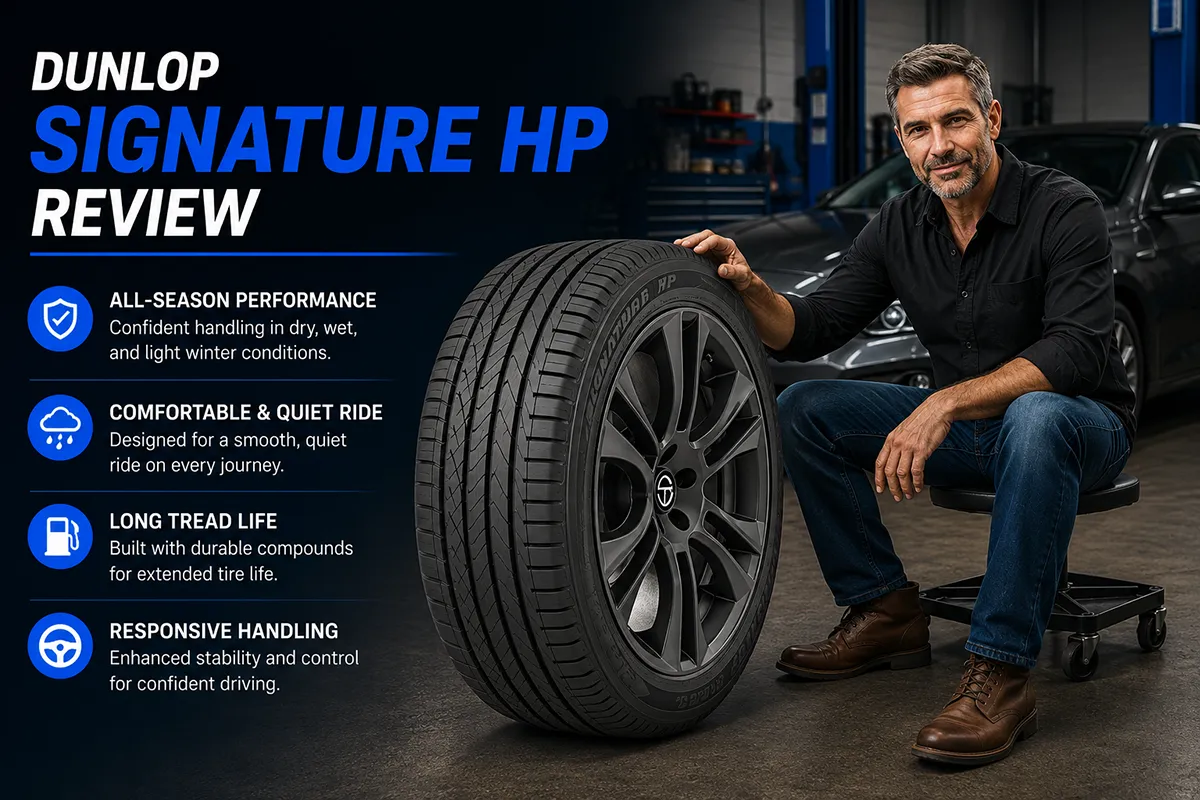
If you’ve ever stood in a tire shop staring at a wall of options, wondering which high-performance all-season tire actually delivers without draining your bank account, you’re not alone. I’ve been there more times than I can count.
The Dunlop Signature HP is one of those tires that flies under the radar — overshadowed by flashier sport tire names — but quietly earns loyal fans among everyday sedan and coupe owners across the US. If you’re comparing several options, our full Dunlop Tires Review guide covers every model side by side and can help you narrow things down fast.
After spending an extended test period putting these tires through real-world conditions — commuting in traffic, highway cruising, rain-soaked back roads, and even a few spirited canyon runs — I’m ready to give you my complete, unfiltered take.
- The Dunlop Signature HP is a budget-friendly high-performance all-season tire ideal for sedans, coupes, and some crossovers.
- Dry grip is genuinely impressive for the price — confident cornering and responsive steering feel.
- Wet traction is above average thanks to the asymmetric tread design and wide circumferential grooves.
- Ride comfort is good, though road noise picks up slightly at highway speeds.
- Tread life is decent for an HP tire, backed by a 45,000-mile treadwear warranty.
- Best suited for drivers who want a step up from standard touring tires without paying ultra-high-performance prices.
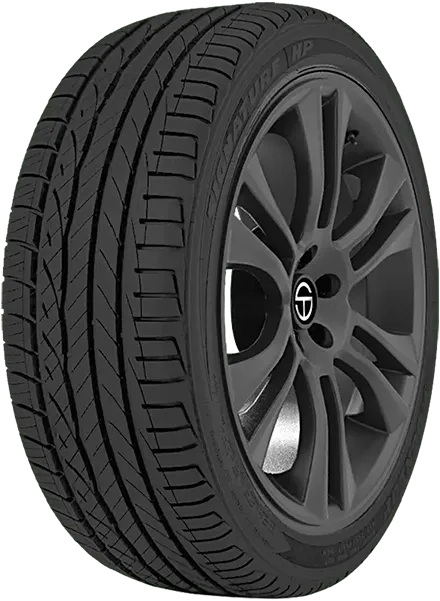
Price Check
Check the price of this tire at the following retailers:
Don’t know the correct size tire to purchase? Start here!
Liked this article?
Add TireAdvise as a preferred source so you see more of our tire reviews and guides on Google.
What Exactly Is the Dunlop Signature HP?
The Dunlop Signature HP sits in the high-performance all-season category — a sweet spot between basic touring tires and aggressive summer-only performance rubber. It’s designed for drivers who want sharper handling and better grip than a standard all-season but still need year-round versatility.
Dunlop positions this tire for sedans, coupes, and select crossovers. You’ll find it in popular sizes ranging from 16 to 18 inches, covering a wide swath of vehicles like the Honda Accord, Toyota Camry, Mazda6, Nissan Altima, Volkswagen Jetta, and similar mid-size platforms.
The tire features an asymmetric tread design, which is a hallmark of performance-oriented all-seasons. The outer shoulder blocks are stiffer for cornering stability, while the inner portion of the tread focuses on wet evacuation and straight-line grip.
My Testing Setup and Conditions
I mounted a set of Dunlop Signature HP tires (in 225/50R17) on a mid-size sedan that I use as my daily driver. This car sees everything from bumper-to-bumper commuting to weekend road trips, so it’s about as real-world as testing gets.
During my test period, I drove in a wide range of conditions: dry summer heat, unexpected afternoon downpours, cool autumn mornings with dew-covered roads, and even a brief cold snap where temperatures dipped into the mid-30s Fahrenheit. I purposely avoided relying on a controlled test track — I wanted to know how these tires perform for normal people doing normal things.
I also compared my experience against other Dunlop tires I’ve tested, including the touring-focused Dunlop Signature II, which is the comfort-first sibling in the lineup.
Dry Performance: Where This Tire Really Shines
Let me start with the Signature HP’s strongest suit — dry grip. From the very first drive, I noticed the steering felt noticeably more connected compared to the standard all-season tires that came off the car.
Cornering and Lateral Grip
The asymmetric tread pattern does real work here. The larger, stiffer outer shoulder blocks dig in during turns and give you a confident, planted feeling. I took some of my favorite twisty roads at progressively quicker speeds, and the tire communicated clearly through the steering wheel. There was no vague, mushy feeling — you know exactly when you’re approaching the limit.
For an all-season tire in this price range, the lateral grip genuinely surprised me. It’s not going to match a dedicated summer tire like the Dunlop Sport Maxx RT2, but for a tire you can drive 365 days a year, the cornering capability is well above average.
Braking and Acceleration
Dry braking distances felt short and predictable. I never experienced any unexpected sliding or ABS intervention during normal driving. Under harder braking — the kind you’d do in an emergency stop — the tire held its composure well.
Acceleration traction was equally solid. No wheelspin pulling away from lights (even with some enthusiasm), and the tire hooked up cleanly on highway on-ramps.
Steering Response
This is probably the single biggest differentiator between the Signature HP and a standard touring all-season. The steering response is crisp. Turn-in is immediate, and there’s minimal squirm or delay between your input and the tire’s reaction. If you’ve been driving on worn-out touring tires and you switch to these, the difference will put a smile on your face within the first few minutes.
Wet Performance: Confidence in the Rain
Living and driving in an area that gets regular rain, wet performance is non-negotiable for me. The Dunlop Signature HP handles wet roads well — not perfectly, but well enough that I never felt unsafe.
Hydroplaning Resistance
The four wide circumferential grooves running around the tire do an effective job of channeling water away from the contact patch. During several heavy downpours, I drove at highway speeds and experienced no hydroplaning. Even through standing water on poorly drained road sections, the tires maintained their composure.
Wet Grip and Braking
Wet cornering grip is good, though you’ll notice a meaningful step down from dry conditions — which is normal and expected for any all-season tire. The key is that the transition from grip to slip is gradual and predictable. There’s no sudden snap that catches you off guard.
Wet braking is where I’d rate the Signature HP as “above average but not class-leading.” It stops shorter than most standard touring tires, but if you compare it to premium wet-focused designs, there’s room for improvement. For the price point, though, I think the wet performance is more than fair.
Light Snow and Cold Weather
I want to be upfront here: the Dunlop Signature HP is not a winter tire. During that brief cold snap I mentioned, the tire stiffened up noticeably, and grip on frosty roads was limited. It’ll get you through a light dusting, but if you regularly deal with snow and ice, you need a dedicated winter set — something like the Dunlop Winter Maxx 3, which I’ve tested and found excellent in true winter conditions.
The Signature HP does not carry the 3PMSF (Three-Peak Mountain Snowflake) symbol, so treat it accordingly.
Ride Comfort and Noise
High-performance tires often sacrifice comfort for grip. The Signature HP strikes a reasonable balance, though it’s not as plush as a dedicated grand touring tire.
Comfort Over Bumps
On smooth highways, the ride is pleasant. The sidewall has enough give to absorb small imperfections without feeling harsh. Expansion joints, manhole covers, and minor potholes are handled without jarring the cabin.
However, on rougher surfaces — think broken pavement, gravel patches, or frost-heaved roads — you feel more road texture than you would with something like the Dunlop Signature II, which is specifically tuned for comfort. The Signature HP’s stiffer construction (a necessity for better handling) means it transmits more of that coarseness through the chassis.
Road Noise
At city speeds (under 40 mph), the Signature HP is quiet. I had no complaints around town.
At highway speeds (65-75 mph), there’s a noticeable hum that develops, particularly on coarser asphalt surfaces. It’s not intrusive enough to drown out music or conversation, but it’s present. If you’re extremely noise-sensitive, this is worth noting.
After several days of driving, I stopped noticing it as much — my ears adjusted. But switching back to a touring tire afterward made the difference clear. This is a common trade-off with HP all-season tires, and the Signature HP is neither better nor worse than most competitors in this regard.
Tread Life and Durability
Dunlop backs the Signature HP with a 45,000-mile treadwear warranty, which is solid for a high-performance all-season. Many competitors in this space offer 40,000 or no warranty at all.
How Is the Tread Wearing?
During my extended test period, tread wear appeared even across all four tires. I kept the car aligned and rotated the tires at the recommended intervals. The tread depth loss was consistent and predictable — no premature wear on the shoulders or center.
The UTQG treadwear rating is 500, which places the Signature HP in a reasonable range for this category. It’s not going to last as long as a 700-rated touring tire, but that’s the trade-off you accept for better grip and handling.
Build Quality
I didn’t experience any issues with tire balance, vibrations, or defects. The tires mounted easily, balanced with minimal weight, and held consistent pressure throughout my testing. Dunlop’s manufacturing quality control seems strong here.
Dunlop Signature HP vs. The Competition
No tire exists in a vacuum, so let’s see how the Signature HP stacks up against some popular alternatives in the HP all-season space.
| Feature | Dunlop Signature HP | Continental ExtremeContact DWS 06+ | Michelin Pilot Sport A/S 4 | General G-MAX AS-07 |
|---|---|---|---|---|
| Tire Type | HP All-Season | UHP All-Season | UHP All-Season | HP All-Season |
| Treadwear Warranty | 45,000 mi | 50,000 mi | 45,000 mi | 50,000 mi |
| Dry Grip | Very Good | Excellent | Excellent | Good |
| Wet Grip | Good | Excellent | Excellent | Good |
| Ride Comfort | Good | Very Good | Very Good | Good |
| Road Noise | Moderate | Low | Low | Moderate |
| Approx. Price (225/50R17) | $110–$130 | $160–$185 | $175–$200 | $105–$125 |
My Take on the Comparison
The Continental DWS 06+ and Michelin Pilot Sport A/S 4 are objectively better tires. They grip harder, ride quieter, and handle wet conditions with more authority. But they also cost $50–$70 more per tire. Over a set of four, that’s $200–$280 extra.
If your budget allows it, those premium options are worth the splurge. But if you’re looking for the best bang for your buck — genuine high-performance feel without the premium price tag — the Dunlop Signature HP earns its spot.
The General G-MAX AS-07 is the closest competitor in terms of price and performance. In my experience, they’re very similar, with the Dunlop edging ahead slightly in dry grip and the General offering a marginally longer tread life.
Who Should Buy the Dunlop Signature HP?
Based on my testing, here’s who I think will be happiest with these tires:
- Daily commuters who want more than a boring touring tire. If you enjoy driving and want your sedan to feel more engaging, this is an accessible upgrade.
- Budget-conscious enthusiasts. You can’t afford the Michelin or Continental premium options, but you refuse to settle for mushy, disconnected all-seasons.
- Owners of mid-size sedans and coupes. The available size range fits popular vehicles like the Accord, Camry, Altima, Jetta, and Mazda6 perfectly.
- Drivers in mild climates. If you live in the Sun Belt or a region where snow is rare, these tires work year-round without issue.
Who Should Skip the Dunlop Signature HP?
Equally important — here’s who should look elsewhere:
- Drivers in heavy snow regions. Without the 3PMSF rating, this tire is not suited for regular winter driving. Consider a winter-specific tire for the cold months.
- Luxury car owners prioritizing silence. If cabin quietness is your top priority, a grand touring tire will serve you better.
- SUV and truck owners. The Signature HP isn’t made for trucks or SUVs. If you drive a larger vehicle and want Dunlop quality, check out the Dunlop Grandtrek AT5 for all-terrain capability.
- Track day enthusiasts. If you’re pushing hard on a track, you need a dedicated performance tire. Something like the Dunlop SP Sport Maxx GT or the Dunlop SP Sport Maxx GT 600 DSST would be far more appropriate for aggressive driving scenarios.
Pricing and Value Assessment
At the time of my review, the Dunlop Signature HP was priced between approximately $100 and $140 per tire depending on size, with the most common sizes falling in the $110–$130 range. You can find them at major US retailers like Tire Rack, Discount Tire, Walmart, and local tire shops.
For what you get — responsive handling, solid wet and dry grip, a 45,000-mile warranty, and Dunlop’s engineering pedigree — I think this represents strong value. It’s one of the best-performing tires you can get under $130 in the HP all-season category.
I’d recommend shopping around online and checking for manufacturer rebates. Dunlop frequently runs promotions, especially during spring and fall tire-buying season, where you can save $50–$70 on a set of four.
Installation and Break-In Notes
A quick note on break-in: like most new tires, the Dunlop Signature HP benefits from a gentle break-in period. During the first few days of driving, I kept speeds moderate and avoided hard cornering or aggressive braking. After that initial period, the tire’s full grip potential became available, and the slightly slick “new tire” feeling disappeared completely.
Make sure your shop mounts them with the correct rotation — the asymmetric tread has an inside and outside designation stamped on the sidewall. Any reputable installer will know this, but it’s worth verifying before you drive off.
How the Signature HP Fits in the Dunlop Lineup
Dunlop offers a wide range of tires, and it can be confusing to figure out where each model sits. Here’s how I think about the Signature HP relative to its siblings:
The Dunlop Signature II is the comfort-focused touring cousin. It rides smoother and quieter but sacrifices the sporty handling edge. The Dunlop Sport Maxx RT2 is the more aggressive performance option — a summer tire that delivers serious grip but can’t be used year-round.
The Signature HP splits the difference. It’s the tire for the driver who wants engagement without extremes. Think of it as the all-rounder that does most things well and nothing poorly.
My Final Verdict on the Dunlop Signature HP
After thorough testing across varied conditions and over an extended period, I’m genuinely impressed with what the Dunlop Signature HP delivers for its price point. It’s not the best tire in any single category, but it’s remarkably competent across the board.
Dry grip and steering response are its standout qualities. Wet performance is solid. Ride comfort is acceptable. Tread life is on par with or better than most competitors. And the price undercuts premium alternatives by a significant margin.
If I had to sum it up in one sentence: the Dunlop Signature HP is the tire you buy when you want your daily driver to feel fun without spending ultra-high-performance money.
I’d give it a strong recommendation for budget-minded drivers who still care about how their car handles. It won’t transform your Camry into a sports car, but it will make every commute and every errand feel a little more alive.
And that’s real value.
Frequently Asked Questions
Is the Dunlop Signature HP a good tire for daily driving?
The Dunlop Signature HP is an excellent choice for daily commuting and everyday driving on sedans, coupes, and minivans. It delivers a comfortable ride with responsive handling on dry roads and reasonable wet traction for most US driving conditions. I found it to be a solid all-season performance tire that balances sporty feel with everyday practicality.
How long do Dunlop Signature HP tires last?
Dunlop backs the Signature HP with a 55,000-mile treadwear warranty on H- and V-rated sizes, which is competitive for an all-season high-performance tire. Real-world longevity depends on driving habits, alignment, and road conditions, but many US drivers report getting 40,000 to 55,000 miles with proper rotation every 5,000–7,500 miles. Tread life is generally consistent with what you’d expect in this price range.
How much do Dunlop Signature HP tires cost?
Dunlop Signature HP tires typically range from about $100 to $160 per tire depending on the size, with popular fitments like 225/45R17 and 225/50R17 falling in the $110–$140 range at major US retailers like Tire Rack, Discount Tire, and Walmart. Installation, balancing, and disposal fees usually add another $15–$25 per tire. They sit in the mid-range price bracket, making them a good value compared to premium competitors like Michelin Pilot Sport All Season.
How does the Dunlop Signature HP perform in rain and wet conditions?
The Dunlop Signature HP features circumferential grooves and a silica-enriched compound designed to evacuate water and maintain grip on wet pavement. In my experience, wet traction is adequate for typical rain you’d encounter across most US states, though it doesn’t quite match dedicated wet-performance tires like the Continental ExtremeContact DWS 06 Plus. Hydroplaning resistance is decent at highway speeds, but I’d recommend reducing speed in heavy downpours as you would with any all-season tire.
Is the Dunlop Signature HP good in snow and winter weather?
The Dunlop Signature HP is an all-season tire, not a winter tire, so it provides only light snow traction and is not recommended as a primary option for harsh winter conditions. It lacks the Three-Peak Mountain Snowflake (3PMSF) rating, meaning drivers in northern US states or areas with regular snowfall should switch to dedicated winter tires. For occasional dustings or mild winter weather in the mid-Atlantic or Pacific Northwest, it handles reasonably well but won’t inspire much confidence on ice.
What vehicles does the Dunlop Signature HP fit?
The Dunlop Signature HP is available in a wide range of sizes from 15 to 18 inches, fitting popular US vehicles like the Honda Accord, Toyota Camry, Mazda6, Nissan Altima, Dodge Charger, and Chrysler 300. It also fits several minivans and crossover sedans with speed ratings of H and V. I’d recommend checking your door jamb placard or owner’s manual for your exact size before ordering.
How does the Dunlop Signature HP compare to the Dunlop SP Sport 5000?
The Dunlop Signature HP generally offers better tread life, a longer mileage warranty, and a quieter ride compared to the older Dunlop SP Sport 5000. The SP Sport 5000 may edge it out slightly in dry cornering grip due to its sportier compound, but the Signature HP is the better all-around choice for US drivers who prioritize comfort and longevity over aggressive performance. For most replacement tire shoppers looking at Dunlop’s lineup, the Signature HP delivers more balanced value.
