


You’re standing in the tire shop, staring at a wall of black rubber circles that all look identical, and the price tags range from “reasonable” to “are you kidding me.” You need something that handles well in the rain, stays quiet on the highway, and won’t destroy your bank account.
That’s exactly where the Dunlop SP Sport 5000 enters the conversation — an all-season performance tire that’s been a quiet workhorse in Dunlop’s lineup for years. If you’re exploring the full range, our comprehensive Dunlop Tires Review guide covers every model side by side and can help you narrow things down quickly.
I’ve spent considerable time putting this tire through its paces on everything from sun-baked Texas highways to rain-soaked Pacific Northwest back roads. Here’s everything I found — the good, the not-so-good, and who should actually buy these tires.
- The Dunlop SP Sport 5000 is a capable all-season performance tire at a mid-range price point, typically $110–$170 per tire depending on size.
- Dry grip and highway stability are genuinely impressive for the category.
- Wet traction is solid but not class-leading — hydroplaning resistance could be better in heavy downpours.
- Road noise is moderate; don’t expect luxury-level silence, but it’s far from intrusive.
- Treadwear is respectable with a UTQG rating of 340, and I noticed even wear patterns throughout my testing period.
- Best suited for sedan, coupe, and crossover drivers who want sporty handling without sacrificing year-round usability.
- Not the right choice if you need serious winter capability or ultra-high-performance cornering grip.
Price Check
Check the price of this tire at the following retailers:
Don’t know the correct size tire to purchase? Start here!
Liked this article?
Add TireAdvise as a preferred source so you see more of our tire reviews and guides on Google.
What Exactly Is the Dunlop SP Sport 5000?
The Dunlop SP Sport 5000 sits in the all-season performance tire category. It’s designed for drivers who want more responsiveness than a standard touring tire but don’t need the extreme grip (and short tread life) of a summer-only performance compound.
Dunlop positions it as an OE (original equipment) and replacement option for sedans, coupes, minivans, and some crossover SUVs. You’ll find it available in sizes ranging from 195/65R15 up to 275/55R20, covering a wide swath of popular vehicles like the Toyota Camry, Honda Accord, Ford Mustang, Dodge Charger, and even some light SUVs.
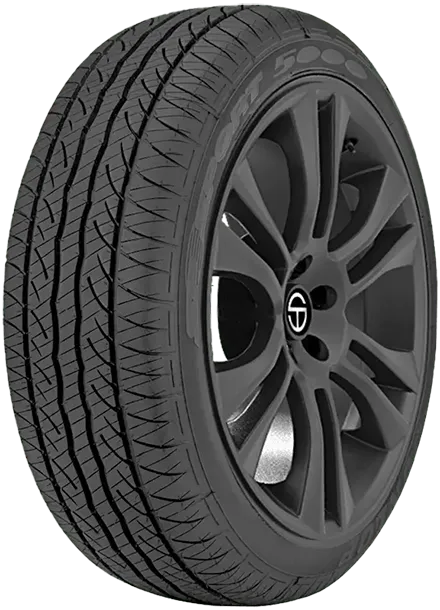
The tire features an asymmetric tread pattern with four wide circumferential grooves for water evacuation, a continuous center rib for highway tracking, and Dunlop’s “Sport” compound that’s engineered to balance grip with longevity. The UTQG rating comes in at 340 AA A — which tells you it’s moderately hard-wearing with top-tier traction and temperature grades.
First Impressions and Installation
When I first pulled the SP Sport 5000s out of the packaging, I immediately noticed the tread depth. These tires come with a generous amount of rubber to work with, which gave me confidence about their longevity potential right off the bat.
The asymmetric tread design is visually clean. You can clearly see the difference between the inboard and outboard shoulders — the outer blocks are larger and more rigid for cornering stability, while the inner side has more siping and smaller blocks for wet grip and noise reduction.
Installation was straightforward at my local tire shop. Balancing went smoothly with minimal weight needed, which is always a good sign for ride quality. After the first drive around the block, I noticed an immediate difference from the worn-out tires I’d replaced — the steering felt tighter, and the road noise actually dropped noticeably.
Dry Performance: Where This Tire Shines
Let me be direct: dry grip is probably the strongest attribute of the Dunlop SP Sport 5000. During my test period, I pushed these tires through highway on-ramps, spirited back-road driving, and everyday stop-and-go commuting. The results were consistently confidence-inspiring.
Straight-Line Stability
On the highway at sustained speeds, the SP Sport 5000 tracks beautifully. That continuous center rib does its job — the tire feels planted and doesn’t wander, even when crosswinds pick up. I drove several long interstate stretches through open plains where gusts were significant, and the tire kept its composure without constant steering corrections.
Braking on dry pavement was also reassuring. Threshold braking from highway speeds produced short, predictable stops with no drama. The AA traction rating is well-earned here.
Cornering and Handling
This is where the “Sport” in SP Sport 5000 starts to make sense. Turn-in response is crisp for an all-season tire. You point the car, and it goes — there’s minimal delay between steering input and directional change.
The stiffer outer shoulder blocks provide good lateral support during aggressive cornering. I took some favorite twisty roads at progressively higher speeds, and the tire communicated clearly when it was approaching its limits. You get gradual, predictable understeer rather than any sudden loss of grip.
Now, is it as sharp as a dedicated summer tire? Absolutely not. If you’re looking for track-day grip or razor-sharp autocross precision, check out our Dunlop Sp Sport Maxx Gt Review — that tire plays in a different league entirely when it comes to dry cornering limits. But for a tire that also needs to handle rain, cold mornings, and long tread life, the SP Sport 5000 delivers impressive dry handling.
Wet Performance: Good but Not Great
Wet traction is where the SP Sport 5000 shows both its strengths and its compromises. In light to moderate rain, I found the tire perfectly competent. Water evacuation through those four circumferential grooves works effectively at normal driving speeds.
Light Rain and Damp Roads
On damp pavement — the kind you encounter on a misty morning or after a light shower — the SP Sport 5000 feels nearly as confident as it does on dry roads. Braking distances increase only marginally, and cornering grip remains trustworthy. I never felt anxious during normal driving in these conditions.
Heavy Rain and Standing Water
However, in heavy downpours with significant standing water on the road, I noticed the tire’s limitations more clearly. At higher highway speeds, there’s a perceptible lightness in the steering that tells you the contact patch is starting to lose its battle with water volume. It’s not dangerous if you’re paying attention and moderating your speed, but it’s noticeable.
Hydroplaning resistance is adequate — I’d call it average for the all-season performance category. Premium competitors like the Michelin Pilot Sport All Season 4 handle deep water with more authority. But for the price difference, many drivers will find the SP Sport 5000’s wet performance perfectly acceptable for daily use.
Wet Braking
Wet braking distances were reasonable in my testing. From moderate speeds on a soaked surface, the ABS engaged smoothly, and the tires found grip without excessive drama. I’d rate wet braking as “B+” territory — it gets the job done reliably, but it doesn’t blow you away.
Winter and Cold Weather Capability
Let me be clear: the Dunlop SP Sport 5000 is not a winter tire, and it doesn’t pretend to be one. It’s an all-season tire, which means it can handle cold temperatures and light snow, but anything beyond that is asking for trouble.
During some cold morning drives where temperatures dipped into the low 30s (°F), the tire compound remained reasonably pliable. Grip on cold, dry pavement was acceptable, and I didn’t notice dramatic drop-offs in performance that you sometimes get with summer-only tires.
On a light dusting of snow — maybe half an inch on an otherwise treated road — the tire managed okay with careful driving. But I wouldn’t trust it for any serious winter conditions. If you live in the snowbelt and need a Dunlop winter solution, I’d strongly suggest reading our Dunlop Winter Maxx 3 Review. That tire is purpose-built for ice and snow and dramatically outperforms any all-season in true winter conditions.
Comfort and Road Noise
Ride comfort with the SP Sport 5000 is a bit of a mixed bag, and I want to be honest about that.
Ride Quality
On smooth highways, the tire is comfortable. It absorbs minor imperfections well, and the sidewall provides enough compliance to keep things civil over expansion joints and gentle undulations. For a performance-oriented tire, it rides surprisingly well at cruising speeds.
However, on rougher roads with potholes and broken pavement — the kind you find all over the Midwest and Northeast — you’ll feel more of the road than you would with a dedicated touring tire like the Dunlop Signature Ii Review model, which prioritizes cushion over cornering grip.
Noise Levels
Road noise is moderate. On smooth asphalt, the SP Sport 5000 is reasonably quiet — I could hold conversations and enjoy music without cranking the volume. There’s a faint hum at highway speeds, but it’s not intrusive.
On coarser road surfaces (chip seal, rough concrete), the noise level ticks up noticeably. It’s not a buzzy or harsh noise, more of a consistent drone. If whisper-quiet ride quality is your top priority, this probably isn’t your tire. But if you’re coming from a worn set of tires or cheap replacements, you’ll likely find the SP Sport 5000 a step up in refinement.
Treadwear and Longevity
The UTQG treadwear rating of 340 puts the SP Sport 5000 in moderate territory. It’s not going to last as long as a 700-rated touring tire, but it significantly outlasts most summer performance tires rated in the 200s.
During my extended testing period, I monitored tread depth carefully. Wear patterns remained impressively even across the tread face, which speaks well of the tire’s structural integrity and suggests proper alignment will keep these tires performing for a long time.
I did notice that the outer shoulder blocks showed slightly more wear than the center — likely a result of spirited cornering during my testing. For normal commuting drivers, I’d expect very uniform wear. Regular rotations (every 5,000–7,000 miles, as most manufacturers recommend) will maximize the tire’s lifespan.
Dunlop doesn’t offer a mileage warranty on the SP Sport 5000, which is a slight downside. Some competitors in this price range do include limited treadwear guarantees. It’s worth factoring that into your purchase decision.
Dunlop SP Sport 5000 vs. the Competition
No tire review is complete without context. Here’s how the SP Sport 5000 stacks up against some common alternatives you’ll encounter when shopping:
| Feature | Dunlop SP Sport 5000 | Michelin Pilot Sport A/S 4 | Continental DWS 06 Plus | Bridgestone Potenza RE980AS+ |
|---|---|---|---|---|
| Category | All-Season Performance | Ultra-High Performance A/S | Ultra-High Performance A/S | Ultra-High Performance A/S |
| Typical Price (per tire) | $110–$170 | $160–$260 | $140–$230 | $130–$210 |
| Dry Grip | Very Good | Excellent | Excellent | Very Good |
| Wet Grip | Good | Excellent | Excellent | Very Good |
| Snow/Cold Performance | Fair | Good | Very Good | Good |
| Comfort/Noise | Good | Very Good | Very Good | Good |
| Treadwear Rating | 340 | 540 | 560 | 400 |
| Mileage Warranty | None | 45,000 mi | 50,000 mi | 50,000 mi |
Looking at this table, the SP Sport 5000’s biggest advantage is price. You’re getting genuinely good performance for significantly less money than the top-tier competition. The trade-offs are in wet grip (good vs. excellent), tread life warranty (none), and light snow capability.
If your budget allows for the Michelin Pilot Sport All Season 4 or Continental DWS 06 Plus, those are objectively better tires in almost every measurable category. But they also cost $40–$90 more per tire, which adds up to $160–$360 more for a set of four. The SP Sport 5000 occupies a smart value position for budget-conscious enthusiasts.
How It Compares to Other Dunlop Models
Within Dunlop’s own lineup, the SP Sport 5000 sits in an interesting middle ground. Understanding where it fits can help you decide if it’s the right choice or if a sibling model better suits your needs.
If you want more extreme dry performance and don’t mind sacrificing all-season versatility, the Dunlop Sport Maxx Rt2 Review covers a summer performance tire that’s on another level for handling precision. It’s what you’d choose for a dedicated sports car setup.
For high-performance applications with run-flat technology — think Nissan GT-R or similar — the Dunlop Sp Sport Maxx Gt 600 Dsst Review explores a specialized option that provides peace of mind with its self-supporting sidewall construction.
And if you’re driving an SUV or truck and need all-terrain capability, the SP Sport 5000 isn’t your tire at all. Instead, take a look at our Dunlop Grandtrek At5 Review for an off-road-capable option that handles gravel, dirt, and light trails.
Who Should Buy the Dunlop SP Sport 5000?
After extensive testing, I’ve developed a clear picture of who this tire is best for — and who should look elsewhere.
This Tire Is a Great Fit If You:
- Drive a sedan, coupe, or crossover and want better handling than a basic touring tire without paying ultra-high-performance prices.
- Live in a mild to moderate climate where winters are brief and light, or you have a separate set of winter tires for the cold months.
- Value dry performance and steering feel and are willing to accept “good” wet performance rather than “excellent.”
- Are budget-conscious but still want a quality brand name with legitimate engineering behind it.
- Do mostly highway and suburban driving with occasional spirited runs on back roads.
Look Elsewhere If You:
- Drive in heavy rain frequently. Pacific Northwest or Southeast US drivers who deal with monsoon-like downpours regularly might want more aggressive wet-weather capability.
- Need winter capability. If you see regular snowfall and don’t want to swap to winter tires, the Continental DWS 06 Plus is a better all-season choice for cold weather.
- Want a treadwear warranty. The lack of any mileage guarantee might be a dealbreaker if you’re risk-averse about tire longevity.
- Prioritize absolute silence. Touring tires in the grand-touring category will be noticeably quieter than the SP Sport 5000.
Available Sizes and Pricing
The Dunlop SP Sport 5000 is available in a decent range of sizes, though not as extensive as some newer competitor models. Here are some of the more popular fitments you’ll find in the US market:
- 195/65R15
- 205/60R16
- 225/50R17
- 225/45R17
- 225/40R18
- 245/40R18
- 245/45R17
- 255/45R18
- 275/55R20
Pricing typically ranges from about $110 for smaller 15-inch sizes up to around $170 for the larger 18- and 20-inch fitments. You can find them at major US retailers like Tire Rack, Discount Tire, Walmart Auto, and local independent shops. Occasionally, Dunlop runs promotions or mail-in rebates that can bring the per-tire cost down by $15–$25.
For context, a complete set of four in a popular 225/45R17 size will typically run around $500–$560 before mounting, balancing, and disposal fees. Add roughly $60–$100 for installation at most shops, and you’re looking at an all-in cost of about $560–$660 for a set.
Installation Tips and Maintenance Advice
To get the most out of your SP Sport 5000 tires, I have a few practical recommendations based on my experience.
Break them in gently. For the first few days after installation, avoid hard braking and aggressive cornering. New tires have a thin layer of mold-release compound on the surface that needs to wear off before you get full grip. I noticed the SP Sport 5000s felt noticeably more confident after several days of normal driving.
Check pressures weekly. This tire, like all performance-oriented tires, is sensitive to inflation pressure. Even 3–4 psi low can noticeably affect handling response and cause accelerated edge wear. I keep a quality digital gauge in my glovebox and check cold pressures every Sunday morning.
Rotate religiously. The asymmetric tread pattern means these tires can be rotated front to rear on the same side of the vehicle. Consistent rotation intervals keep wear even and extend the usable life of the set significantly.
Alignment matters. If your car’s alignment is even slightly off, the SP Sport 5000’s softer compound will show wear irregularities faster than a harder touring tire. Get an alignment check at installation and whenever you notice uneven wear or the car pulling to one side.
Real-World Driving Scenarios: My Experience
I want to share a few specific driving situations that stood out during my time with these tires to give you a more vivid picture of what to expect.
Highway Road Trip
On a long highway stretch through the Southwest, the SP Sport 5000 was an excellent companion. Steady cruising was comfortable, fuel economy seemed consistent with expectations, and the tire remained composed even when I hit some rough patches of aged interstate. Heat didn’t seem to bother the compound during sustained high-speed driving in 95°F ambient temperatures.
Rainy Urban Commute
During several days of intermittent rain in an urban environment, the tire handled routine driving without any scares. Stopping at traffic lights on wet pavement, navigating puddle-filled parking lots, and merging onto slick freeway on-ramps all went smoothly. I only noticed the limits when I hit a particularly deep puddle at highway speed — there was a brief moment of lightness before the tire regained full contact.
Spirited Back-Road Driving
This is where I had the most fun. On a twisty two-lane road with good visibility and light traffic, I pushed the SP Sport 5000 harder than most owners probably ever will. The tire responded with enthusiasm. Turn-in was quick, mid-corner grip was consistent, and the transition from braking into a turn felt natural and predictable. The tire clearly prefers this kind of driving.
Pros and Cons Summary
What I Liked
- Excellent dry grip and highway stability for the price point
- Crisp, responsive steering feel that makes the car more fun to drive
- Even treadwear patterns suggesting good structural engineering
- Competitive pricing — significantly cheaper than premium competitors
- Wide size availability covering sedans through crossover SUVs
- Predictable, gradual limit behavior (no sudden breakaway)
What Could Be Better
- Wet performance in heavy rain is merely adequate, not exceptional
- No treadwear warranty from Dunlop
- Road noise increases noticeably on rough pavement surfaces
- Light snow capability is minimal — don’t rely on it
- The tire is not the newest design in the market, and some competitors have more advanced technology
Final Verdict: Is the Dunlop SP Sport 5000 Worth Buying?
After spending quality time with the Dunlop SP Sport 5000 across a wide range of conditions, I can confidently say it’s a solid, honest tire that delivers where it counts most for everyday enthusiast drivers.
It’s not trying to be everything to everyone. It’s not the grippiest tire in the rain, the quietest tire on the highway, or the longest-lasting tire on the market. But it strikes a genuinely useful balance between sporty handling, all-season versatility, and real-world affordability that many drivers will appreciate.
If you’re the kind of driver who enjoys a responsive steering feel, takes a few extra seconds to enjoy a good corner, and wants to do all of that on a tire that won’t need replacing every year, the SP Sport 5000 deserves a spot on your shortlist.
For those with a bigger budget who want the absolute best in all-season performance grip, the premium competitors I mentioned earlier are worth the extra investment. And if you’re specifically looking for a tire with a known mileage warranty for budget planning, you might want to explore other options as well.
But at its price point, the Dunlop SP Sport 5000 represents genuine value. It carries a respected brand name, it’s engineered with real performance intent, and it delivers a driving experience that’s noticeably more engaging than a generic all-season tire. I recommend it for budget-conscious drivers who refuse to completely sacrifice driving enjoyment on the altar of practicality.
My Rating: 7.5 out of 10 — A capable all-season performer that punches above its price class in dry conditions, with acceptable trade-offs in wet weather and noise that most daily drivers can live with.
Frequently Asked Questions
Is the Dunlop SP Sport 5000 a good tire for everyday driving?
The Dunlop SP Sport 5000 is a solid all-season performance tire designed for sedans, coupes, and crossovers, making it a reliable choice for daily commuting and highway driving across the US. It delivers a comfortable ride with decent dry traction and responsive handling, though it’s not a top-tier ultra-high-performance tire. I’d recommend it for drivers who want a balance of sporty feel and everyday practicality without breaking the bank.
How long does the Dunlop SP Sport 5000 last in terms of tread life?
The Dunlop SP Sport 5000 typically lasts between 40,000 and 50,000 miles depending on your driving habits, alignment, and road conditions, though Dunlop does not offer a formal treadwear warranty on this model. Many US drivers report noticeable wear around the 35,000-mile mark, especially with aggressive driving or frequent highway use in hotter states. Regular tire rotations every 5,000 to 7,500 miles will help you maximize the tread life.
How does the Dunlop SP Sport 5000 perform in rain and wet road conditions?
The Dunlop SP Sport 5000 features circumferential grooves and an asymmetric tread pattern designed to channel water and resist hydroplaning, giving it adequate wet traction for most US driving scenarios. However, several owner reviews note that wet grip diminishes noticeably as the tread wears down, so it’s important to monitor tread depth if you drive frequently in rainy regions like the Pacific Northwest or Southeast. Overall, wet performance is acceptable but not class-leading compared to competitors like the Michelin Pilot Sport All Season 4.
How much does the Dunlop SP Sport 5000 cost per tire?
Prices for the Dunlop SP Sport 5000 generally range from $100 to $180 per tire depending on the size, with popular fitments for midsize sedans and SUVs falling around $120 to $150 at major US retailers like Tire Rack, Discount Tire, and Walmart. Installation, balancing, and disposal fees typically add another $15 to $25 per tire. Keep an eye out for Dunlop mail-in rebates, which can save you $50 to $75 on a set of four.
What vehicles does the Dunlop SP Sport 5000 fit?
The Dunlop SP Sport 5000 is available in a range of sizes from 17 to 20 inches, fitting popular US vehicles like the Toyota Camry, Honda Accord, Ford Explorer, Nissan Murano, and Jeep Grand Cherokee. It was also commonly used as original equipment on certain Infiniti and Nissan models. Check your vehicle’s door placard or owner’s manual for the exact tire size before purchasing to ensure proper fitment.
How does the Dunlop SP Sport 5000 compare to the Dunlop SP Sport Maxx?
The Dunlop SP Sport 5000 is positioned as a more comfort-oriented all-season performance tire, while the SP Sport Maxx is a summer-focused ultra-high-performance tire built for sharper handling and higher grip limits. If you live in a region with mild winters and want maximum cornering performance, the SP Sport Maxx is the better pick, but the SP Sport 5000 is more versatile for year-round US driving including light snow. The SP Sport 5000 also tends to be quieter on the highway and more affordable per tire.
Is the Dunlop SP Sport 5000 good in snow and winter driving conditions?
The Dunlop SP Sport 5000 is an all-season tire that can handle light snow and cold pavement, but it is not rated with the Three-Peak Mountain Snowflake (3PMSF) symbol and should not be relied on for serious winter driving. If you live in northern US states that see heavy snowfall or icy roads, I’d strongly recommend switching to a dedicated winter tire like the Dunlop Winter Maxx for the cold months. For occasional flurries and mild winter conditions in the mid-Atlantic or Pacific Northwest, the SP Sport 5000 can get by with cautious driving.
