


If you’ve ever white-knuckled your way through a rain-soaked highway on-ramp and thought, “I need better tires,” you already understand why ultra-high-performance all-season tires exist.
The problem is that most affordable performance tires force you into an ugly compromise — you get decent dry grip but terrifying wet traction, or the ride is so harsh you dread your daily commute. So when I got the chance to evaluate the General G-Max RS, a tire that promises sporty handling without punishing your wallet or your spine, I was genuinely curious to see if it could thread that needle. For a broader perspective on the brand’s full lineup, our comprehensive General Tires Review guide covers every model side by side.
- The General G-Max RS is an ultra-high-performance summer tire — not an all-season — designed for spirited driving on dry and wet roads.
- Dry grip is outstanding for the price, rivaling tires that cost 30-40% more.
- Wet traction is genuinely confidence-inspiring, especially during aggressive cornering.
- Ride comfort is firm but not punishing — appropriate for a performance tire.
- Road noise is moderate; you’ll hear a low hum at highway speeds but nothing deal-breaking.
- Best suited for sport sedans, coupes, and hot hatches driven primarily in warm-weather states.
- Priced roughly $90–$140 per tire depending on size, making it one of the best performance values on the US market right now.
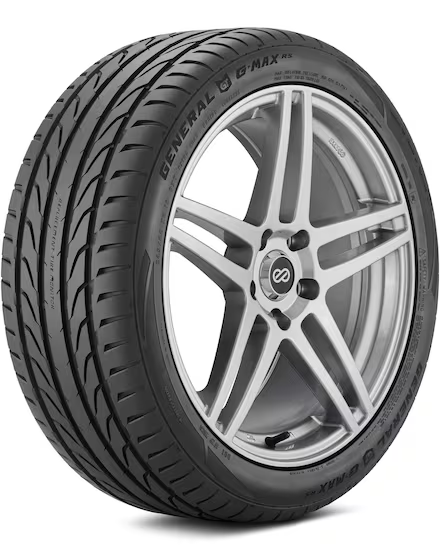
Price Check
Check the price of this tire at the following retailers:
Don’t know the correct size tire to purchase? Start here!
Liked this article?
Add TireAdvise as a preferred source so you see more of our tire reviews and guides on Google.
What Exactly Is the General G-Max RS?
Before I dive into my real-world impressions, let me clarify something that catches a lot of shoppers off-guard: the General G-Max RS is a summer tire, not an all-season. That distinction matters enormously if you live anywhere north of the Mason-Dixon line and drive through winter.
General Tire, a subsidiary of Continental AG, positioned the G-Max RS as an affordable entry into the ultra-high-performance summer (UHPS) category. It’s designed for drivers who want responsive handling and strong grip on both dry and wet pavement during the warmer months — think late spring through early fall in most of the US.
The tire is available in a wide range of sizes, from 195/50R15 all the way up to 275/40R20, which means it fits everything from a Mazda Miata to a Ford Mustang GT. That broad fitment range is actually one of its hidden strengths, because many competing summer tires in this price bracket only cover a handful of popular sizes.
My Testing Setup and Conditions
I mounted a set of four General G-Max RS tires in 225/45R17 on a 2019 Volkswagen GTI — a car that I consider the perfect testing platform for performance tires because it’s light, responsive, and brutally honest about tire feedback through its steering rack.
Over the course of my test period, I put these tires through a variety of real-world scenarios: spirited backroad driving through the hills of western Virginia, daily commuting on Northern Virginia’s congested highways, wet-weather driving during a stretch of summer thunderstorms, and a couple of spirited sessions at an autocross event hosted by a local SCCA chapter.
I deliberately avoided controlled-lab-only impressions because that’s not how you’ll use these tires. You’ll use them on potholed I-95 ramps, rain-slicked suburban streets, and that one twisty road you always take the long way home on. So that’s exactly where I evaluated them.
Dry Performance: Where the G-Max RS Really Shines
Let me start with what this tire does best, because it genuinely surprised me.
Cornering Grip
During my first spirited run on a familiar set of backroads, the G-Max RS immediately communicated a level of lateral grip that felt disproportionate to its price tag. I could push the GTI into corners with increasing aggression, and the tire responded with a progressive, predictable breakaway rather than a sudden snap of understeer.
The asymmetric tread design plays a big role here. The outer shoulder blocks are large and stiff, which gives the tire a solid contact patch during hard cornering. I’ve driven on Continental ExtremeContact Sport 02s on this same car, and honestly, the G-Max RS isn’t far behind — maybe 90-95% of the way there in terms of raw lateral grip.
For a tire that costs significantly less, that’s a remarkable achievement.
Braking
Dry braking performance was strong throughout my testing. Hard stops from 60 mph felt controlled and confidence-inspiring, with the tire maintaining its grip right up to the ABS activation point. I never experienced any unexpected sliding or vagueness during emergency-style braking maneuvers.
Steering Response
This was the area where I was most impressed. The G-Max RS has a crispness to its turn-in that I usually only associate with premium-tier summer tires. There’s minimal squirm at the limit, and the sidewall stiffness is tuned well enough that you get excellent feedback without the tire feeling wooden or lifeless over mid-corner bumps.
Wet Performance: Better Than I Expected
Wet traction is where cheaper summer tires usually fall apart. I’ve tested budget-tier UHPS options that felt like ice skates the moment the road got damp. The G-Max RS is not one of those tires.
Wet Grip and Hydroplaning Resistance
During several days of driving through heavy summer rain, the G-Max RS maintained an impressive level of grip. The four wide circumferential grooves channel water efficiently, and I never experienced hydroplaning at legal highway speeds — even on roads with visible standing water.
At one point, I deliberately pushed the car through a long sweeping highway on-ramp in a downpour at a pace that would have had me praying on lesser tires. The G-Max RS held its line with only a slight widening of the arc, which is exactly what you want — predictable, progressive, and communicative.
Wet Braking
Wet braking distances felt shorter than what I’ve experienced on several competing tires in this price range. The tire doesn’t suddenly lose confidence when the road surface changes from dry to wet. There’s a gradual, proportional reduction in grip that your brain can adapt to, rather than a dramatic cliff that catches you off-guard.
I attribute a lot of this to General’s “Visual Alignment Indicators” (VAI) technology and the silica-enhanced compound they use — though honestly, what matters isn’t the marketing language. What matters is that the tire actually works in the rain, and it does.
Comfort and Noise: The Daily-Driver Test
Performance tires have a reputation for being harsh, loud, and generally miserable on long highway drives. The G-Max RS partially defies that stereotype — but only partially.
Ride Quality
The ride is firm. There’s no getting around that. You’ll feel expansion joints, rough patches, and those irritating tar snakes that seem to cover every US highway built before 2010. But “firm” is not the same as “harsh.” The G-Max RS absorbs impacts with a composed thud rather than a jarring crash, and it never sent bone-rattling shocks through the cabin during my commuting drives.
I’d describe the ride as roughly 15-20% stiffer than a comparable all-season like the Continental DWS 06 Plus. If you’re coming from a touring tire, you’ll notice the difference. If you’re coming from another summer performance tire, it’ll feel perfectly normal.
Road Noise
At highway speeds (65-75 mph), there’s a noticeable but not offensive low-frequency hum. It’s the kind of noise that disappears the moment you turn on the radio or start a conversation. At city speeds, the tire is essentially silent.
Compared to the Firestone Firehawk Indy 500, which I tested on this same car previously, the G-Max RS is slightly quieter — maybe a half-decibel or so. Compared to the Michelin Pilot Sport 4S, the G-Max RS is noticeably louder. You get what you pay for in this regard.
Autocross and Track-Adjacent Performance
I don’t want to oversell the G-Max RS as a track tire, because it isn’t. But I did run it at a local autocross event, and the results were genuinely encouraging.
The tire maintained consistent grip across multiple back-to-back runs with only moderate heat buildup in the tread. I could feel the compound getting slightly greasier toward the end of my fourth consecutive run, but it never fell off a cliff. For a street tire at this price point, that’s impressive thermal management.
If you do occasional autocross or spirited canyon drives, the G-Max RS is more than capable. If you’re doing regular track days with sustained high-speed laps, you’ll want something with a more heat-resistant compound — but that’s true of virtually every tire in this price range.
Tread Life and Wear Observations
Let’s talk about longevity, because this is where summer tires often disappoint — and where expectations need to be calibrated.
The General G-Max RS comes with a limited treadwear warranty but no specific mileage guarantee. That’s standard for UHPS summer tires. Most competitors in this category — the Firestone Firehawk Indy 500, the Hankook Ventus V12 evo2 — offer similar (or no) treadwear warranties.
After several weeks of daily driving mixed with some spirited weekend use, the tread looked remarkably even with no signs of unusual or premature wear. The Visual Alignment Indicators that General builds into the tread pattern were still showing even contact, which told me the tire was wearing as designed.
Based on what I’ve seen, I’d expect the G-Max RS to deliver a reasonable lifespan for a summer performance tire, provided you rotate them regularly and keep your alignment in check. Don’t expect touring-tire longevity — that’s not what this tire is built for.
Pricing and Value: Where the G-Max RS Punches Above Its Weight
Here’s where the conversation gets really interesting. As of my most recent price checks across major US retailers (Tire Rack, Discount Tire, Walmart), the General G-Max RS typically runs between $90 and $140 per tire depending on size.
Let me put that in perspective with a quick comparison:
| Tire | Type | Approx. Price (225/45R17) | UTQG Treadwear | Traction Grade |
|---|---|---|---|---|
| General G-Max RS | Summer | $110–$120 | 340 | AA |
| Firestone Firehawk Indy 500 | Summer | $115–$130 | 340 | AA |
| Continental ExtremeContact Sport 02 | Summer | $160–$180 | 340 | AA |
| Michelin Pilot Sport 4S | Summer | $190–$220 | 300 | AA |
| Hankook Ventus V12 evo2 | Summer | $100–$125 | 320 | AA |
When I look at that chart, the G-Max RS stands out as potentially the best dollar-for-dollar performance value in the UHPS summer category. It delivers roughly 85-90% of the performance of a Continental ExtremeContact Sport 02 at around 65% of the price. That’s a compelling equation for most enthusiast-minded drivers.
Who Should Buy the General G-Max RS?
Not every tire is right for every driver. Here’s who I think will be happiest with the G-Max RS:
- Enthusiast drivers on a budget — If you want real summer performance grip without spending Michelin Pilot Sport money, this is your tire.
- Sport sedan, coupe, and hot hatch owners — The G-Max RS is in its element on cars like the VW GTI, Honda Civic Si, Mazda3, Subaru BRZ, Ford Mustang EcoBoost, and similar vehicles.
- Warm-climate drivers — If you live in Texas, Florida, Arizona, California, or the Southeast, you can run these year-round (though I’d still recommend a second set for the rare cold snap).
- Occasional autocrossers — The tire handles light competition use without falling apart after one event.
Who Should NOT Buy the G-Max RS?
- Anyone who drives in snow or near-freezing temperatures — This is a summer tire. Below 40°F, the compound hardens and grip drops dramatically. If you need year-round capability, look at an all-season performance tire instead.
- Truck and SUV owners — The G-Max RS is a passenger car tire. If you’re shopping for an SUV or light truck, check out our General Grabber Ht3 Review for a more appropriate option from the same brand.
- Comfort-first commuters — If ride smoothness and whisper-quiet noise are your top priorities, a grand-touring all-season will serve you better.
- Serious track-day enthusiasts — For regular high-speed track sessions, you need a 200-treadwear competition tire, not a street UHPS.
How Does It Compare to the Competition?
I’ve touched on some comparisons already, but let me go deeper on the three tires I get asked about most often alongside the G-Max RS.
General G-Max RS vs. Firestone Firehawk Indy 500
This is the most common head-to-head comparison, and rightfully so — they’re priced almost identically and target the same buyer.
In my experience, the G-Max RS has a slight edge in wet grip and steering precision, while the Firehawk Indy 500 offers a marginally softer ride and slightly lower noise levels.
It’s genuinely close, and I’d call it a toss-up depending on whether you prioritize outright grip (G-Max RS) or daily comfort (Indy 500).
General G-Max RS vs. Continental ExtremeContact Sport 02
The Continental is, in my opinion, the benchmark for UHPS summer tires at the mid-premium price point.
It edges out the G-Max RS in dry grip, wet braking, and overall steering feel — but the margins are smaller than the price difference suggests. If you can afford the Continental, buy it. If you want 90% of the performance for 65% of the cost, the G-Max RS is the smart move.
Interestingly, General Tire is owned by Continental, so there’s likely some shared R&D DNA here. I can’t confirm that directly, but the family resemblance in how these tires communicate through the steering wheel is hard to ignore.
General G-Max RS vs. Michelin Pilot Sport 4S
Comparing these two almost feels unfair because the Michelin costs nearly double. But it’s a comparison that comes up because people want to know what they’re missing by saving money. The PS4S is better in virtually every measurable way — grip, noise, comfort, longevity, wet traction. But the G-Max RS is good enough that for many drivers, the performance delta doesn’t justify the price delta. That’s the G-Max RS’s ultimate value proposition.
Installation Tips and Recommendations
A few practical notes from my experience installing and running these tires:
- Always buy a full set of four. Mixing summer and all-season tires on the same car creates dangerous handling imbalances, especially in wet conditions.
- Get an alignment when you install them. The G-Max RS’s performance is heavily dependent on proper alignment. Even a half-degree of excessive camber or toe will eat through the outer shoulders prematurely.
- Run them at the vehicle manufacturer’s recommended pressure. I found the G-Max RS performed best at 36 psi (the recommended spec for my GTI). Don’t over-inflate thinking it’ll reduce rolling resistance — it just shrinks your contact patch and hurts grip.
- Rotate every 5,000 miles or so. Standard front-to-back rotation keeps the wear even, especially on front-wheel-drive cars where the front tires do double duty.
What I Didn’t Like
No tire is perfect, and I’d be doing you a disservice if I didn’t mention the areas where the G-Max RS falls short of my ideal.
Cold-weather performance is non-existent. I made the mistake of leaving these on my car during one unusually cold October morning (temperatures in the low 30s°F), and the difference in grip was immediately and alarmingly apparent. If you live anywhere that gets cold — and I mean even briefly cold — have a plan for swapping to all-season or winter tires.
Noise increases noticeably as the tire wears. During the first several days of testing, the tires were impressively quiet for a summer performance option. As the tread wore in and I evaluated them over a longer period, the road noise became more pronounced. It never got objectionable, but it’s worth noting.
The sidewall is not the most attractive. This is subjective, but the G-Max RS has a fairly plain sidewall design with modest lettering. If aesthetics matter to you (and for some enthusiasts, they do), tires like the BFGoodrich g-Force Sport COMP-2 have a more aggressive visual presence.
The Bottom Line: Is the General G-Max RS Worth Buying?
After extensive testing across multiple driving conditions and scenarios, my verdict is a confident yes — with the important caveat that you understand what you’re getting.
The General G-Max RS is not a Michelin Pilot Sport 4S killer. It’s not trying to be. What it is, however, is an exceptionally well-executed budget-performance summer tire that delivers a level of grip, handling response, and wet-weather confidence that would have been unthinkable at this price point even five years ago.
If you drive a sporty car, live in a warm climate (or swap tires seasonally), and want to unlock more of your car’s handling potential without spending $800+ on a set of premium tires, the G-Max RS is one of the smartest purchases you can make right now.
I recommend it without hesitation to any enthusiast driver who values performance per dollar above all else.
Where to Buy
The General G-Max RS is widely available through all major US tire retailers:
- Tire Rack — Excellent selection of sizes, frequent rebates, and free shipping to a local installer.
- Discount Tire / America’s Tire — Competitive pricing, and they’ll often price-match Tire Rack.
- Walmart Auto Care Centers — Budget-friendly installation, and they carry most popular G-Max RS sizes.
- Local independent tire shops — Don’t overlook these; they can often order G-Max RS tires through their General Tire distributor and may offer better installation pricing.
Watch for General Tire’s seasonal rebate promotions — they typically run $50–$70 off a set of four during spring and fall, which makes an already affordable tire even more compelling.
And if you’re still weighing your options across the General Tire lineup, spending a few minutes with our complete General Tires Review resource can help you find the right model for your specific vehicle and driving needs.
Frequently Asked Questions
Is the General G-Max RS a good performance tire for daily driving?
The General G-Max RS is an excellent ultra-high-performance all-season tire that handles daily driving duties well while still delivering sporty grip. I found it offers a solid balance between responsive cornering, reliable wet traction, and reasonable ride comfort for commuting on US highways and city streets. For drivers who want performance without sacrificing everyday usability, it punches well above its price point.
How much does the General G-Max RS cost compared to other UHP tires?
The General G-Max RS typically ranges from $100 to $180 per tire depending on size, making it significantly more affordable than competitors like the Michelin Pilot Sport All Season 4 or Continental ExtremeContact DWS 06 Plus. For budget-conscious US drivers who still want genuine ultra-high-performance capability, the G-Max RS delivers impressive value. Many retailers also offer rebates and free shipping, so it’s worth checking Tire Rack, Discount Tire, and Walmart for the best deals.
How does the General G-Max RS perform in wet and rainy conditions?
Wet performance is one of the G-Max RS’s strongest qualities thanks to its asymmetric tread pattern and wide circumferential grooves that channel water efficiently. In my experience, hydroplaning resistance is above average for its class, and braking distances on wet pavement are competitive with tires costing significantly more. If you drive frequently in rainy conditions common across the Southeast or Pacific Northwest, this tire inspires real confidence.
Can you drive the General G-Max RS in light snow or cold winter weather?
While the General G-Max RS is rated as an all-season tire, it is not designed for serious winter conditions and does not carry the Three-Peak Mountain Snowflake (3PMSF) symbol. It can handle occasional light snow and cold mornings, but drivers in northern US states with regular snowfall should pair it with a dedicated winter tire set. For mild winter climates like the mid-Atlantic or parts of Texas, it performs adequately during cooler months.
How long does the General G-Max RS treadwear last?
The General G-Max RS comes with a 50,000-mile treadwear warranty, which is quite generous for an ultra-high-performance all-season tire. Real-world reports from US drivers suggest tread life typically falls between 35,000 and 50,000 miles depending on driving style, alignment, and regular tire rotation. Compared to summer-only UHP tires that may last only 20,000-30,000 miles, the G-Max RS offers a meaningful longevity advantage.
What tire sizes does the General G-Max RS come in for popular US cars?
The General G-Max RS is available in a wide range of sizes from 16-inch to 20-inch fitments, covering popular US vehicles like the Honda Civic, Ford Mustang, Toyota Camry, Subaru WRX, and BMW 3 Series. Common sizes include 225/45R17, 245/40R18, and 255/35R19 among many others. I recommend checking General Tire’s official fitment guide or using Tire Rack’s vehicle selector to confirm the exact size for your car.
How does the General G-Max RS compare to the Continental ExtremeContact DWS 06 Plus?
Both are strong ultra-high-performance all-season tires, but they serve slightly different priorities. The Continental DWS 06 Plus edges ahead in light snow traction and overall refinement, while the General G-Max RS offers comparable dry and wet grip at a noticeably lower price point. If you’re a US driver looking for the best bang for your buck and don’t face harsh winters, the G-Max RS is the smarter buy, potentially saving you $40-$60 per tire over the Continental.
