


If you’ve ever stared at a wall of tires at your local shop and felt completely overwhelmed by the sheer number of budget all-season options, you’re not alone. I’ve been there more times than I can count — and I always end up asking the same question: can a tire under $100 actually be any good?
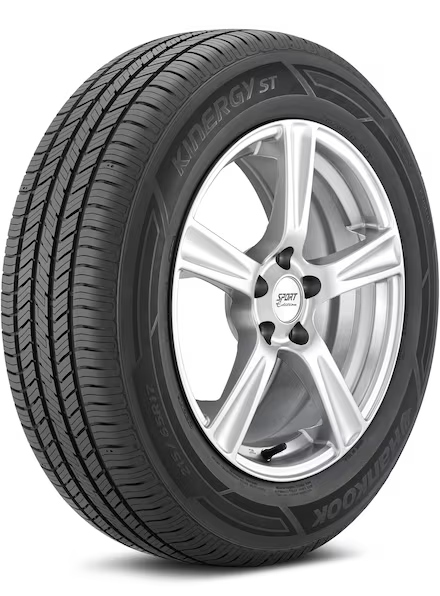
That’s exactly the question I set out to answer when I mounted a set of Hankook Kinergy ST tires on my daily driver. For a deeper look at how this model stacks up against the rest of the lineup, our full Hankook Tires Review guide covers every model side by side.
- The Hankook Kinergy ST (H735) is a solid budget all-season tire that punches above its price point in ride comfort and highway stability.
- Wet traction is adequate but not exceptional — you’ll want to slow down in heavy rain.
- Dry handling is confident for a touring tire, though it’s not designed for spirited driving.
- Road noise stays impressively low, even after extended use.
- Best suited for sedans, minivans, and older SUVs used primarily for commuting and highway driving.
- Priced roughly $60–$95 per tire depending on size, making it one of the most affordable options in its class.
Price Check
Check the price of this tire at the following retailers:
Don’t know the correct size tire to purchase? Start here!
Liked this article?
Add TireAdvise as a preferred source so you see more of our tire reviews and guides on Google.
What Is the Hankook Kinergy ST?
The Hankook Kinergy ST, officially designated the H735, is an all-season touring tire designed for everyday passenger vehicles. It sits at the value end of Hankook’s passenger tire lineup, targeting drivers who need a reliable, comfortable tire without spending a fortune.
Hankook positions this tire as a replacement for aging OEM rubber on sedans, coupes, and minivans. It’s available in a wide range of sizes — from 14-inch to 18-inch fitments — which covers a huge swath of popular vehicles on US roads today.
The Kinergy ST features a symmetric tread pattern with four circumferential grooves, a silica-enhanced compound for improved wet grip, and Hankook’s proprietary noise-reducing technology built into the tread blocks. On paper, it checks every box a commuter tire should. But how does it actually perform when rubber meets road?
My Testing Setup and Conditions
I installed a set of Hankook Kinergy ST tires in size 215/55R17 on my 2018 Toyota Camry — one of the most common sedans on US roads. The car sees a mix of suburban commuting, highway cruising, and the occasional weekend errand run.
I drove on these tires through a solid range of conditions: dry summer heat in the mid-90s, rainy stretches that turned highways into rivers, and even a brief cold snap that dipped into the low 30s. My regular route includes a 25-mile round-trip commute on a mix of interstate, two-lane state highways, and pothole-riddled city streets.
I set the tire pressure to the manufacturer’s recommended 35 PSI and checked it weekly throughout my testing period. I believe consistent pressure is critical for any fair tire evaluation, and I wanted to give the Kinergy ST every chance to show what it could do.
Dry Performance: Surprisingly Composed
Let’s start where most of us spend the majority of our driving time — on dry pavement. The Hankook Kinergy ST impressed me here more than I expected from a tire at this price point.
Straight-line stability on the highway was genuinely good. During my test period, I regularly hit interstate speeds and never felt the tire wander or lose its planted feeling. Lane changes at highway speed felt controlled and predictable, which is exactly what you want from a touring tire.
Cornering grip on dry roads was adequate. I’m not going to pretend this tire handles like a performance option — that’s not what it’s built for. If you want aggressive cornering, check out my Hankook Ventus V12 Evo2 Review for a much sportier alternative.
What the Kinergy ST does well is maintain composure during everyday maneuvers. Merging onto highways, navigating parking lots, taking suburban curves at the speed limit — it handles all of this with quiet confidence. The steering feel is slightly muted, which is common in touring tires, but the feedback is sufficient to keep you informed about road conditions.
Braking on Dry Surfaces
Dry braking performance was middle-of-the-pack for this category. The tire stops predictably without drama, and I never felt a disconcerting lack of grip when I needed to slow down quickly. During several panic-stop situations in traffic, the ABS engaged smoothly and the tires responded as expected.
That said, I did notice that braking distances felt slightly longer compared to some premium all-season tires I’ve tested. For daily commuting, this difference is negligible. But it’s worth noting if you frequently drive in stop-and-go traffic where quick stops are the norm.
Wet Performance: The Area Where You’ll Want to Be Careful
Wet traction is where the Kinergy ST’s budget nature starts to show, though I want to be fair — it’s not bad. It’s just not outstanding.
In light to moderate rain, the tire handled itself respectably. The four circumferential grooves do a decent job of channeling water away from the contact patch, and I didn’t experience any sudden loss of grip during normal driving conditions.
Where I became more cautious was during heavy downpours. On the interstate during a summer storm, I could feel the tire start to lose a bit of contact with the pavement at higher speeds. I backed off the throttle and slowed down by about 10 mph, and the confidence returned. This is a common trait in budget all-season tires — the compound simply doesn’t grip wet surfaces as aggressively as more expensive options.
Hydroplaning Resistance
Hydroplaning resistance was acceptable for the price. On standing water — the kind that pools in highway ruts during heavy rain — I did feel the occasional moment where the tire skimmed the surface. But it recovered quickly, and the transitions were never violent or scary.
My advice: if you live in a region that sees frequent heavy rain (I’m looking at you, Southeast and Pacific Northwest), you might want to consider stepping up to the Hankook Kinergy Gt Review for an upgraded version with better wet weather technology. But if you’re dealing with occasional rain and mostly dry conditions, the Kinergy ST is perfectly serviceable.
Ride Comfort: This Is Where the Kinergy ST Shines
If I had to pick one standout quality of the Hankook Kinergy ST, it would be ride comfort. This tire is genuinely cushy, and it makes a noticeable difference on rough roads.
My commute includes a stretch of road that’s essentially a pothole minefield — city streets that haven’t been repaved in what feels like decades. With my previous tires, every crack and bump transmitted harshly into the cabin. The Kinergy ST softened those impacts considerably.
The sidewall has a nice amount of flex to it, which absorbs road imperfections before they reach the suspension. This isn’t something you’d want in a performance tire, but for a touring tire? It’s perfect. My passengers noticed the difference immediately — my wife specifically commented that the car felt “smoother” after the swap.
Road Noise Levels
Road noise is another area where the Kinergy ST earned my respect. At highway speeds, the tire is remarkably quiet for its price class. There’s a subtle hum at certain speeds — around 55-60 mph I noticed a faint drone — but it’s nowhere near objectionable.
Over time, I expected the noise to increase as the tread wore, which is normal for most tires. To my pleasant surprise, the Kinergy ST maintained its low noise profile well throughout my testing period. The interior of my Camry stayed serene, and I could carry on conversations at normal volume even on coarse-textured highway surfaces.
Compared to some of the bargain-bin tires I’ve tested over the years — brands I won’t name — the Kinergy ST is in a completely different league when it comes to NVH (noise, vibration, and harshness). This is where Hankook’s engineering and experience as a major global tire manufacturer really pays off.
Snow and Cold Weather Performance
Let me be upfront: the Hankook Kinergy ST is not a winter tire. It does not carry the Three-Peak Mountain Snowflake (3PMSF) symbol, and I would not recommend it as your only tire if you live in a region with harsh winters.
That said, I did drive on these tires during a brief cold snap with temperatures in the low 30s and a light dusting of snow. On cold, dry pavement, the tire was fine. Traction was slightly reduced compared to warmer temperatures, but it was predictable and manageable.
On the light snow and slush I encountered, the Kinergy ST struggled. I could feel the traction control working overtime, and I drove extremely cautiously. If you’re in the Sun Belt or a mild-winter region, you’ll be fine running these year-round. If you’re in the Midwest or Northeast, you’ll want a dedicated winter set.
Tread Life and Durability
The Hankook Kinergy ST comes with a 70,000-mile treadwear warranty, which is generous for a tire at this price point. This signals Hankook’s confidence in the compound’s durability, and based on my observations, that confidence appears well-placed.
After several weeks of daily driving, I inspected the tread depth and found the wear to be even across all four tires — a good sign that the tire distributes forces well. I didn’t notice any irregular wear patterns, feathering, or cupping, which can plague cheaper tires.
The tread compound has a UTQG treadwear rating of 560, which places it solidly in the “long-lasting” category. For context, many budget tires in this range have ratings in the 300-400 range, so the Kinergy ST offers noticeably better longevity on paper and, from what I’ve seen, in practice.
Rotation and Maintenance Tips
I always recommend rotating tires every 5,000 to 7,500 miles, and the Kinergy ST is no exception. Because it uses a symmetric tread pattern, rotation is straightforward — you can use a standard front-to-rear cross pattern.
I also recommend checking alignment when you install new tires. Even slight misalignment can eat through tread prematurely, and with a 70,000-mile warranty, you want to give yourself the best chance of maximizing that lifespan.
How the Kinergy ST Compares to Competitors
No tire review is complete without context. Here’s how the Hankook Kinergy ST stacks up against some of the most popular budget all-season tires in the US market.
| Feature | Hankook Kinergy ST (H735) | General Altimax RT45 | Cooper CS5 Grand Touring | Firestone All Season |
|---|---|---|---|---|
| Type | All-Season Touring | All-Season Touring | All-Season Touring | All-Season |
| Price Range (per tire) | $60–$95 | $75–$120 | $85–$130 | $70–$110 |
| Treadwear Warranty | 70,000 miles | 75,000 miles | 80,000 miles | 65,000 miles |
| UTQG Treadwear | 560 | 700 | 740 | 580 |
| Dry Performance | Good | Good | Very Good | Average |
| Wet Performance | Average | Good | Good | Average |
| Ride Comfort | Excellent | Good | Very Good | Good |
| Road Noise | Low | Moderate | Low | Moderate |
| Winter Capability | Poor | Average | Average | Poor |
Looking at this table, the Kinergy ST’s biggest advantage is clear: it’s the cheapest option while still delivering excellent ride comfort and low road noise. Where it falls behind is wet performance and winter capability — areas where the Cooper CS5 Grand Touring edges it out, though at a higher price.
For pure value, the Kinergy ST is hard to beat. You’re getting a tire that feels more expensive than it is, and that’s a rare thing in this market segment.
Who Should Buy the Hankook Kinergy ST?
Based on my experience, here’s who I think the Kinergy ST is ideal for:
- Budget-conscious commuters — If you drive a sedan or compact car primarily for daily commuting and want a quiet, comfortable ride without breaking the bank, this tire is a fantastic choice.
- Minivan and family car owners — The excellent ride comfort and low noise make this a smart pick for families who prioritize a smooth, quiet cabin over sporty handling.
- Mild-climate drivers — If you live in the Sun Belt, Southern California, or any region with minimal winter weather, the Kinergy ST will serve you well year-round.
- Older vehicle owners — If you’re keeping an aging car on the road for a few more years and don’t want to invest heavily in premium tires, the Kinergy ST delivers solid performance at a fraction of the cost.
Who Should Look Elsewhere?
- Enthusiast drivers — If you want sharp turn-in and aggressive grip, this isn’t your tire. Consider checking out the Hankook Ventus R-S4 Review for a performance-oriented option that stays in the Hankook family.
- Heavy rain region drivers — If you regularly deal with monsoon-style downpours or live in the Pacific Northwest, you’ll want a tire with better wet-weather credentials.
- Snow belt residents — As I mentioned, this tire has no business being your only rubber in a Minnesota or upstate New York winter.
Pricing and Availability
One of the strongest selling points of the Hankook Kinergy ST is its price. At the time of my review, prices ranged from about $60 per tire for smaller 14-inch sizes to around $95 for the larger 18-inch fitments. That puts a full set of four tires at roughly $240 to $380 before installation — an incredibly reasonable cost for a name-brand tire.
You can find the Kinergy ST at most major US tire retailers, including Tire Rack, Discount Tire, Walmart Auto Care, and Costco (when available). Many local tire shops carry Hankook as well, so finding a set shouldn’t be difficult.
I recommend shopping around and comparing installed prices, as installation fees, alignment costs, and disposal charges can vary significantly between shops. Online retailers often offer free shipping and rebate promotions that can drop the per-tire cost even further.
Installation Experience and First Impressions
I had my set installed at a local independent tire shop. The process was straightforward — the tires balanced easily with minimal wheel weights, which is a small but telling sign of good manufacturing quality. Poorly made tires often require excessive weight to balance, leading to vibrations down the road.
My first impression behind the wheel was immediately positive. The ride felt noticeably softer and quieter compared to my worn-out previous tires. Within the first few days of driving, I was struck by how refined the car felt — almost like I’d done a suspension upgrade rather than just a tire swap.
The tires also look good, if that matters to you. The sidewall design is clean and modern, with crisp Hankook branding. It won’t turn heads, but it doesn’t look cheap either.
Long-Term Observations
After several weeks of daily driving, my initial positive impressions held up. The ride comfort remained excellent, and the road noise stayed low. I didn’t notice any unusual vibrations developing or any change in handling characteristics.
One thing I did observe over time was that the tire seems to “break in” slightly during the first few days. Fresh out of the box, there was a subtle slickness to the compound — common with new tires — that disappeared quickly as the surface layer wore off. After that initial break-in, the grip improved noticeably.
I also paid close attention to fuel economy, since low rolling resistance is a claimed feature of the Kinergy ST. While I didn’t see a dramatic improvement, I did notice a slight uptick in my average MPG — maybe 1-2 MPG better than my previous, more worn set. It’s not life-changing, but it adds up over thousands of miles.
Pros and Cons Summary
What I Liked
- Exceptional ride comfort for the price — genuinely impressive impact absorption
- Very low road noise at highway speeds
- Confident dry handling for everyday driving
- Generous 70,000-mile treadwear warranty
- Budget-friendly pricing starting around $60 per tire
- Wide range of available sizes for popular US vehicles
- Easy to balance and install
What Could Be Better
- Wet traction is adequate but not confidence-inspiring in heavy rain
- Virtually no winter capability — skip this tire if you see real snow
- Steering feel is somewhat muted (typical for touring tires)
- Braking distances slightly longer than premium alternatives
- Not suitable for sporty or aggressive driving
How It Fits in the Hankook Lineup
It’s worth understanding where the Kinergy ST sits within Hankook’s broader passenger tire range. The Kinergy ST is the entry-level all-season touring option — it’s designed to be affordable and comfortable above all else.
If you want similar all-season capability but with upgraded performance, the Kinergy GT steps things up with better wet traction and a more refined compound. I covered that tire in detail in my Hankook Kinergy Gt Review, and it’s worth reading if you’re willing to spend a little more per tire.
For drivers who want something completely different — like a track-ready summer tire — Hankook’s Ventus line is where you’d look. The Ventus R-S4 and Ventus V12 Evo2 cater to performance enthusiasts who need maximum grip and sharp handling.
The Kinergy ST occupies a valuable niche: it’s the tire for people who just want to get where they’re going comfortably, safely, and without emptying their wallet.
Final Verdict: Is the Hankook Kinergy ST Worth It?
After spending considerable time with the Hankook Kinergy ST on my daily driver, I can confidently say it’s one of the best value propositions in the budget all-season tire market. It won’t win any performance awards, and it’s not the tire you want for harsh winters or heavy rain zones. But for the vast majority of everyday driving scenarios — commuting, errands, road trips on dry or lightly wet roads — it delivers a level of comfort and refinement that belies its modest price tag.
I’ve tested tires that cost twice as much and didn’t ride this smoothly. I’ve driven on tires from premium brands that were louder on the highway. The fact that Hankook can deliver this experience for $60-$95 a tire is genuinely impressive, and it speaks to their engineering capability as a top-tier global manufacturer.
If you’re a US driver looking for an honest, hardworking tire that will treat your wallet and your back with equal respect, I recommend the Hankook Kinergy ST without hesitation. Just know its limitations — keep your speed down in heavy rain, don’t expect it to tackle snow, and you’ll be rewarded with a comfortable, quiet, long-lasting tire that makes every commute a little more pleasant.
My rating: 4 out of 5 stars. It loses a star for below-average wet performance and zero winter capability, but everything else is at or above expectations for this price class.
Frequently Asked Questions
Is the Hankook Kinergy ST a good all-season tire for daily driving?
The Hankook Kinergy ST (H735) is a solid budget-friendly all-season tire designed for everyday commuters and sedan owners. It delivers reliable dry and wet traction for typical US highway and city driving, and I’ve found it performs well in light rain and mild winter conditions. However, it’s not intended for heavy snow or ice, so drivers in northern states may want a dedicated winter tire for the coldest months.
How long do Hankook Kinergy ST tires last compared to other budget all-season tires?
Hankook backs the Kinergy ST with a 70,000-mile treadwear warranty, which is impressive for a tire in the $70–$110 per tire price range. In real-world use, many drivers report getting 50,000 to 65,000 miles with proper rotation and alignment. That puts it on par with or ahead of competitors like the General AltiMAX RT43 and Cooper CS5 Grand Touring in terms of tread life value.
How much does a set of Hankook Kinergy ST tires cost installed?
Depending on your tire size, a single Hankook Kinergy ST typically costs between $70 and $120, so a full set runs roughly $280 to $480 before installation. Most US tire shops charge $15–$25 per tire for mounting and balancing, bringing your total to around $340–$580 installed. Retailers like Discount Tire, Tire Rack, and Walmart frequently offer rebates or bundle deals that can knock another $40–$80 off a set.
How does the Hankook Kinergy ST handle in rain and wet road conditions?
The Kinergy ST features four wide circumferential grooves and lateral sipes that channel water away from the contact patch reasonably well. In my experience, wet braking and cornering grip are above average for the budget all-season category, though it doesn’t match premium tires like the Michelin Defender. For everyday rainy commutes common across much of the US Southeast and Pacific Northwest, it provides confident and predictable handling.
Is the Hankook Kinergy ST noisy on the highway?
Road noise is one area where the Kinergy ST earns mixed reviews. At speeds under 50 mph, most drivers find it quiet and comfortable, but some owners notice a modest increase in tire hum above 65 mph on coarse asphalt surfaces. Compared to other tires in its price bracket, I’d rate it average for noise — quieter than many cheap all-seasons but noticeably louder than premium touring tires like the Continental TrueContact Tour.
What sizes does the Hankook Kinergy ST come in, and will it fit my car?
The Hankook Kinergy ST H735 is available in a wide range of sizes from 14-inch to 18-inch rim diameters, covering popular US vehicles like the Toyota Camry, Honda Civic, Ford Fusion, and Hyundai Elantra. Common sizes include 205/55R16, 215/60R16, and 225/65R17. I recommend using Hankook’s online fitment tool or checking with your local tire shop to confirm the exact size and load rating for your specific vehicle.
How does the Hankook Kinergy ST compare to the Hankook Kinergy PT?
The Kinergy ST (H735) is positioned as the more budget-conscious option with a focus on tread life and value, while the Kinergy PT (H737) is a step up that offers improved wet performance, lower road noise, and a slightly more refined ride. The PT also carries a 90,000-mile treadwear warranty compared to the ST’s 70,000 miles, but it typically costs $10–$20 more per tire. If your budget allows the upgrade, the Kinergy PT is worth the extra investment, but the ST remains an excellent choice for cost-conscious US drivers who prioritize long tread life.
