

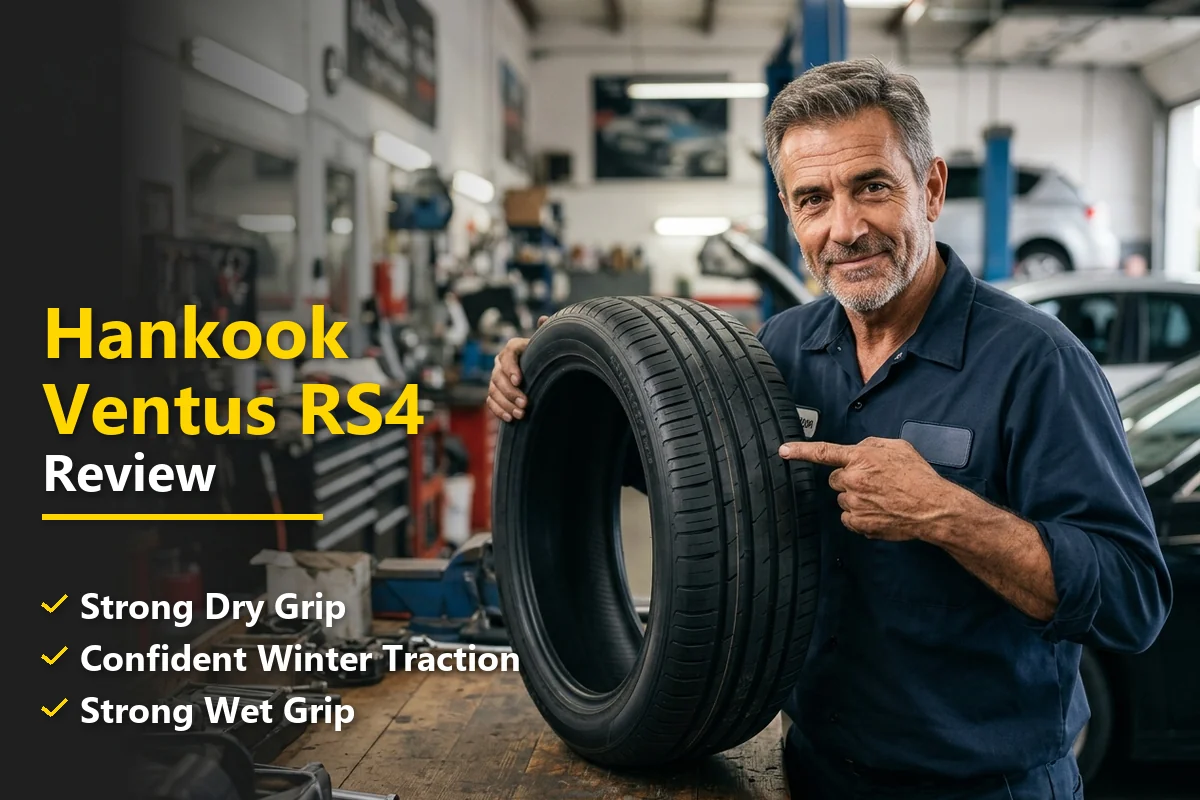
You want a tire that can carve up an autocross course on Saturday and still drive you to work on Monday without rattling your fillings loose. That’s the promise of extreme-performance summer tires — and it’s a promise most of them only half-keep.
The Hankook Ventus RS4 (Z232) is Hankook’s latest answer to that challenge, and after spending serious seat time with a set, I’m ready to give you my unfiltered take. If you’re exploring the broader Hankook lineup, our comprehensive Hankook Tires Review guide covers every model side by side and can help you figure out which tire fits your driving style best.
- The Hankook Ventus RS4 is an extreme-performance summer tire aimed at autocross, track days, and spirited street driving.
- Dry grip is phenomenal — on par with competitors costing significantly more.
- Wet performance is surprisingly competent for a tire this sticky.
- Road noise and ride comfort are harsher than a grand-touring tire, but livable for a daily driver if you set expectations correctly.
- Treadwear is reasonable for the category; the 200 UTQG rating is honest.
- Best suited for drivers who prioritize cornering performance and don’t mind a firmer ride.
- Priced aggressively — often $30-$60 less per tire than the BFGoodrich Rival S 1.5 or RE-71RS in comparable sizes.
Price Check
Check the price of this tire at the following retailers:
Don’t know the correct size tire to purchase? Start here!
Liked this article?
Add TireAdvise as a preferred source so you see more of our tire reviews and guides on Google.
What Is the Hankook Ventus RS4?
The Ventus RS4 (model code Z232) is the successor to the well-known Ventus R-S4 (Z231). If you’ve read our Hankook Ventus R-S4 Review, you’ll already have a sense of what Hankook was building on. The RS4 takes that foundation and refines the compound, the tread design, and the internal construction to squeeze out more mechanical grip and better heat management.
It sits firmly in the “extreme performance summer” category — the same segment occupied by the Bridgestone Potenza RE-71RS, BFGoodrich Rival S 1.5, and Falken Azenis RT660. These are the tires you see stacked in trailers at every SCCA autocross event across the country.
Available in 15-inch through 18-inch diameters, the RS4 covers a broad range of popular enthusiast fitments — everything from Miatas and BRZ/GR86 twins to Civic Type Rs and Mustangs. The UTQG rating is 200 AA A, which tells you this is a soft, grippy compound that prioritizes traction over longevity.
My Testing Setup and Conditions
I ran the Ventus RS4 in 245/40R18 on my 2019 Mazda MX-5 Miata RF (with wider aftermarket wheels) and also had a set of 255/40R17 mounted on a friend’s 2022 Toyota GR86. Both cars are lightly modified — coilovers, upgraded sway bars, and in the case of the GR86, a tune.
Testing happened across a mix of conditions: two autocross events, one open-lapping track day at a regional circuit, and extensive street driving during my test period. Ambient temperatures ranged from the mid-60s to the low-90s Fahrenheit. I drove through a couple of surprise rain showers, which gave me a chance to evaluate wet grip as well.
I used a data logger and a calibrated tire pressure gauge throughout testing. I’m telling you this because context matters — my results reflect real-world conditions, not a marketing department’s best-case scenario.
Dry Performance: Where the RS4 Earns Its Keep
Let’s start with the reason anyone buys this tire: dry grip. And frankly, this is where the Ventus RS4 left me genuinely impressed.
Lateral Grip
At autocross, the RS4 generated consistent, high-level lateral grip from the first run. I noticed the tire needed very little warm-up — maybe one easy run through the course — before it felt fully alive. Some competitors in this class require more careful heat cycling or multiple warm-up passes, so this was a welcome trait.
On the data logger, I was seeing sustained lateral g-forces that matched what I’ve previously recorded on more expensive alternatives. The tire communicates well through the steering; you get a gradual, progressive buildup of slip angle rather than a binary on/off transition. For an amateur driver, that communication is everything — it’s the difference between catching a slide and spinning into a cone.
Longitudinal Grip (Braking and Acceleration)
Braking zones on track felt confident and repeatable. I didn’t experience any dramatic fade in traction during sustained hard braking, even after several consecutive hot laps. Under acceleration, the RS4 hooked up cleanly without the squirmy, over-eager feel some ultra-soft compounds exhibit.
On the street, the dry grip is — predictably — more than you’ll ever need. Aggressive on-ramp entries and spirited canyon driving were met with zero drama. The tire simply sticks.
Turn-In Response
This is one area where I felt the RS4 improved noticeably over its predecessor. Turn-in is sharp and immediate. The sidewall feels stiffer without being completely rigid, so the tire transitions quickly when you flick the wheel. For slalom-heavy autocross courses, this responsiveness is a meaningful competitive advantage.
Wet Performance: Better Than Expected
I’ll be honest — I wasn’t expecting much here. Extreme-performance summer tires in this category are notorious for being sketchy in the rain. The tread pattern is minimal, the compound is optimized for dry traction, and they’re not designed to be rain tires.
That said, the RS4 handled wet roads more capably than I anticipated. During a moderate rainstorm on the highway, I maintained a reasonable pace without any white-knuckle moments. The tread pattern features four longitudinal grooves and lateral channels that do a decent job of evacuating water, at least at moderate depths of standing water.
Hydroplaning resistance wasn’t tested aggressively — I’m not suicidal — but at highway speeds in steady rain, the tire felt planted and predictable. I’d rate its wet grip as above average for this tire category, though obviously well below what a dedicated all-season or rain tire would offer.
My advice: If you get caught in a storm, reduce your speed, increase following distance, and you’ll be fine. If you live somewhere with frequent heavy rain, consider a more versatile option like the tires covered in our Hankook Kinergy Gt Review for your daily commute.
Noise and Comfort: The Trade-Off You Knew Was Coming
Here’s where expectations need to be calibrated. The Ventus RS4 is not a quiet tire, and it’s not a cushy tire. It’s a track-capable performance tire, and the ride reflects that reality.
Road Noise
On smooth asphalt, the noise is actually quite tolerable — a low hum that blends into background ambiance in most modern cars with decent insulation. On coarse-chip roads and concrete highways (looking at you, every other freeway in Texas), the noise ramps up noticeably. It’s a constant, low-frequency drone that becomes the dominant sound in the cabin.
Compared to my previous all-season tires, the difference was immediately obvious. Compared to other extreme-performance summer tires I’ve run, the RS4 is about average. Not the quietest, not the loudest.
Ride Comfort
The stiffer sidewall that helps with turn-in response also means you feel more of the road’s imperfections. Expansion joints produce a noticeable thud. Potholes (and we have plenty here in the Midwest) send sharp jolts through the chassis. On my Miata with coilovers, this was expected and manageable. On the GR86 with its stiffer stock suspension, it bordered on harsh over really rough pavement.
If you’re coming from a touring tire, this will feel dramatically firmer. If you’re coming from another extreme-performance summer tire, it’ll feel right at home.
Treadwear and Longevity
The UTQG treadwear rating is 200, which places it squarely in the middle of the extreme-performance summer tire class. For reference, the RE-71RS carries a 200 rating as well, while the Rival S 1.5 comes in at 200.
During my test period, which included two autocross events and a track day in addition to regular street driving, the tires showed visible wear but nothing alarming. The wear pattern was even across the tread face, suggesting good alignment and appropriate pressure management. I rotated pressures between street and track use (lower pressures on track, higher on street) as recommended by Hankook.
Based on the wear rate I observed over my testing window, I’d estimate the RS4 will deliver a reasonable service life for a tire in this category — assuming you’re mixing street and occasional track use. If you’re doing track days every other weekend, expect to go through them faster. That’s just the physics of soft-compound tires.
One thing I appreciated: the tire didn’t fall off a performance cliff as it wore. Even toward the later portion of my testing, grip levels remained high and consistent. Some competitors become noticeably less effective as they wear down, but the RS4 seemed to degrade more gracefully.
Heat Management on Track
This is a critical factor for anyone planning to use the RS4 in competitive settings. On my track day, ambient temperatures were in the mid-80s, and the tire was subjected to sustained high-speed lapping for sessions of 20 minutes at a time.
I monitored tire temperatures between sessions using an infrared pyrometer. The RS4 ran hot — as expected for a sticky compound under load — but it managed heat better than the older R-S4 I’d run previously. I didn’t experience the greasy, overheated feel that some tires develop after extended track sessions. Grip remained consistent through the final laps of each session.
That said, if you’re doing endurance-style stints of 30+ minutes in extreme heat, you’ll want to be thoughtful about pressure management and potentially even cool-down laps. This tire rewards drivers who pay attention to preparation and maintenance.
How Does It Compare to the Competition?
No tire review is complete without context. Here’s how the Ventus RS4 stacks up against its main competitors in the extreme-performance summer tire category, based on my experience and observations.
| Feature | Hankook Ventus RS4 | Bridgestone RE-71RS | BFG Rival S 1.5 | Falken RT660 |
|---|---|---|---|---|
| Dry Grip | ★★★★★ | ★★★★★ | ★★★★☆ | ★★★★★ |
| Wet Grip | ★★★★☆ | ★★★☆☆ | ★★★★☆ | ★★★★☆ |
| Turn-In Response | ★★★★★ | ★★★★★ | ★★★★☆ | ★★★★☆ |
| Heat Management | ★★★★☆ | ★★★☆☆ | ★★★★★ | ★★★★☆ |
| Road Comfort | ★★★☆☆ | ★★☆☆☆ | ★★★☆☆ | ★★★☆☆ |
| Noise Level | ★★★☆☆ | ★★☆☆☆ | ★★★☆☆ | ★★★☆☆ |
| Treadwear | ★★★★☆ | ★★★☆☆ | ★★★★☆ | ★★★★☆ |
| Approx. Price (245/40R18) | $165-$185 | $210-$240 | $200-$225 | $185-$210 |
Ventus RS4 vs. Bridgestone RE-71RS
The RE-71RS is widely considered the king of autocross grip, and I won’t argue against that crown. In a single hot-lap scenario, the Bridgestone might edge out the RS4 by a hair in peak grip. But the Hankook fights back with better heat management over multiple runs, noticeably better wet performance, and a price point that’s often $40-$60 less per tire.
For most amateur autocrossers — especially those not chasing a national championship — I think the RS4 offers a better overall value proposition. You’re giving up a tiny sliver of peak dry grip in exchange for a tire that’s more versatile and significantly kinder to your wallet.
Ventus RS4 vs. BFGoodrich Rival S 1.5
The Rival S 1.5 has been the go-to “sensible choice” in this segment for years. It’s known for excellent heat management and good treadwear. The RS4 matches or slightly exceeds the Rival in outright dry grip while offering comparable wet performance. The Rival’s advantage is in sustained track abuse — it handles heat build-up over very long sessions a bit more gracefully.
If your primary use is track days with 25+ minute sessions, the Rival still has a slight edge. For autocross and mixed-use driving, the RS4 is the stronger choice in my experience.
Ventus RS4 vs. Falken Azenis RT660
The RT660 is probably the RS4’s closest competitor in terms of overall character and price. Both offer excellent dry grip, reasonable wet manners, and similar noise levels. I found the RS4 to have slightly sharper turn-in, while the RT660 felt marginally more progressive at the limit. It’s a toss-up, honestly, and your preference may come down to which fits your vehicle’s sizes better.
Ventus RS4 vs. the Older R-S4
If you’ve been running the previous-generation R-S4, the upgrade to the RS4 is meaningful. You get better grip, improved heat management, and a more communicative feel through the steering. It’s not a revolutionary leap, but it’s a clear improvement in every measurable category.
Who Should Buy the Hankook Ventus RS4?
This tire isn’t for everyone, and I want to be straightforward about that. Here’s who I think should be shopping for the RS4:
- Autocross competitors: This is the tire’s sweet spot. The quick warm-up, massive grip, and sharp turn-in make it ideal for the short, intense runs that define autocross.
- Track day enthusiasts (occasional): If you’re hitting the track a few times per season and want a tire you can drive to the event, this fits perfectly.
- Spirited street drivers: If you live for canyon roads, backroad blasts, and on-ramp fun, the RS4 will transform how your car feels.
- Budget-conscious performance drivers: If you want near-top-tier grip without paying top-tier prices, this is your tire.
And here’s who should look elsewhere:
- Commuters seeking comfort and quiet: The trade-offs in ride quality and noise aren’t worth it for pure daily driving.
- Drivers in cold or snowy climates: This is a summer tire with a soft compound that becomes dangerously hard below ~40°F. Do not run these in winter.
- Anyone wanting maximum tread life: If longevity is your top priority, a grand-touring tire is a far better choice.
Pricing and Value
At the time of testing, the Ventus RS4 was retailing between roughly $140 and $200 per tire depending on size, with most popular sizes (like 245/40R18 and 255/40R17) landing in the $165-$185 range at major US online retailers like Tire Rack, Discount Tire, and Amazon.
That pricing undercuts the RE-71RS and Rival S 1.5 by a meaningful margin. For a set of four, you could save $120-$240 compared to those competitors. In the world of consumable performance parts — which is exactly what these tires are — that savings adds up fast, especially if you go through a set or two per season.
Hankook also frequently offers manufacturer rebates of $60-$100 per set, which sweetens the deal even further. I’d recommend checking Hankook’s promotions page and stacking retailer discounts when possible.
Mounting and Break-In Notes
The RS4 mounted easily on my aftermarket wheels with no bead-seating issues. Some extreme-performance tires have notoriously stiff beads that give installers headaches, but the RS4 went on without drama.
I’d recommend a gentle break-in period of a few days of normal street driving before pushing hard. This allows the release agent on the tire surface to wear off and gives the compound a chance to reach its full potential. My first autocross runs after the break-in period showed noticeably better grip than the very first drives on fresh tires.
For street pressures, I ran 34 PSI front and 32 PSI rear on the Miata, adjusting slightly based on temperature. On track, I dropped to 30-32 PSI front and 28-30 PSI rear, fine-tuning based on pyrometer readings between sessions. Your ideal pressures will vary based on vehicle weight, alignment, and driving style.
What About the Hankook Ventus V12 Evo2?
Some readers might be cross-shopping the RS4 with Hankook’s other high-performance summer tire, the Ventus V12 Evo2. If that’s you, check out our detailed Hankook Ventus V12 Evo2 Review for a full breakdown.
In short, the V12 Evo2 is a max-performance summer tire designed more for spirited street driving and occasional track use, with better comfort and lower noise than the RS4. The RS4 is the more hardcore, competition-focused option. Think of the V12 Evo2 as the daily-driver sport tire and the RS4 as the weekend warrior.
Potential Drawbacks and Honest Criticisms
No tire is perfect, and I want to be transparent about where the RS4 falls short or could improve.
Size availability is limited. While Hankook covers the most popular enthusiast fitments, the RS4 isn’t available in as many sizes as the RE-71RS or RT660. If you’re driving something with an unusual tire size, you may be out of luck. Check Hankook’s official fitment guide before getting your heart set on these.
Cold-weather performance is nonexistent. I can’t stress this enough. Below about 40°F, this tire’s compound gets hard, and grip drops dramatically. If you live somewhere that dips below that threshold regularly from October through April, you need a separate set of winter or all-season tires.
Ride harshness on rough roads. While I’ve already covered this, it bears repeating: if your local roads resemble a moonscape (hello, Michigan), the RS4’s stiff sidewall will make every crack and pothole felt. Cars with already-firm suspension setups will amplify this.
Not the absolute peak of dry grip. In a pure, peak-grip shootout, the RE-71RS and possibly the RT660 may still edge out the RS4 by a small margin. If you’re chasing a national championship and every hundredth of a second matters, you might opt for those alternatives. For 95% of drivers, the difference is negligible.
Final Verdict: Is the Hankook Ventus RS4 Worth It?
After spending extensive time with the Hankook Ventus RS4 across autocross, track, and street driving, I can confidently say this tire punches well above its price point. It delivers near-best-in-class dry grip, surprisingly good wet performance, and a level of driver communication that makes every drive more engaging.
Is it the single grippiest tire in its class? Maybe not by the thinnest of margins. But it’s close enough that only professional-level drivers with data overlays would notice, and the savings of $120-$240 per set compared to the top-shelf competition is real money that you can put toward entry fees, brake pads, or your next mod.
For the enthusiast who wants a tire that performs at a high level across multiple driving scenarios without breaking the bank, the Ventus RS4 is one of the smartest buys in the extreme-performance summer category right now. I’ve been genuinely impressed, and I’ll be running another set when these wear out.
My Rating: 4.5 out of 5 stars
- Dry Performance: 9.5/10
- Wet Performance: 7.5/10
- Comfort: 5.5/10
- Noise: 5/10
- Treadwear: 7/10
- Value: 9.5/10
If you’re still weighing your options across Hankook’s full performance lineup, I’d encourage you to compare notes with our other reviews. Each tire serves a different driver, and getting the right match for your car and driving habits is what separates a good tire purchase from a great one.
Frequently Asked Questions
Is the Hankook Ventus RS4 a good street-legal track tire?
The Hankook Ventus RS4 is one of the best street-legal extreme performance tires you can buy for combined track day and spirited street driving. Its 200 treadwear rating and aggressive compound deliver exceptional dry grip that rivals many R-compound tires, while still being DOT-approved for road use. I found it strikes a great balance between raw track performance and enough durability to drive to and from events on public roads.
How long do Hankook Ventus RS4 tires last compared to other extreme performance tires?
With a UTQG treadwear rating of 200, the Hankook Ventus RS4 typically lasts between 10,000 and 20,000 miles depending on how aggressively you drive and how many track days you run. Compared to competitors like the BFGoodrich g-Force Rival S 1.5 or Toyo Proxes R888R, the RS4 offers similar or slightly better longevity. If you use them exclusively for street driving without hard cornering, you can push closer to the higher end of that range.
How does the Hankook Ventus RS4 perform in wet and rainy conditions?
The Hankook Ventus RS4 offers decent wet traction for an extreme performance tire, but it’s noticeably less confidence-inspiring than an all-season or even a standard summer performance tire in heavy rain. Its tread pattern does channel some water, but the soft compound and minimal siping mean hydroplaning resistance is limited at highway speeds. If you regularly drive in rainy US regions like the Pacific Northwest, I’d recommend having a second set of tires for wet-weather commuting.
What is the price of Hankook Ventus RS4 tires and where can I buy them in the US?
Hankook Ventus RS4 tires typically range from $140 to $220 per tire depending on the size, with popular fitments like 255/40R17 falling around $170 each. You can purchase them from major US retailers like Tire Rack, Discount Tire, and Amazon, as well as local performance tire shops. I recommend comparing prices across retailers since promotions and rebates from Hankook can save you $50 to $100 on a full set.
How does the Hankook Ventus RS4 compare to the BFGoodrich g-Force Rival S 1.5?
Both the Hankook Ventus RS4 and BFGoodrich g-Force Rival S 1.5 are top-tier 200-treadwear street-legal track tires, but they have different strengths. The RS4 tends to offer a slightly more progressive breakaway at the limit, making it more forgiving for intermediate drivers, while the Rival S 1.5 is known for higher peak grip but a sharper transition when it lets go. Price-wise they’re competitive, but the RS4 often edges out the BFG in tread life based on real-world user reports from autocross and HPDE communities.
What sizes does the Hankook Ventus RS4 come in and will it fit my car?
The Hankook Ventus RS4 is available in a wide range of sizes from 15-inch to 18-inch wheels, covering popular fitments for Miatas, Mustangs, Corvettes, WRXs, Civic Type Rs, and BMW M cars. Common sizes include 225/45R15, 245/40R17, 255/40R17, and 275/40R18 among others. I’d recommend checking Hankook’s official fitment guide or using Tire Rack’s vehicle selector to confirm the exact size for your specific year, make, and model.
Can you daily drive on Hankook Ventus RS4 tires or are they track-only?
You can technically daily drive on the Hankook Ventus RS4 since they are fully DOT-approved and street legal, but there are trade-offs to consider. Road noise is noticeably higher than a standard performance tire, ride comfort is firmer, and the soft compound wears faster during regular commuting, especially on hot summer pavement common across the southern US. Most enthusiasts I know run the RS4 as a dedicated track and weekend set and use a separate all-season tire for everyday driving to get the most value out of both.
