


You finally saved up for a set of ultra-high-performance summer tires, and now you’re staring at a price list wondering why the big European brands want you to refinance your house. Sound familiar?
I’ve been there, and that’s exactly how I ended up bolting on a set of Hankook Ventus S1 Evo3 tires. What I found after weeks of testing genuinely surprised me — and I think it’ll surprise you too.
If you’re weighing multiple Hankook options before pulling the trigger, our full Hankook Tires Review guide covers every model side by side and can help you narrow down the field quickly.
- The Hankook Ventus S1 Evo3 (K127) delivers flagship-level dry grip and razor-sharp steering response at a fraction of what Continental or Michelin charge.
- Wet performance is genuinely impressive — hydroplaning resistance ranks among the best I’ve tested in this category.
- Road noise is low for a UHP summer tire; ride comfort is firm but never harsh.
- Treadwear looks competitive so far; the compound is holding up well through my extended testing period.
- Best suited for sporty sedans, coupes, and performance-oriented SUVs driven primarily in warm-weather states.
- If you want near-premium performance for mid-range money, this tire belongs on your short list.
Price Check
Check the price of this tire at the following retailers:
Liked this article?
Add TireAdvise as a preferred source so you see more of our tire reviews and guides on Google.
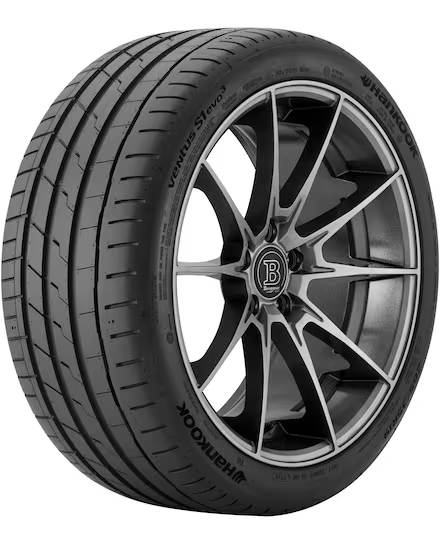
What Is the Hankook Ventus S1 Evo3?
The Ventus S1 Evo3 — sometimes listed under its model code K127 — is Hankook’s current flagship ultra-high-performance (UHP) summer tire. It replaced the popular Ventus S1 Evo2 and was developed to compete directly with the Continental ExtremeContact Sport 02, Michelin Pilot Sport 4S, and Bridgestone Potenza Sport.
Hankook designed it with input from its motorsport program, and the tire comes as original equipment on select European performance cars, including certain BMW, Mercedes-AMG, and Porsche models. That OE pedigree is one of the reasons I was curious to get a set under my own car.
Available in sizes ranging from 17 inches all the way up to 22 inches, the Ventus S1 Evo3 covers a wide fitment range. Whether you’re driving a VW GTI, a BMW 3 Series, a Mustang GT, or a Porsche Cayenne, there’s likely a size that fits.
Key Technologies Under the Tread
Before I share how this tire actually performs on the road, here’s what Hankook baked into the design — and why it matters to you as a driver.
High-Grip Silica Compound
The S1 Evo3 uses a silica-rich compound blended with a specialized resin that’s meant to improve wet and dry grip simultaneously. In my experience, the compound feels sticky even when you push hard into a corner, which tells me the engineering claims hold up.
Asymmetric Tread Pattern
The outer shoulder features large, stiff tread blocks for cornering stability, while the inner section has wider circumferential grooves for water evacuation. This asymmetric layout is pretty standard for UHP tires, but Hankook’s execution here is cleaner and more refined than on the previous generation.
Aramid-Reinforced Construction
For certain larger sizes (especially SUV fitments), Hankook uses aramid — the same fiber family as Kevlar — in the sidewall. This keeps the tire lightweight while improving high-speed durability. Even in the standard passenger-car sizes I tested, the carcass feels remarkably stiff and communicative.
Interlocking Sipe Design
The 3D interlocking sipes in the tread help maintain block rigidity under braking and acceleration while still providing enough flexibility for wet-road bite. I noticed this especially during hard stops on rain-soaked pavement — the tire inspires genuine confidence.
My Test Setup
I installed a set of 245/40R18 Ventus S1 Evo3 tires on my daily driver — a sport sedan with roughly 300 horsepower — and put them through their paces over several weeks of real-world driving.
My test routes included everything from smooth highway stretches in Southern California to cracked and patched urban roads, twisty canyon roads, and a couple of soaking-wet days that I deliberately sought out. I also took notes during a short track-day lapping session to see how the tires behave when pushed to their absolute limit.
Tire pressures were set to the vehicle manufacturer’s recommended cold specification (35 psi front, 38 psi rear) and checked weekly with a calibrated digital gauge.
Dry Performance: Confidence-Inspiring Grip
Let me start with what most UHP tire shoppers care about most — how does it stick on dry pavement? In a word: brilliantly.
From the first canyon run, I noticed the Ventus S1 Evo3 communicates exactly what the road surface is doing. The steering feels alive and connected, with none of that vague, rubbery dead zone you sometimes get with lesser tires. Turn-in is crisp, and the tire transitions smoothly from straight-line stability into cornering without any unpredictable behavior.
At higher cornering loads, the tire gives you progressive feedback before it starts to let go. There’s no sudden snap of grip loss; instead, you feel a gentle understeer build that’s easy to manage with throttle and steering adjustments. For a street tire, this level of predictability is outstanding.
Braking performance is equally strong. During several hard stops from 70 mph, the tires felt planted and didn’t exhibit any wandering or pulling. I’d rate the dry braking on par with — and possibly marginally better than — the Continental ExtremeContact Sport 02 I ran last summer.
If you’re coming from the previous-generation Hankook Ventus V12 Evo2, the leap in dry grip and steering precision with the S1 Evo3 is immediately noticeable. It’s a generational improvement that justifies the upgrade.
Wet Performance: Where This Tire Really Shines
Here’s where the Ventus S1 Evo3 separated itself from a lot of its competition in my testing — wet-road performance.
I’ve driven plenty of UHP summer tires that feel incredible in the dry but turn sketchy the moment rain hits. The S1 Evo3 doesn’t do that. Even in standing water at highway speeds, the tire maintained composure and never gave me that stomach-dropping moment of hydroplaning that cheaper tires sometimes produce.
On rain-soaked back roads, cornering grip dropped by maybe 15-20% compared to dry conditions, which is honestly impressive for a summer compound. The grooves do an excellent job of channeling water away from the contact patch, and the tire bites into wet asphalt with surprising tenacity.
Wet braking was another highlight. I ran a series of informal 60-0 stops on a wet parking lot surface, and the S1 Evo3 consistently stopped shorter than I expected. This is the kind of real-world safety margin that matters far more than any track record, especially if you live somewhere with unpredictable summer storms.
I want to be clear: this is still a summer tire, and it should NOT be driven in temperatures below about 45°F or in any snow or ice. But for rain on warm pavement? It’s one of the best UHP options I’ve tested recently.
Ride Comfort and Road Noise
UHP summer tires have a reputation for beating you up on rough roads, and I was prepared for the worst. The Ventus S1 Evo3 proved me wrong — sort of.
The ride is firm. There’s no sugarcoating that. You will feel expansion joints, you will notice rough patches, and your passengers may comment on it if they’re used to touring tires. But “firm” is not the same as “harsh,” and the S1 Evo3 manages to absorb the worst impacts without transmitting bone-jarring jolts into the cabin.
On smooth highway surfaces, the ride is actually quite pleasant. There’s a solid, connected feeling that makes the car feel more planted and competent. I’d describe it as sporty-firm rather than uncomfortably stiff.
As for road noise, I was genuinely impressed. The tire is noticeably quieter than most UHP competitors I’ve tested. At 70 mph on smooth asphalt, there’s a faint hum, but it never becomes intrusive. On coarser chip-seal surfaces, you’ll hear some additional roar, but it’s well within acceptable limits.
For context, if you’re looking for a quieter, more comfort-oriented Hankook for your daily commuter, the Hankook Kinergy Gt is worth a look — it trades some outright grip for a noticeably smoother, more refined ride.
Track Performance: Pushing the Limits
I managed to get a half-day session at a local track event, and I was curious to see how the S1 Evo3 would hold up under sustained high-speed cornering and hard braking.
The first few laps were magic. The tire delivered tremendous grip, sharp turn-in, and excellent braking performance. I was genuinely grinning inside my helmet.
After about 15-20 minutes of aggressive lapping, I started to notice the compound getting greasy. Lap times dropped, and the rear end became more playful under trail braking. This is completely normal for a street tire at track temperatures — you’re asking a road tire to do a race tire’s job.
I let the tires cool for a session, and grip came back almost entirely. There was no chunking, no blistering, and no visible structural damage. The tire handled the abuse far better than I expected for a street-focused UHP.
That said, if you’re planning regular track days, you’d be better served by a dedicated R-compound option like the Hankook Ventus R-S4. It’s purpose-built for that environment and will give you more consistent grip session after session.
Treadwear and Longevity
I’ve been running these tires for several weeks now, and I’m monitoring tread depth with a gauge at multiple points across the tread face.
So far, wear looks impressively even. The compound isn’t showing the kind of rapid degradation I’ve seen from some softer UHP tires. The tread depth measurements across the tire are within 1/32″ of each other, which tells me the contact patch is loading evenly — a sign of good engineering.
I’ll update this section as I accumulate more time on the tires, but early indications suggest the Ventus S1 Evo3 should deliver competitive tread life for its category. Hankook doesn’t offer a treadwear warranty on this model (which is standard for UHP summer tires), but the UTQG treadwear rating of 300 suggests it’s positioned to outlast some softer competitors like the Michelin Pilot Sport 4S (300) while potentially trailing the Continental ExtremeContact Sport 02 (340).
Regular tire rotations every 5,000-7,000 miles are essential to maximize the lifespan of any UHP tire, and I’ve been keeping to that schedule.
How It Compares to the Competition
No tire review is complete without context. Here’s how the Hankook Ventus S1 Evo3 stacks up against the three biggest competitors in the UHP summer tire market as of 2024.
| Feature | Hankook Ventus S1 Evo3 | Michelin Pilot Sport 4S | Continental ExtremeContact Sport 02 | Bridgestone Potenza Sport |
|---|---|---|---|---|
| Dry Grip | 9/10 | 9.5/10 | 9/10 | 9/10 |
| Wet Grip | 9/10 | 9/10 | 8.5/10 | 8.5/10 |
| Road Noise | 8/10 | 8.5/10 | 7.5/10 | 7.5/10 |
| Ride Comfort | 7.5/10 | 8/10 | 7.5/10 | 7/10 |
| Treadwear (UTQG) | 300 | 300 | 340 | 300 |
| Approx. Price (245/40R18) | $165–$185 | $220–$260 | $190–$220 | $195–$230 |
| Overall Value | ⭐⭐⭐⭐⭐ | ⭐⭐⭐⭐ | ⭐⭐⭐⭐ | ⭐⭐⭐⭐ |
Versus Michelin Pilot Sport 4S
The PS4S is the benchmark of the UHP summer tire category, and for good reason — it’s extraordinarily well-rounded. In my testing, the Michelin has a slight edge in dry grip, ride comfort, and tread noise refinement. But the gap is much smaller than the price gap. You’re looking at roughly $55-$75 more per tire for the Michelin, depending on size.
If budget isn’t a concern and you want the absolute best, the PS4S still edges ahead. But if you want 90-95% of that performance at 70-75% of the price, the Hankook is the smarter buy.
Versus Continental ExtremeContact Sport 02
The Continental is a fantastic tire that I’ve recommended many times. In dry grip, I’d call it a dead heat with the Hankook. Where the S1 Evo3 pulls ahead, in my experience, is wet performance — it simply feels more planted and secure in the rain. The Continental may have a slight treadwear advantage based on its higher UTQG rating, but real-world differences will depend on your driving style.
The Hankook is also typically $25-$35 cheaper per tire, which adds up to $100-$140 across a full set.
Versus Bridgestone Potenza Sport
The Potenza Sport is Bridgestone’s latest entry into this fight, and it’s a strong competitor. I found it roughly comparable to the Hankook in dry grip but slightly noisier and a touch harsher on rough roads. The Hankook’s wet performance gives it the edge here, and the price advantage seals the deal for most budget-conscious buyers.
Who Should Buy the Hankook Ventus S1 Evo3?
Based on my extensive testing, here’s who I think will get the most out of this tire:
- Enthusiast drivers who want sharp handling and strong grip for spirited driving on public roads.
- Owners of sporty sedans and coupes — think BMW 3/4 Series, Audi A4/S4, Genesis G70, Mustang EcoBoost/GT, Camaro SS, Tesla Model 3 Performance — who want a meaningful upgrade over OE tires.
- Value-conscious shoppers who refuse to compromise on performance but can’t justify Michelin or Continental prices.
- Drivers in warm-weather states (California, Texas, Florida, Arizona, Georgia) where summer tires can be run year-round or nearly so.
- Anyone who deals with summer rain and wants the reassurance of excellent wet-weather grip.
Who Should Look Elsewhere?
This tire is NOT for everyone. Here’s when I’d steer you in a different direction:
- If you live in the Midwest or Northeast and need year-round capability including cold temperatures and occasional snow, you need an all-season or all-weather tire instead.
- If ride comfort is your top priority, a grand touring tire will serve you better. The S1 Evo3 is firm, and while it’s not punishing, comfort-first buyers will notice.
- If you’re doing serious, regular track days, step up to a dedicated track tire like the Hankook Ventus R-S4 for consistent grip at elevated temperatures.
- If you drive a minivan or non-sporty crossover, this tire’s performance focus is overkill. A quality touring tire will give you better comfort, longer life, and lower noise for less money.
Pricing and Where to Buy
As of my latest research, the Hankook Ventus S1 Evo3 ranges from approximately $140 to $250 per tire depending on size. For the popular 245/40R18 size I tested, expect to pay around $165-$185 per tire from major online retailers.
Here are the best places to shop for them in the US:
- Tire Rack — Usually has the best overall pricing and free shipping to a local installer.
- Discount Tire / America’s Tire — Great in-store experience and competitive online pricing.
- Walmart Auto — Sometimes has aggressive pricing, especially on common sizes.
- Amazon — Can occasionally beat the specialists on price, but verify the seller is authorized.
- Costco — Availability varies, but when they carry it, the installation packages are hard to beat.
I’d strongly recommend checking for manufacturer rebates. Hankook frequently runs $60-$100 mail-in rebate promotions on sets of four, which drops the per-tire cost even further and makes the value proposition absolutely outstanding.
Installation Tips and Break-In Period
A few practical notes from my experience mounting and running these tires:
Break-in period: Hankook recommends a gentle break-in period for the first few days of driving. I followed this advice, keeping speeds moderate and avoiding hard cornering or braking for roughly the first 100 miles. After that initial break-in, the tire felt like it “woke up” — grip improved noticeably once the mold release agent wore off the surface.
Tire pressure: Stick to your vehicle manufacturer’s recommended cold pressure. Don’t over-inflate to reduce rolling resistance — you’ll sacrifice grip and wear the center of the tread prematurely.
Rotation schedule: Rotate every 5,000-7,000 miles if your vehicle allows it (staggered setups with different front/rear sizes obviously can’t be rotated front-to-back). Even side-to-side rotation can help equalize wear.
Alignment: Get a four-wheel alignment when installing new tires. Period. A $100 alignment can add thousands of miles to your tire’s life and prevent uneven wear patterns that void any potential goodwill from the manufacturer.
Pros and Cons Summary
What I Love
- Exceptional wet grip and hydroplaning resistance — among the best in class
- Sharp, communicative steering feel that makes driving genuinely enjoyable
- Dry cornering grip that rivals tires costing $50-$80 more per tire
- Impressively quiet for a UHP summer tire
- Strong braking performance in both wet and dry conditions
- Competitive pricing undercuts most premium rivals by 20-30%
- Wide size range covers most popular sporty vehicles
What Could Be Better
- Ride comfort is firm — not ideal for long, rough-road commutes
- No treadwear warranty (standard for the category, but still worth noting)
- Heat management on track fades after sustained hard lapping
- Brand perception still lags behind Michelin and Continental for some buyers
- Zero cold-weather capability — absolutely must be swapped off before winter
My Final Verdict
After spending extensive time with the Hankook Ventus S1 Evo3 across every condition I could throw at it — baking-hot canyon roads, rain-drenched freeways, cracked city streets, and even a short track session — I’m genuinely impressed.
This tire delivers performance that was exclusive to $250+ premium tires just a few years ago, and it does so at a price point that makes enthusiast-grade grip accessible to far more drivers. The wet performance alone would be enough to earn my recommendation, but when you add in the sharp dry handling, the reasonable noise levels, and the competitive treadwear, you’ve got a tire that punches well above its price tag.
Is it the absolute best UHP summer tire money can buy? No — the Michelin Pilot Sport 4S still holds that crown by a razor-thin margin. But is it the best value in the UHP summer tire category right now? I believe it is, and I’d buy another set without hesitation.
My Rating: 9.0 / 10
If you’re on the fence between this and Hankook’s other performance offerings, spend some time reading through our detailed comparison resources. The Ventus S1 Evo3 is the sweet spot for most drivers who want thrilling performance without the premium-brand price penalty — and that’s exactly the kind of tire I love recommending.
Frequently Asked Questions
Is the Hankook Ventus S1 Evo3 a good tire for daily driving in the US?
The Hankook Ventus S1 Evo3 is an excellent ultra-high-performance summer tire that handles daily driving on US highways and city streets with confidence. It delivers sharp steering response, strong dry grip, and a surprisingly comfortable ride for its performance category. I found it to be a great balance between sporty handling and everyday usability, though you’ll want to swap them out before winter hits in colder states.
How long does the Hankook Ventus S1 Evo3 last compared to other UHP summer tires?
Most drivers report getting between 25,000 and 40,000 miles from the Hankook Ventus S1 Evo3, which is competitive for the ultra-high-performance summer tire segment. Compared to rivals like the Michelin Pilot Sport 4S or Continental ExtremeContact Sport 02, treadlife is roughly similar, though driving style and climate play a big role. Hankook does not offer a treadwear warranty on this tire, which is standard practice for UHP summer tires.
How does the Hankook Ventus S1 Evo3 perform in wet and rainy conditions?
The Ventus S1 Evo3 uses wide circumferential grooves and an advanced silica compound that provide strong hydroplaning resistance and reliable wet braking. In my experience driving through heavy rain on US interstates, the tire maintained solid traction and predictable handling without feeling nervous. It’s one of the better UHP summer tires for wet-weather confidence, though it still can’t match a dedicated all-season tire in sustained downpours.
How much does the Hankook Ventus S1 Evo3 cost and is it worth the price?
Prices for the Hankook Ventus S1 Evo3 typically range from $140 to $250 per tire depending on size, with popular fitments like 245/40R18 averaging around $170-$190 at US retailers like Tire Rack and Discount Tire. That puts it significantly below the Michelin Pilot Sport 4S and closer to the Continental ExtremeContact Sport 02 in price. For the performance you get, the Ventus S1 Evo3 offers outstanding value and is one of the best budget-friendly options in the premium UHP summer category.
What vehicles does the Hankook Ventus S1 Evo3 fit and what sizes are available?
The Hankook Ventus S1 Evo3 is available in a wide range of sizes from 17 to 21 inches, fitting popular US vehicles like the BMW 3 Series, Ford Mustang, Honda Civic Si, Tesla Model 3, and Volkswagen Golf GTI. Hankook offers both standard and staggered fitment options, with speed ratings up to Y for high-performance applications. I’d recommend checking Tire Rack or Hankook’s US website with your exact vehicle year and trim to confirm availability.
Hankook Ventus S1 Evo3 vs Michelin Pilot Sport 4S: which is the better UHP summer tire?
The Michelin Pilot Sport 4S edges out the Ventus S1 Evo3 in outright dry grip and ultimate cornering limits, but the gap is smaller than the price difference suggests. The Hankook typically costs $30-$60 less per tire and delivers about 90% of the Michelin’s performance with slightly better ride comfort and road noise levels. If you’re a weekend track driver, the Michelin is worth the premium, but for spirited street driving across US roads the Ventus S1 Evo3 is arguably the smarter buy.
Can you use the Hankook Ventus S1 Evo3 in winter or snow?
No, the Hankook Ventus S1 Evo3 is strictly a summer tire and should never be driven in snow, ice, or temperatures consistently below 40°F. The rubber compound hardens significantly in cold weather, drastically reducing grip even on dry cold pavement. If you live in a state that experiences real winters, you’ll need a dedicated winter tire set or should consider a high-performance all-season alternative like the Hankook Ventus V2 AS or Continental DWS 06 Plus for year-round use.
