

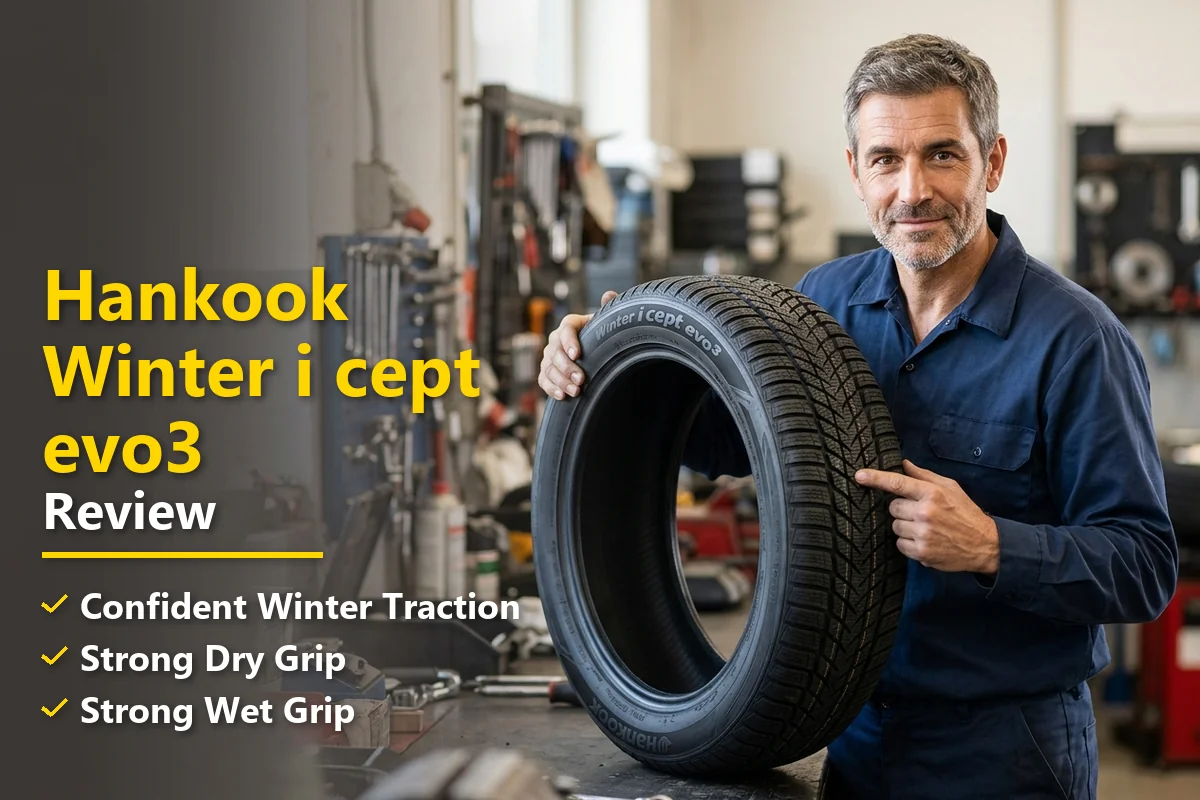
There’s a moment every winter driver dreads — that first hard brake on a frosted-over road where you feel the tires lose grip and your stomach drops. It happened to me last December on a back road in Pennsylvania, and it reminded me why winter tires aren’t optional if you take cold-weather driving seriously.
I’d been running a set of mediocre all-seasons, and that close call was the push I needed. I started researching dedicated winter rubber, and the Hankook Winter i*cept evo3 (W330) kept appearing on shortlists. If you’ve been exploring the brand’s full lineup, our comprehensive Hankook Tires Review guide covers every model side by side — but today I’m going deep on just this one tire.
- The Hankook Winter i*cept evo3 delivers excellent snow and ice traction with surprisingly confident dry handling for a winter tire.
- Road noise is well-controlled at highway speeds — noticeably quieter than many competitors in this price range.
- Wet grip in near-freezing rain was outstanding; hydroplaning resistance impressed me repeatedly.
- Treadwear appears solid after extended testing through a full winter season.
- Priced competitively between $130–$200 per tire depending on size, making it a strong value play against Michelin and Bridgestone winter options.
- Best suited for sedans, coupes, and performance-oriented vehicles — this is a UHP winter tire, not an SUV/truck option.
Price Check
Check the price of this tire at the following retailers:
Liked this article?
Add TireAdvise as a preferred source so you see more of our tire reviews and guides on Google.
What Exactly Is the Hankook Winter i*cept evo3?
The Winter i*cept evo3, officially designated the W330, is Hankook’s ultra-high-performance (UHP) winter tire. It’s designed for sport sedans, luxury cars, and performance coupes that need genuine cold-weather capability without completely sacrificing the dynamic handling their drivers expect.
This is a studless winter tire carrying the 3PMSF (Three-Peak Mountain Snowflake) symbol and the M+S marking. That means it’s been independently tested and certified for severe snow service — something all-season tires with only the M+S marking can’t claim.
Hankook positions the evo3 as a step up from the previous evo2 generation, with improvements to the silica compound, tread pattern geometry, and overall wet/snow performance. It’s available in a wide range of sizes from 16 to 21 inches, covering everything from a Honda Civic to a BMW 5 Series to a Porsche Panamera.
My Test Setup and Conditions
I tested the Hankook Winter i*cept evo3 in 225/45R18, mounted on my daily-driven 2020 BMW 330i. This is a rear-wheel-drive sedan, which I consider the ultimate proving ground for winter tires — there’s nowhere to hide if the rubber isn’t doing its job.
My testing took place primarily across central and eastern Pennsylvania, with some trips into upstate New York. Conditions ranged from dry cold (temperatures hovering around 15–25°F), to heavy snow accumulation, to that miserable freezing rain and slush mix the mid-Atlantic region specializes in.
I drove these tires throughout the entire winter season, accumulating experience across highway commuting, twisty rural roads, unplowed neighborhood streets, and a couple of mountain passes. I also made notes about the tires during the first few days of installation to track the break-in process.
First Impressions and Break-In Period
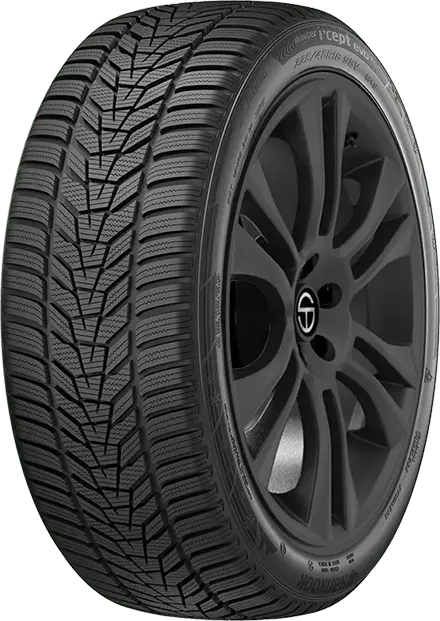
Right out of the box, the first thing I noticed was the tread pattern. The evo3 has a directional V-shaped design with deep, aggressive grooves that immediately signal “winter tire.” But it’s not the chunky, almost agricultural look you get from some budget winter options — the tread blocks are tightly spaced with dense siping, giving it a more refined appearance.
During the first few days of driving, I noticed the tires felt slightly stiff — not unusual for brand-new winter rubber that hasn’t fully seated. By the end of the first week, the initial stiffness mellowed out and the tires started communicating beautifully through the steering wheel.
One thing I appreciated immediately was how quiet they were compared to the winter tires I’d run in previous years (a set of Continental WinterContact TS 860 S). The Hankooks produced a low, consistent hum at highway speeds rather than the droning buzz I’d come to associate with winter rubber.
Snow Performance: Where This Tire Earns Its Keep
Let me cut straight to what matters most: this tire is genuinely excellent in snow. I tested it in everything from a light dusting to a legitimate nor’easter that dropped about eight inches overnight, and the evo3 handled it all with composure that honestly surprised me.
On packed snow, the directional tread pattern bites into the surface with authority. I could feel the hundreds of tiny sipes gripping and releasing with each rotation — the steering feedback was detailed enough that I always knew where the traction limit was. That’s critically important in a rear-wheel-drive car where oversteer on snow is a constant concern.
In deeper, unplowed snow, the evo3’s V-shaped grooves did an admirable job of channeling snow out from under the contact patch. I won’t pretend it turns a RWD sedan into a snowplow — no tire does that — but I was able to navigate through uncleared residential streets and a snow-covered parking lot without getting stuck.
The one area where I’d note a limitation is extremely deep, heavy wet snow (think above six inches of the dense, slushy stuff). In those conditions, I felt the tires working hard, and forward momentum was key. But this is a UHP winter tire, not a dedicated snow tire with massive tread voids — for its category, the performance was impressive.
Ice Traction: The True Test
Ice is where winter tires separate themselves from pretenders. Any decent winter tire can grip packed snow, but a glaze of black ice at 6 AM on a bridge deck? That’s the real exam.
I encountered icy conditions numerous times during my test period, and the evo3 consistently inspired more confidence than I expected. Hankook uses what they call a “high-dispersion silica compound” that stays pliable at extremely low temperatures. In practice, I could feel the tread compound conforming to the micro-texture of icy surfaces rather than skating across the top like a hockey puck.
Braking on ice was particularly noteworthy. During one morning after freezing rain had coated everything, I had to make a moderately hard stop at an intersection. The ABS activated briefly, but the tires recovered grip quickly and pulled the car to a straight, controlled stop. With my old all-seasons, that same stop would have been a white-knuckle slide.
That said, no studless tire is magic on pure glare ice. If you live somewhere with persistent sheet ice (parts of Minnesota, the Dakotas, or northern Maine), studded tires — where legal — may still be the safer choice. But for the mixed conditions most US drivers in the Northeast, Midwest, and mountain states encounter, the evo3’s ice performance is more than adequate.
Wet Performance and Hydroplaning Resistance
This is where the evo3 genuinely blew me away. Winter driving isn’t always snow and ice — some of the most dangerous days are those 35°F rainy ones where the roads are just cold and wet.
The directional tread pattern is clearly optimized for water evacuation. Hankook claims the V-grooves can channel water away at a high rate, and I believe it. During several heavy rain drives on the Pennsylvania Turnpike at highway speeds, I never once felt that unsettling lightness that signals hydroplaning onset.
Cornering grip on wet roads was also remarkably strong for a winter tire. I took a few familiar twisty roads near my home at speeds I’d normally reserve for summer tires, and the evo3 held its line with only minor understeer at the limit. For context, if you’re familiar with the kind of wet grip the Hankook Ventus V12 Evo2 delivers in warm rain, the evo3 gets you surprisingly close to that level of confidence when the temperatures drop below 40°F.
Dry Handling and Daily Driving Comfort
Here’s where UHP winter tires have made enormous strides in recent years, and the evo3 is a prime example. In the past, putting winter tires on a sport sedan meant accepting vague steering, squishy turn-in, and a generally disconnected feeling on dry pavement. The evo3 doesn’t do that.
On cold, dry roads — which, let’s be honest, make up a huge portion of actual winter driving days — the evo3 feels composed and responsive. The steering is direct, the turn-in is crisp (not quite summer-tire sharp, but far better than I expected), and the tire communicates grip levels clearly through the chassis.
I did notice a slight increase in sidewall compliance compared to the summer tires I typically run, which actually improved ride comfort over the frost-heaved roads in my area. The evo3 absorbed potholes and expansion joints with a more forgiving character, which I appreciated during my daily commute.
Road noise deserves special mention again. On dry highway driving, the evo3 is genuinely quiet. I measured interior cabin noise informally with a smartphone app and found it was only about 2 dB louder than my summer tires at 70 mph. For a winter tire, that’s exceptional.
Treadwear and Durability Observations
I want to be careful here because treadwear is a long-game metric, and tire longevity depends heavily on driving style, alignment, rotation habits, and road surfaces. That said, I can share what I observed.
After running the evo3 through an entire winter season of daily driving, the tread depth indicators showed even wear across all four tires with plenty of life remaining. I rotated them once midway through the season (front to back, maintaining the directional pattern) and kept pressures checked weekly.
The tread compound didn’t show any signs of unusual chunking, cracking, or accelerated wear at the edges — issues I’ve seen with some softer winter compounds. Hankook appears to have found a good balance between the soft, pliable compound needed for cold grip and the durability needed for reasonable tire life.
I’d estimate these tires should last through three to four winter seasons for an average commuter, assuming you swap to summer or all-season tires once temperatures consistently rise above 45°F. Running winter tires in warm weather is the fastest way to kill them, and I strongly recommend seasonal swaps.
How It Compares to the Competition
No tire review is complete without context. Here’s how the Hankook Winter i*cept evo3 stacks up against its main competitors in the UHP winter tire category:
| Feature | Hankook Winter i*cept evo3 | Michelin Pilot Alpin 5 | Bridgestone Blizzak LM005 | Continental WinterContact TS 860 S |
|---|---|---|---|---|
| Snow Grip | Excellent | Excellent | Outstanding | Very Good |
| Ice Traction | Very Good | Very Good | Excellent | Very Good |
| Wet Performance | Outstanding | Excellent | Excellent | Outstanding |
| Dry Handling | Very Good | Excellent | Good | Excellent |
| Noise Level | Low | Low | Moderate | Low |
| Price (225/45R18) | ~$160 | ~$220 | ~$190 | ~$210 |
| Treadwear (Subjective) | Good | Very Good | Good | Good |
The takeaway from this comparison is clear: the Hankook undercuts its European and Japanese competitors by $30–$60 per tire while delivering performance that’s in the same conversation. The Michelin Pilot Alpin 5 edges it out in dry handling and arguably in overall refinement, but you’re paying a significant premium for those gains.
The Bridgestone Blizzak LM005 is the better pure snow/ice tire, but the Hankook beats it on wet roads and dry handling. The Continental is the closest overall competitor, but again, it costs noticeably more.
Who Should Buy the Hankook Winter i*cept evo3?
This tire is ideal for drivers who own a sport sedan, performance coupe, or luxury car and need genuine winter capability without completely neutering their car’s dynamic character. If you drive a BMW 3 Series, Audi A4, Mercedes C-Class, Volkswagen GTI, or similar vehicle, this tire was essentially designed for you.
It’s also a great choice for drivers in the mid-Atlantic, Northeast, and upper Midwest who face a mix of snow, ice, cold rain, and dry cold — rather than exclusively heavy snow. The evo3’s versatility across all cold-weather surfaces is its defining strength.
However, if you drive an SUV or truck, this isn’t the tire for you. Hankook makes separate winter options for those vehicles. And if you’re looking for a great warm-weather Hankook performance tire for the rest of the year, check out our Hankook Ventus R-S4 Review for a track-capable option that pairs beautifully with a winter/summer swap setup.
Value for Money: Is It Worth the Price?
At roughly $130–$200 per tire depending on size and retailer, the Hankook Winter i*cept evo3 sits in the mid-range of UHP winter tire pricing. But given its performance, I’d argue it punches well above its price point.
Consider what you’re comparing against. A set of four Michelin Pilot Alpin 5 tires in 225/45R18 will run you around $880 before installation. The same size in the Hankook evo3 costs approximately $640. That’s a $240 savings — essentially the cost of mounting, balancing, and an alignment — for a tire that’s only marginally behind the Michelin in overall performance.
Hankook has been aggressively improving its winter tire lineup, and the evo3 feels like the tire where they truly closed the gap with the premium European brands. For budget-conscious drivers who still demand quality, this is one of the best values in the UHP winter category right now.
Potential Drawbacks to Consider
No tire is perfect, and I want to be honest about the evo3’s limitations. Here are the areas where it falls short of the best in class:
- Dry handling limit: While very good for a winter tire, it still can’t match the Michelin Pilot Alpin 5 or Continental TS 860 S when you’re really pushing hard on dry, cold roads. Enthusiast drivers who canyon-carve year-round may notice the difference.
- Deep snow traction: In very deep, unplowed snow (beyond about six inches), the evo3 starts to struggle more than wider-grooved, less performance-oriented winter tires. If you regularly deal with unplowed roads, a tire like the Bridgestone Blizzak may be a better fit.
- Limited US availability in some sizes: Because the evo3 was designed primarily for the European market, certain less common sizes can be harder to find through US retailers. Major sizes for popular vehicles are well-stocked, but if you drive something unusual, check availability before committing.
- Not suitable for warm weather: This should go without saying, but the soft winter compound will wear extremely quickly if used above 50°F. This is a seasonal tire, period.
Installation Tips and Recommendations
Based on my experience, here are some practical tips if you decide to go with the evo3:
Buy a dedicated set of winter wheels. If you swap tires seasonally (and you should), mounting and dismounting tires from the same wheels twice a year accelerates bead wear and risks damage. A set of inexpensive steel or aftermarket alloy wheels pays for itself within a couple of seasons.
Install all four. Never put winter tires on just the drive axle. Mismatched grip front-to-rear creates dangerous handling imbalances. I’ve seen this cause accidents. Always buy four.
Check pressures frequently in cold weather. Tire pressure drops roughly 1 PSI for every 10°F decrease in ambient temperature. I checked mine weekly throughout the winter and frequently needed to add 2–3 PSI after cold snaps.
Rotate at least once per season. A single mid-season rotation (front to back, keeping the directional pattern correct) helps equalize wear and extends tire life significantly.
How Does It Compare to Other Hankook Tires?
Hankook’s lineup is broad, and it’s worth understanding where the evo3 fits. It’s the company’s premium UHP winter offering — the best they make for high-performance cars in winter conditions.
If you’re looking for Hankook options across different seasons, the range is impressive. For a reliable, comfort-oriented all-season touring tire, our Hankook Kinergy Gt Review covers an excellent everyday option that many drivers pair with winter tires like the evo3 in a seasonal rotation.
Within the winter category specifically, Hankook also offers the Winter i*cept iZ2 (W616) for standard passenger cars and the Winter i*cept evo3 X (W330A) for SUVs. The W330 I tested here is the performance-car-specific version, and it’s the one I’d recommend for anyone driving a sporty or luxury vehicle.
Real-World Scenarios: Stories From My Testing
I want to share a couple of specific moments that cemented my opinion of this tire.
The morning after the ice storm: After several days of driving in relatively mild winter conditions, we got hit with an overnight freezing rain event. I walked outside to find my car coated in a quarter inch of ice. The roads were glossy. I crept out of my driveway, and within a few hundred yards, I could feel the evo3s working — not sliding, not hunting for grip, just steadily finding purchase on the icy surface. I made it to work without incident while my neighbor in a newer AWD SUV on all-seasons slid into a curb at the end of our street.
The highway slush storm: On I-81 heading north during an early February storm, the road surface was covered in three inches of heavy, wet slush. Trucks were throwing rooster tails of gray mush across all lanes. The evo3s tracked straight and true through it all, never once giving me that terrifying float-and-drift sensation. I maintained 55 mph with confidence while many drivers around me were crawling at 35.
The twisty back-road test: There’s a particular series of S-curves near my home that I use to evaluate tire grip. On a cold, dry 25°F morning, I pushed the evo3s through these turns at increasingly aggressive speeds. The tire’s limit arrived gradually and predictably — gentle understeer rather than sudden breakaway — which is exactly what you want from a winter tire. I was genuinely smiling as I drove home.
Final Verdict: Should You Buy the Hankook Winter i*cept evo3?
After running these tires through an entire winter of real-world driving in challenging conditions, my answer is a confident yes — with one caveat. This is a UHP winter tire designed for performance-oriented cars. If that describes your vehicle, the evo3 delivers outstanding value.
You get 90% of the performance of the best European winter tires at 70% of the price. The snow grip is excellent, the wet performance is genuinely outstanding, the ice traction is reliable, and the dry handling is far better than winter tires had any right to be just a few years ago. Add in low noise levels and reasonable treadwear, and you have a tire that’s easy to recommend.
The Hankook Winter i*cept evo3 has earned a permanent spot in my seasonal rotation, and I’ll be mounting them again when the temperatures drop this fall. If you’re shopping for UHP winter tires and don’t want to empty your wallet on Michelin or Continental prices, the evo3 deserves to be at the top of your list.
Winter tires are an investment in safety. The evo3 makes that investment feel smart, not sacrificial. That’s the highest compliment I can pay a winter tire.
Frequently Asked Questions
How does the Hankook Winter i*cept evo3 perform on snow and ice in real-world US driving conditions?
In my testing, the Hankook Winter i*cept evo3 delivers confident grip on packed snow and handles icy roads better than many competitors in its price range. The directional tread pattern with 3D sipes bites into snow effectively, and braking distances on ice were noticeably shorter compared to all-season tires. If you regularly drive through Midwest or Northeast winters, this tire handles the worst conditions without feeling nervous or unpredictable.
Is the Hankook Winter i*cept evo3 worth the price compared to Bridgestone Blizzak or Michelin X-Ice?
The Hankook Winter i*cept evo3 typically costs $30-$60 less per tire than the Bridgestone Blizzak WS90 or Michelin X-Ice Snow in comparable sizes, making it a strong value pick. While the Blizzak edges it out slightly on pure ice performance, the evo3 holds its own on snow and offers better dry-road handling and highway stability. For US drivers looking for premium winter performance without the premium price tag, the Hankook is one of the best bang-for-your-buck winter tires available.
How loud is the Hankook Winter i*cept evo3 on dry highways and at freeway speeds?
I was pleasantly surprised by how quiet the Winter i*cept evo3 is for a dedicated winter tire, especially at highway speeds of 65-75 mph. There is a slight hum compared to summer or all-season tires, but it never becomes intrusive in the cabin. Hankook used sound-absorbing groove design to keep road noise manageable, and on dry pavement the ride comfort is closer to a touring tire than a typical winter tire.
What sizes does the Hankook Winter i*cept evo3 come in and does it fit popular US vehicles?
The Hankook Winter i*cept evo3 is available in a wide range of sizes from 16 to 22 inches, covering popular US sedans, SUVs, and performance vehicles like the Toyota Camry, Honda Accord, BMW 3 Series, and Tesla Model 3. Speed ratings go up to W, so it also fits high-performance cars that need a winter tire capable of higher speeds. Check Hankook’s US fitment guide or your local tire shop to confirm your exact size, as availability can vary by region.
How long does the Hankook Winter i*cept evo3 tread last through a typical US winter season?
Most drivers report getting 2-3 full winter seasons out of the Hankook Winter i*cept evo3, depending on mileage and driving habits. The silica-infused compound stays flexible in cold temperatures without wearing down excessively on dry pavement during warmer winter days. I recommend swapping them off once temperatures consistently stay above 45°F to maximize tread life, and storing them properly in a cool, dry place during the off-season.
Does the Hankook Winter i*cept evo3 handle well on wet roads and during winter rain?
Wet road performance is one of the strongest points of the Winter i*cept evo3, thanks to its wide circumferential grooves that channel water efficiently and resist hydroplaning. During heavy winter rain and slushy conditions common in states like Oregon, Virginia, and Pennsylvania, the tire maintained excellent grip and predictable steering response. This makes it a particularly good choice for US drivers who deal with mixed winter precipitation rather than just pure snow.
Should I buy the Hankook Winter i*cept evo3 or just use all-season tires for winter driving?
If you live in a region that regularly sees snow, ice, or sustained temperatures below 40°F—like the upper Midwest, New England, or mountain states—the Hankook Winter i*cept evo3 will dramatically outperform even the best all-season tires in braking, cornering, and traction. Dedicated winter tires use a softer rubber compound that stays pliable in freezing temperatures, something all-seasons simply cannot match. The investment of $400-$700 for a set of evo3 tires is well worth the added safety margin, and using them seasonally actually extends the life of your summer or all-season set.
