

I’ve replaced more tire pressure sensors than I’d like to count — some on my own vehicles, some while helping friends figure out why that annoying dashboard light wouldn’t turn off.
The TPMS system seems simple on the surface, but once you start pulling back the curtain, there are more moving parts (and potential costs) than most drivers realize.
Before you head to a shop or start ordering parts, read this. I’ll walk you through exactly what it takes to replace a tire sensor, what it actually costs, and how to avoid the mistakes that turn a $50 fix into a $300 headache.
Before I get into the details — if you’re also shopping for new tires at the same time, check out my tire buying and maintenance guide for a full breakdown of what to look for.
Replacing a tire pressure sensor (TPMS) typically costs $50–$250 per sensor depending on your vehicle and whether you use a dealership, independent shop, or go DIY. Factory sensors run $30–$100+ each; aftermarket sensors can be had for $15–$40. Labor and relearning add another $20–$80 per wheel. Doing it yourself is possible but requires a relearn tool. Most people are best served by an independent shop.
Liked this article?
Add TireAdvise as a preferred source so you see more of our tire reviews and guides on Google.
What Is a Tire Pressure Sensor and Why Does It Fail?
A tire pressure monitoring system (TPMS) sensor is a small battery-powered device mounted inside your wheel — usually attached to the valve stem.
It wirelessly transmits real-time tire pressure data to your vehicle’s ECU, which triggers the dashboard warning light if any tire drops significantly below the recommended PSI.
Every new passenger vehicle sold in the United States after September 2007 is required by federal law (TREAD Act) to have a functioning TPMS system.
That means if your sensor goes out, you can’t just ignore it — not legally if you’re going through an inspection, and not safely if you’re relying on it to catch a slow leak.
TPMS sensors fail for a few main reasons:
Dead battery. This is by far the most common cause. The battery inside a TPMS sensor is not rechargeable and not replaceable on most factory designs — it’s sealed inside the unit. Typical lifespan is 5–10 years, or roughly 100,000 miles, whichever comes first. When the battery dies, the whole sensor gets replaced.
Physical damage. Road debris, curb strikes, and aggressive tire dismounting at shops can all crack or break the sensor body. I’ve personally seen a careless tire shop snap a sensor clean off a rim during a routine tire swap.
Corrosion. The metal valve stem components corrode over time, especially in road-salt climates. Once corrosion compromises the seal or the electrical contact, the sensor reads incorrectly or goes silent.
Sensor drift. Older sensors occasionally develop calibration issues and start reporting wrong pressures even when the battery is fine. At that point, replacement is more reliable than chasing the problem.
Signs You Need to Replace a Tire Sensor
The most obvious signal is the TPMS warning light on your dashboard — the horseshoe-shaped icon with an exclamation point. But don’t automatically assume a lit TPMS light means a failed sensor.
Here’s how to tell the difference:
Flashing TPMS light (then stays on): When you start the car, the TPMS light flashes for about 60–90 seconds then remains illuminated. This usually means a sensor malfunction — not low pressure.
Solid TPMS light: Usually means one or more tires are actually low on pressure. Check your pressures first before assuming it’s a sensor problem. I can’t tell you how many times someone has spent money on a sensor diagnosis only to find out they just had a slow leak.
TPMS light goes away after inflating tires: Confirm it’s just a pressure issue. No sensor replacement needed.
One sensor consistently reads differently: If you can read individual sensor IDs on your instrument cluster or a scan tool, and one sensor keeps showing a suspicious reading, that’s a good sign the sensor itself is off.
No reading from one sensor: A scan tool will show “no signal” or a fault code for a specific wheel. That sensor is likely dead.
If you’re unsure, a quick TPMS diagnostic scan at most shops runs $20–$50 and will tell you definitively which sensor (if any) is bad. Worth doing before spending money on parts.
How Much Does It Cost to Replace a Tire Pressure Sensor?
This is where most people get confused, because the replace tire sensor cost has several components that shops don’t always break down clearly.
Parts Cost
OEM (factory) sensors: These are made to your vehicle’s exact spec and are typically plug-and-play with your car’s TPMS receiver. Expect to pay $30–$100+ per sensor depending on your vehicle. Luxury brands like BMW, Mercedes, and Audi tend to run toward the higher end. Toyota and Honda sensors are often more affordable.
Aftermarket universal sensors: Brands like Autel, Schrader, and Standard Motor Products make programmable sensors that can be cloned or configured to match your vehicle’s frequency and ID. These run $15–$40 each and work well when programmed correctly. I’ve used them on several vehicles without issues.
Aftermarket direct-fit sensors: These are pre-configured for specific makes and models — less universal but often easier to install. Priced between OEM and universal, usually $25–$60.
Labor Cost
Labor to replace a tire pressure sensor typically includes:
- Dismounting and remounting the tire
- Replacing the sensor (and often the valve stem hardware)
- Rebalancing the wheel
- TPMS relearn procedure
Expect to pay $20–$50 per wheel in labor at an independent shop, or $50–$80+ at a dealership.
TPMS Relearn Cost
After a sensor is replaced, your car’s computer needs to recognize the new sensor’s ID. This process is called a “relearn” or “reset.” Some vehicles do this automatically after driving for a few miles. Others require a relearn tool — either a dedicated TPMS tool or a scan tool with TPMS capabilities.
If the shop charges separately for this, budget $10–$30 per vehicle for the relearn procedure.
Total Replace Tire Pressure Sensor Cost Summary
| Scenario | Estimated Cost |
|---|---|
| DIY with aftermarket sensor + relearn tool | $40–$120 (includes tool amortized) |
| Independent shop, aftermarket sensor | $60–$120 per sensor |
| Independent shop, OEM sensor | $80–$180 per sensor |
| Dealership, OEM sensor | $150–$300+ per sensor |
| Full set of 4 sensors (independent shop) | $220–$500 |
| Full set of 4 sensors (dealership) | $400–$900+ |
These are ballpark ranges — your specific vehicle, location, and shop rates will all affect the final number. That said, I’ve found these figures to be pretty representative of what most U.S. drivers are actually paying.
OEM vs. Aftermarket TPMS Sensors: Which Should You Choose?
This is a question I get asked a lot, and the answer depends on your situation.
Go OEM if:
- Your vehicle is under warranty or extended warranty coverage
- You’re driving a European luxury vehicle where TPMS integration is more complex
- The cost difference is small (under $30 per sensor) and you want zero hassle
- Your shop strongly recommends it for your specific vehicle
Go aftermarket if:
- You’re driving a high-mileage vehicle and want to keep costs down
- You’re replacing all four sensors at once — the savings add up fast
- You’re using a reputable brand (Autel, Schrader, Dorman, Standard Motor Products)
- Your mechanic is experienced with programming aftermarket sensors
I’ve personally used aftermarket sensors from Autel and Dorman on my own vehicles — a 2016 F-150 and a 2014 Honda Accord — without any issues. Both were programmed correctly and passed state inspection. The key is making sure whoever installs them programs them properly to your vehicle’s system.
The one caveat: a handful of vehicles (certain Fords and GMs, for example) have more finicky TPMS systems that don’t always play nicely with aftermarket sensors. Your shop should know if your vehicle falls into that category.
Can You Replace a Tire Pressure Sensor Yourself?
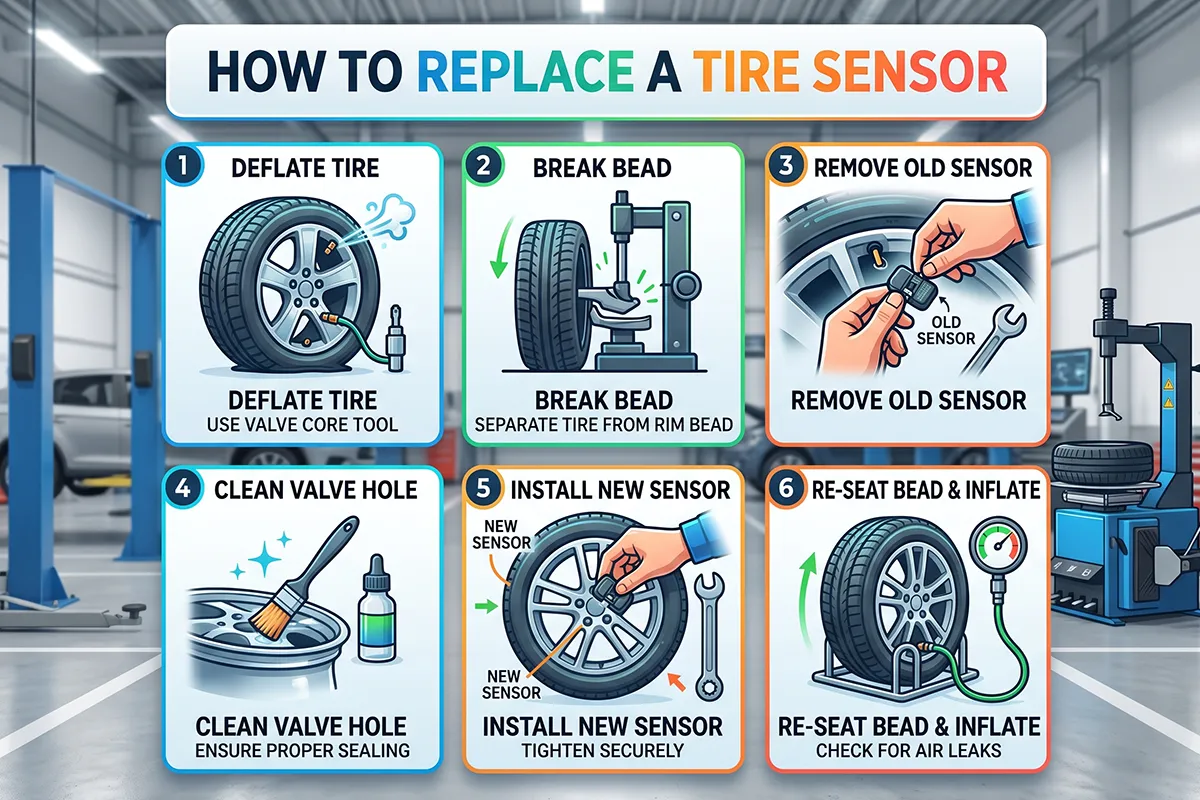
Yes — with the right tools and some mechanical confidence. Here’s what DIY tire pressure sensor replacement actually involves:
What You’ll Need
- Replacement TPMS sensor(s)
- TPMS relearn/programming tool (required for most vehicles)
- Tire mounting and balancing equipment (or a shop to do this part)
- Basic hand tools (valve stem socket, torque wrench)
The Honest DIY Assessment
The tricky part isn’t the sensor itself — it’s the tire dismounting and the relearn procedure.
Unless you have a tire machine at home (most people don’t), you’ll need to bring the wheel to a shop to have the tire dismounted and remounted. That usually costs $15–$25 per wheel. At that point, you’re already most of the way to just letting the shop do the whole job.
Where DIY makes the most sense is if you’re replacing all four sensors and buying a TPMS programming tool — tools like the Autel TS508 (around $100–$140) or the Autel MaxiTPMS TS401 (around $70) allow you to program aftermarket sensors and perform the relearn on most vehicles.
If you’ve got a fleet of vehicles or plan to keep your car long-term, the tool pays for itself quickly.
If it’s a one-time repair on one car, I’d honestly tell most people to skip the DIY route and find a good independent shop. The time and tool investment don’t pencil out for a single sensor.
The TPMS Relearn Process Explained
After any sensor replacement, your vehicle’s ECU needs to learn the new sensor’s ID. There are three main types of relearn procedures:
Auto relearn: The vehicle learns the new sensor IDs automatically after you drive above a certain speed (usually 15–25 mph) for several minutes. No special tool required. Common on many GM and Chrysler vehicles.
Stationary relearn (manual): Involves a specific sequence using the vehicle’s controls (buttons, ignition cycles, deflating specific tires in order) to initiate the relearn mode. The process varies significantly by manufacturer — your owner’s manual or a quick web search for your specific year/make/model will give you the exact steps. No tool required, but it can be tedious.
OBD relearn: Requires a TPMS tool or scan tool connected to the OBD-II port. Common on Ford, BMW, and many import vehicles. Without the right tool, the relearn simply won’t happen — which means your TPMS light stays on even after a perfect sensor installation.
If you’re having a shop do the work, confirm upfront that the relearn is included in the price. Some shops (especially tire shops focused on volume) will replace the sensor and hand the car back without completing the relearn — then charge you extra when the light doesn’t go off. I’ve seen it happen.
When to Replace All Four Sensors at Once
If one sensor has failed due to age or dead battery, the others are often not far behind. Here’s my general rule:
If the failing sensor is 7+ years old and you plan to keep the vehicle: Replace all four. The cost difference between one and four is mostly labor — if the tire is already coming off, you’re paying for dismounting regardless. Doing all four at once saves you from making this same trip in 18 months when the next one dies.
If the sensor failed due to physical damage (not age): Replace only the damaged sensor. No reason to replace healthy ones.
If you’re buying new tires at the same time: Great timing. Have the shop inspect all sensors and replace any that are weak or showing low battery signals. TPMS sensors and tires tend to be on similar replacement cycles for high-mileage drivers.
What Happens If You Don’t Replace a Faulty Sensor?
Let me be straightforward here: driving with a dead or missing TPMS sensor is a bad idea, and not just because of the annoying dashboard light.
The TPMS system exists to catch pressure drops you might not notice by feel — especially slow leaks that can cause a tire to run significantly underinflated without obvious symptoms.
Underinflated tires run hotter, wear faster, and are more vulnerable to blowouts. A $75 sensor replacement is a lot cheaper than a blown tire on the highway.
Beyond safety: in many states, a lit TPMS warning light will fail a vehicle inspection. If your state requires annual inspections, a faulty sensor will eventually need to be addressed to keep the car street-legal.
How to Find a Good Shop for TPMS Sensor Replacement
Not all shops are equally experienced with TPMS work. Here’s how I vet a shop for this job:
Ask specifically if they perform the TPMS relearn in-house. A good shop will say yes without hesitation and explain which tool or method they use.
Ask whether they use OEM or aftermarket sensors, and for which brands. A shop that’s using no-name sensors from a generic supplier is a yellow flag. Reputable shops stock brands like Schrader, Autel, Dorman, or Standard Motor Products.
Get a written quote that breaks out parts and labor separately. If a shop quotes a flat “TPMS replacement” price without itemization, push for the breakdown.
Check reviews specifically for tire or TPMS work. Look for mentions of the dashboard light still being on after service — it’s a common sign the shop skipped the relearn step.
For most drivers, an independent tire shop or automotive service shop will give you the best value. Dealerships are appropriate if your vehicle is under warranty or if you have an unusual TPMS system that requires OEM programming.
Frequently Asked Questions
How long does it take to replace a tire pressure sensor?
For a single sensor at a shop, expect 30–60 minutes including tire dismount, remount, balance, and relearn. Replacing all four takes 1.5–2.5 hours.
Can I drive with a TPMS warning light on?
You can, but you shouldn’t rely on the system if a sensor is faulty. Check your tire pressures manually and more frequently until the sensor is replaced.
Does replacing a TPMS sensor require a special tool?
The installation itself doesn’t — but the relearn procedure often does. Your vehicle’s manual will tell you which relearn method applies. Many vehicles require an OBD scan tool or dedicated TPMS programming tool.
How long do TPMS sensors last?
Most sensors last 5–10 years or roughly 100,000 miles before the internal battery dies. Battery life is affected by extreme temperatures and how frequently the sensor transmits (higher-mileage vehicles wear out sensors faster).
Will a TPMS light always mean the sensor needs replacing?
No. The most common cause of a lit TPMS light is simply low tire pressure. Always check and inflate your tires first before assuming a sensor issue.
Is it okay to use aftermarket TPMS sensors?
Yes, for most vehicles. Use reputable brands and make sure they’re programmed correctly to your vehicle’s system. On some vehicles — particularly certain European makes — OEM sensors are strongly recommended.
Can I replace just the battery in a TPMS sensor?
On most factory sensors, no — the battery is sealed inside and the whole sensor is replaced. A few third-party sensors are designed with replaceable batteries, but they’re the exception.
What’s the difference between a TPMS sensor and a TPMS valve stem?
On most vehicles, the sensor IS the valve stem — the sensor housing is integrated with the stem. When you replace the sensor, you’re replacing the valve stem hardware too, which is actually a good thing since old stems can corrode and leak.
Final Thoughts
Replacing a tire pressure sensor isn’t the most complicated repair a car owner will face, but there are enough variables — sensor type, relearn procedure, shop quality — that it’s worth going in informed.
The replace tire pressure sensor cost range is wide, and where you land within it has a lot to do with choices you can control: which shop you use, OEM vs. aftermarket, and whether you replace one or all four at once.
My practical advice: find a reputable independent tire or auto shop, get a written quote that includes the relearn, and ask about sensor brands.
If you’re replacing one sensor on a vehicle with high mileage, seriously consider doing all four. The incremental cost is small, and you’ll save yourself a repeat appointment sooner than you’d like.
If you’re replacing tires at the same time and want a full picture of what to look for — from tire specs to warranty coverage — my tire buying and maintenance guide is worth reading before you spend a dime.
Have a TPMS question specific to your vehicle? Drop it in the comments — I’m happy to help you figure out what you’re looking at.
