

If you’ve ever stared at all-terrain tire prices and felt your wallet physically recoil, you’re not alone. The big-name options from BFGoodrich, Falken, and Toyo can easily run $200 to $300 per tire — and that adds up fast when you need a full set of five.
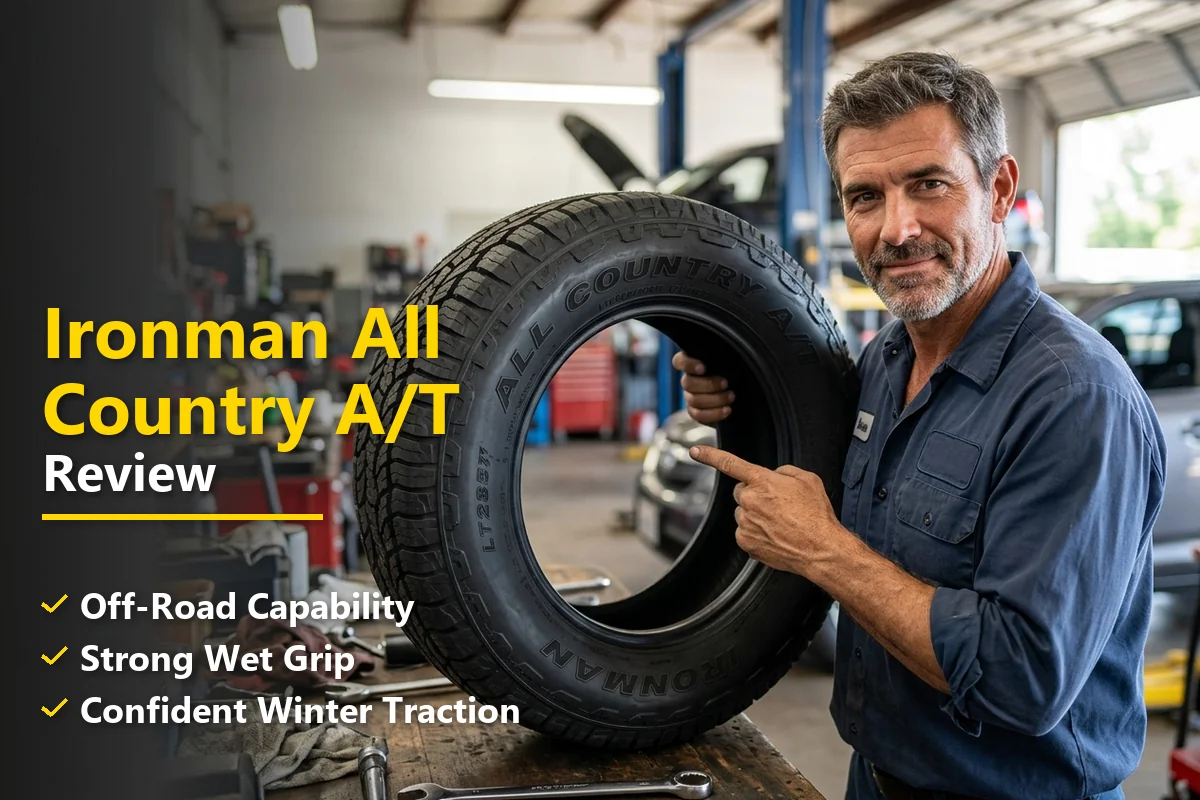
That’s exactly why I decided to put the Ironman All Country A/T through a thorough real-world test. For a deeper look at the brand’s full lineup, check out our comprehensive Ironman Tires Review guide, which covers every model side by side.
- The Ironman All Country A/T is a surprisingly capable budget all-terrain tire that punches above its price point.
- On-road comfort and highway noise levels are better than I expected for a tire in this price range.
- Off-road traction on dirt, gravel, and light mud is solid — but deep mud and rock crawling aren’t its strong suit.
- Wet performance is adequate but not exceptional; I’d recommend extra caution in heavy rain.
- At roughly $100–$140 per tire (depending on size), it’s one of the best value all-terrain tires available in 2024.
- Best suited for daily drivers, weekend adventurers, and light-duty truck owners who want versatility without breaking the bank.
Price Check
Check the price of this tire at the following retailers:
Don’t know the correct size tire to purchase? Start here!
Liked this article?
Add TireAdvise as a preferred source so you see more of our tire reviews and guides on Google.
Who Is the Ironman All Country A/T Actually For?
Let me be upfront: the Ironman All Country A/T isn’t trying to be a Nitto Ridge Grappler or a BFGoodrich KO2. It’s not an extreme off-road tire, and it doesn’t pretend to be one. What it is — and what it does well — is serve as an affordable, versatile all-terrain option for everyday drivers who occasionally leave the pavement.
I think the ideal buyer is someone who drives a mid-size pickup or SUV, commutes on highways during the week, and heads out on dirt roads, gravel trails, or unpaved campgrounds on the weekends. If that sounds like you, keep reading.
If you’re looking for a tire to handle serious rock crawling in Moab or deep mud in the backwoods of Arkansas, this isn’t the tire for you. But if you need something that handles a variety of surfaces competently while keeping your bank account intact, the All Country A/T deserves serious consideration.
About the Ironman Brand: What You Should Know
Ironman is a budget tire brand manufactured by Hercules Tire, which itself is a subsidiary of American Tire Distributors (ATD) — one of the largest tire distribution companies in the United States. So while the name might not carry the same prestige as Michelin or Goodyear, there’s a legitimate operation behind these tires.
Hercules has been around since 1952, and their budget lines — including Ironman — benefit from decades of tire engineering experience. The tires are manufactured overseas to keep costs low, but they still carry a limited tread life warranty and meet all US Department of Transportation (DOT) safety standards.
I mention this because brand trust matters. When you’re saving 40% to 60% compared to premium competitors, it’s reasonable to wonder where corners are being cut. After spending extensive time on these tires, I can say that the savings come primarily from manufacturing location and brand positioning — not from dangerously compromised quality.
First Impressions and Installation
I had the Ironman All Country A/T tires mounted at a local tire shop, and my first impression was genuinely positive. The tread pattern looks aggressive enough to give the truck a rugged appearance without being obnoxiously loud at first startup — something I was honestly worried about.
The sidewall design features a subtle but attractive pattern with the “All Country A/T” branding. It’s not as bold as some competitors, but it doesn’t look cheap either. The tires balanced without issue, and the technician didn’t flag any concerns during mounting.
One thing I noticed right away during the drive home: these tires felt noticeably different from the worn highway tires I’d been running. The steering felt more planted, and the ride — while slightly firmer — inspired more confidence.
On-Road Performance: Highway and City Driving
This is where the Ironman All Country A/T genuinely surprised me. I spend the majority of my driving time on paved roads — interstate highways, suburban streets, and the occasional freeway on-ramp that tests a tire’s grip under acceleration. After several days of commuting and errand running, I had a clear picture of what this tire can do on pavement.
Highway Comfort
The ride quality is good — not great, but good. There’s a slight firmness compared to a dedicated highway tire, which is expected from any all-terrain. But it’s nowhere near the harsh, jarring ride that some aggressive A/T tires deliver.
At highway speeds, the tire tracks straight and doesn’t wander. I didn’t experience any pull or drift, even during sustained high-speed stretches. The overall driving feel is composed and predictable, which is exactly what you want from your daily driver.
Noise Levels
Tire noise was one of my biggest concerns going in. Many budget all-terrain tires are notorious for droning on the highway, and I’ve personally returned tires in the past because the cabin noise was unbearable.
The Ironman All Country A/T is respectably quiet. There’s a faint hum at highway speeds — you can hear it if the radio is off and the windows are up — but it’s not intrusive. I’d rate the noise level as comparable to tires costing $50 to $80 more per tire.
After the first week of daily driving, the noise actually seemed to settle slightly as the tires broke in. It never became a source of annoyance, even on long highway stretches.
Dry Traction
Dry pavement grip is solid. Braking distances felt normal, cornering grip was predictable, and acceleration traction was never an issue — even when merging aggressively onto the highway. The interlocking tread blocks do a good job of maintaining consistent contact with the road surface.
I wouldn’t call it sports-car level grip, obviously. But for a truck tire in this category, it handles dry conditions with confidence.
Wet Performance: Where It Gets Honest
Wet traction is where budget tires often reveal their compromises, and the Ironman All Country A/T is no exception. I tested these tires through multiple rainstorms — from light drizzle to heavy downpours — and my assessment is mixed but fair.
In light to moderate rain, the tire performs well. The four circumferential grooves channel water effectively, and I never felt a loss of control during normal driving. Braking felt confident, and hydroplaning resistance was acceptable at reasonable speeds.
However, during heavy rain at highway speeds, I did notice a slight reduction in steering feedback. The tire didn’t lose grip dramatically, but there was a subtle vagueness in the steering that told me the tire was working harder to maintain contact. I instinctively backed off the speed by about 5-10 mph, and the confidence returned.
My honest take: the wet performance is adequate for the price. It’s not as reassuring as a premium tire like the Falken Wildpeak A/T3W, which is one of the best wet-performing all-terrain tires I’ve ever tested. But for a tire that costs roughly half as much, the Ironman holds its own in most wet conditions. Just exercise extra caution in heavy rain — as you should with any tire.
Off-Road Performance: Dirt, Gravel, and Beyond
Here’s where it gets fun. I took the Ironman All Country A/T through a variety of off-road surfaces over my test period to see how it handles the terrain its “A/T” designation promises it can tackle.
Gravel and Dirt Roads
This is the All Country A/T’s sweet spot off-road. On loose gravel and packed dirt roads, the tire felt confident, stable, and composed. The open tread design does a good job of gripping loose surfaces, and I never felt the tires spinning or struggling for traction on standard fire roads and forest service routes.
During my test on a long stretch of washboard gravel road, the tire handled the rough surface without excessive vibration or loss of control. It was genuinely enjoyable.
Light Mud
In light mud — the kind you encounter after a rain shower on a dirt trail — the tire performed reasonably well. The tread pattern has enough depth and spacing to cycle through soft mud without immediately packing up. I was able to maintain forward momentum through several muddy patches without needing to air down or engage four-wheel drive.
That said, deep mud is a different story. On a particularly soft, rutted section of trail, the tread blocks started to fill up, and I could feel the traction fading. I engaged 4WD and made it through, but the tire was clearly at its limit. This is not a mud tire, and you shouldn’t treat it like one.
Sand and Loose Terrain
I didn’t have access to deep sand dunes, but I did test the tire on sandy shoulders and loose, decomposed granite surfaces. With slightly reduced air pressure, the tire handled these surfaces well. The flexible sidewall spread out nicely, and I maintained good traction.
Rocks and Rocky Trails
On rocky terrain, the All Country A/T was acceptable but not impressive. The sidewalls, while reinforced, aren’t as thick and puncture-resistant as premium alternatives. I drove carefully over rocky stretches and didn’t experience any punctures or damage, but I was conscious of the limitations.
If rocky trails are a regular part of your driving, I’d suggest investing in a tire with more robust sidewall protection. The Ironman is better suited for smoother off-road surfaces.
Snow and Light Winter Performance
The Ironman All Country A/T does not carry the Three-Peak Mountain Snowflake (3PMSF) certification. This is worth noting because several competitors in this price range — and most premium all-terrain tires — do carry that certification.
I was able to test the tire on a light dusting of snow and some icy morning roads. In light snow (an inch or two), the tire performed reasonably well. The siping in the tread blocks bites into snow, and I felt adequate grip during acceleration and braking.
However, without the 3PMSF rating, I wouldn’t rely on this tire as a dedicated winter solution. If you live in the northern US or any region that sees regular snow, consider a tire that carries that certification — or plan on running a separate set of winter tires.
For occasional light snow and cold weather driving, the All Country A/T will get you by. But it’s not a snow champion.
Tread Life and Durability
The Ironman All Country A/T comes with a limited tread life warranty — typically around 55,000 miles for most sizes (always verify with the retailer for your specific size). For a budget all-terrain tire, that’s a reasonable warranty.
During my test period, I monitored tread wear closely. The wear pattern was even across all four tires after several weeks of mixed driving, which tells me the tread compound and design are well-balanced. I didn’t see any signs of premature or uneven wear.
Of course, tread life depends heavily on driving habits, vehicle alignment, tire rotation, and inflation maintenance. I kept my tires rotated on schedule and maintained proper air pressure, which I recommend for anyone running these tires. Neglecting rotation and inflation will kill any tire’s lifespan prematurely — budget or premium.
Ride Quality and Steering Feel
I want to dedicate a section to ride quality because it’s something that doesn’t always show up in specifications but makes a huge difference in daily driving satisfaction.
The Ironman All Country A/T delivers a ride that I’d describe as “pleasantly firm.” It’s not as cushy as a highway touring tire, and you do feel expansion joints and road imperfections a bit more. But the impacts are well-damped — they’re felt without being harsh.
Steering feel is responsive and direct. There’s no excessive play or vagueness in the center, which makes the tire confidence-inspiring on the highway. During my time with these tires, I felt connected to the road without feeling like I was fighting the tires.
The one area where ride quality drops slightly is at very low speeds over rough pavement. You feel the tread blocks working, and there’s a subtle vibration that disappears once you get above about 25 mph. It’s a minor complaint, and it’s common among all-terrain tires in general.
How It Compares: Ironman All Country A/T vs. the Competition
To give you a fair comparison, I’ve put together a table comparing the Ironman All Country A/T against some of the most popular all-terrain tires in the US market. I’m using the common 265/70R17 size as the baseline for pricing.
| Feature | Ironman All Country A/T | Falken Wildpeak A/T3W | Cooper Discoverer AT3 4S | Hankook Dynapro AT2 |
|---|---|---|---|---|
| Approx. Price (each) | $115–$140 | $185–$210 | $175–$200 | $170–$195 |
| Tread Life Warranty | 55,000 mi | 55,000 mi | 65,000 mi | 60,000 mi |
| 3PMSF Rated | No | Yes | Yes | Yes |
| Highway Comfort | Good | Excellent | Excellent | Very Good |
| Off-Road Capability | Good | Very Good | Good | Good |
| Wet Traction | Adequate | Excellent | Very Good | Very Good |
| Noise Level | Low-Moderate | Low | Low | Low |
| Value Rating | ⭐⭐⭐⭐⭐ | ⭐⭐⭐⭐ | ⭐⭐⭐⭐ | ⭐⭐⭐⭐ |
The Value Proposition
Here’s the bottom line on competition: the Ironman All Country A/T doesn’t beat any of these premium tires in any single performance category. It’s not as quiet as the Falken. It’s not as long-lasting as the Cooper. It doesn’t have the snow rating of the Hankook.
But it costs $60 to $80 less per tire. For a full set of four, that’s $240 to $320 in savings. For a set of five (if you carry a full-size spare), you’re approaching $400 in savings.
That’s significant money. And for the performance you’re getting, I think it’s a genuinely smart trade-off for many buyers.
Available Sizes and Fitment
The Ironman All Country A/T is available in a wide range of sizes covering most popular trucks and SUVs on American roads. Here are some of the most common sizes I’ve seen available:
- LT245/75R16
- LT265/70R17
- LT275/65R18
- LT275/70R18
- LT285/70R17
- LT285/75R16
- 265/70R16
- 275/60R20
- LT275/65R20
- LT305/55R20
This covers popular vehicles like the Ford F-150, Chevrolet Silverado 1500, Toyota Tacoma, Toyota 4Runner, Jeep Wrangler, RAM 1500, Nissan Frontier, and more. I’d recommend checking with your local tire retailer or searching online to confirm availability in your specific size.
Pros and Cons: My Honest Summary
After spending extensive time testing the Ironman All Country A/T across a variety of conditions, here’s my honest breakdown:
What I Liked
- Outstanding value: At roughly $100–$140 per tire, it’s hard to find a more capable all-terrain option for the money.
- Respectable highway manners: The noise level and ride comfort exceed what I expected from a budget A/T tire.
- Good gravel and dirt road performance: This is where the tire truly shines off-road.
- Even tread wear: During my test period, the wear pattern was consistent and promising.
- Attractive tread pattern: It gives trucks and SUVs a rugged look without going overboard.
- Wide size availability: Most popular truck and SUV sizes are covered.
What I Didn’t Like
- No 3PMSF snow certification: This is a notable disadvantage for drivers in snow-prone states.
- Wet performance is just adequate: In heavy rain, you’ll want to slow down and give yourself extra stopping distance.
- Limited deep off-road capability: Deep mud, heavy rocks, and extreme terrain are beyond this tire’s comfort zone.
- Sidewall durability concerns: The sidewalls aren’t as robust as premium off-road tires, so rocky trails demand extra caution.
- Slight low-speed vibration: The tread blocks produce a minor vibration at very low speeds, though it disappears quickly.
Who Should Buy the Ironman All Country A/T?
Based on my testing, I recommend the Ironman All Country A/T for these types of drivers:
- Budget-conscious truck and SUV owners who need an all-terrain tire without the premium price tag.
- Daily commuters who also enjoy weekend camping, fishing, hunting, or exploring unpaved roads.
- Second-vehicle owners who want a capable tire on a truck that sees moderate use.
- Drivers in the southern and central US where snow isn’t a primary concern.
- First-time all-terrain buyers who want to experience the A/T category without a major investment.
I would NOT recommend this tire for:
- Drivers who regularly encounter heavy snow and ice (look for a 3PMSF-rated tire instead).
- Serious off-roaders who tackle muddy trails, rock crawling, or extreme terrain.
- Anyone prioritizing maximum wet-weather safety above all else.
- Commercial or heavy-duty applications where maximum durability is critical.
Where to Buy and What to Expect to Pay
The Ironman All Country A/T is widely available across the US from both online and brick-and-mortar retailers. Here are some places I’ve seen them stocked:
- Discount Tire / America’s Tire: Often has competitive pricing and easy installation scheduling.
- Tire Rack: Great for comparing specs and reading additional user reviews. Ships to local installers.
- Walmart Auto Care Centers: Frequently carries Ironman tires at some of the lowest prices.
- Amazon: Available for purchase, though I recommend having them shipped to a professional installer.
- Local independent tire shops: Many carry Ironman through the Hercules distribution network.
Pricing varies by size, but expect to pay roughly $100 to $140 per tire for the most popular light truck sizes. That means a full set of four will run you approximately $400 to $560 before mounting, balancing, and disposal fees. Even with installation costs, you’re looking at a total well under $700 for most sizes — a figure that’s hard to argue with.
I’d suggest shopping around and watching for rebates. Ironman and Hercules occasionally run mail-in rebate promotions that can save you an additional $40 to $80 on a set of four.
Maintenance Tips to Get the Most Out of These Tires
No matter what tires you buy — budget or premium — proper maintenance is the single biggest factor in how long they last and how well they perform. Here’s what I recommend specifically for the Ironman All Country A/T:
- Rotate every 5,000 to 6,000 miles: This is critical for even wear, especially on trucks where the front and rear axles carry different loads.
- Check tire pressure at least monthly: The recommended pressure is on the placard inside your driver’s door jamb. Don’t use the “max pressure” printed on the tire sidewall.
- Get an alignment check at installation: A misaligned vehicle will eat through any tire’s tread unevenly. Have your alignment verified when the new tires go on.
- Inspect tread depth regularly: Use a tread depth gauge (they’re about $5 at any auto parts store) to monitor wear across the entire tread face.
- Clean the tread of debris: If you drive off-road regularly, check for rocks, sticks, and debris lodged in the tread grooves. Small stones can work their way through the tread over time.
Final Verdict: Is the Ironman All Country A/T Worth It?
After extensive testing across highways, city streets, gravel roads, dirt trails, and wet weather, I can confidently say the Ironman All Country A/T earns its place as one of the best value all-terrain tires in the US market right now.
Is it perfect? No. The lack of snow certification, the middling wet performance, and the limited extreme off-road capability are real compromises. If any of those are deal-breakers for your specific driving needs, you should spend more on a premium option.
But here’s the thing: most drivers don’t need the absolute best. Most drivers need a tire that does many things well at a price that doesn’t hurt. The Ironman All Country A/T does exactly that.
I walked away from my test period impressed. Not blown away — but genuinely impressed. This tire delivers roughly 80% of the performance of tires that cost 50% to 60% more. In the world of budget tires, that’s an exceptional ratio.
If you’re a truck or SUV owner in the US looking for a capable, quiet-enough, good-looking all-terrain tire that won’t break the bank, the Ironman All Country A/T belongs on your short list. I’d buy them again — and that’s the most honest endorsement I can offer.
Frequently Asked Questions
How does the Ironman All Country A/T perform in real-world driving conditions?
The Ironman All Country A/T delivers solid performance for a budget all-terrain tire, handling highway cruising comfortably while still providing decent grip on gravel roads and light off-road trails. I found that it performs well in dry and wet conditions on pavement, though it’s not going to match premium brands like BFGoodrich or Falken in aggressive off-road situations. For daily drivers who occasionally venture onto dirt roads or unpaved trails, it strikes a good balance between on-road comfort and off-road capability.
How much do Ironman All Country A/T tires cost compared to other all-terrain tires?
Ironman All Country A/T tires typically range from $100 to $180 per tire depending on size, making them one of the most affordable all-terrain options on the US market. By comparison, popular competitors like the Falken Wildpeak A/T3W or BFGoodrich All-Terrain T/A KO2 often cost $170 to $280 per tire in similar sizes. If you’re looking for a budget-friendly all-terrain tire that still carries a 50,000-mile treadwear warranty, the Ironman A/T is hard to beat on value.
Who makes Ironman All Country A/T tires, and are they a reliable brand?
Ironman tires are manufactured by Hercules Tire, which is a subsidiary of American Tire Distributors and part of the Cooper Tire family now owned by Goodyear. This means the Ironman All Country A/T benefits from proven manufacturing processes and quality control standards backed by a major tire conglomerate. While Ironman is positioned as a budget brand, many US drivers report reliable performance and reasonable tread life for the price point.
How long do Ironman All Country A/T tires last in terms of tread life and mileage?
The Ironman All Country A/T comes with a 50,000-mile treadwear warranty, which is competitive for a budget all-terrain tire. Real-world reviews from US drivers suggest most owners get between 40,000 and 55,000 miles depending on driving habits, vehicle weight, and whether they maintain proper tire rotations every 5,000 to 7,000 miles. Aggressive driving on highways or frequent off-road use will naturally reduce tread life, but for the price you’re paying, the longevity is respectable.
Are Ironman All Country A/T tires good in snow and winter driving conditions?
The Ironman All Country A/T is not branded with the Three-Peak Mountain Snowflake (3PMSF) symbol, which means it hasn’t passed the industry standard for severe snow traction. It handles light snow and cold weather reasonably well thanks to its all-terrain tread pattern with siping, but I wouldn’t rely on it for heavy snow, ice, or mountain driving in states like Colorado or Montana. If you regularly drive in harsh winter conditions, you’re better off pairing these with a dedicated set of winter tires or stepping up to a snow-rated all-terrain like the Falken Wildpeak A/T3W.
How noisy are Ironman All Country A/T tires on the highway?
Road noise is one area where the Ironman All Country A/T performs better than expected for a budget all-terrain tire. Most drivers report a mild hum at highway speeds between 60 and 75 mph, but it’s not intrusive enough to be a dealbreaker for daily commuting on trucks or SUVs. The tire isn’t as quiet as a premium highway all-terrain like the Michelin LTX A/T2, but for the price difference, the noise level is very manageable.
What truck and SUV sizes are available for the Ironman All Country A/T?
The Ironman All Country A/T is available in a wide range of popular US truck and SUV sizes, from 15-inch to 20-inch rim diameters, covering fitments like 265/70R17, 275/65R18, and 275/60R20 that fit common vehicles like the Ford F-150, Chevy Silverado, Toyota Tacoma, and Jeep Wrangler. LT (Light Truck) rated options are available for heavier-duty applications like towing and hauling. I’d recommend checking with your local tire shop or an online retailer like Tire Rack or Discount Tire to confirm exact fitment for your specific vehicle.
