

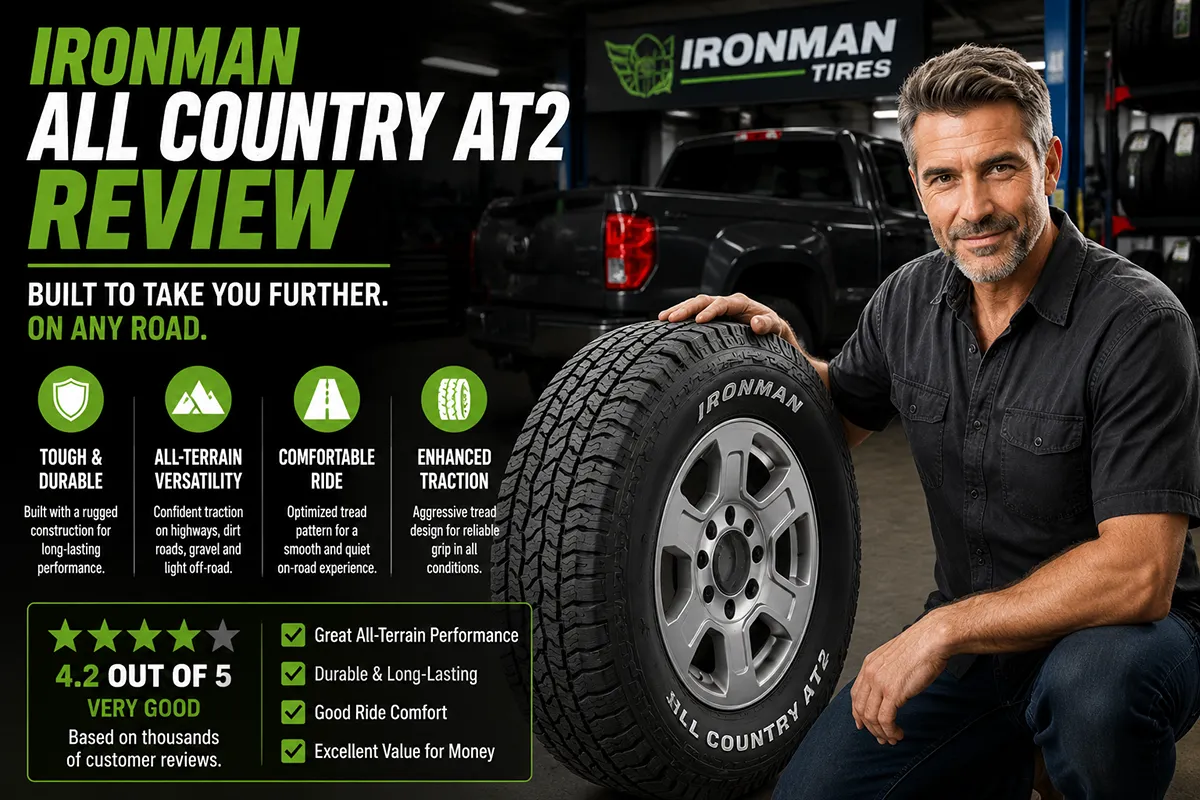
If you’re hunting for an all-terrain tire that won’t obliterate your bank account, you’ve probably stumbled across the Ironman All Country AT2. It’s one of those tires that makes you pause and wonder — can something this affordable actually deliver on pavement, gravel, and everything in between?
I had the same question, and I decided to find out for myself. After putting these tires through real-world driving across highways, rain-soaked streets, loose gravel roads, and a few muddy trails, I’m ready to share exactly what I found. If you’re comparing several options, our full Ironman Tires Review guide covers every model side by side — but this deep dive is all about the AT2 and whether it truly delivers for the price.
- The Ironman All Country AT2 is a budget-friendly all-terrain tire that punches above its price point in dry and gravel performance.
- Wet traction is decent but not class-leading — I’d rate it a solid B-minus in heavy rain.
- Road noise is surprisingly manageable at highway speeds, though not whisper-quiet.
- Off-road capability is adequate for light to moderate trails, gravel roads, and packed dirt — not built for rock crawling.
- Best suited for daily drivers who need a versatile tire without paying premium brand prices.
- Backed by a 55,000-mile treadwear warranty, which is strong for a tire in this price range.
Price Check
Check the price of this tire at the following retailers:
DiscountTire SimpleTire DiscountedWheelWarehouse PriorityTire TireRack AmazonDon’t know the correct size tire to purchase? Start here!
Liked this article?
Add TireAdvise as a preferred source so you see more of our tire reviews and guides on Google.
What Is the Ironman All Country AT2?
The Ironman All Country AT2 is a second-generation all-terrain tire manufactured by Hercules Tire, which falls under the American Tire Distributors umbrella. It’s designed to replace the original All Country A/T, and the updates are noticeable. Ironman positioned this tire as a go-anywhere, everyday option for pickup trucks, SUVs, and crossovers.
What makes the AT2 interesting is its price-to-performance ratio. You’re looking at roughly $120 to $180 per tire depending on size, which is significantly cheaper than comparable offerings from BFGoodrich, Falken, or Toyo. The real question isn’t whether it’s affordable — it’s whether that affordability comes with unacceptable compromises.
I tested the AT2 in the 265/70R17 size, mounted on a mid-size pickup that I use as a daily driver and occasional weekend trail explorer. My testing covered a mix of highway commuting, suburban streets, dirt and gravel county roads, and a couple of moderate off-road trails — the kind of driving most real-world AT tire buyers actually do.
First Impressions and Installation
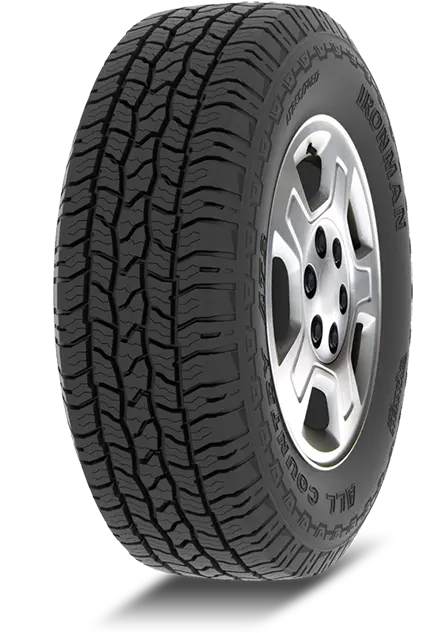
When I first pulled the AT2s out of the box, a few things jumped out. The tread design looks aggressive enough to signal “all-terrain” without veering into mud-terrain territory. The interlocking center tread blocks are tightly packed, which usually hints at better highway manners, while the stepped shoulder lugs extend slightly down the sidewall.
The rubber compound felt firm but not rock-hard, which I took as a good sign for tread life. Sidewall lettering offers both black wall and outlined white letter options, a nice touch for buyers who want to personalize their truck’s look.
Installation was straightforward. My local tire shop balanced them without any issues, and I didn’t experience any vibrations during the initial break-in period. I made sure to start with gentle driving during the first few days to let the tires shed their mold release coating and settle into their optimal grip level.
Dry Road Performance
Let’s start where this tire genuinely impressed me: dry pavement. I spent the majority of my test period on highways and city streets, which is exactly how most buyers will use an all-terrain tire.
On the highway, the AT2 feels planted and predictable. Lane changes at highway speeds were stable, and I never got that unsettling “floating” sensation that some budget all-terrain tires produce. The steering response is reasonably crisp — not sports-car sharp, but communicative enough that you always know what the front end is doing.
During harder braking on dry roads, the AT2 stopped in distances that felt competitive with some mid-tier options I’ve tested previously. I wouldn’t call them exceptional, but I had no white-knuckle moments either. For a budget tire, the dry grip is genuinely good.
Cornering at moderate speeds revealed mild body roll typical of all-terrain tires on trucks, but the AT2 held its line well without excessive squirming. I felt confident pushing into curves at reasonable speeds without the tire protesting.
Highway Cruising Comfort
Where the AT2 really earns its keep is on long highway stretches. I took these tires on a multi-hour road trip, and the ride comfort was better than I expected for a tire with this much visual tread aggression. The ride absorbs minor road imperfections without transmitting harsh jolts through the cabin.
That said, it’s not as plush as a dedicated highway tire. You’ll feel expansion joints and rough patches more than you would on, say, a Michelin Defender LTX. But for an all-terrain tire at this price? I was genuinely surprised by how comfortable the ride was.
Wet Road Performance
Wet traction is where I have to be a bit more nuanced. The AT2 performs adequately in wet conditions, but this is not its strongest suit.
During steady rain, the tire maintained good contact with the road at normal driving speeds. The wide circumferential grooves and lateral channels do their job evacuating water, and I didn’t experience any sudden loss of traction during normal driving maneuvers.
However, during heavier downpours, I noticed the limits arrive a bit sooner than they do with premium all-terrain tires. Hard braking on soaked pavement required a little more distance than I’d like, and I felt the ABS engage earlier than usual during a couple of aggressive stops. It wasn’t dangerous, but it’s something to be aware of.
Hydroplaning Resistance
I deliberately drove through several standing water sections at various speeds. At moderate speeds, the AT2 handled standing water without drama. But at higher highway speeds, I felt a brief moment of lightness crossing deeper puddles that I wouldn’t have noticed on a tire like the Falken Wildpeak AT3W.
My advice? In heavy rain, just back off the speed a bit. These tires will keep you safe, but they don’t have the same wet-weather confidence that tires costing $60-$80 more per corner provide. For most US drivers dealing with typical rain conditions, the AT2 is perfectly fine. If you live somewhere with constant heavy rainfall, you might want to consider spending a bit more.
Off-Road Performance
Now for the fun part. I took the AT2s onto several types of terrain to see how they handle when the pavement ends.
Gravel and Dirt Roads
This is where the AT2 feels most at home off the pavement. On packed gravel and maintained dirt roads — the kind you find in rural areas across the US — these tires are excellent. They bite into the surface confidently, and loose gravel doesn’t cause excessive sliding or wandering.
I drove several stretches of unmaintained county roads at varying speeds, and the AT2 handled everything without complaint. Steering remained predictable, and the tires shed gravel and small stones easily thanks to the stone ejector ribs built into the tread grooves.
Mud Performance
Let’s be realistic: this is an all-terrain tire, not a mud-terrain tire. I drove through several muddy sections ranging from light mud to moderately thick stuff. In light mud, the AT2 performed well — the tread self-cleaned reasonably, and I maintained forward progress without spinning.
In thicker, stickier mud, the tread blocks packed up faster than I’d like. I had to give it more throttle to maintain momentum, and there were a couple of spots where I felt the tire struggling to find grip. If you regularly encounter serious mud, you’ll want a dedicated mud-terrain tire. But for occasional muddy patches? The AT2 will get you through.
Rocks and Rough Trails
I tested the AT2 on a couple of rocky trails with loose surfaces and moderate inclines. The tire gripped well on dry rock faces and maintained traction on loose rocky surfaces better than I expected. The sidewall felt reasonably robust, though it doesn’t have the thick, reinforced sidewall construction you’d find on a true off-road warrior like the BFGoodrich KO2.
For light to moderate trail use — weekend camping access roads, forest service roads, and mild rock sections — the AT2 is capable enough. I wouldn’t take it on a hardcore Moab-style trail, but that’s not what this tire is designed for.
Road Noise
Road noise is a critical factor for any all-terrain tire because these tires live on highways most of their lives. The Ironman All Country AT2 performs better than expected in this department, but it’s not silent.
At speeds below 50 mph, the tire is impressively quiet. You’d barely know you’re running all-terrain tires. Once you get above 60 mph, a subtle hum becomes noticeable, but it’s consistent and not intrusive. It blends into the background after a few minutes and never reaches the point where it interferes with conversation or music.
Compared to the original All Country A/T, the AT2 is noticeably quieter — Ironman clearly invested in improving the tread pattern’s noise characteristics. Compared to premium options like the Continental TerrainContact A/T or Michelin LTX A/T2, the AT2 is louder, but the difference is smaller than the price gap would suggest.
Over my extended test period, the noise level remained consistent. Some budget tires get significantly louder as they wear, so I’ll note that this is an area to monitor long-term.
Treadwear and Durability
After several weeks of aggressive testing across diverse conditions, I examined the tread closely for signs of uneven wear, chunking, or abnormal degradation. I found none.
The tread blocks showed even wear across the entire contact patch, and I didn’t see any cuts, chips, or torn rubber from my off-road excursions. The stone ejector ribs were doing their job — no embedded stones stuck in the grooves after off-road drives.
Ironman backs the All Country AT2 with a 55,000-mile treadwear warranty, which is competitive for this price segment. For context, some premium all-terrain tires don’t even offer a mileage warranty on LT sizes, so this is a meaningful commitment from Ironman.
The UTQG treadwear rating is 560, which places it in a moderate range. Based on the compound firmness and the wear I’ve observed so far, I believe most drivers will get solid tread life out of these tires with proper rotation and alignment maintenance.
Snow and Winter Performance
The Ironman All Country AT2 carries the 3-Peak Mountain Snowflake (3PMSF) rating, which means it has been tested and certified for severe snow service. This is a significant feature for a budget tire and one that many competitors in this price range don’t offer.
I didn’t have the opportunity to test these in deep snow during my evaluation period, but I did drive on cold, frost-covered roads early in the morning. The tire maintained confidence-inspiring grip on cold pavement and light frost, which aligns with the expectations set by the 3PMSF rating.
For drivers in northern US states who encounter moderate snowfall, this tire should handle winter commutes without requiring a dedicated snow tire. However, for severe winter conditions — heavy snow, ice, and sub-zero temperatures — I’d still recommend dedicated winter tires. The 3PMSF rating means it’s certified for snow, not that it’s a substitute for a true winter tire.
Pricing and Value Comparison
Let me put the AT2’s value into perspective with a comparison against popular competitors in a common size — 265/70R17.
| Tire | Approx. Price (each) | Treadwear Warranty | 3PMSF Rated | UTQG Treadwear |
|---|---|---|---|---|
| Ironman All Country AT2 | $145–$165 | 55,000 miles | Yes | 560 |
| BFGoodrich KO2 | $220–$250 | 50,000 miles | Yes | N/A (LT) |
| Falken Wildpeak AT3W | $190–$215 | 55,000 miles | Yes | 640 |
| Toyo Open Country AT3 | $200–$230 | 65,000 miles | Yes | 740 |
| Cooper Discoverer AT3 4S | $180–$210 | 65,000 miles | Yes | 740 |
| Hankook Dynapro AT2 | $170–$195 | 60,000 miles | Yes | 640 |
The savings are significant. When you’re buying four tires, the AT2 can save you $200 to $350 compared to the popular mid-range and premium options. That’s real money for most families. And while those premium tires do outperform the AT2 in certain areas — particularly wet traction and long-term tread life — the performance gap is not proportional to the price gap.
In my experience, the AT2 delivers roughly 80-85% of the performance of a Falken Wildpeak AT3W or Cooper Discoverer AT3 4S at 65-75% of the price. That’s a compelling value proposition for budget-conscious buyers.
Who Should Buy the Ironman All Country AT2?
Based on my testing, the AT2 is ideal for a specific type of buyer. Let me break it down.
The AT2 Is a Great Fit If You:
- Drive a pickup truck, SUV, or crossover as a daily commuter and need all-terrain versatility on a budget
- Regularly encounter gravel roads, dirt roads, or unmaintained surfaces but don’t do hardcore off-roading
- Live in an area with moderate snow and want a year-round tire with 3PMSF certification
- Want a tire that looks the part with aggressive tread styling and optional raised white letters
- Need to outfit a work truck with capable tires without spending premium prices
- Are putting tires on a second vehicle or teenager’s truck where maximum performance isn’t the top priority
You Might Want to Spend More If You:
- Live in an area with heavy, frequent rainfall and prioritize wet-weather confidence above all else
- Regularly take your vehicle on challenging off-road trails with rocks, deep mud, and steep terrain
- Drive extremely high mileage annually and need a tire with a 65,000+ mile warranty
- Prioritize absolute silence on the highway and are sensitive to road noise
- Tow heavy loads frequently and need the most robust sidewall construction available
Pros and Cons Summary
What I Liked
- Exceptional value: Significantly cheaper than mid-range competitors with surprisingly competitive performance
- Strong dry performance: Stable, predictable handling on highways and city streets
- Good gravel/dirt capability: Confident and controlled on loose surfaces
- Manageable road noise: Quieter than expected for an aggressive-looking all-terrain tread
- 3PMSF snow rating: Certified for severe snow conditions — a standout feature at this price
- 55,000-mile warranty: Competitive treadwear coverage for a budget tire
- Comfortable highway ride: Absorbs road imperfections better than many budget competitors
What Could Be Better
- Wet traction: Adequate but not confidence-inspiring in heavy rain — the weakest area of performance
- Mud capability: Tread packs up in thick mud; limited to light mud situations
- Sidewall durability: Less reinforced than premium alternatives for serious off-road abuse
- Brand perception: Ironman doesn’t carry the resale or recognition cachet of BFGoodrich or Toyo
- Limited long-term data: As a newer tire, there’s less real-world data on how it performs at high mileage
How the AT2 Compares to the Original All Country A/T
If you ran the original Ironman All Country A/T, you’re probably wondering what changed. Based on my experience with both generations, the AT2 brings several meaningful improvements.
The tread pattern has been redesigned with more interlocking elements in the center, which improves highway stability and reduces noise. The shoulder lugs on the AT2 are more aggressive, offering better off-road bite. Ironman also refined the siping pattern, which likely contributes to the improved snow performance and the 3PMSF certification that the original lacked.
Overall, the AT2 feels like a full generational leap forward. It’s quieter, grips better, and inspires more confidence across the board. If you were on the fence about the original, the AT2 addresses most of the common complaints.
Available Sizes
The Ironman All Country AT2 is available in a wide range of sizes covering most popular US trucks and SUVs. Here’s a sampling of the most common fitments:
- LT235/75R15
- LT245/75R16
- 265/70R16
- LT265/75R16
- 245/65R17
- 265/65R17
- 265/70R17
- LT285/70R17
- 275/60R20
- LT275/65R20
- 275/55R20
- 33×12.50R20LT
This coverage means the AT2 fits everything from Jeep Wranglers and Toyota Tacomas to full-size F-150s, Silverados, and RAM 1500s. The availability of both P-metric and LT sizes is a plus, allowing buyers to choose based on their load-carrying needs.
Where to Buy
The Ironman All Country AT2 is widely available through online tire retailers and local shops across the US. I’ve seen the best pricing through Tire Rack, Discount Tire, Simple Tire, and Priority Tire. Many local independent tire shops also carry Ironman products, so it’s worth calling around for quotes.
I’d recommend checking at least three sources before purchasing. Prices vary more on budget tires than premium ones, and you can sometimes find significant savings — especially when retailers run promotions or bundle installation deals.
Don’t forget to factor in installation, balancing, valve stems, and disposal fees when comparing prices. These costs can add $60 to $120 to a set of four, depending on your area.
Final Verdict: Is the Ironman All Country AT2 Worth It?
After putting the Ironman All Country AT2 through its paces across every type of driving I could throw at it, I came away impressed — with a few caveats.
This is not the best all-terrain tire you can buy. Premium options from Falken, Toyo, Cooper, and BFGoodrich will outperform it, particularly in wet conditions and extreme off-road situations. If you have the budget and need peak performance in every category, those are still the tires to choose.
But here’s the thing — most people don’t need peak performance. Most people need a capable, reliable all-terrain tire that handles their daily commute, occasional bad weather, and weekend gravel roads without breaking the bank. The Ironman All Country AT2 does exactly that.
For the price, the performance you get is genuinely remarkable. Dry handling is strong. Highway comfort and noise levels are better than you’d expect. Gravel and dirt performance is confident. The 3PMSF snow rating adds real-world winter capability. And the 55,000-mile treadwear warranty backs it all up.
I recommend the Ironman All Country AT2 to anyone who wants all-terrain capability and is willing to accept minor compromises in wet weather and extreme off-road performance to save a substantial amount of money. For budget-minded truck and SUV owners across the US, this tire makes a lot of sense.
It’s not trying to be the best. It’s trying to be the best value — and in my experience, it succeeds.
Frequently Asked Questions
Is the Ironman All Country AT2 a good all-terrain tire for daily driving?
The Ironman All Country AT2 is a solid budget-friendly all-terrain tire that performs well for daily driving on highways and light off-road use. It offers a comfortable ride with relatively low road noise for an AT tire, making it a practical choice for drivers who split time between pavement and gravel or dirt roads. I’d recommend it for commuters with trucks or SUVs who occasionally venture off the beaten path but don’t need extreme off-road capability.
How long does the Ironman All Country AT2 last in real-world driving?
The Ironman All Country AT2 comes with a 55,000-mile treadwear warranty, and most drivers report getting between 40,000 and 55,000 miles depending on driving habits, alignment, and regular tire rotation. In my experience reviewing budget all-terrain tires, that’s competitive mileage for a tire in this price range. To maximize tread life, rotate them every 5,000 to 7,000 miles and keep your tire pressure at the manufacturer’s recommended PSI.
How much do Ironman All Country AT2 tires cost compared to other all-terrain tires?
Ironman All Country AT2 tires typically range from $110 to $190 per tire depending on size, making them significantly cheaper than premium all-terrain options like the BFGoodrich KO2 or Falken Wildpeak AT3W, which often run $180 to $280 per tire. For budget-conscious US drivers looking for capable all-terrain performance without spending $800+ on a full set, the AT2 delivers strong value. Installation and balancing will add roughly $15 to $25 per tire at most US tire shops.
How does the Ironman All Country AT2 perform in snow and winter conditions?
The Ironman All Country AT2 does carry the 3-Peak Mountain Snowflake (3PMSF) rating, meaning it meets industry standards for severe snow traction. It handles light to moderate snow reasonably well thanks to its aggressive siping and open tread pattern, but it’s not a substitute for dedicated winter tires in heavy snow or icy conditions common in northern US states. For drivers in the Midwest or Northeast who see occasional winter weather, it’s a capable year-round option, but I’d pair it with chains or swap to winter tires for harsh conditions.
Who manufactures Ironman tires, and are they a reliable brand?
Ironman tires are manufactured by Hercules Tire, which is a subsidiary of American Tire Distributors and produces tires through Cooper Tire’s global manufacturing network. They’re a budget-oriented brand that has steadily improved quality over the years, and the All Country AT2 represents their latest all-terrain engineering. While they don’t carry the same reputation as Goodyear or Michelin, Ironman backs this tire with a solid warranty, and user reviews across US retailers consistently rate it 4 out of 5 stars or higher.
Is the Ironman All Country AT2 noisy on the highway?
For an all-terrain tire, the Ironman All Country AT2 is surprisingly quiet on the highway, though it’s noticeably louder than a standard highway touring tire. The variable pitch tread design helps reduce the constant hum that many AT tires produce, and most drivers report the noise level is acceptable even on long interstate road trips. At speeds above 65 mph you’ll hear some tread noise, but it’s far less intrusive than more aggressive all-terrain or mud-terrain options.
What truck and SUV sizes does the Ironman All Country AT2 come in?
The Ironman All Country AT2 is available in a wide range of popular US truck and SUV sizes, from 15-inch wheels up to 20-inch fitments, covering common sizes like 265/70R17, 275/65R18, and 275/60R20. This makes it compatible with best-selling vehicles like the Ford F-150, Chevrolet Silverado, Toyota Tacoma, Jeep Wrangler, and RAM 1500. I’d recommend checking your exact tire size on your door jamb placard or current tire sidewall before ordering to ensure proper fitment.
