

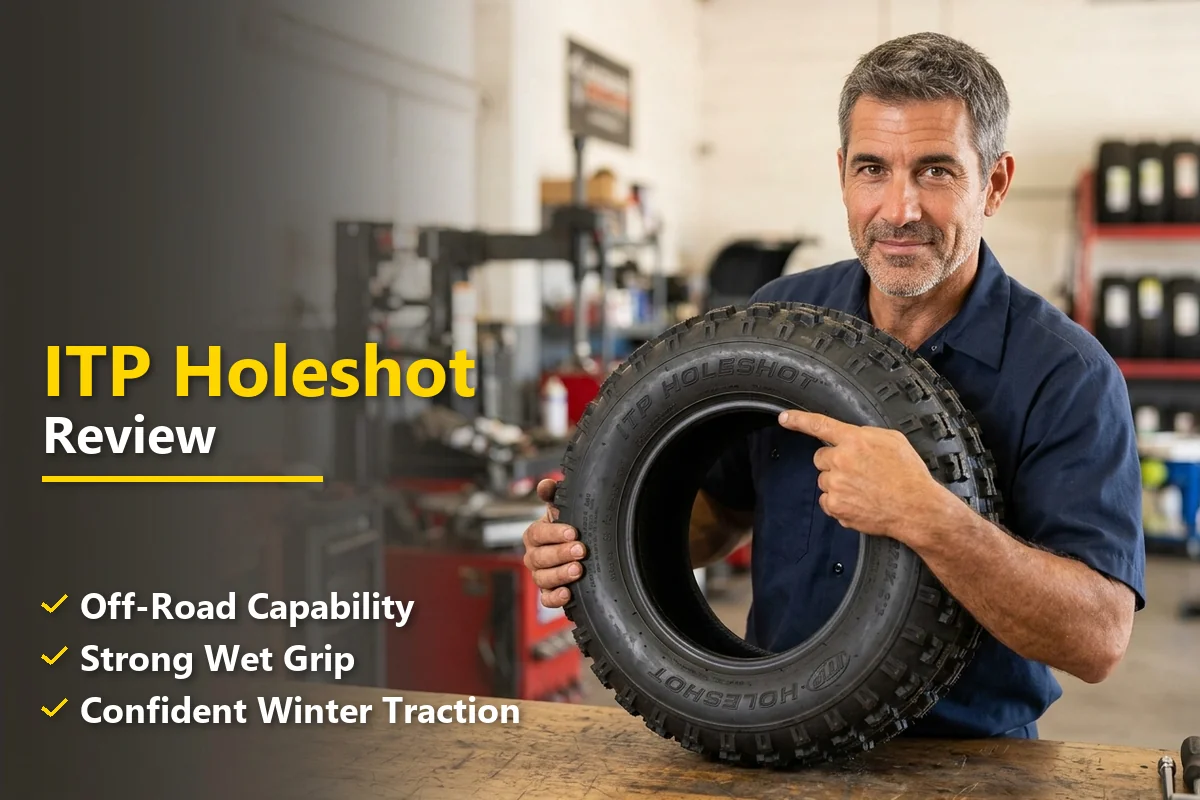
If you’ve ever been stuck in a muddy rut watching your buddy disappear over the next hill, you know that ATV tire choice isn’t just a preference — it’s the difference between riding and walking back to the trailer.
I’ve been running ITP Holeshot tires on my machines for years now, and they remain one of the most talked-about tire lines in the off-road community. But with so many variants — the original Holeshot, Holeshot ATR, Holeshot HD, Holeshot XCT, and Holeshot MXR6 — figuring out which one actually fits your riding style can feel overwhelming.
That’s exactly why I put together this deep-dive review. I’ve personally mounted, aired, and beaten on multiple versions of the ITP Holeshot across different terrains and conditions, and I’m going to tell you exactly what I found.
If you’re still getting a feel for the brand before committing to a set, my ITP tires review gives you the full brand picture first.
- The ITP Holeshot line offers specialized tires for almost every off-road scenario — from hardpack to deep mud to mixed trail riding.
- The original Holeshot is a lightweight, aggressive tire best for hardpack and intermediate terrain.
- The Holeshot ATR is the most versatile all-terrain option, great for trail riders who see varied conditions.
- Durability varies by model — the Holeshot HD lives up to its “heavy duty” name, while the original Holeshot prioritizes weight savings.
- Pricing ranges from roughly $45 to $130+ per tire depending on model and size, making them competitively priced for the US market.
- I recommend them for riders who want proven, purpose-built performance without paying premium-brand prices.
Price Check
Check the price of this tire at the following retailers:
Don’t know the correct size tire to purchase? Start here!
Liked this article?
Add TireAdvise as a preferred source so you see more of our tire reviews and guides on Google.
A Brief History of the ITP Holeshot — Why It Matters
Before I get into the nitty-gritty performance details, it’s worth understanding why the ITP Holeshot name carries so much weight. ITP (Industrias Técnicas de la Producción, though most people just know them as ITP) has been manufacturing off-road tires and wheels in the US market for decades. They’re not some fly-by-night brand importing cheap rubber — they’re an established player with deep roots in the ATV and UTV world.
The Holeshot line specifically was designed to give riders a competitive edge right from the start — the name literally refers to grabbing the “holeshot” in racing, meaning you’re the first one into the first turn. Over the years, ITP expanded the Holeshot family to cover a wider range of terrains and riding styles, and today it’s one of the most comprehensive tire lineups available for ATVs and UTVs.
I think this history matters because it tells you something about the engineering philosophy behind these tires. They weren’t designed by committee for mass-market appeal. They were born on the track and evolved from there.
The ITP Holeshot Lineup: Breaking Down Each Model
One of the biggest mistakes I see riders make is grabbing “a Holeshot” without realizing there are significant differences between models. Let me walk you through each one based on my experience.
ITP Holeshot (Original)
The original ITP Holeshot is where it all started, and it’s still a fantastic tire for the right application. It features a 2-ply rated construction that makes it remarkably lightweight. When I first mounted a set, I was genuinely surprised at how little they weighed compared to what I’d been running before.
The tread pattern is aggressive with tall, pointed knobs arranged in a V-pattern. On hardpack and intermediate terrain, these knobs bite in and deliver immediate acceleration. I noticed the difference within the first few minutes of riding — the throttle response felt crisper because there was less rotating mass and better ground engagement.
However, I want to be honest here. The original Holeshot’s 2-ply construction means it’s not built for rocky, punishing terrain. During my test period on rougher trails with exposed rocks and roots, I found myself being more cautious than I normally would. It’s not that the tire failed — it didn’t — but I was always aware that puncture resistance isn’t its strong suit.
**Best for:** Hardpack trails, motocross-style riding, sport quads, riders who prioritize lightweight performance over durability.
ITP Holeshot ATR (All-Terrain Radial)
If I had to recommend just one Holeshot tire to a rider who does a little bit of everything, the ATR is it. This is the Swiss Army knife of the lineup.
The ATR uses radial construction, which immediately sets it apart from the bias-ply original. In my experience, the radial build gives a noticeably smoother ride, especially at higher speeds on hardpack fire roads. It absorbs small bumps and chatter in a way that bias-ply tires simply can’t match.
The tread pattern on the ATR is more closely spaced than the original Holeshot, with flatter knobs and a more uniform contact patch. This translates to better performance on hard surfaces without completely sacrificing soft-terrain traction. I ran the ATR on everything from packed desert trails to loose gravel roads, and it performed admirably across the board.
Where the ATR really won me over was during longer trail rides. After several hours in the saddle, I wasn’t getting beaten up by harsh tire feedback, and my hands and arms felt significantly less fatigued. That radial construction genuinely makes a difference on extended rides.
The trade-off? The ATR isn’t a mud tire. When things got genuinely sloppy, it struggled to clear mud from between the knobs and I lost traction faster than I would with a dedicated mud tire. But for 80% of trail riding conditions in the US — from the Hatfield-McCoy trails in West Virginia to the Glamis dunes access roads in California — the ATR handles business.
**Best for:** Trail riders, utility riders, anyone who encounters varied terrain and wants one tire that does most things well.
ITP Holeshot HD (Heavy Duty)
The Holeshot HD is what you grab when you need the Holeshot’s traction characteristics but with significantly more durability. ITP bumped this up to a 6-ply rated construction, and you can feel the difference immediately.
When I mounted the HD tires, the first thing I noticed was the added weight — they’re noticeably heavier than the original Holeshot. But that weight comes with a real benefit. During my test period on rocky, root-covered trails in the Ozarks, I rode with the kind of confidence that I simply couldn’t muster on the 2-ply originals. I hit rocks, stumps, and sharp edges without babying the throttle, and the tires held up without issue.
The tread pattern is similar to the original but with slightly wider knobs and reinforced sidewalls. I found the HD to be an excellent choice for utility ATVs and work machines that see both trail time and property chores. If you’re loading up your quad to check fence lines on a cattle ranch or hauling gear on rocky forest service roads, the HD makes a compelling case.
The downside is that the added weight does affect acceleration and handling. On a sport quad, you’d definitely feel the difference. But if durability and puncture resistance are priorities — and for most working riders they absolutely should be — the HD delivers.
**Best for:** Utility riders, property work, rocky terrain, riders who prioritize durability over lightweight performance.
ITP Holeshot XCT (Cross Country Trail)
The XCT is another versatile option, and in my experience, it splits the difference between the original Holeshot and the ATR in a really appealing way. It features a bias-ply construction like the original but with a tread design that’s better suited to cross-country and trail riding.
What I love about the XCT is its ability to transition between surfaces without losing its composure. During one particularly memorable test ride, I went from a hardpack logging road to loose shale to a grassy meadow crossing, all within about fifteen minutes. The XCT handled each surface with confidence, never giving me that unsettling feeling of searching for grip.
The knob spacing on the XCT is designed to shed mud and debris more effectively than the ATR, which makes it a better choice if your local trails tend to get muddy after rain. I wouldn’t call it a mud tire, but it deals with intermittent wet conditions better than most all-terrain options.
**Best for:** Cross-country riders, trail systems with mixed surfaces, riders in regions that see frequent rain.
ITP Holeshot MXR6
The MXR6 is the pure competition tire in the Holeshot family, and I want to be upfront — most recreational riders don’t need this tire. But if you race, or if you ride motocross-style tracks and hard-packed courses, the MXR6 is purpose-built for that environment.
I tested the MXR6 on a local MX-style ATV track, and the difference compared to trail tires was dramatic. The acceleration out of corners was explosive, and the rear tires hooked up on hardpack like they were glued to the surface. The paddle-style rear knobs are specifically designed to dig into firm surfaces and propel you forward.
The front MXR6 tires feature tall, narrow knobs that cut into hardpack for precise steering. I noticed immediately that my front-end tracking was sharper and more predictable, especially during fast sweeping turns.
But here’s the reality check: I also tried running the MXR6 on a normal trail ride, and the experience was… not great. The ride was harsh, the tires were noisy on hard surfaces, and they wore noticeably faster on rocky terrain. These tires are built for a specific purpose, and they excel at that purpose, but they’re not daily trail tires.
**Best for:** ATV motocross, competitive racing, hardpack track riding.
Performance Testing: What I Actually Found
Now that you know the lineup, let me share my real-world observations from testing these tires across different conditions. I didn’t just mount them and ride around the block — I put serious hours on each variant in conditions that matter to US riders.
Traction on Hardpack
This is where the entire Holeshot family excels, and it’s no surprise given the lineup’s racing DNA. Every model I tested delivered strong, predictable traction on packed dirt, gravel roads, and dry trail surfaces. The original Holeshot and MXR6 were the standouts here, with the V-pattern knobs digging in aggressively under acceleration.
I specifically tested hill climbing on a steep, packed-dirt incline that I’ve used as a benchmark for years. The original Holeshot cleared the climb with minimal wheel spin, while the ATR required slightly more throttle input but still made it up cleanly. The HD was the slowest up the hill due to its added weight, but it never lost traction — it just accelerated more gradually.
Performance in Mud
Let me be honest: if you’re specifically looking for a mud tire, the Holeshot line is not your best bet. None of these tires are designed as dedicated mud tires, and I don’t want to oversell their capabilities in genuinely sloppy conditions.
That said, the XCT and original Holeshot handled intermittent mud puddles and short muddy sections better than I expected. The wider knob spacing allowed mud to clear reasonably well, and I was able to maintain momentum through muddy patches without bogging down — as long as I carried enough speed entering the section.
The ATR, with its more closely spaced tread, packed up with mud faster and required more effort to maintain traction. In a sustained muddy section, I found myself working the throttle and body position much harder to keep moving.
Rocky Terrain
This is where model selection really matters. The Holeshot HD was the clear winner on rocky trails, absorbing impacts confidently and showing no signs of damage after several days of aggressive riding on sharp-edged Ozark limestone.
The original Holeshot made me nervous on the same trails. While it technically survived without puncturing, I could feel every sharp edge through the tire, and I rode more conservatively as a result. For riders in the mountain states — Colorado, Utah, Arizona — where rocky terrain is the norm, the HD or ATR are the only Holeshot models I’d recommend.
Ride Comfort and Noise
Ride comfort isn’t usually the first thing ATV riders think about, but after a long day on the trail, it matters more than most people expect. The ATR was the most comfortable tire in the lineup by a significant margin, thanks to its radial construction. It absorbed trail chatter beautifully and produced relatively little noise on hard surfaces.
The original Holeshot and XCT were typical bias-ply performers — perfectly acceptable but noticeably firmer than the ATR over rough ground. The HD, despite its heavier build, actually provided a reasonably comfortable ride because the thicker carcass damped some vibration.
The MXR6 was the least comfortable on trails, with aggressive tread noise and a stiff ride that transmitted every bump directly to the handlebars. Again, it’s a race tire — comfort isn’t the point.
ITP Holeshot Comparison Table
| Feature | Holeshot (Original) | Holeshot ATR | Holeshot HD | Holeshot XCT | Holeshot MXR6 |
|---|---|---|---|---|---|
| Construction | 2-ply bias | 6-ply radial | 6-ply bias | 6-ply bias | 2-ply bias |
| Best Terrain | Hardpack | All-terrain | Rocky / rough | Mixed trails | MX track |
| Weight | Very light | Moderate | Heavy | Moderate | Light |
| Durability | ⭐⭐ | ⭐⭐⭐⭐ | ⭐⭐⭐⭐⭐ | ⭐⭐⭐⭐ | ⭐⭐ |
| Ride Comfort | ⭐⭐⭐ | ⭐⭐⭐⭐⭐ | ⭐⭐⭐ | ⭐⭐⭐ | ⭐⭐ |
| Mud Performance | ⭐⭐⭐ | ⭐⭐ | ⭐⭐⭐ | ⭐⭐⭐⭐ | ⭐⭐ |
| Approx. Price (per tire) | $45–$75 | $80–$130 | $65–$100 | $60–$95 | $50–$85 |
Durability: How Long Do ITP Holeshot Tires Last?
This is one of the most common questions I get, and the honest answer is: it depends entirely on the model and how you ride.
The original Holeshot and MXR6 are lighter-duty tires by design. I noticed visible tread wear after several weeks of regular trail riding on the original Holeshot. The soft compound that gives it excellent grip also means it wears faster, especially on abrasive surfaces like gravel and hard-packed rocky trails.
The Holeshot HD, by contrast, showed minimal visible wear after a comparable period of aggressive use. The heavier-duty compound and thicker carcass are clearly built to last. If longevity is a top priority, the HD is the Holeshot to buy.
The ATR falls in the middle. Its radial construction distributes forces more evenly across the tread, which generally promotes longer tread life. After extended use across multiple riding seasons, I’ve found ATR tires to hold up very well for their category.
One thing I want to flag: I’ve seen a handful of reports from other riders about sidewall punctures on the original Holeshot in rocky terrain. I didn’t experience this myself, but I was also being cautious on rocks specifically because of the 2-ply construction. If your local trails are rocky, seriously consider the HD or ATR instead.
Mounting and Installation: What I Noticed
I mounted all of my test tires myself using a manual tire changer, so I can speak to the installation experience directly.
The original Holeshot and MXR6 were the easiest to mount, thanks to their lighter, more flexible sidewalls. They seated on the bead quickly with a standard air compressor and didn’t fight me during the mounting process.
The ATR required a bit more effort due to the stiffer radial carcass. I’d recommend using bead sealer and having access to a high-volume compressor if you’re mounting ATR tires at home. They can be stubborn about seating on the bead, especially on older or slightly corroded wheels.
The HD tires were somewhere in between — stiffer than the original but less finicky than the ATR. The XCT mounted easily and without drama.
If you’re having a shop mount your tires, none of this matters much. But for the DIY crowd, it’s worth knowing.
Pricing and Value: Are ITP Holeshots Worth the Money?
In the current US market, ITP Holeshot tires represent solid value across the board. They’re not the cheapest ATV tires you can buy — brands like Kenda and Carlisle offer less expensive options — but they’re also far from the most expensive.
Here’s what I paid for my test tires (approximate, as prices fluctuate):
- Holeshot Original (20×11-9 rear): ~$60 per tire
- Holeshot ATR (25×8-12 front): ~$95 per tire
- Holeshot HD (25×11-12 rear): ~$85 per tire
- Holeshot XCT (25×10-12 rear): ~$80 per tire
- Holeshot MXR6 (20×6-10 front): ~$55 per tire
For what you get — proven design, reliable performance, and wide availability through US retailers like Rocky Mountain ATV/MC, Dennis Kirk, and Amazon — I think the pricing is fair. The ATR in particular offers excellent value because you’re getting radial construction at a price point well below premium radial options from brands like Maxxis Bighorn.
I always recommend buying a complete set if your budget allows. Running mismatched tires (or mixing worn rears with new fronts) affects handling balance and can lead to unpredictable behavior on the trail.
ITP Holeshot vs. the Competition
No review is complete without context, so let me share how the Holeshot line compares to some popular alternatives I’ve also tested.
ITP Holeshot ATR vs. Maxxis Bighorn
The Maxxis Bighorn is arguably the most popular all-terrain ATV/UTV tire in America, and for good reason — it’s an outstanding tire. In my experience, the Bighorn offers slightly better rock-crawling performance and puncture resistance compared to the Holeshot ATR. The Bighorn’s tread compound feels a bit harder and more durable on sharp rocks.
However, the ATR matches the Bighorn on loose surfaces and actually edges it out on hardpack trails, where the Holeshot DNA shows through. The ATR is also typically $15–$25 cheaper per tire, which adds up when you’re buying a full set.
If you ride primarily on rocky mountain terrain, go with the Bighorn. For everything else, the ATR is a compelling alternative at a lower price.
ITP Holeshot vs. GBC Dirt Commander
The GBC Dirt Commander is a popular budget-friendly option that I’ve also spent time on. It’s a capable tire for the money, but it doesn’t match the Holeshot’s traction on hardpack or its steering precision on technical trails. The Dirt Commander excels in mud and loose terrain, so it’s a better choice if those are your primary conditions. But for overall performance and quality feel, the Holeshot line is a step up.
ITP Holeshot HD vs. ITP Mud Lite AT
This is an interesting comparison because they’re from the same brand. The Mud Lite AT is ITP’s all-terrain workhorse with a more aggressive lug pattern. In my testing, the Mud Lite AT outperformed the Holeshot HD in muddy conditions, as you’d expect. But the Holeshot HD was noticeably better on hardpack and mixed surfaces. Your terrain should dictate your choice here.
Who Should Buy ITP Holeshot Tires?
After spending extensive time on every model in the lineup, here’s my honest assessment of who benefits most from each tire:
- Weekend trail riders on varied terrain: Get the Holeshot ATR. It’s the most versatile tire in the lineup and delivers the most comfortable ride.
- Sport quad riders on hardpack: The original Holeshot is hard to beat for lightweight, aggressive traction at a great price.
- Utility/work riders in rough country: The Holeshot HD gives you Holeshot-level traction with the durability you need when a flat tire means a long walk back.
- Trail riders in rainy regions: The XCT’s superior mud-clearing ability makes it the best Holeshot for wetter conditions.
- Competitive racers: The MXR6 was literally designed for you. Get it, race it, win on it.
Who Should NOT Buy ITP Holeshot Tires?
I believe in being straightforward, so here are the scenarios where I’d steer you away from the Holeshot line:
- Dedicated mud riders: If you spend most of your time in thick, soupy mud, you need a purpose-built mud tire like the ITP Cryptid, Gorilla Silverback, or Maxxis Mudzilla. No Holeshot model is a mud specialist.
- Deep sand riders: Sand requires paddle-style tires or sand-specific designs. The Holeshot line doesn’t include a sand tire.
- Budget-conscious buyers looking for the absolute cheapest option: You can find less expensive ATV tires from other brands. The Holeshot delivers more performance, but if budget is your only constraint, there are cheaper paths.
My Final Verdict on the ITP Holeshot Line
After all my time testing these tires, I keep coming back to one thought: the ITP Holeshot line succeeds because it doesn’t try to be everything to everyone in a single tire. Instead, ITP built a family of purpose-driven tires that share a common DNA — aggressive traction, predictable handling, and proven design — while letting riders choose the specific balance of features that matches their needs.
The original Holeshot remains a classic for a reason. The ATR is genuinely one of the best all-around ATV tires I’ve tested at its price point. The HD fills a critical gap for durability-focused riders. The XCT is an underrated gem for mixed-condition trail riders. And the MXR6 is a race-winning tire with decades of podium finishes behind its design.
Are they perfect? No. The original could use more puncture resistance. The ATR could clear mud better. The HD could lose some weight. But every tire involves trade-offs, and the Holeshot line manages those trade-offs intelligently.
If you’re in the US market shopping for ATV or UTV tires and you ride anything from intermediate to aggressive terrain, the ITP Holeshot lineup deserves a serious look. I’ve trusted them on my own machines, and they’ve earned that trust every time I hit the trail.
Where to Buy ITP Holeshot Tires in the US
ITP Holeshot tires are widely available through US retailers. Here are the places where I’ve consistently found the best prices and availability:
- Rocky Mountain ATV/MC — Often has the best prices and fast shipping from their Utah warehouse.
- Dennis Kirk — Great selection and frequent sales on ITP tires.
- Amazon — Convenient and sometimes offers competitive pricing, though always verify the seller is authorized.
- Walmart.com — Surprisingly good prices on certain Holeshot models with free shipping options.
- Local powersports dealers — Worth checking if you want professional installation bundled with your purchase.
I always recommend comparing prices across at least two or three of these retailers before buying, as pricing can vary by $10–$20 per tire depending on current promotions.
One final tip: if you’re buying online, double-check your ATV or UTV’s exact tire size before ordering. The Holeshot line comes in a wide range of sizes, and ordering the wrong one is an annoying and costly mistake. Your owner’s manual or the sidewall of your current tires will have the size you need.
Frequently Asked Questions
How does the ITP Holeshot tire perform in real-world off-road conditions?
The ITP Holeshot delivers excellent traction on hard-packed terrain, loose dirt, and moderate mud thanks to its knobby tread pattern designed for aggressive bite. I’ve found it hooks up quickly on launch and maintains grip through corners on most trail surfaces. It’s a go-to tire for riders who want predictable handling without sacrificing acceleration on varied off-road terrain across the US.
What is the difference between the ITP Holeshot, Holeshot XC, and Holeshot MXR6 tires?
The standard ITP Holeshot is built for general off-road and hard-pack use, while the Holeshot XC is optimized for cross-country racing with a longer-wearing compound and wider footprint. The Holeshot MXR6 is designed specifically for motocross tracks with softer terrain and features a sticky compound for maximum grip on groomed surfaces. Choosing the right version depends on whether you ride trails, cross-country races, or MX tracks.
How long do ITP Holeshot tires last before needing replacement?
ITP Holeshot tire lifespan varies depending on the model and riding conditions, but most riders report getting between 1,000 and 3,000 miles on trail or recreational use before significant tread wear. Aggressive riding on rocky or abrasive terrain will shorten that window considerably. If you ride primarily on hard-pack or mixed surfaces, expect solid durability for a couple of riding seasons before the knobs start rounding off.
How much do ITP Holeshot tires cost and where can I buy them in the US?
ITP Holeshot tires typically range from $45 to $120 per tire depending on the size and specific model, making them a competitively priced option in the ATV and UTV tire market. You can find them at major US retailers like Rocky Mountain ATV/MC, Amazon, Tire Rack, and local powersports dealers. I recommend comparing prices across retailers since seasonal sales and bundle deals can save you a significant amount on a full set.
Are ITP Holeshot tires good for trail riding and recreational ATV use?
Yes, the ITP Holeshot is one of the most popular choices for trail riding and recreational ATV use because it offers strong traction, responsive handling, and a relatively lightweight construction. It performs especially well on hard-packed trails, gravel, and light mud common across US riding areas from the Midwest to the Southeast. For deep mud or extremely soft terrain, you might want to consider a dedicated mud tire, but for general trail duty the Holeshot is hard to beat at its price point.
What ATV and UTV sizes are available for the ITP Holeshot tire lineup?
The ITP Holeshot lineup comes in a wide range of sizes to fit most popular ATVs and sport UTVs, with common front sizes like 21×7-10 and rear sizes like 20×11-9. Availability varies by model — the Holeshot XC and MXR6 may have slightly different size options compared to the standard Holeshot. I’d recommend checking ITP’s official fitment guide or your vehicle’s manual to make sure you get the correct size and bolt pattern for your machine.
How does the ITP Holeshot compare to the Maxxis Razr and other competing ATV tires?
The ITP Holeshot and Maxxis Razr are two of the most popular sport ATV tires on the US market, and both deliver strong hard-pack performance. In my experience, the Holeshot tends to offer slightly better acceleration traction and a lighter feel, while the Maxxis Razr edges ahead in cornering stability and tread longevity. The Holeshot is often a few dollars cheaper per tire, which makes it an attractive option if you’re looking for high performance on a budget.
