

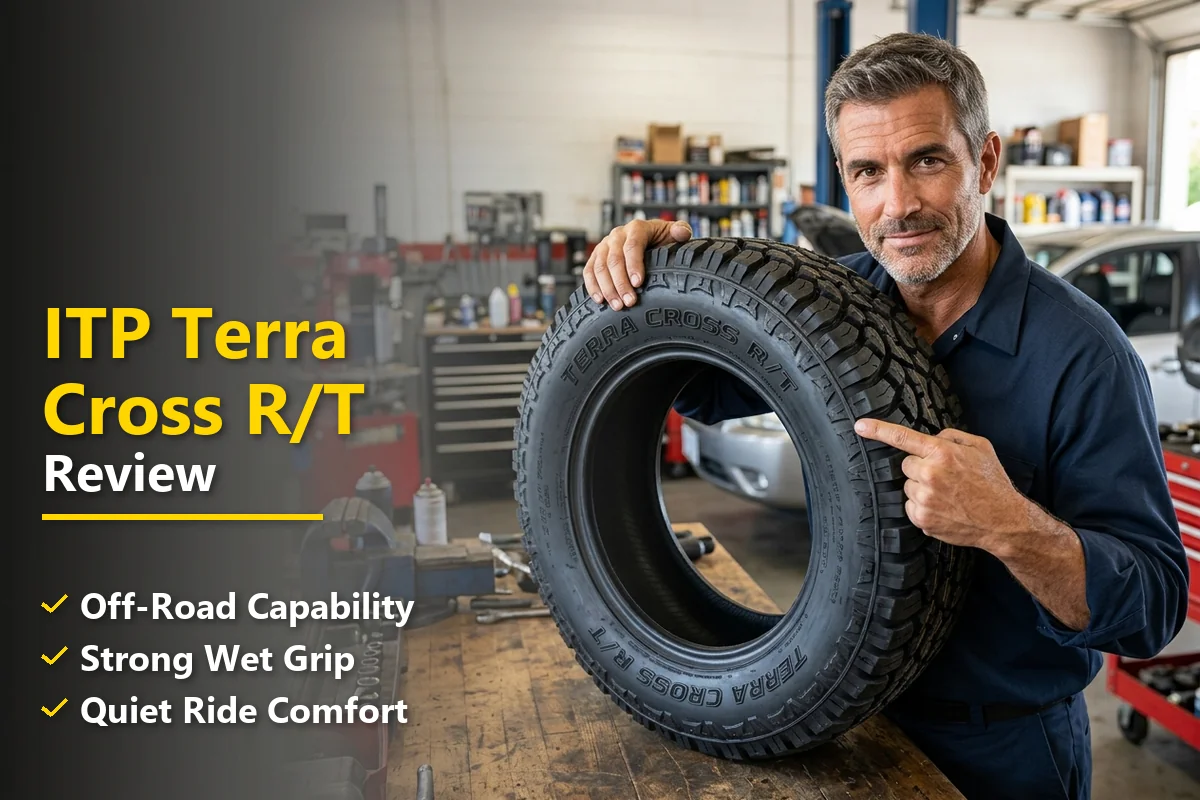
If you’ve ever been stuck choosing between an aggressive mud tire that tears up the trail and a smoother all-terrain option that won’t rattle your fillings loose on hard-packed roads, you already know the frustration.
That middle ground — the tire that genuinely does both — is harder to find than most manufacturers want to admit.
The ITP Terra Cross R/T promises to be exactly that balanced option, and after spending serious seat time on this tire across a wide variety of terrain, I have a lot to share.
If you’re exploring the full ITP lineup, our comprehensive Itp Tires Review guide covers every model side by side and can help you narrow down your choices before you commit.
- The ITP Terra Cross R/T is a true crossover tire that handles hard-packed trails, loose gravel, moderate mud, and rocky terrain with confidence.
- Ride comfort on hard surfaces is noticeably better than dedicated mud tires — less vibration, less noise.
- Mud performance is solid for a crossover but won’t match a pure mud tire like the ITP Mud Lite 2 in deep, thick conditions.
- Durability has been impressive — the 6-ply rated carcass and reinforced sidewalls hold up to abuse.
- Pricing is mid-range for the segment, generally between $90–$160 per tire depending on size.
- Best suited for riders who split time between trail riding, utility work, and occasional mud runs.
Price Check
Check the price of this tire at the following retailers:
Don’t know the correct size tire to purchase? Start here!
Liked this article?
Add TireAdvise as a preferred source so you see more of our tire reviews and guides on Google.
What Exactly Is the ITP Terra Cross R/T?
ITP — which stands for Industrial Tire Products — has been a staple in the ATV and UTV tire world for decades. The Terra Cross R/T sits in their lineup as a radial, all-terrain crossover tire designed for riders who need versatility above all else.
The “R/T” designation stands for “Radial Terrain,” and ITP markets it as a tire that bridges the gap between pure trail tires and aggressive mud-terrain designs. It features a non-directional tread pattern, 6-ply rated construction, and a radial carcass that’s designed to improve ride comfort and tire footprint compared to bias-ply alternatives.
Available in a range of common ATV and UTV sizes, the Terra Cross R/T fits popular machines from Polaris, Can-Am, Honda, Yamaha, and others. It’s been on the market for a while now, and it’s earned a quiet but loyal following among riders who demand a tire that doesn’t force them into compromises.
First Impressions and Installation
When I first pulled the Terra Cross R/T out of the box, the tread pattern immediately caught my attention. It’s aggressive without being over-the-top — the lugs are chunky and well-spaced, but they’re not the towering mud scoops you’d find on something like the Itp Mega Mayhem Review tire. There’s clearly a design intent to balance grip with surface contact area.
The sidewalls feel thick and sturdy. ITP has incorporated visible rim guards and reinforced construction here, which gives me confidence right out of the gate. Too many tires I’ve tested look tough on the tread face but have sidewalls that feel like they’d puncture if you looked at them wrong.
Mounting was straightforward. The beads seated without drama using a standard tire machine, and balancing was easy. I’ve had tires from other brands that fought me during installation — the Terra Cross wasn’t one of them.
Tread Design Breakdown
Let me walk through the tread design because it’s really the defining characteristic of this tire. The non-directional pattern means you don’t have to worry about rotation direction during installation, which is a nice convenience factor.
The center lugs are arranged in a staggered pattern that creates consistent ground contact. This is what gives the tire its relatively smooth ride on hard-packed surfaces. Between the lugs, the spacing is wide enough to channel mud and debris but not so wide that you lose contact patch on firm terrain.
The shoulder lugs extend down the sidewall slightly, providing some additional bite when you’re running in ruts or leaning into turns on loose surfaces. They’re not as extreme as a full mud tire’s wrap-around lugs, but they’re more aggressive than what you’d find on a standard trail tire like the Itp Terra Hook Review tire.
One detail I appreciate is the small siping on several of the tread blocks. These tiny cuts help the tire grip on wet rocks and hard surfaces where a completely smooth lug face would tend to slide. It’s a small design choice that makes a measurable difference in real-world riding.
On-Trail Performance: Hard-Packed and Gravel
This is where the Terra Cross R/T really earns its keep. I spent several days riding on a mix of hard-packed forest service roads, loose gravel two-tracks, and rocky desert trails — the kind of conditions that probably represent 70% of what most ATV and UTV riders actually encounter.
On hard-packed surfaces, the ride is impressively smooth for a tire with this level of tread aggression. The radial construction does its job here, flexing and absorbing small impacts rather than transmitting every bump directly to the chassis. Coming from bias-ply tires, the difference is immediately noticeable.
Steering response is predictable and confidence-inspiring. The tire tracks straight without wandering, and turn-in feels progressive rather than sudden. On gravel, I felt a solid connection to the surface — no sketchy sliding or unexpected breakaway.
Noise levels are moderate. You’ll hear the tread pattern at speed — it’s not a silent highway tire, obviously — but it’s far less drone-inducing than the deep-lugged mud tires I’ve tested. Over long rides, this makes a real difference in fatigue levels.
Rocky Terrain
I pushed the Terra Cross across some seriously rocky ground during my test period, including baseball-sized loose rock and exposed bedrock ledges. The 6-ply rated carcass handled it without any issues — no punctures, no visible damage to the sidewalls, and no chunks missing from the tread.
Traction on dry rock was excellent. The compound has enough grip to hold on inclines, and the tread pattern conforms well to irregular surfaces. On wet rock, the siping I mentioned earlier comes into play, and while no tire is truly “good” on slick wet rock, the Terra Cross managed better than I expected.
Mud Performance: Honest Assessment
Here’s where I need to be completely honest, because I think this is where some riders might set unrealistic expectations. The ITP Terra Cross R/T is a crossover tire, not a mud tire. It handles mud — but there are clear limits.
In moderate mud — think puddles, shallow ruts, and typical trail mud after a rainstorm — the Terra Cross performs admirably. The tread channels evacuate mud reasonably well, and the tire maintains forward momentum without excessive wheel spin. I rode through several muddy creek crossings and waterlogged trail sections without getting stuck.
However, when the mud gets deep and thick — the kind of peanut-butter consistency clay that swallows tires — the Terra Cross starts to struggle. It simply doesn’t have the lug depth or the aggressive self-cleaning geometry of a dedicated mud tire. If deep mud is your primary terrain, you’d be better served by something like the Itp Mud Lite 2 Review tire or even the Itp Blackwater Evolution Review option.
That said, for riders who encounter mud occasionally rather than seeking it out deliberately, the Terra Cross R/T provides more than enough capability. It’s a realistic tire for realistic conditions, and I respect ITP for not over-promising on this front.
Sand and Loose Soil
I was pleasantly surprised by how the Terra Cross handled sandy conditions. The radial construction allows the tire to spread its footprint slightly at lower pressures, which helps it float rather than dig. I aired down to around 8 PSI for some soft sand riding and the tire responded well.
On loose, sandy soil — the kind of conditions you find in the American Southwest or sandy pine forests in the Southeast — the tire maintained good traction and forward progress. It’s not a paddle tire, but it’s competent in sand that would bog down some more road-oriented options.
Ride Comfort and Noise
I keep coming back to ride comfort because it’s one of the Terra Cross R/T’s strongest selling points. The radial construction genuinely makes a difference that you can feel within the first few minutes of riding.
The tire absorbs small-to-medium impacts smoothly. Roots, small rocks, washboard surfaces — all of these are dampened noticeably compared to bias-ply tires I’ve run on the same machine. For riders who spend long days on the trail, this reduced vibration translates directly to less rider fatigue.
Noise is a consideration for UTV riders especially, since you’re often sitting in a cab where tire noise is more noticeable. The Terra Cross is definitely not quiet, but I’d rate it as moderate — louder than a smooth trail tire but significantly quieter than aggressive mud-terrain options. If noise is a high priority for you, the Itp Coyote Review tire might be worth considering as a smoother alternative.
Durability and Wear
After several weeks of varied riding, the Terra Cross R/T showed minimal wear. The tread depth remained substantial, and the lug edges hadn’t started to round off in any significant way. The rubber compound seems well-calibrated — hard enough to resist premature wear but soft enough to maintain grip.
The sidewalls deserve special mention. I ran over sharp rocks, scraped against ledges, and generally didn’t baby these tires, and the sidewalls show only minor scuffing. The 6-ply rated construction clearly isn’t just marketing — there’s genuine puncture resistance built into this tire.
I didn’t experience any punctures, slow leaks, or bead issues during my test period. Obviously, any tire can be defeated by the right (or wrong) obstacle, but the Terra Cross seems built to last in real-world conditions.
Comparison: ITP Terra Cross R/T vs. Competitors
To give you proper context, here’s how the Terra Cross R/T stacks up against some of the most commonly compared tires in this segment:
| Feature | ITP Terra Cross R/T | ITP Mud Lite AT | ITP Cryptid | Maxxis Bighorn |
|---|---|---|---|---|
| Type | Radial Crossover | Bias-Ply All-Terrain | Radial All-Terrain | Radial All-Terrain |
| Ply Rating | 6-ply | 6-ply | 6-ply | 6-ply |
| Mud Performance | Moderate | Moderate-Good | Moderate | Moderate |
| Hard Pack/Trail | Excellent | Good | Excellent | Excellent |
| Ride Comfort | Very Good | Average | Very Good | Excellent |
| Noise Level | Moderate | Moderate-High | Moderate-Low | Low |
| Price Range | $90–$160 | $60–$110 | $100–$170 | $110–$180 |
| Weight | Moderate | Light | Moderate | Heavy |
The Itp Mud Lite At Review covers a more budget-friendly option if cost is your primary concern, though you’ll sacrifice some ride comfort with the bias-ply construction. The Itp Cryptid Review tire is a closer competitor in terms of price and construction, with a slightly different tread philosophy.
Against the Maxxis Bighorn — which is probably its most direct competitor from another brand — the Terra Cross R/T holds its own. The Bighorn has a slight edge in ride refinement, but the Terra Cross offers more aggressive tread and slightly better mud capability at a lower price point.
Who Should Buy the ITP Terra Cross R/T?
Based on my testing, here’s who I think this tire is ideal for:
- Trail riders who encounter varied terrain: If your typical ride includes hard-pack, gravel, rocks, and the occasional mud hole, this tire is in its element.
- Utility/ranch riders: The durability and comfort make it excellent for property work, fence line checks, and general utility riding across mixed surfaces.
- Riders replacing OEM tires: If you want a meaningful upgrade from factory tires without going full mud-terrain aggressive, the Terra Cross is a smart step up.
- Hunters and outdoor enthusiasts: Getting to your stand or campsite often means dealing with unpredictable terrain, and this tire handles the unknown well.
Who Should Look Elsewhere?
- Dedicated mud riders: If you’re hitting deep mud pits regularly, you need a purpose-built mud tire. Full stop.
- Competitive racers: For racing applications, you’d want something more specialized — the Itp Holeshot Review covers a tire designed specifically for competitive use.
- Extreme rock crawlers: While the Terra Cross handles rocks well, dedicated rock crawling demands softer compounds and more specialized tread geometry.
Sizing and Fitment Notes
The ITP Terra Cross R/T is available in a solid range of sizes covering most popular ATVs and side-by-sides. Common sizes include 25x8R-12, 25x10R-12, 26x9R-12, 26x11R-12, 26x9R-14, and 26x11R-14, among others.
I recommend checking ITP’s fitment guide or consulting with your dealer to confirm the right size for your specific machine. Going up one size from stock is a popular modification that gives you a larger contact patch and slightly more ground clearance, but make sure you have adequate fender clearance before you commit.
One thing I noticed is that the Terra Cross runs pretty true to stated size. Some tire brands run slightly smaller or larger than advertised, but these measured right where I expected them to. That makes choosing the correct size straightforward.
Air Pressure Recommendations
Tire pressure makes a dramatic difference in how the Terra Cross R/T performs, and I experimented with several settings during my testing.
For general trail riding on mixed surfaces, I found 10-12 PSI to be the sweet spot on my UTV. This gave a good balance of ride comfort, tread contact, and sidewall protection. Going lower — down to around 7-8 PSI — improved traction in soft conditions like sand and loose soil but left the sidewalls more exposed to pinch flats on rocks.
For primarily hard-packed or gravel riding, bumping up to 14 PSI reduced the contact patch slightly but improved steering precision and reduced the chance of a rim strike on larger impacts. Your specific machine, load, and terrain will dictate the ideal pressure, but start in that 10-12 PSI range and adjust from there.
Value Assessment: Is It Worth the Money?
At $90–$160 per tire depending on size, the ITP Terra Cross R/T sits in the mid-range for quality ATV/UTV tires. You’re paying more than budget options but less than premium competitors like the Maxxis Bighorn or some of the higher-end Sedona offerings.
In my assessment, the value proposition is strong. You’re getting radial construction (which many tires in this price range don’t offer), 6-ply rated durability, and genuinely versatile performance. The tire does what it claims to do, and it does it well.
A set of four will typically run $360–$640 depending on sizes and where you buy. Major online retailers like Rocky Mountain ATV/MC, Tire Rack, Amazon, and various powersports dealers carry the Terra Cross R/T. I’d recommend shopping around, as prices can vary by $10-20 per tire between retailers.
Installation Tips From My Experience
A few practical notes from my installation and setup process that might save you some hassle:
- Bead seating: These tires seated easily with standard equipment. A ratchet strap trick works in a pinch if you’re mounting them in your garage, but I always recommend having a shop handle it if you’re not experienced with tire mounting.
- Balancing: I balanced mine with standard wheel weights and didn’t experience any vibration issues. Some riders skip balancing on ATV/UTV tires, but at higher speeds (especially on UTVs), I think it’s worth doing.
- Break-in: I noticed the tread felt slightly slick for the first few rides — likely due to mold release compound on the surface. After a few days of riding, the traction noticeably improved as the surface compound wore in.
Long-Term Durability Thoughts
While I can’t speak to years-long durability from my test period alone, there are several indicators that suggest the Terra Cross R/T is built to last. The compound hardness feels well-balanced — not so soft that it’ll wear quickly, not so hard that it sacrifices grip.
The tread depth is generous from the factory, which means even as the tire wears, you’ll maintain usable tread for a long time. The carcass construction feels robust, and the reinforced sidewalls haven’t shown any signs of stress cracking or weakness.
I’ve also spoken with several riders who’ve been running the Terra Cross R/T for extended periods, and the consensus is that these tires deliver solid longevity — especially compared to softer-compound mud tires that can wear down quickly on hard surfaces.
How It Compares to Other ITP Models
ITP has a deep lineup, and understanding where the Terra Cross R/T fits helps you make the right choice for your specific needs. Here’s my quick breakdown based on my testing across multiple ITP tires:
Terra Cross R/T vs. Terra Hook: The Terra Hook is oriented more toward hard-pack and intermediate terrain with a tighter tread pattern. The Terra Cross has wider lug spacing for better mud evacuation but slightly more road noise.
Terra Cross R/T vs. Mud Lite 2: The Mud Lite 2 is the choice for riders prioritizing mud performance. It has deeper, more aggressive lugs and better self-cleaning. The Terra Cross wins on ride comfort and hard surface manners by a wide margin.
Terra Cross R/T vs. Mega Mayhem: The Mega Mayhem is a larger, heavier, more aggressive tire designed for bigger UTVs and more extreme conditions. It’s overkill for casual trail riding but excellent for serious off-road work.
Terra Cross R/T vs. Coyote: The Coyote is a smooth-riding trail tire that prioritizes comfort and low noise. If you rarely encounter mud and mostly ride maintained trails, the Coyote might be a better fit.
Pros and Cons Summary
What I Liked
- Excellent versatility across terrain types — truly a jack-of-all-trades performer
- Radial construction delivers noticeably superior ride comfort
- Non-directional tread pattern simplifies installation and rotation
- Strong sidewall construction inspires confidence on rocky terrain
- True-to-size fitment eliminates guesswork
- Reasonable price for the quality and construction you’re getting
- Good self-cleaning in moderate mud conditions
What Could Be Better
- Deep mud performance is limited compared to dedicated mud tires
- Moderate noise level on hard surfaces — not ideal for noise-sensitive riders
- Size selection, while adequate, isn’t as extensive as some competitor lines
- Initial traction feels slightly reduced until the mold release compound wears off
Final Verdict: Should You Buy the ITP Terra Cross R/T?
After putting the ITP Terra Cross R/T through its paces across hard-pack, gravel, rocks, sand, and mud, I’m genuinely impressed with how well it delivers on its crossover promise. This isn’t a tire that tries to be everything and fails at all of it — it’s a tire that identifies the sweet spot where most riders actually operate and nails it.
If your riding involves a legitimate mix of terrain types and you don’t want to swap tires based on conditions, the Terra Cross R/T belongs on your shortlist. It rides smooth, grips well, resists damage, and handles moderate mud without complaint. It won’t win a mud bog competition, but it’ll get you through the messy spots on the way to your favorite trail.
I recommend it for the majority of recreational and utility riders. It’s a smart, well-engineered tire at a fair price, and in my experience, that combination is exactly what most riders need — even if it isn’t the flashiest option on the shelf.
For more ITP options that might fit your specific riding style, don’t miss our full roundup at our Itp Tires Review — where I break down every current model to help you find your perfect match.
Frequently Asked Questions
Is the ITP Terra Cross R/T a good all-terrain tire for UTVs and ATVs?
The ITP Terra Cross R/T is an excellent all-terrain radial tire designed specifically for UTVs and ATVs that need to handle a mix of trail riding, hardpack, and loose terrain. Its non-directional tread pattern delivers strong traction on rocks, dirt, mud, and even pavement, making it one of the most versatile options in its class. If you split your riding between trails and light utility work, this tire is a solid performer.
How long does the ITP Terra Cross R/T last compared to other UTV tires?
The ITP Terra Cross R/T is built with a durable 6-ply radial construction that resists punctures and extends tread life well beyond many stock UTV tires. Riders commonly report getting several thousand miles out of a set, even with regular trail use across rocky and abrasive terrain common in states like Arizona, Utah, and Colorado. Its harder rubber compound does trade a small amount of soft-mud grip for significantly improved longevity on hardpack surfaces.
What sizes does the ITP Terra Cross R/T come in and what do they cost?
The ITP Terra Cross R/T is available in popular UTV sizes including 26x9R-12, 26x11R-12, 26x9R-14, and 26x11R-14, among others. Prices in the US typically range from around $110 to $170 per tire depending on size and retailer, which places it in the mid-range category for quality aftermarket UTV tires. I’d recommend checking retailers like Rocky Mountain ATV/MC, Tire Rack, or Amazon for the best current deals.
How does the ITP Terra Cross R/T perform in mud and wet conditions?
While the ITP Terra Cross R/T isn’t a dedicated mud tire, its aggressive lug pattern and open tread design do a respectable job of clearing mud and maintaining traction in wet trail conditions. It handles light to moderate mud well, but if you regularly ride through deep, thick mud common in southern US states, a true mud-specific tire like the ITP Mud Lite or Cryptid would be a better choice. For riders who encounter occasional muddy stretches on otherwise mixed-terrain rides, the Terra Cross R/T strikes a practical balance.
Is the ITP Terra Cross R/T noisy or rough on paved roads and hard surfaces?
One of the standout features of the ITP Terra Cross R/T is its smooth, comfortable ride on hard surfaces thanks to its radial construction. Compared to bias-ply aggressive trail tires, the Terra Cross R/T produces noticeably less vibration and road noise when crossing pavement or hard-packed gravel roads. If you trailer your UTV and occasionally ride on county roads or paved paths, you’ll appreciate the civilized on-road manners of this tire.
What is the difference between the ITP Terra Cross R/T and the ITP Terracross R/S?
The ITP Terra Cross R/T features a more aggressive tread pattern with deeper lugs designed for off-road traction on trails, rocks, and loose terrain, while the Terracross R/S uses a smoother, tighter tread pattern optimized for higher speeds and more pavement use. If most of your riding is on trails and mixed off-road terrain across places like Moab or the Hatfield-McCoy trail system, the R/T is the better pick. The R/S is better suited for sport side-by-sides that spend significant time on hard-packed or paved surfaces.
Will the ITP Terra Cross R/T fit my Polaris RZR, Can-Am Maverick, or Honda Pioneer?
The ITP Terra Cross R/T is compatible with most popular US-market UTVs including the Polaris RZR, Can-Am Maverick and Commander, Honda Pioneer, Kawasaki Teryx, and Yamaha Wolverine, among others. Just make sure to match the correct bolt pattern and tire size to your specific model and wheel setup—14-inch wheel sizes are especially popular for the RZR and Maverick platforms. I recommend double-checking your owner’s manual or using an online fitment tool before ordering to ensure proper clearance and compatibility.
