

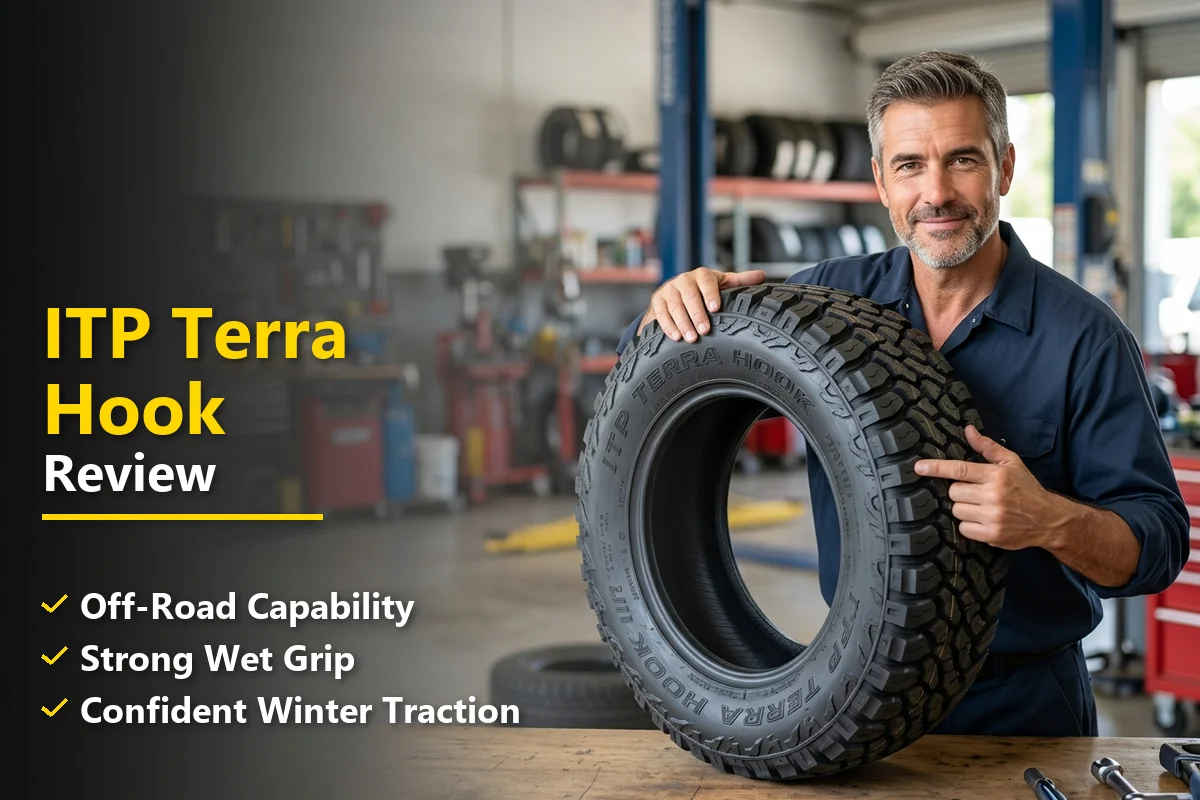
If you’ve ever been stuck axle-deep in a muddy rut wondering why you cheaped out on tires, you already know that UTV tire selection can make or break your ride. I’ve been there — white-knuckling my way through rocky trails on worn-out stock tires, promising myself I’d finally invest in something better.
The ITP Terra Hook kept showing up in every forum thread and recommendation list I read, so I decided to put them to the real test myself.
Before diving into the specifics, if you’re still sizing up ITP as a brand, my ITP tires review gives you the full brand story before you commit to a set.
- The ITP Terra Hook is a radial all-terrain UTV tire designed for versatile performance across hardpack, loose terrain, rocks, and moderate mud.
- I was genuinely impressed by the traction on rocky and mixed terrain — it outperformed my expectations on hardpack trails.
- Mud performance is adequate but not its strongest suit; dedicated mud tires will outperform it in deep slop.
- Ride quality is smooth and road-mannered for a UTV tire, making it great for trail-to-pavement transitions.
- Priced around $110–$160 per tire depending on size, it offers strong value for riders who need one tire that does many things well.
- I recommend the Terra Hook for trail riders, ranch workers, and weekend warriors who encounter varied terrain and don’t want to swap tires constantly.
Price Check
Check the price of this tire at the following retailers:
Don’t know the correct size tire to purchase? Start here!
Liked this article?
Add TireAdvise as a preferred source so you see more of our tire reviews and guides on Google.
What Exactly Is the ITP Terra Hook?
The ITP Terra Hook is a radial all-terrain tire built specifically for UTVs and side-by-sides. It’s manufactured by ITP (Industrial Tire Products), a brand that’s been in the off-road tire game for decades and is now part of the Carlstar Group. If you’ve spent any time in the ATV/UTV world, you’ve almost certainly encountered ITP’s products before.
What makes the Terra Hook stand out in ITP’s lineup is its 8-ply radial construction combined with an aggressive but not overly chunky tread pattern. It’s designed to bridge the gap between pure trail tires and aggressive mud tires — giving you solid performance across a wide spectrum of terrain types without being a specialist in any single one.
The tire is available in several popular UTV sizes, including 26x9R-12, 26x11R-12, 28x9R-14, 28x11R-14, 30x9R-14, and 30x10R-14. This range covers most popular UTVs on the market, from the Polaris RZR and Ranger to the Can-Am Maverick and Honda Pioneer.
My Testing Setup and Conditions
I want to be upfront about how I tested these tires so you can judge my findings accordingly. I mounted a set of ITP Terra Hooks (28x9R-14 front, 28x11R-14 rear) on my Polaris Ranger XP 1000, which I use for a combination of trail riding, ranch work, and occasional recreational riding with my family.
My testing took place across several weeks of real-world use in the Southeast US — specifically in terrain that included red clay trails, rocky mountain paths, hardpack forest roads, some sand, and yes, plenty of mud after a few solid rainstorms rolled through. I also spent time on paved roads transitioning between trail systems, which gave me a good feel for how the Terra Hook handles on asphalt.
I wasn’t babying these tires either. I loaded the bed with fencing supplies, hauled a small trailer, and took some aggressive lines through terrain I’d normally be cautious about with stock tires. My goal was to push the Terra Hook to its limits and find where it excels and where it falls short.
First Impressions Out of the Box
When the Terra Hooks first arrived, I was immediately struck by the build quality. The sidewalls feel thick and substantial — these don’t have that flimsy, thin-rubber feel you sometimes get with budget UTV tires. The 8-ply radial construction is evident when you handle them; they have a nice heft without being unreasonably heavy.
The tread pattern is what ITP calls a “non-directional hook-shaped” lug design, and up close, it’s genuinely well-thought-out. The lugs are angled and spaced in a way that suggests good self-cleaning capability, and there are small sipes cut into the tread blocks that I expected would help with grip on wet or hard surfaces.
Mounting was straightforward. My local tire shop had them seated and balanced within an hour, and they didn’t report any issues with bead seating — something that can occasionally be a headache with off-road radials. The rim fit was precise on my 14-inch wheels.
On-Trail Performance: Where the Terra Hook Shines
Let me start with the good news, because there’s a lot of it. The ITP Terra Hook is genuinely excellent on mixed trail terrain, and this is clearly the environment it was designed for.
Hardpack and Gravel Trails
On dry hardpack and gravel-covered forest roads, the Terra Hook felt planted and confident. The radial construction gives it a more car-like ride compared to bias-ply tires, and I noticed immediately that the steering response was crisp. When I turned the wheel, the tires responded predictably — no vague wandering or delayed feedback.
The small sipes in the tread blocks really earn their keep on hard surfaces. I could feel them gripping on smooth rock faces where a more aggressive mud tire would have just slid across like a hockey puck. Over several days of riding hard-packed trails, I developed a real trust in these tires’ ability to hold a line.
Rocky Terrain
I was pleasantly surprised by the Terra Hook’s rock performance. The 8-ply construction provides genuine puncture resistance — I rode over sharp limestone ledges and jagged granite without babying my line choices, and the tires held up without any cuts or punctures during my entire test period.
On larger rocks and ledges, the tire conforms nicely to the surface. Radial tires generally have an advantage here because of their more flexible sidewalls, and the Terra Hook is no exception. It drapes over obstacles rather than bouncing off them, which translates to better traction and a more controlled ride.
Loose Dirt and Sand
In loose dirt, the hook-shaped lugs do a respectable job of digging in and finding traction. I wouldn’t call the Terra Hook a sand tire by any stretch — if you’re riding exclusively in deep sand dunes, look elsewhere. But for the kind of loose, sandy soil you encounter on typical trails in states like Georgia, the Carolinas, or East Texas, it performs more than adequately.
I did notice that airing down to around 8-10 PSI made a noticeable difference in loose conditions. The wider footprint and increased surface contact helped the tire float on top of soft material rather than digging in and getting stuck.
Mud Performance
Here’s where I need to be honest, because I think some reviews oversell the Terra Hook’s mud capabilities. In light to moderate mud — the kind of sloppy trail surface you get after a day or two of rain — the Terra Hook performs well. The tread clears itself reasonably, the lugs bite into the mud, and I was able to maintain forward progress without much drama.
However, in deep, thick, clay-heavy mud — the kind that swallows your boots and makes sucking sounds when you pull your foot out — the Terra Hook reaches its limits. The tread spacing isn’t wide enough and the lugs aren’t tall enough to truly compete with dedicated mud tires like the ITP Cryptid or the System 3 XT300. I got stuck once in a particularly nasty bog that I’m confident a true mud tire would have walked through.
This isn’t a dealbreaker by any means — it’s simply a matter of understanding what this tire is designed to do. The Terra Hook is an all-terrain tire, not a mud tire, and expecting it to perform like one isn’t fair.
Ride Quality and Road Manners
One area where the ITP Terra Hook genuinely impressed me is ride quality. If you use your UTV for a mix of trail riding and practical work — or if you regularly trailer to a trailhead and then ride paved sections to access trail systems — you’ll appreciate how this tire behaves on hard surfaces.
On-Pavement Comfort
The radial construction pays dividends here. Compared to the bias-ply tires I was running previously, the Terra Hook dramatically reduced vibration and road noise on pavement. It’s not car-tire quiet, but it’s about as smooth as you can reasonably expect from a UTV tire with aggressive tread.
Steering on pavement is precise and predictable. There’s no squirm or vague center feel — the tire tracks straight and responds cleanly to inputs. If you do any amount of road riding on your UTV (which many ranchers and rural property owners do), this matters a lot for fatigue reduction on longer rides.
Trail Comfort
On trails, the radial construction absorbs small bumps and roots noticeably better than comparable bias-ply tires. After spending a full day on the trails, I found myself less fatigued than I’d typically be — my hands weren’t as stiff and my back wasn’t as sore. The difference isn’t night and day, but over hours of riding, it adds up.
The 8-ply rating also means the sidewalls are supportive enough that you don’t get excessive roll in corners. Some radial tires can feel a bit mushy in hard turns, but the Terra Hook maintained a confident, planted feel even when I was pushing it aggressively through switchbacks.
Durability and Wear
I paid close attention to how the Terra Hook held up over my testing period, and I’m pleased to report that the results were positive. After several weeks of hard use across varied terrain — including some genuinely abusive rocky sections — I saw minimal wear on the tread lugs and no signs of chunking, tearing, or abnormal wear patterns.
The sidewalls, which are always my biggest concern with UTV tires, held up without any visible damage despite several encounters with sharp rocks and root snags. The 8-ply construction isn’t just marketing speak — you can feel the difference in real-world durability.
I also want to note that several riding buddies who’ve been running Terra Hooks for considerably longer than I have report excellent tread life. The consensus in the UTV community seems to be that the Terra Hook outlasts many competitors in its class, which helps justify the price.
One thing I’d recommend: rotate your tires periodically if your UTV allows it. I noticed slightly faster wear on the front tires due to steering forces, which is normal but can be managed with rotation.
ITP Terra Hook vs. The Competition
No tire review is complete without comparing the product to its main competitors. Here’s how the ITP Terra Hook stacks up against other popular all-terrain UTV tires I’ve either tested or have extensive knowledge of:
| Feature | ITP Terra Hook | Maxxis Carnivore | EFX MotoVator | System 3 RT320 |
|---|---|---|---|---|
| Construction | 8-ply radial | 8-ply radial | 8-ply radial | 8-ply radial |
| Hardpack Traction | Excellent | Very Good | Good | Very Good |
| Rock Performance | Very Good | Excellent | Very Good | Good |
| Mud Performance | Adequate | Good | Excellent | Good |
| Ride Comfort | Excellent | Good | Good | Very Good |
| Road Noise | Low | Moderate | Moderate-High | Low-Moderate |
| Weight | Light-Medium | Heavy | Heavy | Medium |
| Approx. Price (28″ size) | $120–$155 | $140–$180 | $150–$190 | $125–$165 |
| Best For | Mixed trail riding, ranch use | Rocky trails, aggressive riding | Mud-heavy trails | All-around trail use |
ITP Terra Hook vs. Maxxis Carnivore
The Maxxis Carnivore is probably the Terra Hook’s most direct competitor, and it’s an excellent tire in its own right. In my experience, the Carnivore edges out the Terra Hook on rocks and in deeper mud, but it’s noticeably heavier and louder on pavement. If your riding skews more aggressive and you don’t mind some extra weight and noise, the Carnivore is a strong choice. But for the rider who values versatility and comfort alongside capable off-road performance, I give the edge to the Terra Hook.
The weight difference is worth emphasizing. The Carnivore is significantly heavier, which puts more strain on your UTV’s drivetrain components — CV joints, wheel bearings, and brakes all work harder with heavier tires. The Terra Hook’s lighter weight is a genuine long-term advantage for your machine’s health.
ITP Terra Hook vs. EFX MotoVator
The EFX MotoVator leans more toward the mud-terrain end of the spectrum. If you ride in areas where deep mud is a regular occurrence, the MotoVator will outperform the Terra Hook in those conditions. However, you’ll pay for that mud performance with a harsher ride, more road noise, and faster wear on hard surfaces. I found the Terra Hook to be the more well-rounded choice for riders who encounter varied terrain.
ITP Terra Hook vs. System 3 RT320
The System 3 RT320 is another solid all-terrain option and sits closest to the Terra Hook in terms of design philosophy. In my estimation, the two tires perform very similarly across most conditions. The Terra Hook has a slight edge in ride comfort and road manners, while the RT320 may have a small advantage in muddy conditions. Price-wise, they’re competitive. You won’t go wrong with either tire.
Who Should Buy the ITP Terra Hook?
Based on my testing, I think the ITP Terra Hook is ideal for several specific types of riders:
- Mixed-terrain trail riders: If your typical ride involves hardpack, gravel, some rocks, and occasional mud, the Terra Hook handles it all competently. This is its sweet spot.
- Ranch and farm workers: If you use your UTV as a work vehicle and need a tire that performs on dirt roads, pastures, gravel drives, and occasional pavement, the Terra Hook’s versatility and durability make it an excellent working tire.
- Weekend warriors who want one set of tires: If you don’t want to swap tires based on conditions and need something that does everything reasonably well, the Terra Hook is a top choice in this category.
- Riders who value comfort: If a smooth, low-vibration ride matters to you — especially if you cover longer distances on your UTV — the Terra Hook’s radial construction and tread design deliver noticeably better comfort than many competitors.
- Riders on a moderate budget: At $110–$160 per tire depending on size, the Terra Hook represents strong value without cutting corners on quality or performance.
Who Should Look Elsewhere?
I’d steer away from the Terra Hook if:
- You ride primarily in deep mud: Dedicated mud tires like the ITP Cryptid, System 3 XT300, or EFX MotoVator will serve you much better.
- You need a pure sand tire: Paddle tires or sand-specific designs are necessary for deep sand riding.
- You’re an aggressive rock crawler: While the Terra Hook handles rocks well, dedicated rock-crawling tires with softer compounds and more aggressive sidewall lugs will provide better grip on extreme rocky terrain.
Sizing Guide and Fitment Notes
The ITP Terra Hook is available in the following sizes:
- 26x9R-12
- 26x11R-12
- 28x9R-14
- 28x11R-14
- 30x9R-14
- 30x10R-14
A few important fitment notes from my experience. The Terra Hook runs true to size — my 28-inch tires measured right at 28 inches when mounted and inflated. Some UTV tires run slightly undersized, but ITP gets it right here.
For most stock UTVs, I’d recommend sticking with the 28-inch size unless your machine is already lifted. The 30-inch options may require a lift kit or at minimum some testing for clearance at full steering lock and full suspension compression. On my Ranger XP 1000, the 28-inch Terra Hooks fit perfectly with no rubbing at any point.
If you’re running 12-inch wheels, the 26-inch options are your go-to. For 14-inch wheels, you have the full range of 28 and 30-inch options available.
Installation Tips and Recommended Tire Pressure
I had my Terra Hooks professionally mounted and balanced, which I always recommend for radial UTV tires. The beads seated easily and held air without issue — no bead sealer was needed, though some shops apply it as a precaution.
For tire pressure, here’s what I found worked best during my testing:
- Trail riding (mixed terrain): 12-14 PSI provided the best balance of traction, comfort, and sidewall support.
- Rocky terrain: 10-12 PSI allowed the tire to conform to rocks better, but be cautious about going too low with a loaded UTV to avoid pinch flats.
- Loose dirt/sand: 8-10 PSI widened the footprint and improved flotation significantly.
- Pavement/hard surfaces: 14-16 PSI reduced rolling resistance and gave the crispest steering response.
- Heavy hauling/towing: 14-18 PSI (higher end for heavier loads) provided the sidewall support needed to handle weight safely.
Always check your UTV manufacturer’s recommended tire pressure range and don’t exceed the tire’s maximum rated pressure, which is molded into the sidewall.
Pricing and Where to Buy
The ITP Terra Hook is widely available from major online UTV and tire retailers in the US. Here’s what I found for typical pricing at the time of this review:
- 26-inch sizes: $110–$130 per tire
- 28-inch sizes: $120–$155 per tire
- 30-inch sizes: $140–$160 per tire
For a full set of four tires, you’re looking at roughly $440–$640 depending on size. That’s competitive with the Maxxis Carnivore and slightly less than the EFX MotoVator in most sizes.
I’d recommend checking prices at Rocky Mountain ATV/MC, Discount Tire (which carries UTV sizes), Amazon, and your local powersports dealer. Prices can vary by $10–$20 per tire between retailers, so it’s worth shopping around. Also keep an eye out for seasonal sales — Black Friday and early spring tend to bring the best deals on UTV tires.
Pros and Cons Summary
What I Loved
- Excellent traction on hardpack, gravel, and mixed trail surfaces
- Impressive ride comfort for a UTV tire — the radial construction makes a real difference
- Low road noise compared to more aggressive tread designs
- Strong puncture resistance from the 8-ply construction
- Relatively lightweight, reducing strain on drivetrain components
- True-to-size fitment with no surprises
- Competitive pricing for the quality and performance delivered
- Good self-cleaning tread in light to moderate mud
What Could Be Better
- Deep mud performance falls short of dedicated mud tires (expected, but worth noting)
- Limited size options compared to some competitors — no 32-inch option for heavily lifted machines
- The non-directional tread pattern, while versatile, doesn’t excel in any single condition as much as specialized designs
- Availability can be spotty during peak UTV season — I’d recommend ordering early in the spring
My Final Verdict on the ITP Terra Hook
After several weeks of hard testing across diverse terrain, hauling loads, and putting these tires through conditions that ranged from smooth gravel roads to rocky ledges to soupy mud, I came away genuinely impressed with the ITP Terra Hook.
This is a tire that understands its purpose and executes it well. It doesn’t pretend to be a mud tire. It doesn’t pretend to be a rock-crawling specialist. What it does is provide remarkably competent performance across the widest possible range of terrain types while delivering ride comfort that will genuinely surprise you.
In my experience, the best UTV tire is the one that matches how you actually ride — not how you wish you rode or how you ride once a year on that epic trip. For the vast majority of UTV owners in the US who encounter a mix of trail conditions, use their machines for both work and play, and don’t want to maintain multiple sets of tires, the ITP Terra Hook is one of the smartest choices on the market.
I recommend the ITP Terra Hook without hesitation to any mixed-terrain rider looking for a durable, comfortable, and capable all-terrain UTV tire at a fair price. It’s earned a permanent spot in my tire rotation, and I suspect it’ll earn one in yours too.
Frequently Asked Questions
How does the ITP Terra Hook perform on rocky and hard-packed trails?
The ITP Terra Hook excels on rocky terrain and hard-packed surfaces thanks to its non-directional tread pattern and durable 8-ply radial construction. I found that the reinforced sidewalls resist punctures surprisingly well against sharp rocks, which is a common concern for UTV and ATV riders in the western US. It grips confidently on loose gravel and hardpack without excessive vibration at moderate trail speeds.
Is the ITP Terra Hook a good all-terrain UTV tire for the money?
For the price range of roughly $130 to $180 per tire depending on size, the ITP Terra Hook offers excellent value as an all-terrain UTV tire. It handles a wide variety of conditions including dirt, rock, light mud, and even some pavement riding without wearing prematurely. Compared to competitors like the Maxxis Carnivore or EFX MotoHammer, the Terra Hook delivers comparable trail performance at a noticeably lower price point.
How long do ITP Terra Hook tires last compared to other UTV tires?
In my experience and based on widespread rider feedback, ITP Terra Hook tires typically last between 3,000 and 5,000 miles depending on terrain and riding style. The radial construction and harder rubber compound contribute to above-average tread life for the UTV tire segment. They hold up especially well if you split time between trails and light road use, outlasting many similarly priced bias-ply alternatives.
Are ITP Terra Hook tires good in mud and wet conditions?
The ITP Terra Hook handles light to moderate mud reasonably well, but it is not a dedicated mud tire and will struggle in deep, sticky clay. The tread channels clear debris fairly efficiently in wet trail conditions, and the radial design helps maintain traction on slippery surfaces. If you regularly ride in heavy mud in states like Louisiana or Florida, you may want a more aggressive option like the ITP Cryptid or a true mud tire.
What sizes does the ITP Terra Hook come in and what UTVs do they fit?
The ITP Terra Hook is available in popular UTV sizes including 28x10R-14, 30x10R-15, and 32x10R-15, covering most side-by-sides from Polaris RZR and Can-Am Maverick to Honda Talon and Kawasaki Teryx. The 14-inch and 15-inch wheel fitments make them compatible with a huge range of factory and aftermarket wheel setups. Always double-check your bolt pattern and wheel offset before purchasing to ensure proper clearance.
How does the ITP Terra Hook ride on pavement and paved roads?
One of the standout features of the ITP Terra Hook is its surprisingly smooth and quiet ride on pavement compared to more aggressive UTV tires. The radial construction absorbs road vibrations well, making it a solid choice if you need to travel paved roads to reach trailheads or ride in mixed on-road and off-road conditions. I noticed minimal humming at highway speeds, and the tread compound resists accelerated wear on asphalt better than many knobby alternatives.
ITP Terra Hook vs Maxxis Carnivore: which UTV tire should I buy?
The ITP Terra Hook and Maxxis Carnivore are two of the most popular all-terrain UTV tires in the US market, but they serve slightly different needs. The Carnivore has a more aggressive tread and heavier build that performs better in deep mud and extreme rocky conditions, while the Terra Hook is lighter, more affordable, and offers a smoother ride on mixed terrain and pavement. If your riding is primarily moderate trails and you want to save $30 to $50 per tire, the Terra Hook is the better value pick.
