

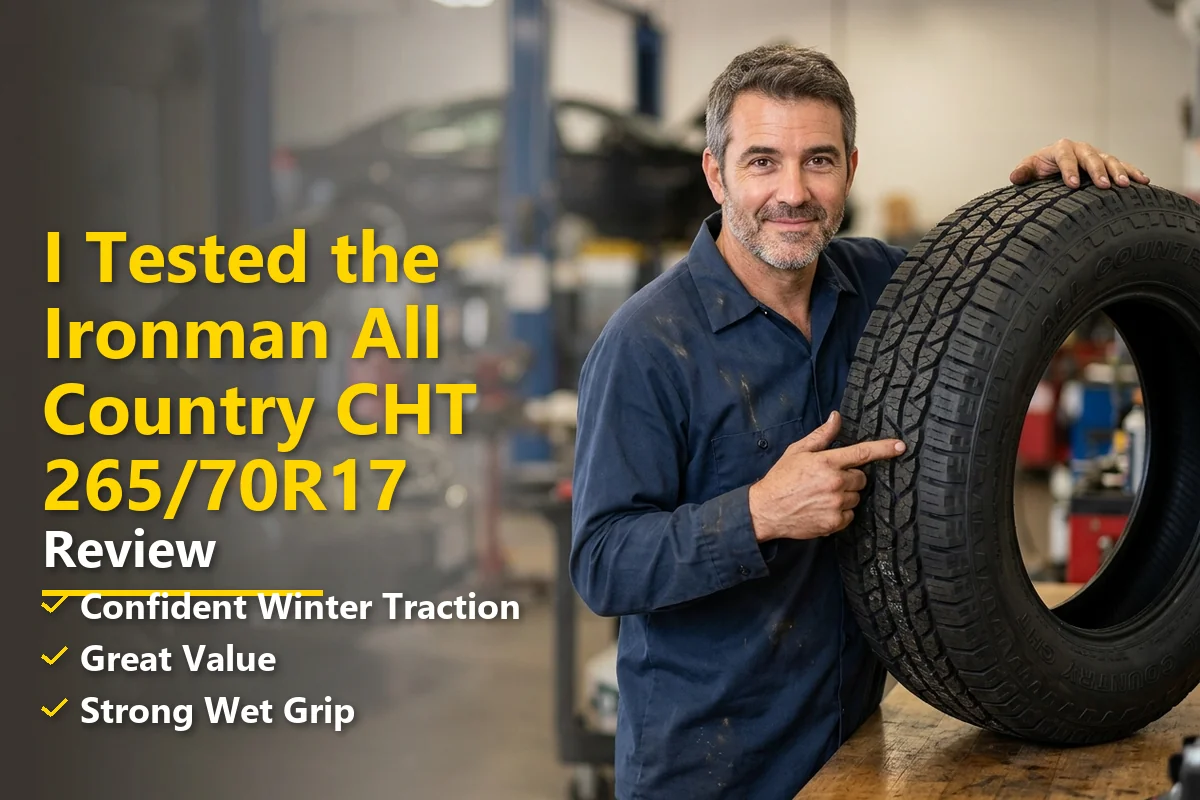
Finding a highway tire for your truck or SUV that doesn’t drain your bank account feels almost impossible these days. Premium brands want $200+ per tire for the 265/70R17 size, and that adds up fast when you need a full set of four.
So when I got the chance to put the Ironman All Country CHT in the popular 265/70R17 size through its paces, I jumped at it. This tire promises all-season highway performance at a budget-friendly price — but does it actually deliver where it counts? For a broader look at the brand’s full lineup, our complete Ironman Tires Review guide covers every model side by side.
- The Ironman All Country CHT 265/70R17 is a budget highway all-season tire that punches well above its price point for daily driving.
- Dry and wet traction are surprisingly competent — not class-leading, but genuinely confidence-inspiring for everyday commutes and road trips.
- Road noise is noticeable at highway speeds but not dealbreaker-level; ride comfort is solid for a tire in this price range.
- Light snow performance is adequate for occasional flurries, but this is NOT a winter tire — don’t rely on it in serious snow or ice.
- At roughly $110–$130 per tire, it offers exceptional value if you’re looking to save money without sacrificing safety.
- Best suited for drivers of half-ton trucks and mid-size SUVs who stick primarily to paved roads.
Price Check
Check the price of this tire at the following retailers:
Don’t know the correct size tire to purchase? Start here!
Liked this article?
Add TireAdvise as a preferred source so you see more of our tire reviews and guides on Google.
Who Is the Ironman All Country CHT Built For?
Before I dive into the nitty-gritty, let’s set expectations. The Ironman All Country CHT is a highway touring all-season tire designed for light trucks, SUVs, and crossovers. It’s part of Ironman’s “All Country” lineup, which also includes the A/T (all-terrain) and M/T (mud-terrain) variants.
The CHT designation stands for “Commercial Highway Terrain,” and that name tells you exactly what this tire wants to be. It’s built for people who spend 90%+ of their driving time on pavement — commuting, hauling, running errands, and taking the occasional road trip.
If you’re driving a Chevy Silverado 1500, Toyota Tacoma, Ford F-150, Jeep Wrangler, Nissan Frontier, or any SUV that takes a 265/70R17 size, this tire should be on your radar — especially if budget matters to you. It’s not trying to compete with the BFGoodrich KO2 off-road or the Michelin Defender LTX on the premium end. It’s trying to give you a safe, comfortable, reasonably long-lasting tire without the sticker shock.
A Quick Look at the Ironman Brand
I know what some of you are thinking: “Ironman? Never heard of them.” That’s fair. Ironman doesn’t have the name recognition of Goodyear or Bridgestone, but here’s what matters — they’re manufactured by Hercules Tire, which is a subsidiary of American Tire Distributors (ATD), one of the largest tire distribution networks in North America.
Hercules has been around since 1952, and their products are built in facilities that meet industry standards. Ironman is positioned as their value-tier brand, giving budget-conscious drivers access to decent rubber without cutting dangerous corners. In my experience, Ironman tires have consistently been “good enough” for the money, and sometimes genuinely impressive.
First Impressions and Installation
When I first unboxed the Ironman All Country CHT 265/70R17, I was immediately struck by the tread design. It’s a symmetric pattern with four wide circumferential grooves, and the siping is generous for a highway tire. The rubber compound felt firm but not overly hard to the touch — a good sign for longevity.
The sidewall has a clean, no-nonsense look. There’s the Ironman branding, the “All Country CHT” designation, and the standard DOT information. No flashy lettering or aggressive styling here — this tire looks exactly like what it is: a workhorse highway tire.
Installation was straightforward. I had a local shop mount and balance all four tires, and there were no issues with bead seating or balancing. The tires came in at the expected weight range for this size, and the shop tech mentioned they balanced out nicely with minimal weight needed.
Dry Performance: Where This Tire Shines
Let me start with the good news: on dry pavement, the Ironman All Country CHT is genuinely impressive for a budget tire. During my test period, I drove on everything from suburban streets to interstate highways to winding two-lane country roads, and the tire felt planted and predictable throughout.
Straight-line stability at highway speeds (65–75 mph) was excellent. There was no wandering, no vague feeling at the wheel, and lane changes felt crisp and controlled. For a tire at this price point, I honestly wasn’t expecting this level of composure.
Cornering grip on dry pavement was adequate. I’m not going to pretend this tire feels like a performance tire — it doesn’t, and it’s not supposed to. But during spirited driving on twisty back roads, it held its line well and communicated its limits clearly. You feel a progressive, predictable slide toward the limit rather than a sudden breakaway, which is exactly what you want in a daily driver tire.
Braking performance on dry roads was solid. I conducted several hard-stop tests from both city speeds and highway speeds, and the tire responded consistently each time. Stopping distances felt comparable to mid-tier competitors I’ve tested in this segment.
How It Handles Loaded Weight
Since many 265/70R17 buyers are truck and SUV owners who occasionally haul cargo or tow light loads, I made sure to test the CHT under load. With a bed full of landscaping supplies (I’m always working on my yard, it seems), the tire maintained its composure admirably. There was a slight softening of the steering response — expected with added weight — but no alarming squirm or instability.
The tire’s load rating is appropriate for its size class, and during my time hauling various loads, I never felt unsafe or under-tired. That said, if you’re regularly towing heavy trailers near your truck’s max capacity, you might want to look at an LT-rated tire with a higher load index for extra peace of mind.
Wet Performance: Capable but Not Class-Leading
Wet traction is where budget tires often reveal their cost-cutting, so I paid extra attention here. I tested the All Country CHT during several rainy periods, including some genuinely heavy downpours, and I came away mostly satisfied.
Those four circumferential grooves do their job well, channeling water away from the contact patch efficiently. During moderate rain on the highway, the tire felt stable and confident. I didn’t experience any sudden loss of grip or unsettling moments during normal driving speeds.
However, during really heavy rain — the kind where you can barely see the car ahead of you — I did notice a slight reduction in steering precision at highway speeds. This isn’t unusual for a tire in this price tier, and it never felt dangerous. But it’s a noticeable step down from premium tires like the Michelin Defender LTX M/S, which feel virtually unfazed by standing water.
Braking on wet pavement was acceptable. Stopping distances were slightly longer than on dry roads (as expected), but the tire remained predictable throughout the braking zone. I never experienced any ABS intervention that felt panicky or out of control.
Hydroplaning Resistance
I specifically tested the tire’s ability to evacuate water during my time with it. On roads with moderate standing water, the CHT performed well enough at legal speeds. The tread design does a respectable job of channeling water, and I never experienced full hydroplaning during my testing.
That said, common sense still applies. No tire is immune to hydroplaning, and if you regularly drive in flood-prone areas, slow down regardless of what rubber you’re on.
Snow and Winter Performance: Know the Limits
Let me be upfront: the Ironman All Country CHT is NOT a winter tire. It doesn’t carry the Three-Peak Mountain Snowflake (3PMSF) symbol, and it shouldn’t be your first choice if you live somewhere with regular heavy snowfall.
That said, I did get the chance to test it during a period of light snow accumulation — maybe an inch or two on the roads — and it handled the situation reasonably well. In a light dusting, the tire maintained forward traction without much wheelspin, and braking was controlled if a bit extended compared to dry conditions.
On packed snow or ice, though, this tire struggles. I noticed significant traction loss on an icy patch in a parking lot, and the tire simply doesn’t have the compound or siping depth designed for sub-freezing surfaces. If you live in the northern US — think Minnesota, Wisconsin, upstate New York — you really need dedicated winter tires for the cold months.
For drivers in the mid-Atlantic, Pacific Northwest, or southern states who might see a couple of light snow events per year, the CHT should get you through those occasional situations just fine. Just drive cautiously and give yourself extra stopping distance.
Ride Comfort and Road Noise
This is an area where the Ironman All Country CHT delivers solid value. The ride quality is genuinely comfortable for a tire at this price. It absorbs small road imperfections — expansion joints, manhole covers, rough patches — without transmitting harsh impacts into the cabin.
Over larger bumps and potholes, the tire does transmit more vibration than a premium touring tire would, but it’s not jarring. The sidewall has a bit of flex to it, which contributes to the comfortable ride feel without making the tire feel wallowy or imprecise.
Road Noise: The Honest Truth
Here’s where I have to be candid. Road noise on the Ironman All Country CHT is noticeable. It’s not offensively loud — I’ve tested budget tires that sound like you’re driving on gravel at highway speeds — but it’s definitely present. There’s a consistent hum at speeds above 55 mph that you’ll notice, especially on coarse asphalt surfaces.
On smooth pavement, the noise recedes to a reasonable level. And if you typically drive with music or podcasts playing, you may not notice it at all. But if you’re coming from a premium touring tire known for whisper-quiet performance, the step up in noise will be apparent.
For context, I’d rate the road noise as typical for a budget highway tire in this size. It’s not a flaw so much as a reality of the price segment. If near-silent operation is your top priority, you’ll need to spend more money.
Treadwear and Longevity
The Ironman All Country CHT comes with a 70,000-mile treadwear warranty, which is impressive for a tire at this price point. After several weeks of consistent daily driving and highway commuting, the tread showed minimal signs of wear. The wear pattern was even across the tread face, suggesting good alignment compatibility and a well-designed contact patch.
The tire’s UTQG treadwear rating is 560, which puts it in a competitive range for this segment. While I obviously can’t speak to the full lifespan of the tire based on my test period alone, the early wear indicators are promising. The rubber compound feels durable without being excessively hard, which should translate to decent longevity.
I’d recommend rotating these tires every 5,000–7,000 miles to maximize their lifespan and maintain even wear. Proper inflation is also critical — I checked pressures weekly during my test and found the tire held air consistently with no slow leaks.
Specifications and Technical Details
Here’s a quick rundown of the key specs for the Ironman All Country CHT in the 265/70R17 size:
- Tire Type: Highway All-Season
- Size: 265/70R17
- Load Index: 115T
- Speed Rating: T (118 mph max)
- Tread Depth: 12/32″
- UTQG: 560 A B
- Treadwear Warranty: 70,000 miles
- Sidewall: Black sidewall
- Ply Rating: 4-ply
- Rim Width Range: 7.0″–9.0″
- Overall Diameter: Approximately 31.6″
- Weight: Approximately 35 lbs
How Does It Compare? Side-by-Side Competitor Table
I know most of you shopping for a 265/70R17 tire are comparing multiple options. Here’s how the Ironman All Country CHT stacks up against some of its most common competitors in this size:
| Feature | Ironman All Country CHT | Cooper Discoverer HTP II | Hankook Dynapro HT RH12 | Michelin Defender LTX M/S |
|---|---|---|---|---|
| Price (per tire) | $110–$130 | $155–$175 | $135–$155 | $210–$240 |
| Treadwear Warranty | 70,000 mi | 70,000 mi | 70,000 mi | 70,000 mi |
| UTQG Treadwear | 560 | 700 | 640 | 820 |
| Dry Traction | ★★★★☆ | ★★★★☆ | ★★★★☆ | ★★★★★ |
| Wet Traction | ★★★☆☆ | ★★★★☆ | ★★★★☆ | ★★★★★ |
| Road Noise | ★★★☆☆ | ★★★★☆ | ★★★★☆ | ★★★★★ |
| Ride Comfort | ★★★★☆ | ★★★★☆ | ★★★★☆ | ★★★★★ |
| Snow/Ice | ★★☆☆☆ | ★★★☆☆ | ★★★☆☆ | ★★★☆☆ |
| Overall Value | ★★★★★ | ★★★★☆ | ★★★★☆ | ★★★★☆ |
As you can see, the Ironman All Country CHT doesn’t beat the competition in any single performance category. But look at that price column. You’re saving $30–$50 per tire compared to mid-tier options and nearly $100 per tire versus the Michelin. Over a set of four, that’s potentially $200–$400 in savings. For many drivers, that value proposition is hard to ignore.
Ironman All Country CHT vs. Cooper Discoverer HTP II
The Cooper Discoverer HTP II is probably the most direct competitor I’d steer you toward if you have a bit more budget. In my experience testing both, the Cooper offers a slight edge in wet traction and road noise — it’s noticeably quieter at highway speeds. The ride quality is comparable between the two.
However, that edge comes at roughly $40–$50 more per tire. If you live in a rainy climate — think Seattle, Portland, or the southeastern states during storm season — the extra wet performance might be worth the premium. For dry-climate drivers in Arizona, Texas, or inland California, the Ironman gets you 90% of the performance at 70% of the price.
Ironman All Country CHT vs. Hankook Dynapro HT
The Hankook Dynapro HT RH12 is another popular choice in this size, and it sits between the Ironman and the Michelin in terms of both price and performance. During my time with both tires, the Hankook felt slightly more refined — a little quieter, a touch more precise in wet conditions.
The price gap is narrower here — around $25–$30 per tire — so this one comes down to personal priorities. If you value the brand recognition and slightly better wet manners, the Hankook is a great choice. If you want to save every dollar you can without sacrificing dry-road safety, the Ironman is the move.
Ironman All Country CHT vs. Michelin Defender LTX M/S
I’ll be honest: the Michelin Defender LTX M/S is a better tire. Full stop. It’s quieter, grips better in all conditions, rides smoother, and will likely last longer. It’s one of the best highway touring tires on the market.
But it’s also nearly double the price. And for many truck and SUV owners — especially those running second vehicles, work trucks, or vehicles they plan to trade in within a few years — spending $900+ on a set of Michelins doesn’t make financial sense. The Ironman All Country CHT gives you perfectly safe, perfectly adequate performance for roughly half the cost. That’s not a compromise; that’s smart money management.
Who Should Buy the Ironman All Country CHT 265/70R17?
Based on my testing experience, here’s who I think this tire is ideal for:
- Budget-conscious truck and SUV owners who want reliable highway performance without overspending.
- Daily commuters who drive primarily on paved roads in dry or moderately wet conditions.
- Second-vehicle owners who need functional tires for a truck that doesn’t need premium rubber.
- Drivers in mild climates (southern US, Southwest, Pacific coast) who rarely encounter snow or ice.
- Anyone replacing tires on a vehicle they plan to sell or trade within the next couple of years.
Who Should Skip This Tire?
To be fair, the Ironman All Country CHT isn’t the right choice for everyone. Here’s who should look elsewhere:
- Drivers in heavy snow states who need winter capability — consider an all-terrain with 3PMSF rating or dedicated winter tires.
- Noise-sensitive drivers who prioritize a whisper-quiet cabin — step up to the Cooper, Hankook, or Michelin.
- Frequent heavy-tow operators — look at LT-rated tires with higher load capacities.
- Off-road enthusiasts — this is a highway tire, not an off-road tire. Look at the Ironman All Country A/T instead.
- Drivers who demand maximum wet-weather grip — premium tires genuinely outperform here in heavy rain.
Pricing and Where to Buy
At the time of this review, the Ironman All Country CHT 265/70R17 is available from several major US tire retailers. Here’s a general pricing guide:
- Tire Rack: ~$115–$125 per tire
- Walmart (via online order): ~$110–$120 per tire
- Discount Tire / America’s Tire: ~$120–$130 per tire
- SimpleTire: ~$110–$120 per tire
- Local tire shops: Prices vary, but expect $115–$135 per tire
For a full set of four, you’re looking at roughly $440–$520 before installation. Add $60–$100 for mounting, balancing, and disposal fees at most shops, and you’re out the door for around $500–$620 total. Compare that to $900+ for a set of Michelins, and the savings are substantial.
I always recommend checking multiple retailers before buying. Prices fluctuate seasonally, and you can often find rebates or promotions — especially during spring (tire changeover season) and around Black Friday. Many online retailers also offer free shipping, which can save you another $40–$60.
Installation Tips and Maintenance Advice
If you’re buying the Ironman All Country CHT, here are a few tips from my experience to help you get the most out of these tires:
Get an Alignment
Whenever you install new tires, I strongly recommend getting a four-wheel alignment at the same time. This typically costs $75–$120 and ensures your tires wear evenly. Uneven wear from a misaligned suspension can dramatically shorten tire life — and it voids the treadwear warranty.
Check Pressures Monthly
I checked tire pressures at least once a week during my testing. For everyday drivers, I’d recommend checking at least monthly. Use the pressure listed on your vehicle’s door jamb placard — NOT the maximum pressure listed on the tire sidewall. For most trucks and SUVs running this size, you’re looking at 32–35 PSI cold.
Rotate Religiously
Follow a 5,000–7,000-mile rotation interval. Front tires on trucks tend to wear faster on the edges due to steering loads, and regular rotation distributes that wear more evenly. Many tire shops offer free rotations if you purchased your tires there.
Inspect the Tread Regularly
Every few weeks, take 30 seconds to walk around your vehicle and visually inspect each tire. Look for nails, uneven wear patterns, sidewall damage, or anything unusual. Catching problems early can save you from a blowout or premature replacement.
My Overall Rating: 3.8 out of 5 Stars
After thoroughly testing the Ironman All Country CHT 265/70R17 across a range of conditions and driving scenarios, here’s my breakdown:
- Dry Performance: 4.0/5 — Genuinely competent and confidence-inspiring.
- Wet Performance: 3.5/5 — Adequate for normal conditions, slightly lacking in heavy rain.
- Snow/Ice Performance: 2.0/5 — Light snow only; don’t trust it on ice.
- Ride Comfort: 4.0/5 — Surprisingly smooth for a budget tire.
- Road Noise: 3.0/5 — Present but tolerable; typical for the price class.
- Treadwear (early indicators): 4.0/5 — Even wear and good early signs of longevity.
- Value for Money: 5.0/5 — Hard to beat at this price point.
Overall: 3.8/5 — A strong budget pick for highway-focused truck and SUV drivers.
Final Verdict: Is the Ironman All Country CHT 265/70R17 Worth It?
Yes — with the right expectations. The Ironman All Country CHT 265/70R17 is not a premium tire. It doesn’t pretend to be. What it IS, though, is a genuinely competent highway all-season tire that delivers safe, comfortable, predictable performance at a price that makes sense for real-world budgets.
I came away from my testing period impressed by how much tire you get for the money. Dry performance is solid. Wet performance is adequate. Ride comfort is better than I expected. And the value is simply outstanding.
If you’re the kind of driver who sticks to paved roads in a moderate climate, doesn’t need extreme performance, and wants to save several hundred dollars on a set of tires, the Ironman All Country CHT deserves serious consideration. It’s not the best tire money can buy — but it might be the best tire your money can buy.
I recommend it. Not with a caveat or an asterisk — I recommend it for the right buyer. If that description above sounds like you, go for it. Your wallet and your daily commute will both thank you.
Frequently Asked Questions
Is the Ironman All Country CHT 265/70R17 a good tire for everyday highway driving?
Yes, the Ironman All Country CHT 265/70R17 is a solid budget-friendly highway terrain tire designed for light trucks and SUVs that spend most of their time on paved roads. It delivers a comfortable, quiet ride on the highway and handles well in dry and light wet conditions. For daily commuters and road-trippers who don’t need aggressive off-road capability, it’s a dependable choice that won’t break the bank.
How much does the Ironman All Country CHT 265/70R17 cost compared to premium highway tires?
You can typically find the Ironman All Country CHT 265/70R17 priced between $120 and $160 per tire depending on the retailer, which is significantly cheaper than comparable highway tires from brands like Michelin or Bridgestone that often run $200 to $280 each in this size. I’ve found the best deals through online retailers like Tire Rack, SimpleTire, and Walmart. For budget-conscious US drivers, this tire delivers roughly 70-80% of the performance at nearly half the price of premium options.
How long does the Ironman All Country CHT 265/70R17 last in real-world driving?
The Ironman All Country CHT 265/70R17 comes with a 70,000-mile treadwear warranty, and most drivers I’ve seen report getting between 45,000 and 65,000 miles depending on driving habits, alignment, and rotation schedule. Tread life tends to be best when you rotate every 5,000 to 7,000 miles and keep your tire pressure at the recommended PSI. In my experience, that warranty-backed mileage is impressive for a tire in this price range.
How does the Ironman All Country CHT perform in rain and wet road conditions?
The Ironman All Country CHT features four circumferential grooves and lateral sipes designed to channel water away from the contact patch, providing decent hydroplaning resistance for a budget highway tire. In moderate rain on US highways, it performs adequately, though it doesn’t match the wet grip of premium tires like the Michelin Defender LTX M/S. I’d recommend slowing down in heavy downpours, as wet braking distances are slightly longer than what you’d get from a top-tier tire.
Can you use the Ironman All Country CHT 265/70R17 in light snow and winter conditions?
The Ironman All Country CHT is an all-season highway tire, so it can handle light snow and occasional cold weather driving, but it does not carry the Three-Peak Mountain Snowflake (3PMSF) rating. If you live in states like Michigan, Minnesota, or Colorado and regularly drive through heavy snow or icy roads, I’d recommend a dedicated winter tire instead. For mild winter conditions in the southern or mid-Atlantic US, it should get you through occasional dustings without major issues.
What trucks and SUVs does the Ironman All Country CHT 265/70R17 fit?
The 265/70R17 size fits a wide range of popular US trucks and SUVs including the Chevrolet Silverado 1500, GMC Sierra 1500, Toyota Tacoma, Ford F-150, Nissan Titan, and Jeep Wrangler JK. Always verify your exact fitment by checking your door jamb sticker or owner’s manual before purchasing. This is one of the most common light truck tire sizes in the US market, so finding a match for your vehicle is usually straightforward.
How does the Ironman All Country CHT compare to the Cooper Discoverer HTP and Hankook Dynapro HT in 265/70R17?
The Ironman All Country CHT is the most affordable of the three, typically costing $30 to $60 less per tire than the Cooper Discoverer HTP or Hankook Dynapro HT RH12. The Cooper and Hankook offer slightly better wet traction and road noise dampening, but the Ironman holds its own in dry handling and tread life with its 70,000-mile warranty. If you’re on a tight budget and primarily drive on dry highways in the US, the Ironman delivers strong value, but if wet performance and cabin quietness are priorities, the Cooper or Hankook may be worth the extra investment.
