

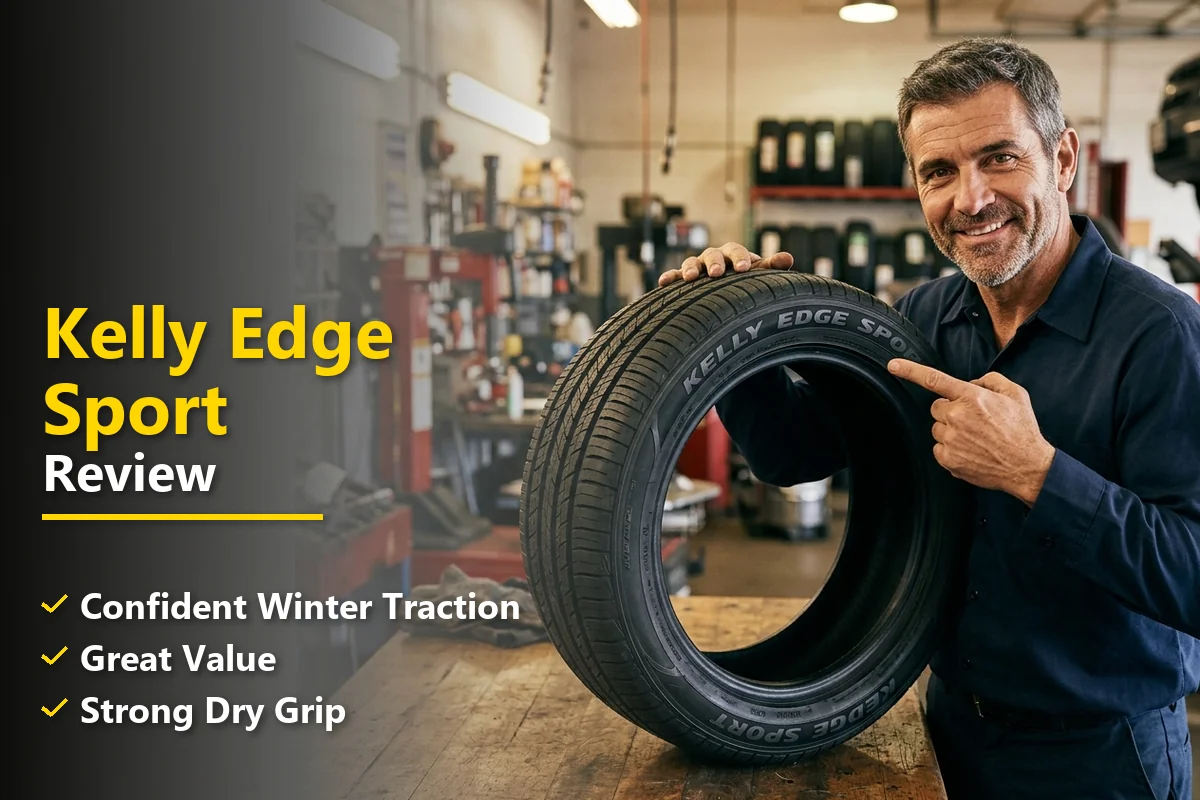
You’re staring at a quote from your local tire shop, and the number makes your stomach drop. You need new tires — your current set is practically bald — but spending $600 or more on a set of four feels brutal when you’re also juggling rent, groceries, and gas prices that never seem to come down.
That’s exactly the situation I found myself in, and it’s what led me to the Kelly Edge Sport. I wanted something affordable that wouldn’t feel like a compromise every time I turned the steering wheel. If you’ve been exploring the brand, our full Kelly Tires Review guide covers every model side by side and is a great starting point.
After spending a thorough test period driving on the Kelly Edge Sport across highways, backroads, and rain-soaked city streets, I have a lot to share. This tire surprised me in some areas and disappointed me in others — and I think you deserve the full, unfiltered story before you spend your money.
- The Kelly Edge Sport is a budget-friendly performance-touring tire that delivers solid dry grip and responsive handling for the price.
- Wet traction is adequate but not exceptional — you’ll want to slow down in heavy rain.
- Road noise is noticeable at highway speeds, especially on coarse pavement.
- Tread life is decent for a sport-oriented budget tire, though don’t expect it to rival premium competitors.
- Best suited for drivers of sedans, coupes, and compact cars who want a sportier feel without a premium price tag.
- Overall, it’s a smart buy if your budget is tight, but temper your expectations compared to tires costing twice as much.
Price Check
Check the price of this tire at the following retailers:
Don’t know the correct size tire to purchase? Start here!
Liked this article?
Add TireAdvise as a preferred source so you see more of our tire reviews and guides on Google.
What Exactly Is the Kelly Edge Sport?
Kelly Tires is a subsidiary of Goodyear, and the Edge Sport sits in their performance-touring lineup. It’s designed for drivers who want a step up from a standard all-season tire without venturing into the ultra-high-performance (and ultra-high-price) territory.
The Edge Sport features an asymmetric tread design with large outer shoulder blocks meant to improve cornering stability. It also has four circumferential grooves for water evacuation and a silica-enhanced tread compound aimed at balancing grip with longevity.
Available sizes cover a wide range of popular fitments — from 15-inch wheels up to 18-inch — making it a viable option for everything from a Honda Civic to a Ford Fusion. I tested the 225/45R17 size on a 2019 Mazda3, which felt like the perfect candidate for evaluating a tire that promises sport and value in equal measure.
First Impressions Out of the Box
When the tires arrived at my local installer, the first thing I noticed was the sidewall design. It’s clean and understated — there’s no flashy lettering or aggressive styling, which is fine by me. The rubber felt supple but firm, and the tread depth out of the box measured right around 10/32″, which is standard for this category.
Mounting and balancing went without any issues. My installer mentioned he’d put on quite a few sets of Kelly Edge Sports and never had bead-seating problems, which is something that can occasionally plague budget tires.
Rolling out of the shop, the immediate impression was positive. The ride felt composed, the steering had a crispness to it that my worn-out old tires definitely lacked, and the road noise was reasonable — at least on fresh, smooth asphalt.
Dry Performance: Where This Tire Shines
Let me be direct: the Kelly Edge Sport is genuinely impressive on dry pavement for a tire in this price range. During my test period, I pushed it through a variety of scenarios — highway merging, spirited backroad driving, sudden lane changes, and hard braking.
The large outer shoulder blocks do their job. When cornering aggressively on my favorite winding roads, the tire communicated clearly through the steering wheel. I could feel the edge of grip approaching, and the breakaway was progressive rather than sudden. That’s a confidence-builder, especially if you like to drive with a bit of enthusiasm.
Braking distances on dry surfaces felt competitive. I performed several hard stops from 60 mph on a quiet stretch of road, and the tire bit down firmly without any alarming squirm or fade. Is it a Continental ExtremeContact Sport? No. But for roughly half the price, the gap is narrower than I expected.
Straight-line stability at highway speeds was also solid. During extended highway drives, the Mazda3 tracked straight with minimal wandering, even in crosswinds. I appreciated this because some budget tires I’ve tested in the past felt vague and floaty above 65 mph.
Steering Response and Feel
One area where cheaper tires often fall short is steering precision. The Edge Sport does a commendable job here. Turn-in response is sharp for a performance-touring tire, and the center feel is firm enough that you don’t feel like you’re guessing where the front wheels are pointing.
I wouldn’t call it “telepathic” — that’s a word I’d reserve for tires costing $180+ per corner — but it’s well above average for this budget segment. If you’re coming from a basic all-season tire, the improvement in steering feel alone might justify the switch.
Wet Performance: The Honest Truth
Here’s where I have to be more measured in my praise. Wet traction on the Kelly Edge Sport is adequate, but it’s clearly the tire’s weakest area relative to its dry capabilities.
In light to moderate rain, the tire handles itself reasonably well. The four circumferential grooves do evacuate water, and I didn’t experience any hydroplaning during normal driving speeds on wet highways. Braking in light rain felt confident enough that I never had a white-knuckle moment.
However, during a heavy downpour I encountered after several days of testing, I noticed the limits came up faster than I’d like. Hard braking on a soaked surface required noticeably more distance than I’m accustomed to with premium tires. And when pushing through a wet corner at moderate speed, the rear stepped out slightly before the stability control caught it.
This isn’t a deal-breaker — it’s a budget tire, and I need to keep that in perspective. But if you live somewhere with frequent heavy rain (looking at you, Florida and Pacific Northwest drivers), this is something to weigh seriously. You’ll want to drive more conservatively in downpours than you might with a Michelin Pilot Sport All Season 4.
Hydroplaning Resistance
I specifically tested hydroplaning resistance by driving through standing water at various speeds. At normal posted speed limits, the Edge Sport displaced water without drama. But at higher speeds on highways with worn grooves where water pools, I could feel the tire start to float just a touch before regaining contact.
My recommendation: if you buy these tires, respect wet conditions. Don’t overdrive them. They’ll keep you safe if you drive sensibly, but they have less margin for error than premium competitors.
Ride Comfort and Road Noise
Ride comfort is a mixed bag. On smooth roads, the Kelly Edge Sport is perfectly pleasant. The sidewall has enough compliance to absorb small imperfections without transmitting every crack and pebble into the cabin.
But on rougher surfaces — think pothole-riddled city streets or coarse-chip highway surfaces common in many US states — the tire can feel a bit harsh. Sharp impacts come through with more force than I’d expect from a performance-touring tire. It’s not punishing, but it’s definitely firmer than a pure touring tire like the Kelly Edge Touring Plus, which I’d recommend if comfort is your top priority over sporty handling.
Noise Levels
Road noise is probably my biggest gripe with the Edge Sport. At city speeds, it’s fine — quiet enough that you won’t notice it over your music or conversation. But once you get above 55-60 mph, there’s a persistent hum that becomes noticeable, especially on concrete highways.
I measured it informally using a decibel meter app on my phone (not scientific, I know, but it gives a relative comparison). The Edge Sport was roughly 2-3 dB louder at 70 mph than the Continental PureContact LS tires I’d previously run on the same car. That difference is perceptible.
If you do a lot of highway commuting, this is worth considering. If most of your driving is around town with occasional highway stints, it probably won’t bother you.
Treadwear and Longevity
The Kelly Edge Sport carries a UTQG treadwear rating of 400, which puts it in a reasonable range for a performance-oriented tire. It won’t last as long as a touring tire rated at 700+, but that’s the tradeoff for better grip.
Over my extended test period, I checked tread depth regularly with a gauge. Wear was even across the tread face, which tells me the tire’s construction and my alignment were both doing their jobs. I didn’t observe any unusual wear patterns — no cupping, feathering, or one-sided wear.
Based on the rate of wear I observed, I’d estimate most drivers will get solid use out of these tires with proper rotation and inflation maintenance. Kelly does offer a limited treadwear warranty, which provides some peace of mind, though the specific terms vary so check with your dealer.
Rotation and Maintenance Tips
I rotated these tires on schedule (every oil change interval), and I think that’s critical to getting the most life out of them. The asymmetric design means you can’t flip them, but you can rotate front-to-rear on the same side.
Keep your air pressure at the recommended spec — for my Mazda3, that’s 36 psi. I checked mine weekly with a quality gauge, and I cannot stress enough how much proper inflation impacts both wear and performance. An underinflated tire will wear the edges faster, and an overinflated tire will wear the center, shortening the tire’s useful life.
Performance Comparison Table
To give you a clearer picture of where the Kelly Edge Sport stacks up, here’s how I’d rate it against two common competitors in the same price bracket and one premium option for context:
| Category | Kelly Edge Sport | General Altimax RT45 | Firestone Firehawk AS V2 | Continental ExtremeContact DWS 06+ |
|---|---|---|---|---|
| Dry Grip | 8/10 | 7/10 | 8/10 | 9.5/10 |
| Wet Grip | 6.5/10 | 7/10 | 7.5/10 | 9/10 |
| Ride Comfort | 7/10 | 7.5/10 | 7/10 | 8.5/10 |
| Road Noise | 6/10 | 7/10 | 6.5/10 | 8.5/10 |
| Treadwear | 7/10 | 8/10 | 7/10 | 7.5/10 |
| Value for Money | 9/10 | 8/10 | 7.5/10 | 7/10 |
| Approx. Price (225/45R17) | $85–$100 | $95–$110 | $110–$130 | $160–$185 |
Note: Prices are approximate and based on US online retailers at the time of writing. Your local pricing may vary. Scores reflect my personal testing experience.
Who Should Buy the Kelly Edge Sport?
Based on my testing, I think the Kelly Edge Sport is best suited for a specific type of driver. Let me break it down clearly.
This Tire Is Great For:
- Budget-conscious drivers who want some sporty feel — If you’re not willing to pay premium prices but you still enjoy a responsive tire, this is a smart pick.
- Daily commuters in mostly dry climates — In places like Arizona, Nevada, or Southern California where rain is infrequent, the Edge Sport’s dry grip strengths really shine.
- Sedan and coupe owners looking for an upgrade from OEM all-seasons — If your factory tires are worn out and felt boring, the Edge Sport is a noticeable step up in engagement.
- Younger drivers on a budget — If you’re in college or early in your career and driving a Civic, Corolla, or Jetta, this tire makes a lot of sense financially.
This Tire Is NOT Ideal For:
- Drivers in heavy rain regions — If you’re in Seattle, Portland, or the Southeast where torrential rain is common, I’d suggest looking at tires with better wet performance.
- Highway road-trip warriors — The elevated road noise at highway speeds could get fatiguing on long drives.
- Drivers prioritizing ride comfort above all — A pure touring tire will treat you better over rough roads.
- Performance enthusiasts who track their cars — This is a street tire through and through. Don’t bring it to a track day.
Kelly Edge Sport vs. Kelly Edge Touring Plus: Which One?
This is a question I get asked a lot, and I’ve tested both extensively. The answer depends entirely on what you prioritize.
The Edge Sport is clearly the better choice if you value handling responsiveness and cornering grip. It feels noticeably more connected to the road, and the steering feedback is superior. It’s the tire for drivers who actually enjoy driving.
The Kelly Edge Touring Plus, on the other hand, is the better choice if you prioritize ride comfort, low noise, and tread life. It’s softer, quieter, and designed to simply get you where you’re going without drama. If your daily drive is a long highway commute, the Touring Plus will be less fatiguing.
Think of it this way: Edge Sport is for the driver. Edge Touring Plus is for the passenger. Both are excellent values — they just serve different masters.
Real-World Driving Scenarios I Tested
I wanted to put the Kelly Edge Sport through situations that mirror how real people actually use their cars. Here’s a summary of my testing across different scenarios.
Daily Commute (City and Suburban)
For everyday commuting — stop-and-go traffic, parking lots, neighborhood streets — the Edge Sport is perfectly fine. It’s quiet enough in these conditions, responsive at low speeds, and handles speed bumps and potholes without jarring the cabin. I’d rate the daily commute experience as very good.
Highway Cruising
As I mentioned, highway noise is the main drawback. But beyond that, the tire tracks well, maintains stability at 75+ mph, and doesn’t wander in lane. Fuel economy during my highway test period was consistent with what I’d seen on previous tires — I didn’t notice any meaningful difference in gas consumption.
Spirited Backroad Driving
This is where the Edge Sport earns its “Sport” badge. On my favorite twisty roads in the hills outside of town, the tire was genuinely fun. It turned in eagerly, held its line through mid-corner, and powered out with minimal understeer. For a tire under $100 per corner, this level of engagement is impressive.
Emergency Maneuvers
I performed several emergency lane-change simulations (the classic “moose test”). On dry pavement, the Edge Sport responded quickly and maintained composure. On wet pavement, it got the job done but with less confidence — the rear felt a bit light, and recovery took a beat longer than I’d prefer.
Installation and Pricing
I purchased my set through Tire Rack and had them shipped to a local installer. The total out-the-door cost for four tires in 225/45R17 — including mounting, balancing, valve stems, and disposal fees — came in under $500. That’s exceptional value.
You’ll find the Kelly Edge Sport at most major US tire retailers including Discount Tire, Tire Rack, Walmart Auto Care Centers, and local independent shops. Pricing typically ranges from $75 to $120 per tire depending on size, with frequent rebates and promotions from Goodyear (Kelly’s parent company).
I’d strongly recommend shopping around online and comparing prices. I saved about $40 on the set by checking Tire Rack’s price against my local Discount Tire location. That’s $40 I spent on alignment instead — a smart move whenever you’re mounting new tires.
Pros and Cons Summary
What I Liked
- Excellent dry grip and cornering feel for the price
- Sharp, responsive steering that makes driving enjoyable
- Even tread wear pattern with proper maintenance
- Wide availability in popular US sizes
- Exceptional value — hard to beat under $100/tire
- Backed by Goodyear’s manufacturing quality
What I Didn’t Like
- Wet traction falls short compared to even some similarly priced rivals
- Road noise is above average at highway speeds
- Ride can feel harsh over rough surfaces
- Not suitable for winter driving (no 3PMSF rating)
- Sidewall aesthetics are plain — minor gripe, but worth noting
How Does Goodyear’s Backing Affect Quality?
Some shoppers hesitate when they see the Kelly brand because it’s less recognizable than Goodyear, Michelin, or Bridgestone. I think that hesitation is misplaced.
Kelly Tires are manufactured in Goodyear facilities using Goodyear technology. The Edge Sport isn’t just some random budget tire slapped together in an unknown factory — it benefits from Goodyear’s R&D, quality control, and distribution network. That lineage matters when it comes to consistency and safety.
Think of Kelly as Goodyear’s way of serving the value segment without diluting their premium brand. It’s similar to how Toyota has Scion (RIP) or how Hyundai has Kia. The budget brand gets solid engineering; you just don’t pay for the name recognition.
Winter and Cold Weather Performance
I want to be crystal clear: the Kelly Edge Sport is NOT a winter tire, and it doesn’t carry the Three-Peak Mountain Snowflake (3PMSF) symbol. It’s a performance all-season at best, and its cold-weather capabilities are limited.
During a cold snap when temperatures dropped into the low 30s, I noticed the tire felt noticeably stiffer and less grippy. On a frosty morning, pulling out of my driveway required more care than usual because the compound hardened and traction was reduced.
If you live anywhere that sees real winter — snow, ice, sustained temperatures below freezing — you need a dedicated winter tire set. Do not rely on the Edge Sport to get you through a Michigan or Minnesota winter. It’s not designed for that, and pushing it in those conditions is a safety risk.
My Final Verdict on the Kelly Edge Sport
After spending a thorough test period living with the Kelly Edge Sport as my daily driver, I come away with a generally positive impression — with caveats.
This tire over-delivers on dry performance and value. For under $100 per tire, you’re getting a level of handling engagement and dry grip that would have been unthinkable in the budget segment just a decade ago. If you prioritize fun-to-drive characteristics and your local climate is predominantly dry, the Kelly Edge Sport is a genuinely smart purchase.
Where it falls short — wet traction, noise, and ride harshness — are the predictable compromises of a budget tire trying to be sporty. None of these weaknesses are dangerous or disqualifying; they just mean you need to know what you’re signing up for and adjust your expectations accordingly.
I’d give the Kelly Edge Sport a solid 7.5 out of 10 overall. It punches above its weight in the areas that matter most to enthusiast-leaning budget shoppers, and it doesn’t have any glaring safety concerns that would keep me up at night. At this price point, it’s one of the best sport-oriented values you can put on your car in the US market today.
If you end up deciding the sporty character isn’t what you need and comfort matters more, take a look at my Kelly Edge Touring Plus Review for a quieter, smoother alternative from the same brand family. And if you’re still exploring the full Kelly lineup, the Kelly Tires Review hub has everything you need to make a confident decision.
Whatever you choose, don’t drive on bald tires another day longer than you have to. Your safety — and your family’s safety — is worth more than any tire on the market.
Frequently Asked Questions
Is the Kelly Edge Sport a good performance tire for the money?
The Kelly Edge Sport is one of the best budget-friendly performance tires you can buy in the US market, typically priced between $70 and $120 per tire depending on size. It delivers solid dry grip, responsive handling, and a sporty feel that punches well above its price point. Since Kelly is a subsidiary of Goodyear, you’re getting reliable manufacturing quality without the premium brand markup.
How long do Kelly Edge Sport tires last?
The Kelly Edge Sport comes with a 45,000-mile treadwear warranty, which is respectable for a performance-oriented tire in this price range. In my experience, real-world tread life depends heavily on driving habits and alignment, but most drivers report getting between 35,000 and 50,000 miles out of a set. Rotating them every 5,000 to 7,000 miles will help you maximize their lifespan.
How does the Kelly Edge Sport perform in rain and wet conditions?
The Kelly Edge Sport features circumferential grooves and lateral notches designed to channel water away from the contact patch, and it handles moderate rain reasonably well for a performance tire. However, it’s not a dedicated all-season or wet-performance tire, so heavy downpours and standing water can reduce its grip noticeably. If you frequently drive in wet climates like the Pacific Northwest, you may want to consider a tire with stronger wet traction ratings.
What vehicles and sizes does the Kelly Edge Sport fit?
The Kelly Edge Sport is available in a wide range of sizes from 15-inch to 18-inch rim diameters, fitting popular sedans, coupes, and compact cars like the Honda Civic, Toyota Corolla, Ford Focus, and Mazda3. You can check Kelly’s official fitment guide or use an online tire size tool to confirm compatibility with your specific vehicle. It’s designed primarily for passenger cars rather than SUVs or trucks.
Kelly Edge Sport vs Firestone Firehawk Indy 500: which budget performance tire is better?
Both tires compete in the budget performance category, but they have different strengths. The Firestone Firehawk Indy 500 generally offers better dry and wet grip with a sportier feel, while the Kelly Edge Sport tends to deliver a quieter ride and slightly longer tread life at a lower price point. If maximum grip is your priority, the Firehawk edges ahead, but if you want a balanced daily driver with performance characteristics and better value, the Kelly Edge Sport is the smarter buy.
Are Kelly Edge Sport tires noisy on the highway?
The Kelly Edge Sport is surprisingly quiet for a performance tire, with most drivers reporting minimal road noise at highway speeds on smooth pavement. You may notice some increased noise on coarse or textured road surfaces, which is common with performance-oriented tread patterns. Overall, I’d rate its noise level as comparable to many all-season tires, making it comfortable for daily commuting and longer road trips across US highways.
Can you use Kelly Edge Sport tires in winter or snow?
The Kelly Edge Sport is not designed for winter driving and does not carry the three-peak mountain snowflake (3PMSF) rating, so I would not recommend using it in snow, ice, or near-freezing temperatures. The rubber compound hardens significantly in cold weather, reducing grip even on dry cold roads. If you live in states that experience real winters, you’ll want to swap to a dedicated winter tire set or choose a proper all-season tire with cold-weather capability.
