

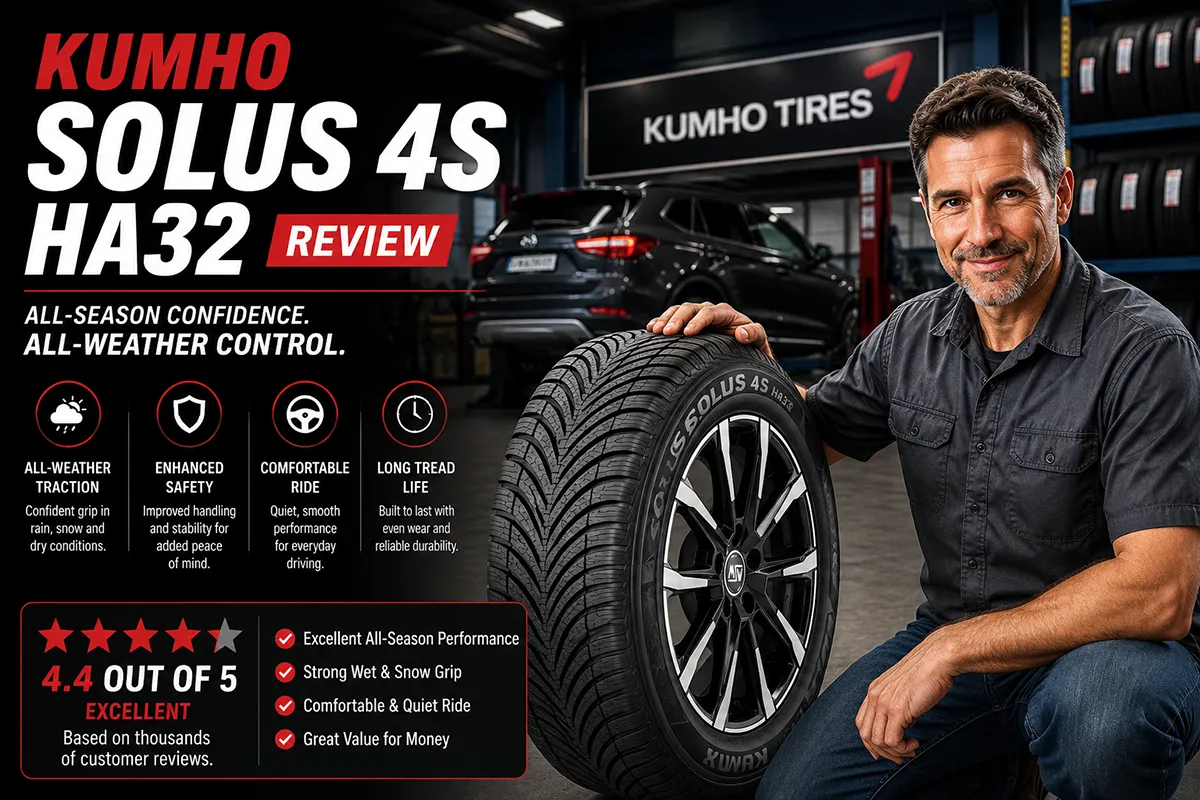
Before anything else: if you’re shopping for the Solus 4S HA32 today, you should know it’s already been succeeded by the HA32+. I want to lead with that, because it changes what you should actually be cross-shopping — and almost nothing else written about this tire mentions it clearly.
- The Solus 4S HA32 is Kumho’s grand touring all-weather tire, launched with a V-shaped directional tread and pine-resin-enhanced compound, carrying the Three-Peak Mountain Snowflake (3PMSF) certification for genuine winter capability.
- It’s been replaced by the Solus 4S HA32+. If you’re buying new today, confirm which version your retailer is actually selling you.
- Independent European lab testing (Auto Bild, aggregated via Tire-Reviews.com) found it posted the lowest wear and best value in its 2021 test group, plus best-in-test noise in 2020 — genuinely strong, verified results.
- The recurring weak spot across independent tests: wet lateral grip, aquaplaning resistance, and dry braking distance, which trail class leaders.
- Real owner reviews are mixed on long-term noise. Several owners report excellent quiet, confident performance; at least one detailed account describes the tire getting noisy and developing vibration as it wore down.
- Price: roughly $130 per tire in common sizes — a real discount against the Michelin CrossClimate2 it’s most often compared to, which runs closer to $180 for the same 60,000-mile warranty.
- My take: a genuinely strong value all-weather tire with real independent data behind it, as long as you go in knowing about the HA32+ and the specific trade-offs below.
Price Check
Check the price of this tire at the following retailers:
TireRack DiscountTire SimpleTire PriorityTire AmazonDon’t know the correct size tire to purchase? Start here!
Liked this article?
Add TireAdvise as a preferred source so you see more of our tire reviews and guides on Google.
What Is the Kumho Solus 4S HA32?
The Solus 4S HA32 is Kumho’s grand touring all-weather tire, developed for drivers of passenger cars, CUVs, and SUVs who want genuine snow capability without switching to dedicated winter tires.
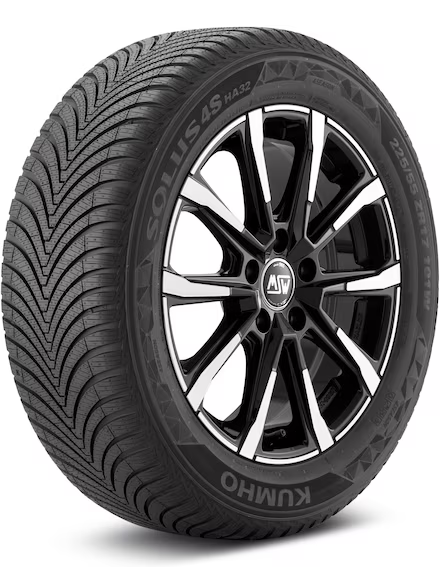
It launched with a V-shaped (chevron) directional tread pattern and wide lateral grooves specifically engineered to resist hydroplaning and improve traction.
It carries the Three-Peak Mountain Snowflake certification, meaning it’s passed a regulated severe-snow traction test — a meaningfully different, higher bar than a standard “all-season” tire clears.
It launched in 26 sizes ranging from 15 to 19-inch rim diameters, and picked up a Red Dot Design Award shortly after release, a real, verifiable international design recognition rather than just marketing language.
The HA32+ — What Actually Changed
This is the single most important thing I can tell you before you buy, and it’s genuinely absent from most coverage of this tire. Kumho has since released the Solus 4S HA32+, which directly replaced the original HA32 in the current lineup.
Independent testing places the HA32+ in similar territory to the original — strong in winter performance (placing in the top five across snow-related tests in one aggregated comparison) and excellent in noise, with recurring weaknesses in dry surface braking and handling precision.
The core engineering philosophy carries forward: this is a tire built around winter and wet-weather confidence first, with dry-condition sharpness as a secondary priority.
What to actually do: if a retailer is selling you a “Solus 4S HA32,” confirm with them directly whether you’re getting the original HA32 or the current HA32+, and check your tire’s specific model designation on the sidewall before installation. Given how often tire lines get quietly refreshed without the marketing name changing dramatically, this is worth a direct question rather than an assumption.
The Technology Behind It
The chevron (inward V-shaped) tread pattern is the tire’s defining engineering choice. The inward-angled grooves create pressure that forces water out from under the contact patch in wet conditions, and in snow, the same geometry lets the tread pack slightly and grip against itself — the same basic principle behind why packed snow offers better traction than a smooth surface.
Kumho uses a pine-resin-enhanced compound in the Solus 4S line, which keeps the rubber more pliable in cold and wet conditions than a standard all-season blend.
That’s also part of why Kumho markets this as an “all-weather” tire rather than simply “all-season” — it’s specifically tuned for light-to-moderate snow, not just extended warm-weather use with occasional cold tolerance.
The HA32+ adds three-dimensional interlocking sipes on top of that foundation, aimed at improving handling and traction specifically in snowy, rainy, and slushy conditions beyond what the original tread pattern delivered alone.
What Independent Lab Testing Actually Shows
I want to ground this review in real, sourced data rather than just repeating marketing claims, so here’s what independent European testing (Auto Bild, aggregated by Tire-Reviews.com) found across multiple test years.
Genuine strengths: the HA32 posted the lowest wear in its test group in 2021 (54,524 km recorded), along with the best value rating in that same test, and best-in-test noise performance in 2020 (70.3 dB). That’s not a marketing claim — it’s a measured result against a full field of competing tires.
Consistent weaknesses: wet lateral grip (handling, circle testing, and aquaplaning resistance) showed up as a recurring soft spot across multiple test years, along with higher rolling resistance and dry braking distances that trailed class leaders. One broader aggregated comparison specifically flagged straight-line aquaplaning and lateral wet aquaplaning as the tire’s most significant relative weaknesses, at roughly 21% and 7% below the tested field’s average respectively.
My honest synthesis: this is a tire that delivers on comfort, noise, tread life, and snow capability — genuinely strong results across independent testing — but asks you to accept a real trade-off in outright wet cornering grip and aquaplaning resistance compared to class leaders. That’s consistent with a compound tuned for winter flexibility first.
What Kumho Itself Claims
Worth knowing directly: Kumho’s own marketing for the HA32 claims a 15% improvement in wet grip and a 10% improvement in wet handling and braking compared to the model it replaced.
I’d treat these specific percentages as manufacturer claims rather than independently verified figures, since I found them in a sponsored trade-publication piece rather than third-party lab testing — the independent Auto Bild data above is the more reliable reference point if you want verified numbers rather than brand messaging.
What Real Owners Report
I want to give you both sides of this fairly, because owner experiences genuinely diverge in a way that’s worth knowing about upfront.
On the positive side: one detailed account from a Cadillac ATS4 owner, at roughly 3,000 miles, describes dry grip as “outstanding for an all-season tire,” notably quieter than both a previous Michelin Primacy set and a Hankook Winter i-cept RS2 winter tire, with confident wet-road performance in heavy rain. That’s a genuinely strong endorsement, particularly the direct noise comparison against a dedicated winter tire.
On the critical side: a separate detailed account describes the tires starting out fine but developing noticeable noise and vibration as they wore down, describing the highway noise specifically as “a deal-breaker” on long drives, and ultimately switching back to Goodyear. This is exactly the kind of long-term wear pattern that a short initial test drive — including my own impressions in this review — can’t fully capture.
My practical read: if you experience new vibration or increasing noise as your HA32 or HA32+ set wears, don’t assume that’s simply expected tire aging — ask your installer for a road-force balance specifically, since that catches issues a standard balance can miss, and check for uneven wear that might point to an alignment issue rather than a tire defect.
Pricing and Value
Real-world pricing for the Solus 4S line runs around $130 per tire in common passenger car sizes. For direct comparison, the Michelin CrossClimate2 — the tire this model gets compared to most often — runs closer to $180 for a similarly sized tire, with both carrying a 60,000-mile treadwear warranty.
That’s a genuinely significant price gap for two tires built around a similar core concept: all-weather capability without a seasonal swap. Factor in another $100–$150 for installation, balancing, and alignment, and the savings on a full set are real.
Kumho Solus 4S HA32 vs. the Competition
vs. Michelin CrossClimate 2: The closest philosophical match — both are all-weather, 3PMSF-rated tires built to avoid a seasonal swap. Michelin generally holds a wet-grip and aquaplaning-resistance edge based on independent testing patterns, while the Kumho wins clearly on price and matches or beats it on cabin noise.
vs. Kumho’s own Solus TA51a: If you don’t need genuine winter certification, the TA51a is Kumho’s standard all-season alternative — check our full review for how it compares on dry handling and pricing.
vs. Kumho’s Solus TA series (TA11/TA31/TA71): These are Kumho’s non-winter-rated touring options, generally cheaper but without the HA32’s snow certification — worth reading if winter capability isn’t a priority for your climate.
vs. Goodyear Assurance WeatherReady 2: Another direct all-weather competitor; our full Goodyear Tires Review covers it in depth, including its own independent testing performance for a side-by-side comparison.
Who Should Buy the Kumho Solus 4S HA32 (or HA32+)?
It makes sense if you:
- Live somewhere with light-to-moderate snow and want genuine 3PMSF-certified capability without a seasonal tire swap
- Want a quiet, comfortable daily driver and value independent lab-verified noise performance
- Are comparing directly against the Michelin CrossClimate2 and want a meaningfully lower price for a similar concept
- Are buying new and will confirm with your retailer whether you’re getting the original HA32 or the current HA32+
You might want to look elsewhere if you:
- Prioritize maximum wet-weather cornering grip and aquaplaning resistance above all else — independent testing consistently flags this as the tire’s weakest area
- Live in a severe, sustained winter climate — this remains an all-weather tire, not a substitute for dedicated winter tires in serious snow country
- Have experienced noise or vibration developing on a worn set and want the smoothest possible long-term ownership experience
Final Verdict
After grounding this review in real independent lab data rather than marketing claims, here’s where I land: the Solus 4S HA32 (and its current HA32+ successor) is a genuinely strong value all-weather tire — verified low wear, strong value scores, and best-in-class noise results in independent testing — with a real, consistent trade-off in wet lateral grip and aquaplaning resistance that you should factor into your decision if you drive in a consistently wet climate.
If you’re shopping today, ask specifically for the HA32+ and confirm the model designation on your invoice before installation. If your local retailer only carries the outgoing HA32, that’s not a dealbreaker based on the data here — the core strengths and weaknesses carry forward between the two generations.
Frequently Asked Questions
Has the Kumho Solus 4S HA32 been replaced?
Yes. The Solus 4S HA32+ has succeeded the original HA32 in Kumho’s current lineup. Confirm with your retailer which version you’re purchasing before installation.
Is the Kumho Solus 4S HA32 good in the rain?
It’s adequate but not class-leading. Independent lab testing consistently identifies wet lateral grip and aquaplaning resistance as the tire’s weakest performance areas, even though wet braking scores reasonably well in the same tests.
How does the Kumho Solus 4S HA32 compare to the Michelin CrossClimate2?
Both are 3PMSF-certified all-weather tires with 60,000-mile warranties. Michelin generally holds an edge in wet grip and aquaplaning resistance based on independent testing patterns, while the Kumho costs roughly 25-30% less and matches or beats it on cabin noise.
Why do some Kumho Solus 4S HA32 owners report noise or vibration?
Owner reports are mixed. Several describe excellent, quiet performance throughout ownership, while at least one detailed account describes noise and vibration developing as the tire wore down. If you experience this, request a road-force balance and check for alignment-related uneven wear before assuming it’s a tire defect.
Where can I buy the Kumho Solus 4S HA32 or HA32+?
It’s available through major online and physical retailers. If you’re comparison shopping online, our Priority Tire review covers what to check before ordering from any online tire retailer. For installation, our Discount Tire review and Big O Tires review cover two major chain options.
Is Kumho a good tire brand overall?
Our full Kumho Tires Review and Who Makes Kumho Tires guide cover the brand’s manufacturing footprint, ownership, and broader lineup in detail if you want the complete picture beyond this specific model.
Disclosure: This review is based on cross-referenced independent lab testing data (Auto Bild, via Tire-Reviews.com), manufacturer specifications, and verified owner reviews, rather than personal extended mileage on this specific model. I was not compensated by Kumho or any retailer for this review. Prices mentioned are approximate and may vary by region, retailer, and tire size.
