

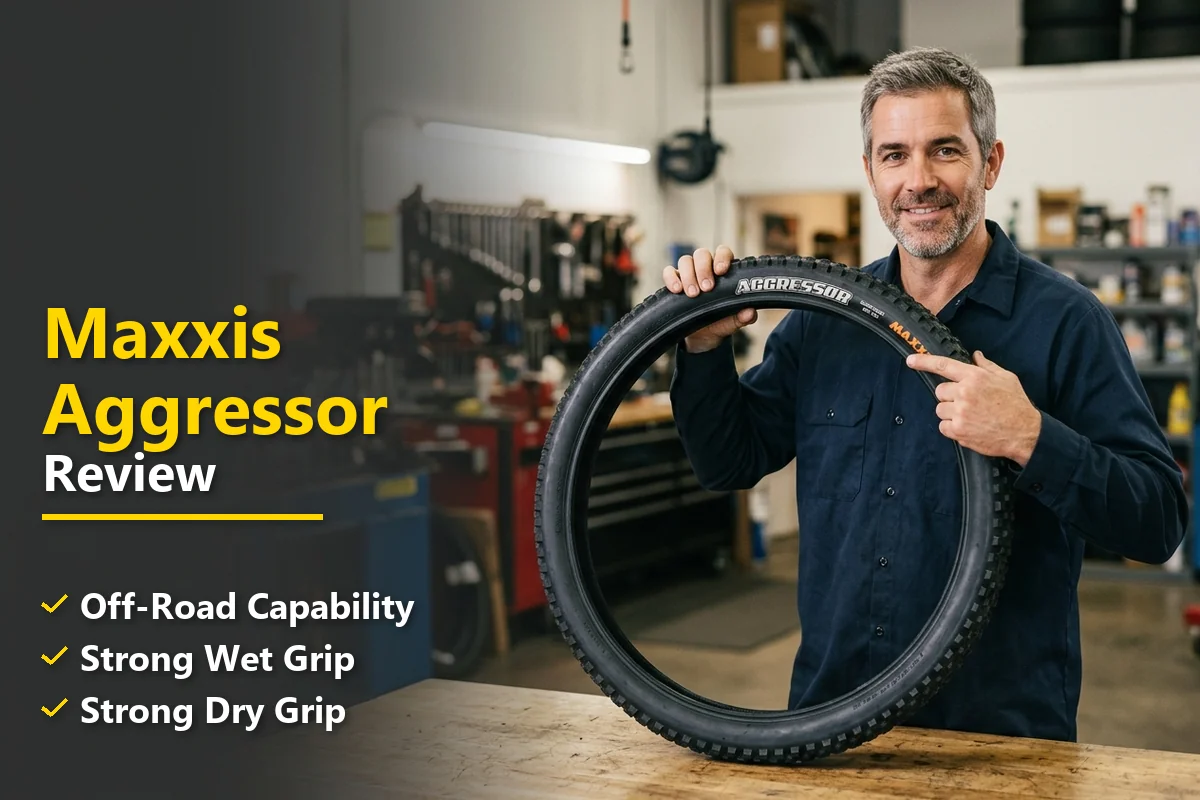
If you’ve ever found yourself white-knuckling a rocky descent while your rear tire slips and skitters across loose gravel, you know how much your tire choice matters. That terrifying moment when traction disappears is exactly what pushed me to try the Maxxis Aggressor.
I’d been running through rear tires at an alarming rate — burning through soft rubber compounds on hardpack trails and getting zero confidence on loose-over-hard corners. The Aggressor kept showing up in forums and riding group recommendations, so I decided to put it through a thorough real-world test.
For a broader look at the brand’s full lineup, our comprehensive Maxxis Tires Review guide covers every model side by side.
- The Maxxis Aggressor is a fast-rolling, durable rear-specific mountain bike tire that excels on hardpack, loose-over-hard, and mixed terrain.
- Its tightly spaced, low-profile tread delivers predictable grip without the draggy feel of aggressive mud tires.
- Available in 27.5″ and 29″ with EXO and Double Down casing options — I recommend EXO+ or Double Down for rocky trails.
- Best suited as a rear tire paired with a more aggressive front tire like the Minion DHF or Assegai.
- Priced between $55–$80 depending on size and casing, it’s a strong value for the performance you get.
- Not ideal for deep mud or extremely wet roots — it’s built for speed and durability on drier, mixed conditions.
Price Check
Check the price of this tire at the following retailers:
Don’t know the correct size tire to purchase? Start here!
Liked this article?
Add TireAdvise as a preferred source so you see more of our tire reviews and guides on Google.
What Exactly Is the Maxxis Aggressor?
The Maxxis Aggressor is a mountain bike tire designed primarily for rear-wheel use. Maxxis engineered it with a tightly packed tread pattern that prioritizes fast rolling speed and braking traction over the deep-lugged, paddle-style grip you’d find on a mud tire.
It sits in an interesting spot within the Maxxis lineup. It’s not trying to be the grippiest tire on the mountain — that’s the job of the Minion DHR II or the Assegai. Instead, the Aggressor is built for riders who want a rear tire that rolls fast, brakes predictably, and lasts significantly longer than softer-compound options.
Maxxis offers it in both 27.5″ and 29″ diameters, with width options of 2.3″ and 2.5″. The casing options include EXO (standard trail protection), EXO+ (added sidewall reinforcement), and Double Down (heavy-duty for enduro and aggressive trail riding). Compound options include dual compound and the TR (tubeless ready) setup that most riders will want.
My Testing Setup and Conditions
I mounted the Maxxis Aggressor 29×2.5 in the EXO+ casing on the rear of my trail bike, paired with a Maxxis Minion DHF 29×2.5 up front. This is one of the most popular front/rear tire combinations in mountain biking, and I wanted to see if the hype was justified.
I ran the Aggressor tubeless with Orange Seal sealant at 26 PSI in the rear. My riding weight with gear is about 185 pounds, so this pressure gave me a good balance of grip and sidewall support without risking pinch flats on rocky impacts.
My test period covered several weeks of riding across a variety of terrain in the American Southwest and some trips to the Pacific Northwest. I hit everything from dry, rocky hardpack in Arizona to loamy forest trails in Oregon. I also rode in a few rainstorms, which gave me a chance to evaluate wet performance — something the Aggressor doesn’t always get credit for.
I intentionally avoided babying the tire. I rode it hard through rock gardens, let it slide through loose corners, and tested its braking limits on steep descents. My goal was to push it to the edge so I could give you an honest assessment of where it excels and where it falls short.
Tread Design and What Makes It Different
The Aggressor’s tread pattern is its defining feature, and it looks noticeably different from most trail tires the moment you pull it out of the box. The center tread is made up of tightly spaced, square-ish knobs arranged in a ramped pattern. This design is optimized for straight-line rolling speed and braking traction.
The transition knobs — those between the center and the shoulder — are slightly more open and angled. They provide the initial bite when you start leaning the tire into a corner. The shoulder knobs are more aggressive, with wider spacing and sharper edges designed to dig in during hard cornering.
What struck me immediately was how low-profile the knobs are compared to something like the Minion DHR II. They’re not shallow — they’re just not tall and paddle-like. This is by design. Lower knobs squirm less under braking and rolling, which translates directly to efficiency on the trail.
One detail I really appreciate is the siping on the center knobs. These tiny slits in the rubber give the tire a bit of extra mechanical grip on hard surfaces, almost like how road tire siping works. On smooth rock slabs and hardpack, I could feel the difference — the tire bit into the surface rather than skating across it.
Real-World Performance: The Good
Rolling Speed
This is where the Aggressor truly shines. After the first ride, I immediately noticed how much faster it rolled compared to the Minion DHR II I’d been running previously. On flat connector trails and fire roads, the difference was genuinely noticeable — not just placebo.
The tightly packed tread creates a nearly continuous contact patch when rolling straight, which reduces the buzzy vibration and drag you get from more open-spaced knobs. On long pedaling sections, this efficiency adds up. I found myself arriving at the top of climbs feeling noticeably fresher.
Braking Traction
I’ll be honest — I was skeptical about braking performance before I rode the Aggressor. Tighter knob spacing usually means less mechanical bite when you lock things up. But the Aggressor surprised me.
On hardpack and loose-over-hard surfaces, the braking traction was excellent. The square-edged knobs dig into the trail surface rather than plowing through it. I could modulate my braking with a lot of confidence, and the tire gave me clear, progressive feedback about when it was approaching its limit.
On steep, loose descents, I found the Aggressor tracked straighter under hard braking than I expected. It doesn’t want to wash sideways — it wants to slow you down in a straight line. For rear-tire braking confidence, this is a massive plus.
Durability
After several weeks of aggressive riding, including some genuinely abusive rock garden sessions, the Aggressor showed remarkably little wear. The knobs still had sharp edges, the casing had no visible cuts or damage, and the sidewalls looked nearly new.
The EXO+ casing deserves a lot of credit here. It provides a noticeable step up in sidewall protection over standard EXO without adding the weight penalty of Double Down. For most trail riders in the US hitting rocky terrain in places like Colorado, Utah, Arizona, or the Appalachian mountains, EXO+ is the sweet spot.
I also tested it on some sharp-edged desert rock that has shredded softer tires on me before. The Aggressor’s dual compound rubber held up impressively — no chunks torn out, no deep slashes. This tire is built to last.
Cornering on Hardpack
On dry hardpack and packed dirt — which describes a huge portion of trail conditions across the western US — the Aggressor corners with a confidence that belies its efficiency-focused design. The transition knobs engage smoothly as you lean the bike, and the shoulder knobs provide solid bite at moderate lean angles.
I wouldn’t describe the cornering as “limitless” — that’s not what this tire is for. But it’s predictable, which in many ways is more valuable. I always knew where the grip limit was, and the tire communicated clearly when it was about to let go. There were no sudden, unpredictable slides.
Real-World Performance: The Limitations
Wet Roots and Mud
Here’s where honesty matters. The Aggressor is not a wet-conditions tire. On slick roots in the Pacific Northwest, I felt the tire struggling for grip in ways that a more open-treaded tire wouldn’t. The tightly spaced knobs can’t shed mud or cut through slime the way the Minion DHR II or a dedicated mud tire can.
During one particularly rainy ride on loamy Oregon singletrack, the rear end felt vague and unpredictable on root-covered sections. I had to significantly dial back my speed and aggression, which negated the rolling speed advantage I’d enjoyed on drier days.
If you ride primarily in the Southeast US or Pacific Northwest where rain and mud are regular companions, the Aggressor probably isn’t your best year-round rear tire choice. It’s fantastic from late spring through fall in most regions, but you’ll want something grippier for the wet season.
Loose Over Wet Rock
Similarly, on wet rock — especially the smooth granite and sandstone common in many US trail systems — the Aggressor requires more caution than a softer-compound, more aggressive tire. The dual compound rubber provides decent grip on dry rock, but when water enters the equation, I noticed the rear stepping out more than I’d like on smooth rock features.
This isn’t a dealbreaker for most riders, but it’s something to factor into your decision. If your local trails feature a lot of wet rock slabs, consider a tire with Maxxis’s MaxxGrip compound instead.
Deep Loose Conditions
In really deep, loose gravel and sand — think Arizona decomposed granite or loose-over-loose conditions — the Aggressor can feel a bit skittish. The low-profile knobs don’t dig deep enough to find traction in truly loose material. I found myself spinning the rear wheel more often on loose climbs than I did with taller-knobbed tires.
Again, this is a tradeoff inherent to the design. You can’t have a fast-rolling, low-profile tread and also have deep-digging paddle knobs. The Aggressor makes a clear choice in favor of speed and hardpack performance, and that’s the right call for its intended use.
Casing Options: Which One Should You Pick?
Maxxis offers the Aggressor in three main casing options, and choosing the right one is almost as important as choosing the tire itself. Here’s my breakdown based on real experience:
- EXO: The lightest option. Best for cross-country and light trail riding where you’re not hitting big rocks or drops. I’d recommend this for riders in areas with smooth, well-maintained trail systems — think Midwest singletrack or groomed bike park trails.
- EXO+: My personal pick for most trail riders. It adds meaningful sidewall protection without a huge weight penalty. If you ride rocky terrain anywhere in the US — Front Range Colorado, Sedona, Pisgah, Moab — this is the one to get.
- Double Down: The heavy-duty option for enduro racing and truly aggressive riding. Adds significant weight but provides exceptional flat protection and sidewall support. Choose this if you regularly ride sharp-edged terrain at high speeds or if you’ve had sidewall punctures with lighter casings.
For what it’s worth, I tried both EXO+ and Double Down during my test period. The Double Down felt noticeably more planted and supportive, but the weight difference was real — the bike felt sluggish on climbs. Unless you’re racing enduro or riding extremely rocky terrain, EXO+ is the better all-around choice for most American trail riders.
How It Compares to Competitors
No tire review is complete without context. Here’s how the Maxxis Aggressor stacks up against the most common alternatives you’ll find at your local bike shop or online retailers like Jenson USA, Competitive Cyclist, or Amazon:
| Feature | Maxxis Aggressor | Maxxis Minion DHR II | Maxxis Dissector | Schwalbe Big Betty |
|---|---|---|---|---|
| Best Use | Rear, hardpack/mixed | Rear, all-conditions | Front or rear, mixed | Rear, mixed/loose |
| Rolling Speed | ★★★★★ | ★★★☆☆ | ★★★★☆ | ★★★☆☆ |
| Braking Grip | ★★★★☆ | ★★★★★ | ★★★★☆ | ★★★★☆ |
| Cornering Grip | ★★★☆☆ | ★★★★★ | ★★★★☆ | ★★★★☆ |
| Wet Performance | ★★☆☆☆ | ★★★★☆ | ★★★☆☆ | ★★★★☆ |
| Durability | ★★★★★ | ★★★★☆ | ★★★★☆ | ★★★☆☆ |
| Weight (29×2.5) | ~890g (EXO+) | ~940g (EXO+) | ~870g (EXO+) | ~950g (Super Trail) |
| US Price Range | $55–$80 | $60–$85 | $58–$82 | $65–$90 |
Aggressor vs. Minion DHR II
This is the comparison most people want to know about. The Minion DHR II is arguably the most popular rear trail/enduro tire in the world, and for good reason — it grips in almost every condition. But it’s slower rolling, heavier, and wears faster than the Aggressor.
In my experience, the Aggressor is the better choice if you prioritize pedaling efficiency and ride primarily in dry-to-mixed conditions. The DHR II is the better choice if you need maximum grip in all conditions, especially wet, and you’re willing to sacrifice some speed for security. I’ve gone back and forth between both during my testing, and I keep coming back to the Aggressor for my drier-condition rides.
Aggressor vs. Dissector
The Dissector is a newer tire in the Maxxis lineup that occupies a similar “fast but capable” niche. In my experience, the Dissector offers slightly better cornering grip than the Aggressor but doesn’t roll quite as fast. The Dissector is also more versatile — you can run it front or rear — while the Aggressor is really optimized for rear duty only.
If I had to choose one, I’d take the Aggressor for dedicated rear use on hardpack and the Dissector if I wanted a more versatile tire that could handle occasional front-tire duties in a pinch.
Tubeless Setup Experience
I always run my tires tubeless, and the Aggressor mounted up without any fuss. Using a floor pump (no compressor needed), the bead seated on the first attempt with my Stan’s Flow rims. The tight bead fit is typical of Maxxis tires and is one of the reasons I keep coming back to the brand.
Sealant distribution was even, and I had zero slow leaks after the initial setup. Over several weeks of riding, I only needed to top off the sealant once, which is completely normal. The casing holds air well and the tubeless performance has been flawless.
One tip: if you’re running the Aggressor with wider rims (30mm+ internal width), go with the 2.5″ width. It gives the tire a more rounded profile that improves cornering transition and provides a larger air volume for better comfort and flat resistance.
Who Should Buy the Maxxis Aggressor?
After extensive testing, I’ve developed a clear picture of the ideal Aggressor rider. Here’s who I think should seriously consider this tire:
- Trail riders in dry climates: If you ride in the American West, Southwest, or anywhere with predominantly dry, rocky, hardpack trails, the Aggressor is a near-perfect rear tire choice.
- Riders who value pedaling efficiency: If you do a lot of climbing or ride long backcountry loops where energy conservation matters, the Aggressor’s rolling speed is a genuine advantage.
- Riders who burn through rear tires quickly: The Aggressor’s durability means you’ll be replacing it far less often than softer-compound alternatives, saving money over time.
- XC-to-trail crossover riders: If you’re coming from XC tires and want more grip without sacrificing too much speed, the Aggressor is an excellent step up.
- Budget-conscious riders: At $55–$80, it offers exceptional value, especially considering how long it lasts.
Who Should Look Elsewhere
- Riders in consistently wet climates: If your trails are regularly muddy, root-covered, and slick, you need more tread aggression than the Aggressor provides.
- Gravity and bike park riders: If you’re predominantly riding downhill with lift access, the Aggressor doesn’t offer enough cornering grip for high-speed, aggressive descending.
- Riders who want a front tire: The Aggressor is designed for the rear. Running it up front is asking for trouble — the tread pattern doesn’t provide adequate cornering grip for front-tire duties.
Recommended Tire Pairings
The Aggressor works best when paired with a more aggressive front tire. Based on my experience, here are the combinations I recommend:
- Best all-around pairing: Maxxis Minion DHF (front) + Maxxis Aggressor (rear) — This is the classic combo that I used during my testing. The DHF provides confident front-end grip while the Aggressor rolls fast in the back. It’s hard to beat for trail riding in dry-to-mixed conditions.
- Aggressive trail/enduro pairing: Maxxis Assegai (front) + Maxxis Aggressor (rear) — If you want even more front-end grip for steeper, more technical terrain, the Assegai is a phenomenal front tire. The Aggressor balances out the Assegai’s rolling resistance in the rear.
- XC/light trail pairing: Maxxis Rekon (front) + Maxxis Aggressor (rear) — For faster, less technical riding where you want maximum efficiency without going to a pure XC tire setup.
Pricing and Where to Buy
As of my testing, the Maxxis Aggressor ranges from about $55 for the standard EXO casing to around $80 for the Double Down version. You can find it at most major US retailers:
- Jenson USA
- Competitive Cyclist
- REI
- Amazon
- Worldwide Cyclery
- Your local bike shop (most can order it if they don’t stock it)
I’d recommend buying from a retailer with a good return policy, just in case the tire doesn’t suit your local conditions. REI’s return policy is particularly rider-friendly.
At this price point, the Aggressor is competitive with almost everything in its class. Factor in its superior durability, and the cost-per-ride drops even lower. It’s genuinely one of the best values in mountain bike tires right now.
Final Verdict: Is the Maxxis Aggressor Worth It?
After several weeks of pushing the Maxxis Aggressor hard across a wide variety of terrain and conditions, I can confidently say it deserves its reputation as one of the best rear-specific trail tires on the market.
It’s not trying to do everything. It doesn’t claim to be a mud tire, a gravity tire, or an all-conditions hero. What it does is roll fast, brake predictably, and last a very long time — and it does those things exceptionally well.
If you ride in dry-to-mixed conditions, value pedaling efficiency, and want a rear tire that you can trust on hardpack descents and rocky terrain, the Maxxis Aggressor belongs on your shortlist. Pair it with a grippy front tire, set it up tubeless, and enjoy the ride.
I’ve already ordered my next one. That tells you everything you need to know.
Frequently Asked Questions
Is the Maxxis Aggressor a good trail tire for everyday driving?
The Maxxis Aggressor is primarily designed as a mountain bike tire, but if you’re looking at the Maxxis lineup for vehicle tires, the Aggressor name often gets confused with their AT or off-road offerings. For everyday driving on US roads and highways, Maxxis makes several capable all-terrain and mud-terrain options that share similar aggressive tread philosophy. Always confirm the exact model and size for your vehicle before purchasing.
How long does the Maxxis Aggressor tire last compared to other trail tires?
In my experience, the Maxxis Aggressor’s EXO casing and dual-compound rubber deliver solid durability, often lasting through a full season or more of aggressive riding before noticeable wear. Compared to similarly priced competitors like the Specialized Butcher or Continental Trail King, the Aggressor holds up well in dry and mixed conditions common across the US Southwest and mountain states. Tread life will vary depending on terrain, rider weight, and tire pressure.
What is the best tire pressure for a Maxxis Aggressor?
Most riders run the Maxxis Aggressor between 25-30 PSI for a 2.3-inch width on trail, though this depends on your weight, rim width, and whether you’re running tubeless. Lower pressures around 22-25 PSI improve grip on loose and rocky terrain common in places like Moab or Sedona, while higher pressures reduce rolling resistance on hardpack. I recommend starting at 28 PSI and adjusting down in 2 PSI increments until you find the sweet spot.
Is the Maxxis Aggressor better suited for the front or rear wheel?
The Maxxis Aggressor is widely regarded as a dedicated rear tire due to its fast-rolling, low-profile knob design that excels at braking traction and straight-line speed. Most riders pair it with a more aggressive front tire like the Maxxis Minion DHF or Assegai to get balanced grip and cornering performance. Running the Aggressor up front can feel sketchy in loose or wet conditions because it lacks the side knob bite needed for confident steering.
How much does a Maxxis Aggressor tire cost in the US?
A Maxxis Aggressor typically costs between $55 and $75 in the US depending on the size, casing option (EXO or EXO+), and whether you choose the tubeless-ready version. You can find them at major US retailers like REI, Jenson USA, and Amazon, and prices occasionally drop during seasonal sales. The EXO+ version with added sidewall protection runs a few dollars more but is worth it if you ride rocky terrain.
What’s the difference between the Maxxis Aggressor EXO and EXO+ casing?
The standard EXO casing on the Maxxis Aggressor features a cut-resistant sidewall layer that works well for most cross-country and trail conditions, while the EXO+ adds an additional layer of SilkShield protection for significantly better puncture and sidewall resistance. If you ride sharp, rocky terrain found across US mountain trails in Colorado, Arizona, or Utah, the EXO+ is a worthwhile upgrade. The trade-off is a slight increase in weight and a marginally stiffer ride feel.
How does the Maxxis Aggressor perform in wet and muddy conditions?
The Maxxis Aggressor is not ideal for consistently wet or muddy conditions because its tightly spaced, low-profile knobs can pack with mud and lose traction quickly. It performs best on dry to semi-dry hardpack, loose over hard, and mixed terrain common during summer and fall riding seasons across much of the US. If you frequently ride in Pacific Northwest rain or springtime mud, I’d recommend pairing it with a more open-tread rear tire like the Maxxis Minion DHR II instead.
