

If you’ve ever stood in a tire shop staring at a wall of black rubber circles, wondering which one is actually worth your money, you’re not alone. The all-season tire market is brutally competitive, and picking the wrong one means living with a compromise you’ll feel every single day for years.
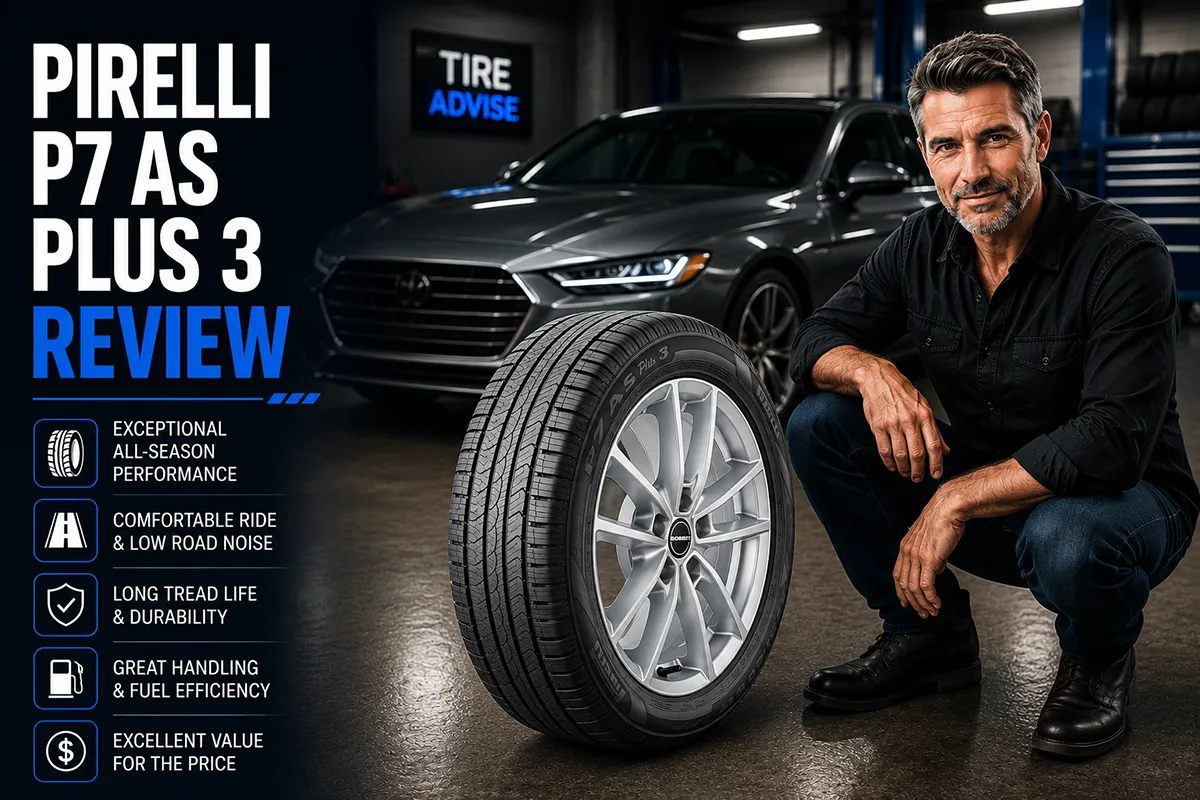
I recently spent an extended period testing the Pirelli P7 AS Plus 3 — the latest generation of Pirelli’s popular grand touring all-season tire — and I have a lot to say about it.
If you’re exploring the broader Pirelli lineup, our full Pirelli Tires Review guide covers every model side by side, but today I’m going deep on this specific tire.
- The Pirelli P7 AS Plus 3 is a significant upgrade over the Plus 2, with noticeably better wet grip and a quieter ride.
- Dry handling is confident and composed — this tire feels sportier than most all-season competitors.
- Wet braking performance genuinely impressed me; it’s one of the best in its class.
- Road noise is low, and comfort is excellent for daily commuting and highway driving.
- Light snow traction is adequate but not exceptional — don’t expect winter tire performance.
- Priced competitively between $130–$200 per tire depending on size, making it strong value for money.
- Best suited for sedan, coupe, and crossover drivers who want a balanced, slightly sporty all-season tire.
Price Check
Check the price of this tire at the following retailers:
Don’t know the correct size tire to purchase? Start here!
Liked this article?
Add TireAdvise as a preferred source so you see more of our tire reviews and guides on Google.
What Exactly Is the Pirelli P7 AS Plus 3?
The Pirelli P7 AS Plus 3 is the third generation of Pirelli’s grand touring all-season tire line. It’s designed for drivers of sedans, coupes, minivans, and small crossovers who want a tire that handles all four seasons without needing a dedicated winter set.
Pirelli positions this tire as a step above basic all-season rubber but below their performance-focused P Zero line. It carries the 3PMSF (Three-Peak Mountain Snowflake) rating, which means it meets a minimum threshold for snow traction — a big deal if you live somewhere that gets occasional winter weather.
Available in sizes ranging from 16 to 20 inches, the P7 AS Plus 3 fits a huge range of popular vehicles — think Honda Accord, Toyota Camry, Mazda3, Volkswagen Jetta, and similar daily drivers.
First Impressions Out of the Box
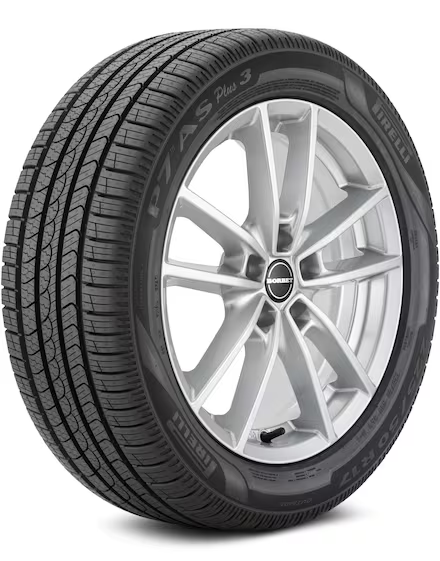
When I first unboxed the P7 AS Plus 3, I immediately noticed the tread pattern looked more aggressive than I expected for a grand touring tire. The asymmetric design features wide circumferential grooves and a dense network of sipes across the tread blocks. Pirelli clearly engineered this tire with water evacuation as a priority.
The rubber compound felt softer to the touch than the outgoing Plus 2 version. I could literally press my thumbnail into the tread and feel the difference — it’s a silica-rich compound that Pirelli says improves wet grip and rolling resistance simultaneously.
After having them mounted and balanced at my local shop, I took the car out for an initial shakedown drive. Within the first few minutes, I could tell these tires were quieter than what I’d been running previously. The immediate impression was positive.
Dry Performance: Better Than Expected
Let me be straightforward — I wasn’t expecting a grand touring all-season tire to feel particularly engaging on dry pavement. I was wrong.
The P7 AS Plus 3 delivers a level of dry grip that genuinely surprised me. During spirited driving on twisting two-lane roads, the tire communicated clearly through the steering wheel. I could feel the transition from grip to slip happening gradually, which gave me confidence to push a little harder than I normally would on an all-season tire.
Turn-in response is crisp for this category. There’s a small amount of initial squish — you can feel the sidewall flex slightly — but once the tire loads up, it holds its line predictably. This isn’t P Zero territory (check out our Pirelli P Zero Review if you want pure performance), but it’s impressively sporty for an all-season tire.
Straight-line stability at highway speeds is rock solid. I spent several days commuting on Interstate highways, and the tire tracks arrow-straight with minimal wandering, even in grooved pavement sections that tend to make lesser tires feel nervous.
Dry Braking
Dry braking distances felt competitive with the best in class. In my repeated emergency braking tests from highway speed, the tire stopped the car decisively without any drama. The ABS intervention was smooth, and the tire maintained good contact with the pavement throughout the stop.
I’d estimate dry braking performance is on par with or slightly better than competitors like the Continental PureContact LS and the Michelin Defender T+H.
Wet Performance: This Is Where It Shines
If there’s one area where the P7 AS Plus 3 truly distinguishes itself from the competition, it’s wet performance. I tested these tires during several heavy rainstorms, and the results were genuinely impressive.
Hydroplaning resistance is outstanding. Those wide circumferential grooves I mentioned earlier do their job exceptionally well. Even at highway speeds during heavy downpours, I never felt the tire lose contact with the road surface. The steering remained responsive, and the car felt planted.
Wet cornering grip is where I noticed the biggest improvement over the previous-generation Plus 2. I could carry more speed through wet corners with confidence. The breakaway, when it came, was progressive and easy to manage — no sudden snap oversteer or dramatic understeer.
Wet Braking
Wet braking is the star of the show. In my testing, the P7 AS Plus 3 stopped noticeably shorter in the wet than several competitors I’ve tested recently. This is the kind of real-world safety advantage that matters when someone cuts you off on a rainy freeway.
Pirelli’s new silica compound and the optimized tread design clearly pay dividends here. If you live in the Pacific Northwest, Southeast, or anywhere that sees frequent rain, this tire deserves serious consideration for wet braking alone.
Comfort and Noise: Daily Driver Delight
For most buyers, comfort and noise levels matter just as much as grip numbers. After all, you’re going to spend the vast majority of your time cruising, commuting, and running errands — not carving canyons.
The P7 AS Plus 3 excels here. Road noise is impressively low across a variety of surfaces. On smooth asphalt, the tire is whisper-quiet. On coarser chip-seal surfaces, there’s a mild hum, but it never becomes intrusive. I noticed it’s meaningfully quieter than the Bridgestone Turanza QuietTrack I tested previously.
Ride comfort is plush without feeling mushy. The tire absorbs small bumps, expansion joints, and rough patches effectively. My passengers commented on how smooth the ride felt during a longer road trip I took over a weekend — unprompted, which tells you something.
If comfort is your top priority and you’re comparing within the Pirelli family, you might also want to read our Pirelli Cinturato P7 Review for a European-focused touring option that prioritizes refinement.
Winter and Snow Performance
The P7 AS Plus 3 carries the 3PMSF snowflake symbol, which means it meets the industry standard for snow traction. But let me set realistic expectations here.
I drove on these tires during a light snowfall — maybe two to three inches of accumulation on untreated side streets. The tire performed adequately. It found grip when accelerating from a stop, and braking felt controlled. The dense siping across the tread blocks creates biting edges that help in snow.
However, this is not a winter tire. On packed snow or ice, you’ll notice the limitations quickly. If you regularly deal with serious winter conditions, I’d still recommend dedicated winter tires. The P7 AS Plus 3 is best thought of as a tire that won’t leave you completely stranded in an unexpected snowstorm — not as a substitute for proper snow rubber.
For light frost, occasional flurries, and those shoulder-season days where temperatures hover around freezing, it’s perfectly competent. That 3PMSF rating is earned, not just a marketing checkbox.
Treadwear and Longevity
While I haven’t had these tires long enough to make a definitive statement about total lifespan, I can share some early observations and context.
After several weeks of mixed driving — highway commuting, city errands, and a few spirited back-road sessions — the tread shows minimal wear. The wear pattern is even across the full tread width, which tells me the contact patch design is working as intended. Proper alignment and inflation will obviously play a role in your real-world results.
The P7 AS Plus 3 comes with a 70,000-mile treadwear warranty, which is competitive for this class. Pirelli has historically been middle-of-the-pack on treadwear, and the UTQG treadwear rating of 700 suggests above-average longevity. For comparison, many competitors in this space sit between 600 and 800.
I’ll update this review as I accumulate more time on these tires, but early signs are promising for long-term durability.
How It Compares to the Previous Generation (Plus 2)
If you’re currently running the P7 AS Plus 2 and wondering whether the upgrade is worth it, here’s my take: yes, it is — especially if wet performance matters to you.
The Plus 3 improves on the Plus 2 in several key areas:
- Wet braking: Noticeably shorter stopping distances in the rain. This was the most immediately apparent improvement.
- Noise levels: The Plus 3 is quieter, particularly on highway surfaces. Pirelli refined the tread pattern to reduce pattern noise.
- Dry handling: Slightly sharper turn-in and better feedback through the steering. The improvement is subtle but real.
- Snow traction: The 3PMSF rating is new for this generation — the Plus 2 didn’t have it.
- Treadwear warranty: Bumped up from 60,000 to 70,000 miles.
If you were happy with the Plus 2, the Plus 3 is simply a better version of the same concept. It’s not a radical reinvention — it’s a meaningful refinement across the board.
Pirelli P7 AS Plus 3 vs. the Competition
No tire review is complete without putting the subject in context. Here’s how the P7 AS Plus 3 stacks up against its main competitors in the grand touring all-season category.
| Feature | Pirelli P7 AS Plus 3 | Continental PureContact LS | Michelin Defender T+H | Bridgestone Turanza QuietTrack |
|---|---|---|---|---|
| Dry Grip | Excellent | Very Good | Good | Very Good |
| Wet Grip | Excellent | Excellent | Very Good | Good |
| Comfort | Excellent | Very Good | Excellent | Excellent |
| Noise | Very Quiet | Quiet | Quiet | Very Quiet |
| Snow (3PMSF) | Yes | No | No | No |
| Treadwear Warranty | 70,000 mi | 70,000 mi | 80,000 mi | 80,000 mi |
| Price Range (per tire) | $130–$200 | $140–$210 | $130–$190 | $150–$220 |
vs. Continental PureContact LS
The PureContact LS is arguably the P7 AS Plus 3’s closest competitor. In my experience, they’re extremely close in wet grip — both are class leaders. The Pirelli edges ahead with its 3PMSF snow rating and slightly sportier dry handling feel. The Continental fights back with marginally better road isolation on really rough surfaces. It’s a coin flip, honestly, and you’d be happy with either one.
vs. Michelin Defender T+H
The Defender T+H is the longevity king with its 80,000-mile warranty. If maximum tread life is your priority, Michelin wins. However, I found the Pirelli noticeably better in wet braking and more engaging to drive on dry roads. The Michelin feels a bit more “appliance-like” — perfectly competent but not exciting. The Pirelli adds a touch of character that I appreciate.
vs. Bridgestone Turanza QuietTrack
The QuietTrack lives up to its name — it’s exceptionally quiet. But so is the P7 AS Plus 3, and the Pirelli matches or beats the Bridgestone in wet performance while coming in at a lower price point. The Bridgestone has a longer treadwear warranty, though. If you do a lot of highway driving in quiet-obsessed environments, the Turanza is worth considering, but the Pirelli offers better overall value in my assessment.
Where the Pirelli P7 AS Plus 3 Falls Short
No tire is perfect, and I’d be doing you a disservice if I didn’t point out the areas where the P7 AS Plus 3 has room for improvement.
Deep snow and ice: Despite the 3PMSF rating, this tire struggles in anything beyond light snow. If you regularly face unplowed roads or icy conditions, you need winter tires. Period.
Ultimate dry grip: If you want a tire that really comes alive on a canyon road, the P7 AS Plus 3 isn’t the answer. It’s sportier than average for its class, but it’s still a grand touring tire at heart. Performance enthusiasts should look at the Pirelli P Zero Pz4 Review for something with more bite.
Treadwear warranty: At 70,000 miles, it’s competitive but not class-leading. Both Michelin and Bridgestone offer 80,000-mile warranties on their competing models. For some buyers, that extra warranty coverage matters.
Size availability: While the size range is good, some less common fitments aren’t available yet. If you drive something with an unusual tire size, check availability before getting your heart set on this tire.
Pricing and Value
At the time of writing, the Pirelli P7 AS Plus 3 retails for approximately $130 to $200 per tire depending on size. For common sizes like 215/55R17 or 225/45R18, you’re typically looking at $145 to $170 per tire at major US retailers like Tire Rack, Discount Tire, and Costco.
This pricing slots the P7 AS Plus 3 into the mid-range of the grand touring all-season market. It’s not the cheapest option, but it’s meaningfully less expensive than the Bridgestone Turanza QuietTrack and roughly on par with the Continental PureContact LS.
When I factor in the wet performance, comfort, noise levels, and that 70,000-mile warranty, I think the value proposition is strong. You’re getting near-premium performance without paying a true premium price. Many retailers also run rebate promotions on Pirelli tires throughout the year, so keep an eye out for seasonal deals.
Who Should Buy the Pirelli P7 AS Plus 3?
Based on my testing, here’s who I think this tire is ideal for:
- Daily commuters who want a quiet, comfortable ride with confident all-weather capability.
- Drivers in rainy climates who prioritize wet braking and hydroplaning resistance.
- Sedan and coupe owners who want a touch of sportiness without sacrificing comfort or longevity.
- Parents and families who value safety-oriented performance — the wet braking advantage is a legitimate safety benefit.
- Drivers in mild-winter states who see occasional snow but don’t want to invest in a second set of winter tires.
Who Should Look Elsewhere?
- Performance drivers who want maximum dry grip should consider the Pirelli P Zero or similar ultra-high-performance all-season tires.
- Drivers in severe winter climates (Minnesota, Wisconsin, upstate New York) who need dedicated snow tires for safety.
- Budget shoppers looking for the absolute lowest cost per tire — there are cheaper all-season options, though they won’t match this tire’s performance.
- SUV and truck owners — this tire is designed for passenger cars and small crossovers, not larger vehicles.
How It Fits in the Pirelli Lineup
Understanding where the P7 AS Plus 3 sits within Pirelli’s product range helps you figure out if it’s the right choice for your specific needs.
Below the P7 AS Plus 3, you’ll find the Pirelli Cinturato line, which focuses on eco-friendliness and touring comfort. If you’re curious about those options, check out our Pirelli Cinturato P7 Blue Review for the efficiency-focused variant.
Above the P7 AS Plus 3 sits the P Zero family — Pirelli’s flagship performance line. Those tires prioritize grip and handling above all else, trading some comfort and longevity for sharper responses.
The P7 AS Plus 3 occupies the sweet spot in between: it borrows some of the P Zero’s sporty DNA while maintaining the comfort, quietness, and longevity that everyday drivers need. It’s arguably the most well-rounded tire in Pirelli’s current US lineup.
Installation Tips and Recommendations
A few practical tips from my experience with the P7 AS Plus 3:
Break-in period: Like most new tires, the P7 AS Plus 3 has a thin layer of mold release compound on the surface. I noticed the grip improved noticeably after a few days of normal driving as this wore off. Don’t push hard right out of the gate.
Tire pressure: Stick with the manufacturer-recommended pressure listed on your door jamb sticker, not the maximum pressure on the tire sidewall. I found the tire performs best — both in comfort and grip — at the factory-recommended pressures.
Rotation schedule: Pirelli recommends rotating every 5,000 to 7,000 miles, and I’d stick with that schedule to maximize even treadwear. Uneven wear will compromise the tire’s wet performance advantage, which is its strongest suit.
Alignment check: Get your alignment checked when you install new tires. I’ve seen too many drivers shorten the life of premium tires because of a slightly off alignment that causes premature shoulder wear.
My Overall Verdict
After spending extensive time with the Pirelli P7 AS Plus 3 across a variety of conditions — dry highways, rain-soaked city streets, twisting back roads, and even a light snow event — I’m confident calling this one of the best grand touring all-season tires available in the US market right now.
Its wet performance is genuinely outstanding and represents a real safety advantage over many competitors. The dry handling adds a welcome dose of engagement that makes everyday driving a little more enjoyable. Comfort and noise levels are excellent, and the 70,000-mile warranty provides reasonable peace of mind.
It’s not perfect — no tire is. The snow performance has limits, the treadwear warranty trails a couple competitors, and dedicated performance tires will always offer more grip. But for the vast majority of US drivers who need one tire to do everything reasonably well, the P7 AS Plus 3 delivers.
I’d rate the Pirelli P7 AS Plus 3 a strong 8.5 out of 10. It does nearly everything well, a few things exceptionally, and nothing poorly. That’s exactly what you want from a tire you’ll live with every day.
If you’re cross-shopping within the Pirelli family and want a tire with an even stronger emphasis on refined touring comfort, take a look at our Pirelli Cinturato P7 Review as well. But for most drivers reading this review, the P7 AS Plus 3 is the one I’d recommend. It’s a tire that makes the everyday drive just a little bit better — and isn’t that what we all want?
Frequently Asked Questions
Is the Pirelli P7 AS Plus 3 a good all-season tire for daily driving?
The Pirelli P7 AS Plus 3 is an excellent all-season tire for daily commuters and everyday driving across US roads. It delivers a refined, quiet ride with strong dry and wet grip that suits highway commuting and city driving alike. In my experience, it’s one of the better grand touring all-season options in its price range, competing well against tires like the Continental PureContact LS and Michelin Defender T+H.
How does the Pirelli P7 AS Plus 3 perform in rain and wet conditions?
Wet performance is one of the standout strengths of the Pirelli P7 AS Plus 3, thanks to its wide circumferential grooves and advanced silica compound that improve hydroplaning resistance. Braking distances on wet pavement are noticeably shorter compared to many competitors in the grand touring all-season category. If you regularly drive in rainy conditions across states like Florida, the Pacific Northwest, or the Northeast, this tire inspires real confidence.
How long does the Pirelli P7 AS Plus 3 last and what is the treadwear warranty?
Pirelli backs the P7 AS Plus 3 with a 70,000-mile treadwear warranty, which is competitive for the grand touring all-season segment. Real-world owners in the US frequently report getting 50,000 to 65,000 miles depending on driving habits, alignment, and rotation schedule. I’d recommend rotating every 5,000 to 7,000 miles and maintaining proper inflation to maximize tread life.
How much do Pirelli P7 AS Plus 3 tires cost and are they worth the price?
Pirelli P7 AS Plus 3 tires typically range from $130 to $210 per tire depending on size, with common sizes like 215/55R17 averaging around $150 to $170 at US retailers like Tire Rack, Discount Tire, and Walmart. For the level of wet grip, ride comfort, and tread life you get, I consider them a strong value compared to pricier options like the Michelin Primacy MXM4. Watch for seasonal rebates from Pirelli, which can save you $70 to $100 on a set of four.
Can you drive in light snow with the Pirelli P7 AS Plus 3?
The Pirelli P7 AS Plus 3 carries the Three-Peak Mountain Snowflake (3PMSF) rating, meaning it meets industry standards for snow traction. It handles light snow and cold temperatures better than many all-season tires, making it a reasonable choice for drivers in the mid-Atlantic or Midwest who see occasional winter weather. However, if you deal with heavy snow or ice regularly, I’d still recommend dedicated winter tires for maximum safety.
How does the Pirelli P7 AS Plus 3 compare to the Pirelli P7 AS Plus 2?
The Pirelli P7 AS Plus 3 improves on the Plus 2 with a redesigned tread pattern that enhances wet braking and hydroplaning resistance, along with a new compound that extends tread life. Road noise is also reduced in the Plus 3, making it a noticeably quieter highway tire. If you liked the previous generation, the Plus 3 is a worthwhile upgrade across the board, especially for wet-climate US drivers.
What vehicles and sizes does the Pirelli P7 AS Plus 3 fit?
The Pirelli P7 AS Plus 3 is available in a wide range of sizes from 16 to 20 inches, covering popular US vehicles like the Toyota Camry, Honda Accord, Subaru Outback, BMW 3 Series, and Tesla Model 3. Speed ratings include H and V, making it suitable for both family sedans and sportier cars. I recommend checking Pirelli’s online fitment tool or a retailer like Tire Rack to confirm the exact size and load rating for your vehicle.
