

I’ve lost count of how many times I’ve walked into a tire shop for a simple replacement and been told I need “a balance and an alignment” — as if they’re a package deal. For years, I nodded along and paid for both without really understanding what either service did.
But after spending over a decade reviewing tires and logging countless hours at shops across the country, I can tell you that balancing and alignment are two completely different services that solve completely different problems. Knowing the difference has saved me hundreds of dollars — and it can save you money too.
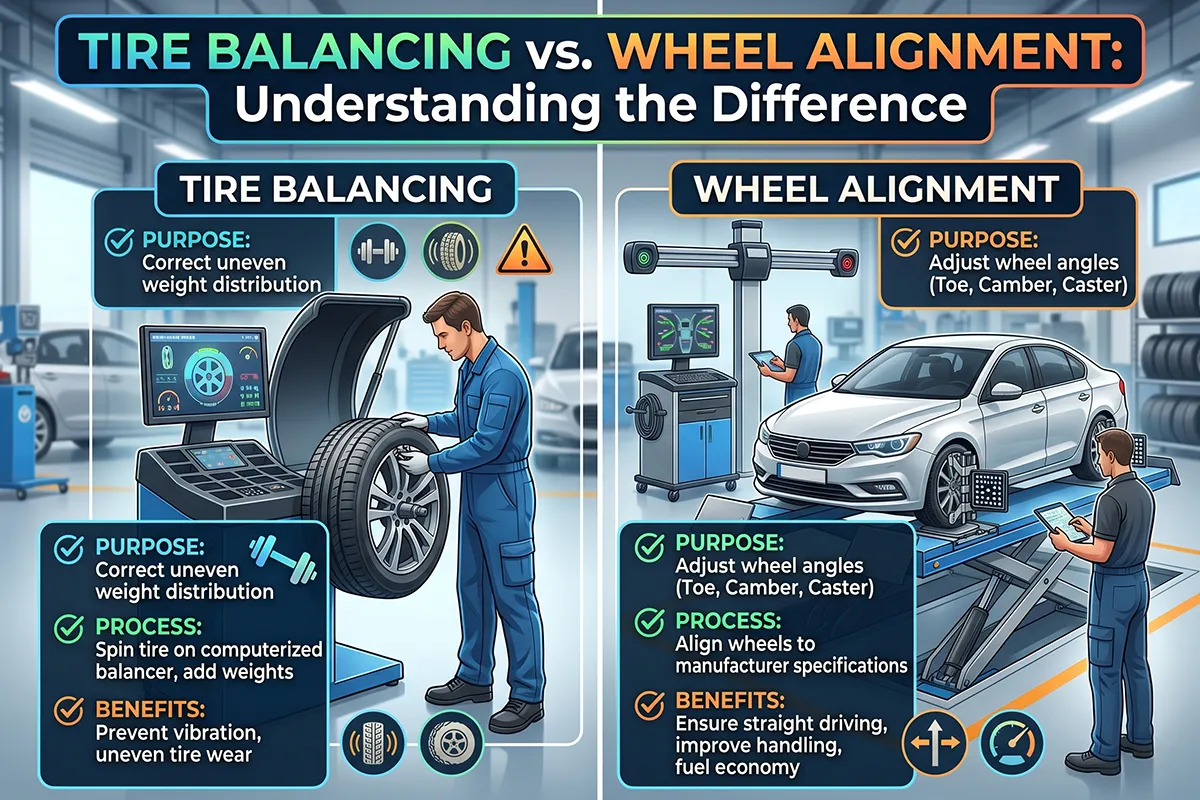
- Tire balancing fixes vibrations caused by uneven weight distribution in your tire-wheel assembly. It’s quick, cheap ($15–$25 per tire), and should be done every time you mount new tires.
- Wheel alignment adjusts the angles of your wheels so they point in the correct direction. It prevents uneven wear and pulling. Costs $75–$150 for a four-wheel alignment.
- They are NOT the same service — you may need one, the other, or both depending on your symptoms.
- A vibrating steering wheel usually means a balance issue. A car that pulls left or right usually means an alignment issue.
- Getting the wrong service wastes money and leaves the real problem unfixed.
Liked this article?
Add TireAdvise as a preferred source so you see more of our tire reviews and guides on Google.
What Is Tire Balancing? A Real-World Explanation
Let me start with balancing because it’s the one most people get confused about. Tire balancing is the process of equalizing the weight distribution around your tire and wheel assembly. No tire is manufactured with perfectly uniform weight — there are always slight heavy spots.
When I mount a new set of tires, I always watch the technician put each wheel on the balancing machine. The machine spins the tire at high speed and identifies exactly where the heavy spots are. The tech then attaches small metal or adhesive weights to the rim to counterbalance those heavy spots.
I think of it like a washing machine with an unbalanced load. If all the heavy clothes bunch up on one side, the whole machine shakes violently. Your tire works the same way — if there’s a weight imbalance, you’ll feel vibrations through the steering wheel and the vehicle body, especially at highway speeds.
Signs You Need Tire Balancing
Over the years, I’ve learned to spot the symptoms of an out-of-balance tire pretty quickly. Here’s what I consistently notice:
- Steering wheel vibration at highway speeds: This is the number one giveaway. If your steering wheel starts shaking once you hit 55–70 mph, there’s a very good chance at least one front tire is out of balance.
- Seat or floorboard vibration: If the vibration is coming through the seat rather than the steering wheel, the imbalance is likely in the rear tires.
- Cupping or scalloped wear pattern: When I inspect tires with balance issues, I often find a wavy, cupped wear pattern around the tread surface. It feels bumpy when you run your hand across it.
- Vibration that appeared after a tire rotation or new tire installation: If the shop didn’t re-balance during a rotation, or if a wheel weight fell off, you’ll notice it quickly.
In my experience, balance issues tend to develop gradually. Wheel weights can fall off after hitting a pothole or curb, and tires naturally wear in slightly uneven patterns over time, shifting the weight distribution.
When Should You Get Tires Balanced?
I follow a simple rule: balance your tires every time they’re removed from the rim and remounted. That means with every new tire installation, and ideally with every tire rotation.
Many shops include balancing with rotation services, so ask before you pay extra. I also recommend getting a balance check anytime you notice a new vibration that wasn’t there before. After several weeks of driving on a new set, I’ve occasionally had a weight come loose and needed a quick rebalance — it took less than 20 minutes.
How Much Does Tire Balancing Cost?
Tire balancing is one of the most affordable maintenance services you can get. Here’s what I’ve typically paid at shops across the US:
- Per tire: $15–$25 at most independent shops
- Four-tire package: $40–$80
- Discount tire chains (Discount Tire, Tire Rack install partners, Costco): Often free for life if you purchased tires there
- Dealerships: $20–$30 per tire (usually the most expensive option)
I always recommend buying tires from a retailer that includes free lifetime balancing. Discount Tire, for instance, offers free rotations and rebalancing for the life of the tires you purchase from them. Over the lifespan of a set of tires, that can easily save you $150 or more.
What Is Wheel Alignment? Breaking It Down Simply
Wheel alignment is a completely different service, and I’d argue it’s the one that causes the most confusion. An alignment doesn’t touch the tires themselves. Instead, it adjusts the suspension components that determine the angle at which your tires contact the road.
When I take my car in for an alignment, the technician drives it onto a special rack with sensors attached to each wheel. A computer then measures three key angles: camber, caster, and toe. The tech adjusts the suspension components until all four wheels are set to the manufacturer’s specifications.
Think of it this way: if balancing is about how the tire spins, alignment is about where the tire points. Even if your tires are perfectly balanced, they’ll wear unevenly and your car will pull to one side if the alignment is off.
The Three Alignment Angles Explained
I’m not going to bore you with engineering textbook explanations. Here’s how I explain the three alignment angles to friends and family:
- Toe: Stand up and look at your feet. If your toes point inward, that’s toe-in. If they point outward, that’s toe-out. Your car’s wheels work the same way. Incorrect toe is the most common alignment issue I see, and it chews through tire tread faster than anything else.
- Camber: This is the inward or outward tilt of the tire when viewed from the front of the car. If the top of the tire leans outward, that’s positive camber. If it leans inward, that’s negative camber. Excessive camber wears down one edge of the tire much faster than the other.
- Caster: This one’s harder to visualize. It’s the angle of your steering axis when viewed from the side. It affects steering stability and returnability (how well the wheel centers itself after a turn). You can’t usually see caster issues by looking at tire wear, but you’ll feel them in how the car handles.
In my testing, toe misalignment is the one that destroys tires fastest. I’ve seen tires that should have lasted well over a year get completely chewed up in just a few months because of a severe toe issue the owner never addressed.
Signs You Need a Wheel Alignment
Here’s what I look for when I suspect an alignment problem:
- Vehicle pulls to the left or right: If you have to constantly correct the steering to drive straight on a flat road, your alignment is almost certainly off. I test this on a smooth, straight stretch of road with no crown.
- Uneven tire wear: This is the biggest telltale sign. If one edge of a tire is significantly more worn than the other, that’s a camber issue. If the tread has a feathered or diagonal wear pattern, that’s typically a toe problem.
- Steering wheel is off-center: If your steering wheel isn’t straight when you’re driving in a straight line, the alignment needs attention.
- Car feels “wandery” or unstable: After I had an alignment issue on a test vehicle last year, the car felt vague and loose at highway speeds. It wasn’t a vibration — it was more of a floaty, imprecise feeling.
- You just hit a major pothole or curb: I always recommend getting an alignment check after any significant impact. Those massive potholes on US highways — especially in the Northeast and Midwest during spring — are alignment killers.
When Should You Get an Alignment?
Unlike balancing, alignment doesn’t need to happen every time you touch the tires. Here’s my personal schedule:
- Every time you install new tires: Non-negotiable. I never put a fresh set of tires on a car without getting an alignment. It protects your investment.
- Once a year as preventive maintenance: Suspension components wear gradually. An annual check catches problems before they damage your tires.
- After hitting a pothole, curb, or road debris: If the impact was hard enough to make you wince, get it checked.
- After any suspension work: If you’ve replaced struts, shocks, control arms, tie rods, or ball joints, an alignment is mandatory.
- Anytime you notice the symptoms above: Don’t wait. Every day you drive on a misaligned car, you’re shortening the life of your tires.
How Much Does a Wheel Alignment Cost?
Alignment costs more than balancing, but it’s still very reasonable considering how much tire life it preserves:
- Two-wheel (front) alignment: $50–$75
- Four-wheel alignment: $75–$150 at most shops
- Dealerships: $100–$200 (again, usually the priciest option)
- Chains like Firestone, Pep Boys, or NTB: Often run specials in the $70–$100 range for four-wheel alignments
I personally prefer four-wheel alignments even on front-wheel-drive vehicles. All four corners affect handling and wear, and the price difference is usually minimal. Some shops, like Firestone, offer lifetime alignment packages for around $200 that let you come in for unlimited alignments. If you drive on rough roads regularly, that’s a deal worth considering.
Tire Balancing vs Alignment: The Key Differences
Now that I’ve explained both services individually, let me put them side by side so you can see exactly how they differ.
| Feature | Tire Balancing | Wheel Alignment |
|---|---|---|
| What it fixes | Uneven weight in the tire/wheel assembly | Incorrect wheel angles (camber, caster, toe) |
| Main symptom it solves | Vibrations at speed | Pulling, uneven wear, off-center steering |
| What gets adjusted | Small weights added to the wheel rim | Suspension components (tie rods, control arms, etc.) |
| Typical cost | $15–$25 per tire | $75–$150 (four-wheel) |
| Time to complete | 15–30 minutes | 45–90 minutes |
| How often needed | Every tire mount/rotation or when vibrations appear | With new tires, annually, or after impacts |
| Equipment used | Spin balancer machine | Alignment rack with laser/camera sensors |
| DIY possible? | Not practically (requires a balancer) | Not practically (requires precision equipment) |
The bottom line is this: balancing addresses how the tire spins, while alignment addresses where the tire points. They’re related only in that both affect tire wear and ride quality, but the causes, symptoms, and solutions are completely different.
Can You Need Both at the Same Time?
Absolutely — and this is where shops aren’t necessarily upselling you. When I install a new set of tires, I always get both a balance and an alignment. Here’s my reasoning:
New tires need to be balanced as part of the mounting process. There’s no way around it. And since you’re investing in fresh rubber, it makes zero sense to mount them on a car with misaligned suspension. You’d start wearing down those new tires unevenly from day one.
I’ve made this mistake exactly once. Early in my career, I skipped the alignment on a new set of all-season tires to save $100. Within a couple of months, I noticed the inside edges wearing down noticeably faster than the rest of the tread. I ended up needing to replace two tires far sooner than I should have. That “saved” $100 cost me several hundred more in premature tire replacement.
So yes — when you buy new tires, get both services. But if you’re experiencing symptoms mid-life on your current tires, diagnose first and only pay for what you need.
How to Diagnose Your Problem Before Going to the Shop
I want to give you a practical framework so you walk into the tire shop knowing what you need, rather than relying on whatever the service advisor recommends. Here’s my step-by-step process:
Step 1: Check Your Tires Visually
Get down and look at all four tires carefully. Run your hand across the tread surface (with the car off and parked, obviously).
- Cupping or scalloping (wavy, uneven bumps around the circumference) → Likely a balance issue
- One-sided wear (inner or outer edge worn more than the other) → Likely a camber alignment issue
- Feathered or diagonal wear (tread blocks feel smooth one way and rough the other) → Likely a toe alignment issue
- Center wear or edge wear (both edges or center worn) → Likely an inflation issue, not balance or alignment
Step 2: Test Drive and Pay Attention
Take your car on a smooth highway and note what you feel:
- Vibration in the steering wheel at 55+ mph → Balance issue (front tires)
- Vibration in the seat at 55+ mph → Balance issue (rear tires)
- Car pulls steadily to one side on a flat road → Alignment issue
- Steering wheel is crooked when driving straight → Alignment issue
- Car feels vague or floaty → Could be alignment, worn suspension, or both
I always test on a road I know well — one that’s flat, smooth, and straight. Road crown (the slight slope for drainage) can mimic a mild pull, so I test in both directions to confirm.
Step 3: Communicate Clearly at the Shop
When I go to the shop, I describe my symptoms specifically rather than asking for a service by name. I’ll say something like, “I’m getting a vibration in the steering wheel around 65 mph” or “the car is pulling to the right and I’m seeing inside-edge wear on the front tires.”
This gives the technician useful diagnostic information and helps them recommend the right service. It also makes it harder for anyone to sell you something you don’t need.
Common Myths I Want to Clear Up
After years of testing tires and talking to technicians, mechanics, and fellow drivers, I hear the same misconceptions over and over.
Myth 1: “Alignment and balancing are the same thing”
They’re not. I’ve already beaten this point into the ground, but it bears repeating because I still hear it constantly. They involve different equipment, different parts of the vehicle, and fix different problems.
Myth 2: “You need an alignment every time you rotate your tires”
No. Tire rotation is simply moving tires to different positions on the car to even out wear. It doesn’t change your suspension geometry. You need a rebalance with rotation (because different positions can feel different), but alignment should only be checked if there are symptoms or it’s been a long time since the last one.
Myth 3: “New tires don’t need balancing”
Every single new tire needs balancing when it’s mounted on a wheel. No tire comes off the factory line in perfect balance. I’ve seen brand-new premium tires from top brands like Michelin and Continental require significant balancing weights. It’s completely normal and expected.
Myth 4: “Alignment fixes vibrations”
An alignment will not fix a vibration problem. If you’re shaking at highway speed and you pay for an alignment instead of a balance, you’ve wasted your money and the vibration will still be there. I’ve talked to multiple readers who made this exact mistake because a shop recommended the wrong service.
Myth 5: “If my car drives straight, the alignment is fine”
Not necessarily. A toe-out condition on both sides can cause rapid tire wear without any noticeable pull because both sides are equally off. I’ve seen cars that tracked perfectly straight but were eating through tires at an alarming rate due to excessive toe wear.
My Real-World Advice for Everyday Drivers
Here’s the practical playbook I follow and recommend to every driver I talk to:
When You Buy New Tires
- Always get all four tires balanced during installation (this should be included in the mounting fee — if it’s not, ask why).
- Always get a four-wheel alignment at the same time. Budget for it when you’re pricing out tires.
- Buy from a retailer that offers free lifetime balancing and rotation. Discount Tire, Costco, Sam’s Club, and America’s Tire all offer some version of this.
During the Life of Your Tires
- Get tires rotated and rebalanced every six months or at whatever interval your tire manufacturer recommends.
- Inspect your tires monthly for unusual wear patterns. This takes two minutes and can save you from discovering a problem too late.
- Get an alignment check once a year, or immediately after any pothole hit, curb strike, or suspension work.
- Check tire pressures monthly. Incorrect pressure causes its own set of wear problems that no amount of balancing or alignment can fix.
How to Avoid Overpaying
I’ve been to dozens of tire shops, dealerships, and independent mechanics. Here’s what I’ve learned about getting fair prices:
- Get quotes from at least two shops. Prices vary significantly. I’ve seen the same four-wheel alignment priced at $80 at one shop and $180 at a dealership down the street.
- Ask about lifetime alignment plans. If you live in an area with rough roads (looking at you, Michigan and Pennsylvania), a $200 lifetime alignment plan pays for itself after two visits.
- Don’t pay for an alignment if you only need a balance. If your only symptom is a highway vibration with no pulling and no unusual wear, start with a balance. You can always get an alignment later if needed.
- Ask to see the alignment printout. Any reputable shop will give you a before-and-after printout showing exactly which angles were out of spec and what they adjusted. If a shop can’t provide this, I’d question whether they actually performed the service.
What Happens If You Ignore Both Services?
I’ve seen the consequences firsthand, and they’re not pretty. Ignoring balance and alignment issues doesn’t just affect ride comfort — it has real financial and safety implications.
Ignoring a balance issue leads to accelerated, uneven wear (cupping), increased stress on suspension components like struts and bearings, and a progressively worse ride. Over time, that vibration isn’t just annoying — it’s fatiguing on long drives and can mask other developing problems.
Ignoring an alignment issue is even more costly. I’ve watched tires that should have easily lasted a full year or more get destroyed in a fraction of that time due to severe toe misalignment. That’s hundreds of dollars in premature tire replacement — far more than the $100 or so an alignment would have cost.
In extreme cases, a badly misaligned car can be a safety hazard. Significant pull in one direction increases the risk of lane departure, especially in wet conditions or during emergency maneuvers. It also increases your stopping distance because the tires aren’t making optimal contact with the road.
A Word About Road-Force Balancing
If you’re experiencing persistent vibrations even after a standard balance, ask your shop about road-force balancing. This is a more advanced technique I’ve used on several test vehicles with great results.
A road-force balancer presses a large roller against the tire while it spins, simulating the force of the road surface. This can identify tire stiffness variations and rim runout issues that a standard spin balancer can’t detect.
I’ve had situations where a standard balance showed “zero” on the machine, but the car still vibrated. A road-force balance identified a stiff spot in the tire and the technician was able to match-mount it (rotate the tire on the rim to align the tire’s stiff spot with the wheel’s low spot). The vibration disappeared completely.
Road-force balancing typically costs $5–$15 more per tire than standard balancing. In my opinion, it’s well worth it, especially if you’re mounting tires on a vehicle where ride quality is a priority — like a luxury sedan or a family SUV where you want a smooth, comfortable ride.
Final Thoughts: Know What You’re Paying For
The single most important takeaway from this article is that tire balancing and wheel alignment are not interchangeable services. They fix different problems, involve different equipment, and are needed at different times.
As someone who has spent years reviewing tires and working with shops across the US, I can tell you that the drivers who get the most life out of their tires are the ones who understand this distinction. They balance every time they mount or rotate tires. They align when installing new rubber or when symptoms appear. And they inspect their tires regularly so problems get caught early.
Don’t let a shop sell you a service you don’t need — but also don’t skip a service that’s genuinely necessary just to save a few dollars today. In the long run, proper balancing and alignment are the cheapest insurance policies you can buy for your tires.
If you’re shopping for new tires right now and wondering whether to budget for these services, my answer is always the same: yes to both, especially at installation time. Your tires will last longer, your car will ride better, and you’ll be safer on the road. That’s a win no matter how you look at it.
Frequently Asked Questions
What is the difference between tire balancing and wheel alignment?
Tire balancing corrects uneven weight distribution on each tire-and-wheel assembly, while wheel alignment adjusts the angles of your suspension so your tires make proper contact with the road. Balancing fixes vibrations you feel at highway speeds, whereas alignment corrects pulling to one side and uneven tread wear. Both services are essential when installing replacement tires, but they address completely different problems.
How do I know if I need a tire balance or an alignment?
If your steering wheel vibrates or shakes at speeds above 55 mph, you likely need a tire balance. If your car drifts to one side on a straight, flat road or you notice uneven wear on the inner or outer edges of your tires, a wheel alignment is the fix. I always recommend having both checked whenever you buy new tires so you start with a clean slate.
How much does tire balancing vs alignment cost in the US?
Tire balancing typically costs between $15 and $50 per tire at most US shops, while a standard four-wheel alignment runs $75 to $150. Chains like Discount Tire, Firestone, and Walmart often bundle balancing for free with new tire purchases, so always ask about package deals. An alignment is a separate service and rarely included free, but many shops offer coupons or membership plans that bring the price down.
Do I need an alignment every time I get new tires?
It is not strictly required every time, but most tire professionals — myself included — strongly recommend getting a wheel alignment when installing a new set of tires. Proper alignment ensures your new tires wear evenly and last as long as the manufacturer intended. Skipping alignment on new tires can lead to premature tread wear, potentially voiding the treadwear warranty and costing you more money in the long run.
How often should you get tire balancing and wheel alignment done?
A good rule of thumb for US drivers is to have your tires rebalanced every 5,000 to 7,500 miles or whenever you rotate your tires. Wheel alignment should be checked at least once a year or after hitting a major pothole, curb, or road debris — something that is especially common on rough Northeast and Midwest roads. If you drive frequently on highways or notice any handling changes, getting both services checked sooner can save you from buying replacement tires earlier than expected.
Can bad alignment or unbalanced tires cause uneven tire wear?
Yes, both issues cause uneven tire wear but in different patterns. Unbalanced tires tend to create cupping or scalloped wear spots around the tread, while misalignment causes wear concentrated on the inner or outer shoulder of the tire. Catching these patterns early during routine inspections can extend the life of your tires by thousands of miles and help you avoid the cost of premature replacement.
Can I drive safely with tires that are out of balance or out of alignment?
You can drive short distances, but it is not safe or cost-effective to ignore either issue for long. Out-of-balance tires stress suspension components and create uncomfortable vibrations, while a misaligned vehicle reduces steering responsiveness and can be dangerous in wet or icy US driving conditions. I recommend scheduling service as soon as you notice symptoms — delaying the fix often leads to damaged tires, worn suspension parts, and a much bigger repair bill.
