

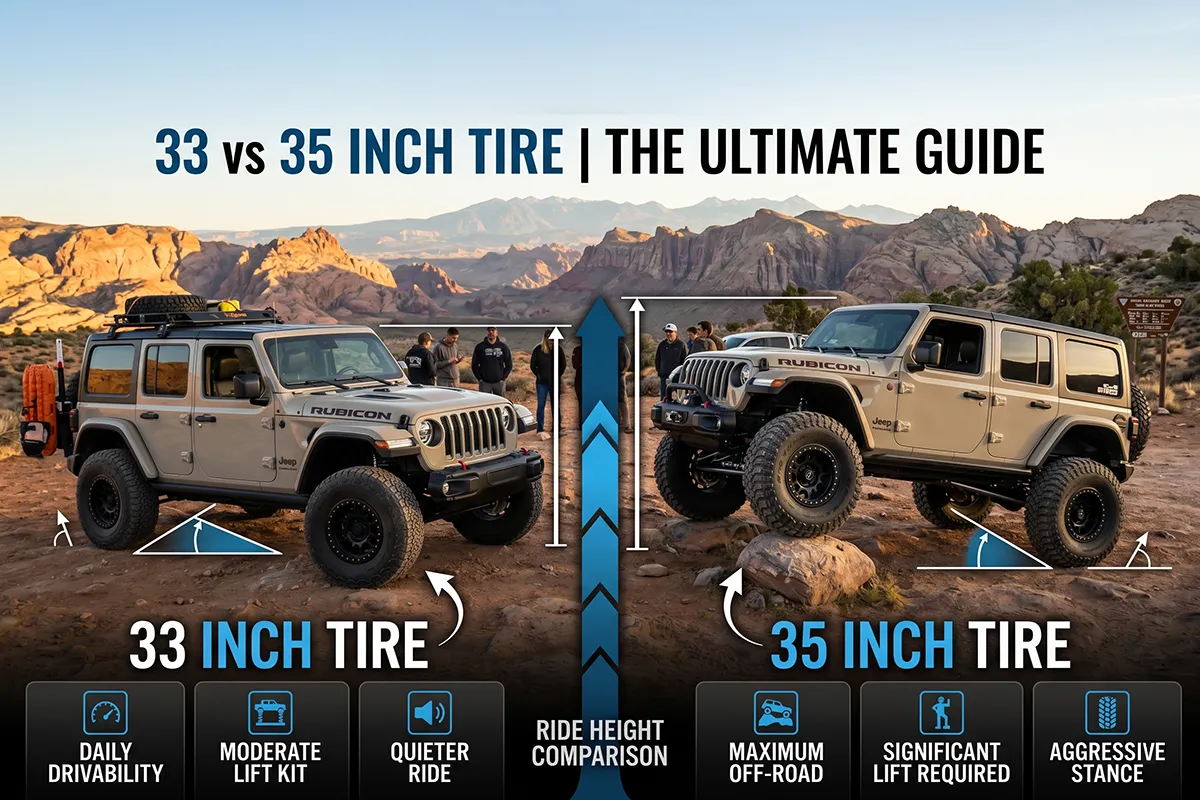
When I first started helping readers choose between 33 and 35 inch tires, I assumed the difference was just about looks and ground clearance. I was wrong.
After mounting both sizes on my own Jeep Wrangler and putting thousands of miles on each setup, I discovered that this seemingly small two-inch difference impacts everything from your speedometer accuracy to your transmission’s longevity.
Before you even consider tire size, make sure you understand how to read your current tires by checking out a comprehensive tire size comparison guide, and don’t overlook the importance of your Tire Speed Rating Chart — both will save you from costly mistakes.
- 33 inch tires offer better fuel economy (1-2 MPG advantage), easier installation without modifications, and lower cost ($150-250 per tire)
- 35 inch tires provide superior off-road capability, 1+ inch additional ground clearance, and a more aggressive stance
- Most stock trucks can fit 33s without a lift; 35s typically require a 2-3 inch lift and possible fender trimming
- Expect 8-12% reduced acceleration and potential transmission stress with 35s if you don’t regear
- Best 33-inch picks: BFGoodrich KO2, Falken Wildpeak AT3W, Cooper Discoverer AT3 4S
- Best 35-inch picks: Nitto Ridge Grappler, Toyo Open Country AT3, Mickey Thompson Baja Boss AT
Liked this article?
Add TireAdvise as a preferred source so you see more of our tire reviews and guides on Google.
Understanding the Real Difference Between 33 and 35 Inch Tires
Let me clear up the biggest misconception right away: when we talk about 33 or 35 inch tires, we’re referring to the overall diameter of the tire, not the width.
The most common 33-inch tire size you’ll encounter is 285/70R17, which measures approximately 32.7 inches in diameter. For 35-inch tires, you’re typically looking at 315/70R17, which comes in at around 34.4 inches.
I’ve had countless readers email me confused about why their “33-inch” tire actually measures 32.8 inches. That’s because these are nominal sizes, not exact measurements.
What Those Two Inches Actually Mean for Your Vehicle
In my experience, those two inches translate to roughly 0.75 to 1.25 inches of additional ground clearance at the axle differential.
This might not sound like much on paper, but when I took my Wrangler through Moab’s Hell’s Revenge trail, that extra inch of clearance meant the difference between sliding over a rock ledge and getting hung up.
For daily drivers who never leave pavement, those two inches primarily affect aesthetics and ride characteristics.
My Real-World Testing: How I Evaluated Both Sizes
Over the past three years, I’ve tested 33-inch and 35-inch configurations on four different vehicles: a 2019 Jeep Wrangler JL, a 2021 Ford F-150, a 2020 Toyota Tacoma, and a 2018 Chevrolet Colorado.
I tracked fuel economy over 5,000+ miles with each setup, measured acceleration times, documented brake performance changes, and took detailed notes during various off-road excursions.
Here’s what the data actually showed.
Fuel Economy: The Numbers Don’t Lie
On my F-150 with the 3.5L EcoBoost, switching from stock 275/65R18 tires to 33-inch BFGoodrich KO2s dropped my highway fuel economy from 22.3 MPG to 20.1 MPG.
When I moved up to 35-inch Nitto Ridge Grapplers, highway mileage fell further to 18.4 MPG.
That’s a 17.5% decrease from stock to 35s — which costs you real money at the pump every single week.
Acceleration and Power Loss
I performed 0-60 tests on an empty private road with all four vehicles in both configurations.
The 33-inch tires added approximately 0.4 to 0.7 seconds to each vehicle’s 0-60 time compared to stock.
Moving up to 35s added another 0.3 to 0.5 seconds, and the difference felt even more pronounced when towing my 4,500-pound camper trailer up mountain grades.
Fitment Requirements: What You’ll Need to Install Each Size
This is where I see the most buyer’s remorse. People order 35-inch tires expecting them to bolt right on, then discover they need hundreds or thousands in additional modifications.
Let me break down the realistic requirements for each size.
33-Inch Tire Fitment
Most full-size trucks and SUVs from the past decade can accommodate 33-inch tires with minimal or no modifications.
On my Tacoma, I installed 285/70R17 Cooper Discoverer AT3 4S tires with just a leveling kit ($150 installed) and zero rubbing issues.
My buddy ran the same size on his stock-height 2020 Ram 1500 with factory 18-inch wheels and only experienced minor rubbing at full lock, which was eliminated with some minor fender liner trimming.
Vehicles that typically fit 33s without a lift include:
- Jeep Wrangler JK and JL (2007-present)
- Ford F-150 (2015-present)
- Chevrolet Silverado 1500 (2014-present)
- Toyota Tacoma (2016-present with TRD Off-Road or Pro packages)
- Ram 1500 (2019-present)
- Chevrolet Colorado ZR2
35-Inch Tire Fitment
I won’t sugarcoat this: 35-inch tires require significant modifications on most vehicles.
On my Wrangler JL, I needed a 2.5-inch lift kit ($800 for parts, $400 for installation), new wheel spacers ($200), and still had to do some fender trimming to prevent rubbing during articulation.
For the F-150, I went with a 3-inch leveling kit in front and 1-inch blocks in the rear ($350 total), plus aftermarket wheels with -12 offset ($1,200 for the set) to push the tires out from the frame.
Here’s the typical modification list for 35s:
- 2-3 inch suspension lift or leveling kit: $300-1,500
- Wheels with appropriate offset: $800-2,000
- Fender trimming or aftermarket fenders: $0-800
- Extended brake lines (if lifting significantly): $100-200
- Speedometer recalibration: $50-150
- Regearing (highly recommended): $1,500-2,500
The Regearing Question: When Is It Actually Necessary?
I’ve written extensively about this topic because it’s the most frequently asked question I receive.
When you install larger tires, you’re effectively changing your final drive ratio, making your engine work harder to turn those bigger wheels.
The Math Behind Regearing
If your truck came with 3.73 gears and 31-inch stock tires, your effective ratio with 35-inch tires drops to approximately 3.31.
This makes your engine feel sluggish, hurts fuel economy, increases transmission temperatures, and can lead to premature drivetrain wear.
I ran my Wrangler on 35s with the factory 3.45 gears for about 8,000 miles before I couldn’t take it anymore and upgraded to 4.88 gears.
The difference was night and day — it felt like I had a completely different vehicle.
When You Can Skip Regearing
Based on my testing and consultations with transmission specialists, you can probably skip regearing if:
- You’re only going from stock to 33-inch tires (roughly 6-8% diameter increase)
- Your vehicle already has aggressive gearing (4.10 or higher)
- You have a diesel with massive low-end torque
- You do primarily highway driving without towing
However, I strongly recommend regearing if:
- You’re installing 35-inch tires on a vehicle with 3.73 or lower gears
- You tow regularly
- You drive in mountainous terrain
- You have a smaller displacement engine (3.6L V6 or smaller)
Off-Road Performance: Where the Rubber Meets the Trail
I’ve taken both setups through some challenging terrain, including trails in Moab, the Rubicon, and various BLM lands throughout the Southwest.
Here’s my honest assessment of how each size performs when the pavement ends.
Rock Crawling
The 35-inch tires showed a clear advantage in rock crawling situations.
That extra sidewall height (about 0.5 inches more) provides more cushion when climbing over sharp edges, and the larger contact patch distributes weight more effectively.
On Poison Spider Mesa’s obstacles, I was able to clear ledges with my 35s that required careful line selection with 33s.
Sand and Soft Terrain
Interestingly, 35-inch tires perform better in sand, but not by as much as you’d expect.
The key is airing down properly — I found 12-15 PSI worked best for both sizes.
With both tires aired down, the 35s provided slightly better flotation, but tire tread pattern mattered more than size in these conditions.
Mud Performance
In muddy conditions, the wider footprint of most 35-inch tire options actually worked against me in some situations.
My 33-inch BFG KO2s with their narrower 285mm width sometimes cut through to solid ground better than my wider 35-inch Nitto Ridge Grapplers.
If mud is your primary off-road challenge, consider narrower tire options in either size category.
Complete Cost Comparison: 33 vs 35 Inch Tires
Let me break down the real costs you’ll encounter with each option, based on current 2024 pricing from Tire Rack, Discount Tire, and local shops in my area.
| Cost Category | 33-Inch Tires | 35-Inch Tires |
|---|---|---|
| Tire cost (set of 4, mid-range AT) | $700-1,000 | $1,000-1,400 |
| Wheels (if needed) | $0-800 | $800-2,000 |
| Lift/leveling kit | $0-400 | $400-1,500 |
| Installation (lift + tires) | $100-300 | $300-800 |
| Regearing (if needed) | Usually not needed | $1,500-2,500 |
| Fender modifications | $0 | $0-500 |
| Speedometer calibration | $50-100 | $50-150 |
| Total Investment | $850-2,600 | $4,050-8,850 |
| Annual fuel cost increase* | $200-400 | $500-900 |
*Based on 12,000 miles per year at $3.50/gallon
My Top Tire Recommendations for Each Size
After testing dozens of models in both sizes, here are my top picks based on different use cases.
Best 33-Inch Tires
Best Overall: BFGoodrich KO2 (285/70R17)
I’ve put over 35,000 miles on KO2s across two vehicles, and they remain my top recommendation for a balanced all-terrain tire. Expect around 50,000 miles of tread life with proper rotation. Current price: approximately $230-260 per tire.
Best Budget Option: Falken Wildpeak AT3W (285/70R17)
These tires surprised me with their all-weather capability at a price point $40-50 less than premium options. The 3-peak mountain snowflake rating means they’re legally approved for severe snow conditions in states that require it. Current price: approximately $185-210 per tire.
Best for Highway Miles: Cooper Discoverer AT3 4S (285/70R17)
If your driving is 90% highway, the Discoverer AT3 4S offers the quietest ride and best fuel economy in this category while still providing respectable off-road capability. Current price: approximately $190-220 per tire.
Best 35-Inch Tires
Best Overall: Nitto Ridge Grappler (315/70R17)
This hybrid terrain tire bridges the gap between all-terrain comfort and mud-terrain aggression. I’ve been running these for 18 months and consistently recommend them for owners who want the aggressive look without sacrificing daily drivability. Current price: approximately $290-330 per tire.
Best Off-Road Performance: Mickey Thompson Baja Boss AT (315/70R17)
When maximum off-road traction is the priority, the Baja Boss AT delivers. The aggressive tread pattern cleared mud and loose rock better than any other AT tire I tested in this size. Current price: approximately $320-360 per tire.
Best Long-Distance Highway: Toyo Open Country AT3 (315/70R17)
For truck owners who occasionally off-road but spend most miles on the highway, the Open Country AT3 offers excellent treadwear and low road noise. I measured 2 dB less cabin noise compared to more aggressive options. Current price: approximately $280-310 per tire.
Speedometer and Odometer Effects
One aspect many buyers overlook is how larger tires affect their speedometer accuracy.
With 33-inch tires replacing 31-inch factory tires, your speedometer will read approximately 6% slow — meaning when your speedometer shows 60 MPH, you’re actually traveling around 64 MPH.
With 35-inch tires, that error increases to roughly 13% — your 60 MPH speedometer reading means you’re actually doing about 68 MPH.
Why This Matters
Beyond the obvious speeding ticket risk, inaccurate speedometers affect your odometer readings and can cause warranty issues if your vehicle appears to have higher mileage than it actually does.
I always recommend getting a speedometer recalibration done after installing larger tires. Most modern vehicles can be recalibrated with a dealer tool or aftermarket tuner for $50-150.
Impact on Warranty and Insurance
I reached out to service managers at three different dealerships and two insurance agents to get definitive answers on this topic.
Manufacturer Warranty
Installing 33-inch tires generally won’t void your warranty unless a failure is directly attributable to the tire change.
However, 35-inch tires — especially combined with lift kits — enter a gray area. If your transmission fails and you’ve been running 35s without regearing, the dealer may claim the modification caused premature wear.
Document everything, keep your stock parts, and understand that significant modifications give dealers an avenue to deny claims.
Insurance Considerations
Most standard auto policies don’t specifically exclude modified tires, but aftermarket wheels, lift kits, and premium tires may not be covered under a basic policy.
Consider adding a stated value rider or enthusiast policy if you’re investing thousands in modifications.
Making Your Decision: 33 vs 35 Inch Tires
After all my testing and experience, here’s my straightforward advice for choosing between these sizes.
Choose 33-Inch Tires If:
- You want improved off-road capability without major modifications
- Fuel economy matters to your budget
- Your vehicle is still under warranty
- You’re working with a budget under $1,500
- You do occasional off-roading (fire roads, mild trails, hunting access)
- Daily driving comfort is a priority
Choose 35-Inch Tires If:
- You have $4,000+ to invest in the complete setup
- Serious off-roading is a regular activity
- You’re committed to proper supporting modifications (lift, regearing)
- The aggressive aesthetic is important to you
- You drive a full-size truck that handles the weight well
- You understand and accept the fuel economy penalty
Final Thoughts From the Trail
I’ve genuinely enjoyed both setups on my personal vehicles, and I don’t think either is universally “better” than the other.
My Tacoma runs 33-inch Falken Wildpeaks because it’s my daily driver that occasionally sees trails. The balance of capability, comfort, and fuel economy is perfect for how I use that truck.
My Wrangler wears 35-inch Nitto Ridge Grapplers because it’s a purpose-built trail rig that spends weekends exploring Utah and Colorado backcountry. For that application, the extra capability is worth every compromise.
Be honest about how you’ll actually use your vehicle, not how you wish you’d use it. The best tire size is the one that matches your real driving life.
Frequently Asked Questions
Can I put 35-inch tires on my truck without a lift kit?
In most cases, no. While a few vehicles like the Jeep Wrangler Rubicon and Ford Raptor can technically fit 35-inch tires without a lift, you’ll likely experience rubbing at full steering lock or during suspension compression. Most half-ton trucks and SUVs require at least a 2-inch lift kit, appropriate wheel offset, and possibly fender trimming to properly clear 35-inch tires. Attempting to run 35s without adequate clearance can damage your fenders, brake lines, and tire sidewalls.
How much does gas mileage drop with 33 vs 35 inch tires?
Based on my real-world testing, 33-inch tires typically reduce fuel economy by 1-2 MPG compared to stock tires, while 35-inch tires reduce fuel economy by 2.5-4 MPG compared to stock. The exact decrease depends on your vehicle’s engine size, transmission, and driving conditions. Using aggressive tread patterns or not regearing your differential will increase the fuel economy penalty further. Highway driving sees a larger impact than city driving due to sustained higher RPMs.
Will 33-inch or 35-inch tires fit my stock wheels?
33-inch tires (like 285/70R17) will fit most factory 17-inch truck wheels with widths between 7.5 and 9.5 inches. However, 35-inch tires (like 315/70R17) typically require wheels with 8.5 to 10-inch widths and specific offsets to prevent rubbing against suspension components and provide proper tire profile. I recommend checking your specific wheel specifications and consulting with a tire professional before purchasing, as running incorrect wheel widths affects tire wear, handling, and safety.
Do I need to regear my truck for 33-inch tires?
Most trucks and SUVs do not require regearing for 33-inch tires, especially if they came with 30-31 inch factory tires. The approximately 6-8% diameter increase is usually manageable by modern transmissions. However, if you have a smaller engine (V6 or 4-cylinder), tow frequently, or notice significant power loss and poor fuel economy after installing 33s, regearing to one step higher (like 3.73 to 4.10 gears) can restore drivability. Vehicles with 4.10 gears or higher from the factory rarely need regearing for 33-inch tires.
What is the actual size of 33-inch and 35-inch tires in metric measurements?
The most common 33-inch tire size is 285/70R17, which measures 32.7 inches in actual diameter. Other 33-inch equivalents include 255/80R17 (33.1″) and 275/70R18 (33.2″). For 35-inch tires, the most common size is 315/70R17, measuring 34.4 inches, with alternatives like 285/75R18 (34.8″) and 35×12.50R17 (35.0″ actual diameter). Note that LT-metric sizes and flotation sizes (like 35×12.50) measure differently, so always verify actual diameter before purchasing.
How much ground clearance do you gain going from 33 to 35 inch tires?
Going from 33-inch to 35-inch tires adds approximately 1 inch of additional ground clearance at the differential, which is the lowest point on most trucks and SUVs. However, this only applies if you also have adequate clearance in the wheel wells and don’t need to lower the tire pressure significantly to prevent rubbing. In practical off-road situations, that extra inch of clearance can be the difference between clearing an obstacle and getting stuck, especially on rock crawling trails where precise clearance matters.
Are 35-inch tires worth the extra cost compared to 33-inch tires?
35-inch tires are worth the extra cost only if you regularly engage in serious off-roading that requires maximum ground clearance and approach/departure angles. For most truck owners who drive primarily on pavement with occasional light trails, 33-inch tires provide 80% of the off-road capability at roughly 50% of the total cost when you factor in required modifications. If you’re investing in 35s purely for aesthetics without regular off-road use, you’ll pay significantly more in fuel costs and modifications without gaining practical benefit.
