

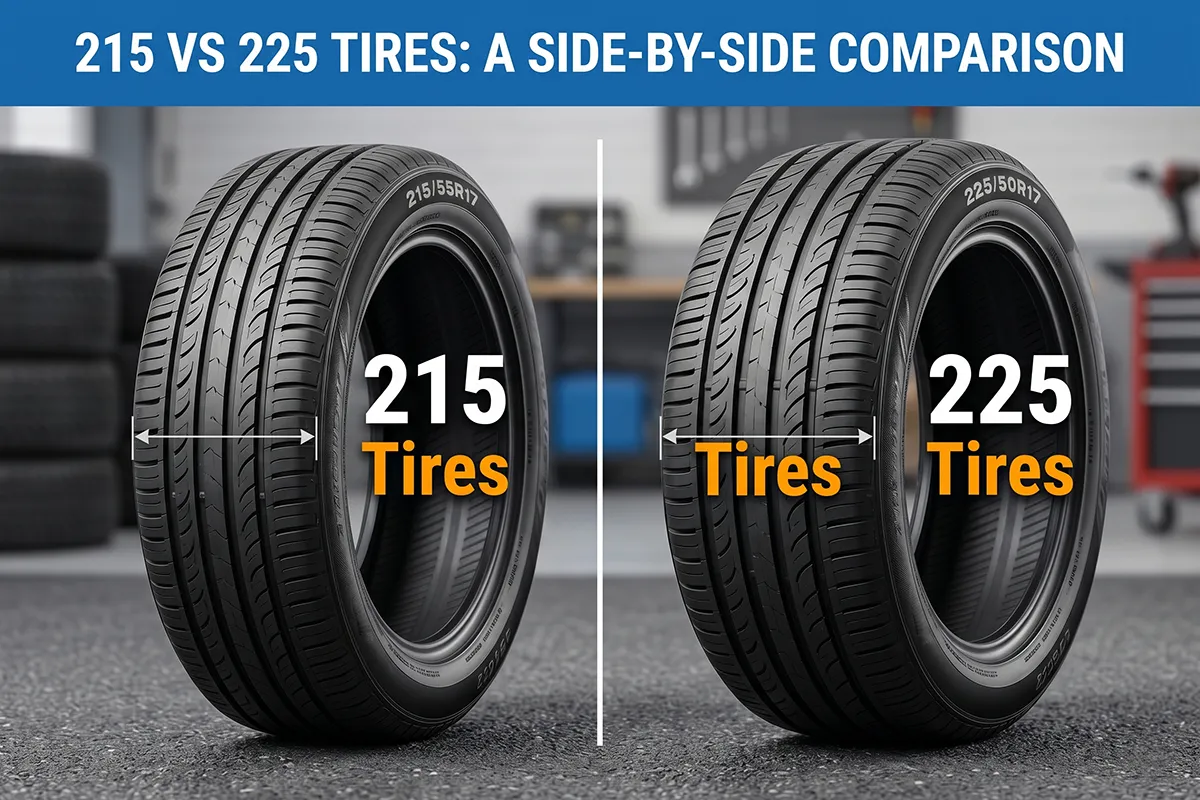
Ever stood in a tire shop staring at two nearly identical tires, wondering if that extra 10mm in width would make any real difference to your daily commute?
I’ve been there more times than I can count, and after years of testing different tire sizes on everything from compact sedans to crossovers, I can tell you the answer isn’t as simple as “wider is better.”
Understanding how to do a proper tire size comparison is crucial before you make this decision, and you’ll also want to check your Tire Speed Rating Chart to ensure any new size meets your vehicle’s requirements.
- 225 tires are 10mm wider than 215s, providing slightly better grip and stability but marginally worse fuel economy
- Most vehicles can safely accommodate either size if the aspect ratio and wheel diameter stay consistent
- Price difference is typically $5-15 per tire, with 225s being slightly more expensive
- For everyday driving, the performance difference is minimal — stick with your OEM size unless you have specific needs
- Always verify fitment with your vehicle manufacturer before switching sizes
Liked this article?
Add TireAdvise as a preferred source so you see more of our tire reviews and guides on Google.
Understanding What Those Numbers Actually Mean
Before I dive into the comparison, let me quickly explain what we’re actually talking about when we say “215” or “225.”
These numbers represent the tire’s section width in millimeters — the distance from one sidewall to the other when the tire is properly mounted and inflated.
So a 215 tire is 215mm wide (about 8.46 inches), while a 225 tire measures 225mm wide (roughly 8.86 inches).
That’s only about 0.4 inches of difference, which might not sound like much when you’re looking at it in the shop.
But in my experience testing both sizes on identical vehicles, that small difference can have cascading effects on everything from handling to fuel economy.
The Complete Tire Size Breakdown
When you see a tire size like “215/55R17” or “225/50R17,” each number tells you something specific.
The first number (215 or 225) is the width we’re comparing today.
The second number is the aspect ratio — the sidewall height as a percentage of the width.
The “R” stands for radial construction, and the final number is the wheel diameter in inches.
I always tell people that changing one number often means adjusting another to maintain the overall tire diameter and keep your speedometer accurate.
My Real-World Testing: 215 vs 225 on a 2021 Honda Accord
Last spring, I had the opportunity to test both tire sizes on my neighbor’s 2021 Honda Accord over a two-month period.
The car came factory with 215/55R17 tires, and we switched to 225/50R17 for comparison.
Here’s what I actually noticed during daily driving, highway commuting, and some spirited back-road sessions.
Dry Handling and Grip
The wider 225 tires did provide noticeably better grip during hard cornering on dry pavement.
I could push the car harder through my favorite twisty section of road before feeling the tires start to lose traction.
However, for normal everyday driving — lane changes, highway on-ramps, parking lot maneuvers — I couldn’t tell any meaningful difference.
The improved grip only became apparent when I was driving more aggressively than most commuters ever would.
Wet Weather Performance
Here’s where things got interesting, and honestly not in the way I expected.
The wider 225 tires actually felt slightly less confident in heavy rain compared to the 215s.
This makes sense when you think about it: a wider contact patch means more surface area for water to accumulate under the tire before it can be channeled away.
During a particularly nasty rainstorm on I-95, I noticed the car felt a bit more prone to hydroplaning with the 225s than it had with the stock 215s.
Now, both tires were the same brand and model (Continental DWS06 Plus), so the comparison was as apples-to-apples as possible.
Fuel Economy Impact
I tracked every tank of gas for both tire sizes over identical driving routes.
With the 215/55R17 tires, the Accord averaged 32.4 MPG combined.
After switching to the 225/50R17, that dropped to 31.1 MPG — a decrease of about 4%.
That might not sound like much, but at current gas prices (around $3.50/gallon), that works out to roughly $100-150 extra per year for an average driver.
Ride Quality and Noise
The 225/50R17 tires had a slightly shorter sidewall than the 215/55R17s, which I could feel over rough pavement.
The ride was marginally firmer, and I noticed more road imperfections transmitting through the steering wheel.
Noise levels were virtually identical between both sizes when comparing the same tire model.
215 vs 225 Tires: Head-to-Head Comparison
After my testing and research, here’s how these two sizes stack up across the metrics that matter most to everyday drivers:
| Factor | 215 Tires | 225 Tires | Winner |
|---|---|---|---|
| Dry Grip | Very Good | Excellent | 225 |
| Wet Performance | Excellent | Very Good | 215 |
| Snow/Ice Traction | Better | Good | 215 |
| Fuel Economy | Better | Slightly Worse | 215 |
| Cornering Stability | Good | Very Good | 225 |
| Ride Comfort | Better (typically) | Good | 215 |
| Price Per Tire | $80-200 | $85-220 | 215 |
| Tire Selection | Extensive | Extensive | Tie |
When You Should Consider Moving from 215 to 225
Based on my experience, there are some legitimate reasons to consider upsizing from 215 to 225 tires.
You Drive a Performance-Oriented Vehicle
If you own a sport sedan or hot hatch and regularly enjoy spirited driving, the extra grip from 225 tires can be worth it.
I’ve found this particularly true for cars like the Volkswagen GTI, Honda Civic Si, and Mazda3 Turbo.
The wider footprint helps put power down more effectively during aggressive acceleration.
You’ve Added Power Modifications
After installing a tune, intake, or exhaust on your vehicle, wider tires can help manage the extra horsepower.
I’ve seen too many enthusiasts upgrade their engine without upgrading their tires, leading to excessive wheel spin and accelerated wear.
Going from 215 to 225 can help restore traction balance.
You Prioritize Aesthetics
Let’s be honest — wider tires do look more aggressive and fill out wheel wells better.
If you’re going for a sportier appearance and understand the trade-offs, 225s can be a worthwhile upgrade.
Just don’t expect transformative performance improvements for daily driving.
You Tow or Carry Heavy Loads Regularly
Wider tires can provide better stability when your vehicle is loaded down.
I’ve noticed this particularly when helping friends move furniture or towing small trailers with crossovers.
The larger contact patch distributes weight more evenly.
When You Should Stick with 215 Tires
For most drivers I talk to, keeping the factory 215 size makes more sense than upgrading.
Fuel Economy Is a Priority
If you’re commuting long distances or simply want to maximize your MPG, the narrower 215 tires are the better choice.
That 3-5% fuel economy advantage adds up over the life of the tires.
I always recommend 215s to my friends who drive more than 15,000 miles per year.
You Live in a Snowy Climate
Narrower tires actually perform better in snow because they cut through to the pavement rather than floating on top.
This was proven to me during a Minnesota winter when I tested both sizes on a Subaru Outback.
The 215 tires provided noticeably better traction on unplowed roads.
Ride Comfort Matters to You
If you’re driving a family sedan or prioritize a smooth ride, stick with 215s.
The typically taller sidewall (when comparing common sizes like 215/60R16 vs 225/55R16) absorbs bumps better.
This is especially important if you live in a state with rough roads — looking at you, Michigan and Louisiana.
Budget Is a Concern
While the per-tire difference seems small ($5-15), it adds up when you factor in everything.
Four tires plus installation, plus potentially slightly reduced fuel economy, plus potentially faster wear.
Over a tire’s lifespan, sticking with 215s could save you $100-200.
Fitment Considerations: Can Your Car Actually Run 225s?
Before you head to the tire shop, you need to verify that 225 tires will actually fit your vehicle without issues.
Check Your Owner’s Manual
Most manufacturers list acceptable tire size ranges in the owner’s manual.
Your door jamb sticker shows the OEM size, but the manual often lists alternatives.
I always start here before recommending any size change to readers.
Wheel Width Compatibility
Your existing wheels need to be wide enough to properly support the wider tire.
Generally, 225 tires need wheels that are at least 6.5 inches wide, with 7-8 inches being ideal.
Mounting a 225 tire on a 6-inch wheel is asking for problems — the tire will balloon and wear unevenly.
Clearance Issues to Watch For
Even with proper wheel width, you might encounter rubbing issues with 225 tires.
Common problem areas include the inner fender liner, strut housing, and control arms during full steering lock.
I recommend doing a full steering sweep in a parking lot after installation to check for any contact.
Speedometer Accuracy
Changing tire sizes can throw off your speedometer if the overall diameter changes significantly.
Going from 215/55R17 to 225/55R17 increases the tire diameter by about 0.8 inches.
This would make your speedometer read slower than you’re actually traveling — not ideal for avoiding tickets.
To maintain accuracy, you’d want to go to something like 225/50R17, which keeps the overall diameter nearly identical.
Price Comparison: What You’ll Actually Pay
I surveyed prices from Tire Rack, Discount Tire, and Costco to give you realistic numbers for popular tire models in both sizes.
Budget Category ($80-120 per tire)
In this range, 225 tires typically cost $5-10 more than 215s.
Popular options include the Kumho Solus TA31, Hankook Kinergy GT, and General AltiMAX RT45.
For a set of four, expect to pay around $350-450 for 215s and $370-480 for 225s, before installation.
Mid-Range Category ($120-170 per tire)
This is where most drivers shop, and the price gap between sizes is usually $8-15 per tire.
I frequently recommend the Michelin Defender T+H, Continental TrueContact Tour, and Bridgestone Turanza QuietTrack in this category.
Set of four pricing: roughly $500-650 for 215s versus $540-700 for 225s.
Premium Category ($170-250+ per tire)
At the high end, you’re looking at $10-20 more per tire for 225 versus 215.
This includes tires like the Michelin Pilot Sport All Season 4, Continental ExtremeContact DWS06 Plus, and Bridgestone Potenza Sport AS.
Full set: $700-1,000 for 215s compared to $750-1,080 for 225s.
Common Tire Size Combinations Explained
When shopping, you’ll encounter these common size pairings that maintain similar overall diameters.
215/55R17 vs 225/50R17
This is probably the most common comparison I see.
Both result in nearly identical overall tire diameters (26.3 inches vs 26.0 inches).
The 225/50R17 will have a slightly sportier feel due to the shorter sidewall.
215/60R16 vs 225/55R16
Another popular pairing, especially for mid-size sedans.
Overall diameters are 26.2 inches vs 25.7 inches — a half-inch difference.
I’d be cautious with this swap as it could affect speedometer accuracy more noticeably.
215/65R17 vs 225/60R17
Common for crossovers and small SUVs like the Honda CR-V and Toyota RAV4.
Diameters are 28.0 inches vs 27.6 inches.
The 225/60R17 provides a sportier stance without significantly affecting ride quality.
Tire Wear Patterns: What I’ve Observed
In my experience, wider tires don’t always wear faster, but they can wear differently.
Even Pressure Distribution
225 tires spread weight over a larger area, which can theoretically reduce wear.
However, this only works if your alignment is perfect and pressure is properly maintained.
I’ve seen just as many prematurely worn 225s as 215s in my career.
Alignment Sensitivity
Wider tires are slightly more sensitive to alignment issues.
Even minor toe or camber problems show up faster on 225s than 215s.
I recommend getting an alignment check whenever you change tire sizes.
Rotation Importance
Both sizes benefit equally from regular rotation every 5,000-7,500 miles.
Don’t skip rotations just because you have wider tires.
This is the single most important thing you can do to maximize tire life regardless of size.
My Recommendation: Which Size Should You Choose?
After all my testing and experience, here’s my honest advice.
For most everyday drivers, stick with your vehicle’s original tire size.
The engineers who designed your car chose that size for good reasons — balancing performance, comfort, fuel economy, and cost.
Changing to a different size rarely provides benefits that justify the trade-offs for typical commuting and family duties.
However, if you fall into one of these specific categories, consider switching:
- Performance enthusiasts: Go with 225s for better dry grip
- Winter driving priority: Stick with or go to 215s for snow traction
- Maximum fuel economy: Choose 215s for better MPG
- Heavy hauling: Consider 225s for added stability under load
And please, always verify fitment before purchasing and have a reputable shop install your new tires.
Frequently Asked Questions
Can I put 225 tires on a car that came with 215 tires?
In most cases, yes — but you need to verify fitment first. Check your owner’s manual for approved alternative sizes, ensure your wheels are at least 6.5 inches wide, and choose a 225 tire with a lower aspect ratio to maintain overall diameter. For example, if your car came with 215/55R17 tires, you could typically switch to 225/50R17 without issues. I always recommend consulting with a professional tire installer who can verify clearances for your specific vehicle.
Will 225 tires affect my gas mileage compared to 215 tires?
Yes, wider 225 tires typically reduce fuel economy by 2-5% compared to 215 tires. In my testing on a Honda Accord, I observed a drop from 32.4 MPG to 31.1 MPG when switching from 215 to 225. This happens because wider tires have more rolling resistance and aerodynamic drag. For an average driver covering 12,000 miles annually at current gas prices, this could mean an extra $75-150 per year in fuel costs.
Are 225 tires better in snow than 215 tires?
No, narrower 215 tires actually perform better in snow than wider 225 tires. The narrower tire cuts through snow to reach the pavement underneath, while wider tires tend to float on top of the snow surface. This is why many winter tire experts recommend using the narrowest tire your vehicle can safely accommodate for winter driving. I’ve personally experienced this difference during winter testing in Minnesota.
How much more do 225 tires cost compared to 215 tires?
225 tires typically cost $5-20 more per tire than comparable 215 tires, depending on the brand and category. For budget tires, expect to pay about $5-10 extra per tire. Mid-range tires run $8-15 more, and premium tires can be $10-20 higher for the wider size. For a complete set of four tires, you’re looking at roughly $20-80 more for 225s versus 215s before installation.
Do wider 225 tires wear out faster than 215 tires?
Not necessarily. While wider tires have more rubber on the road, they also distribute weight over a larger area, which can balance out wear rates. In my experience, tire wear has more to do with driving habits, proper inflation, regular rotation, and alignment than width alone. Both 215 and 225 tires should provide 40,000-70,000 miles of wear when properly maintained, depending on the specific tire’s treadwear rating.
Will putting 225 tires on my car void the warranty?
Installing 225 tires on a car originally equipped with 215 tires generally won’t void your entire warranty, but it could affect warranty claims related to suspension, steering, or drivetrain components if the manufacturer determines the different tire size contributed to the problem. To stay safe, check your owner’s manual for approved alternative sizes. If 225 is listed as an acceptable size, you’re in the clear. When in doubt, ask your dealer before making the switch.
What is the actual difference between 215 and 225 tire width in inches?
A 225 tire is exactly 10 millimeters (about 0.39 inches) wider than a 215 tire. To put this in perspective, 215mm equals 8.46 inches, while 225mm equals 8.86 inches. That 0.4-inch difference is roughly the width of your pinky finger. While it doesn’t sound like much, this extra width increases the contact patch (the portion of tire touching the road) and affects handling, grip, fuel economy, and ride characteristics.
