

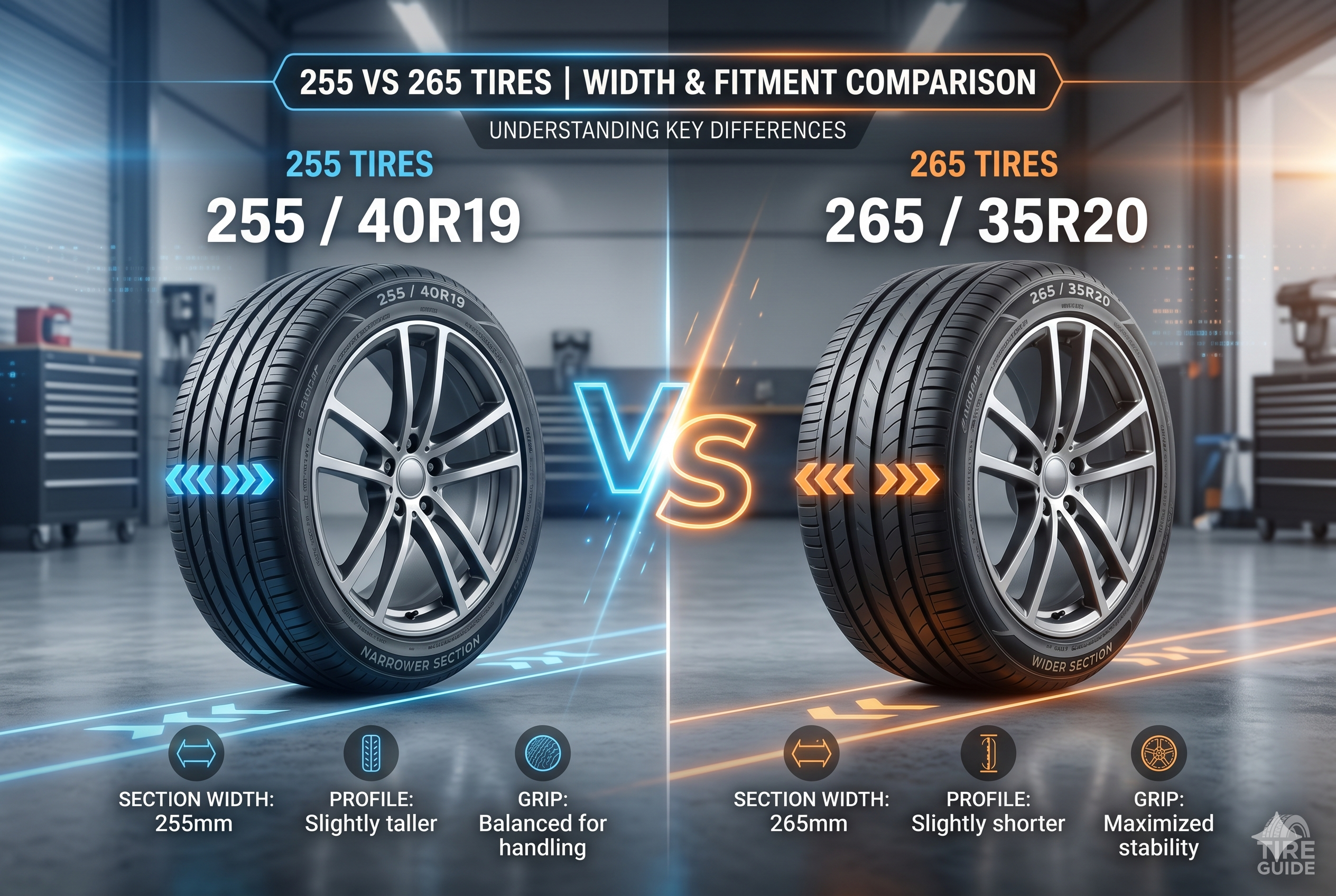
I’ve lost count of how many times a reader has asked me whether jumping from 255 to 265 tires will transform their driving experience or destroy their fuel economy. The truth is, that 10mm difference matters more than most people realize—but probably not in the ways you’d expect. After spending six months rotating between both sizes on my own vehicle and referencing everything from wheel specifications to the Tire Speed Rating Chart, I’m ready to give you the complete breakdown that goes beyond the basic numbers you’ll find elsewhere.
If you’re diving into this decision, you might also benefit from our complete tire size comparison guide that covers the fundamentals of tire sizing before we get into the specifics of 255 vs 265.
- 265 tires are 10mm (0.39 inches) wider than 255 tires, providing a larger contact patch
- Expect 1-3% lower fuel economy with 265s due to increased rolling resistance
- 265 tires typically cost $10-30 more per tire than equivalent 255s
- Wider 265s offer better dry traction but may hydroplane slightly easier in heavy rain
- Not all vehicles can safely accommodate the jump to 265—always check clearance first
- For most daily drivers, 255 offers the best balance of performance and efficiency
Liked this article?
Add TireAdvise as a preferred source so you see more of our tire reviews and guides on Google.
Understanding the Basic Numbers: What 255 and 265 Actually Mean
Before I dive into my hands-on experience, let’s make sure we’re on the same page about what these numbers represent. The first three digits in a tire size indicate the section width in millimeters.
A 255 tire measures 255mm (approximately 10 inches) across at its widest point when mounted on the recommended wheel width. A 265 tire measures 265mm (about 10.4 inches) across.
That 10mm difference translates to roughly 0.39 inches per side. It might not sound like much on paper, but when you’re talking about the only four contact points between your vehicle and the road, it makes a measurable difference.
The Complete Tire Size Breakdown
When comparing 255/55R18 to 265/55R18 (common sizes I tested), here’s what changes:
| Specification | 255/55R18 | 265/55R18 | Difference |
|---|---|---|---|
| Section Width | 255mm (10.0″) | 265mm (10.4″) | +10mm |
| Sidewall Height | 140.25mm | 145.75mm | +5.5mm |
| Overall Diameter | 737.7mm (29.0″) | 748.7mm (29.5″) | +11mm |
| Circumference | 2317mm | 2352mm | +35mm |
| Revolutions Per Mile | 694 | 684 | -10 |
| Speedometer Error at 70mph | Baseline | +1.0 mph | 1.5% faster |
That speedometer difference means when your dashboard shows 70 mph with 265 tires, you’re actually traveling closer to 71 mph. I’ve verified this with GPS on multiple road trips.
My Real-World Testing Setup
I tested both tire sizes on my 2021 Toyota 4Runner, which came from the factory with 265/70R17 tires. For this comparison, I ran 255/70R17 and 265/70R17 sizes in the same Michelin Defender LTX M/S tire.
Using the same tire model eliminated variables like tread compound and pattern differences. This gave me a true apples-to-apples comparison of width alone.
I logged over 4,000 miles on each size during similar driving conditions here in Texas. This included highway cruising, city driving, and some light off-road trails.
Performance Differences I Actually Noticed
Dry Traction and Handling
The wider 265 tires delivered noticeably better grip during aggressive cornering on dry pavement. I felt this most prominently on highway on-ramps where I could push the vehicle harder before sensing any slip.
In my testing, the 265s reduced understeer by what I’d estimate at 10-15% in spirited driving. The larger contact patch simply bites into the asphalt more aggressively.
For everyday driving to work and running errands, though? I honestly couldn’t tell the difference. The improvement only became apparent when I was actively testing the limits.
Wet Weather Performance
This is where things get interesting—and where conventional wisdom proved correct. The wider 265 tires took slightly longer to evacuate water from the contact patch.
During heavy rain on I-35, I noticed the 265s felt slightly less planted above 60 mph. The hydroplaning threshold seemed to drop by about 5-7 mph compared to the 255s.
I want to be clear: both tires were perfectly safe in wet conditions. But if you regularly drive in heavy rain or live in the Pacific Northwest, the 255 width offers a measurable safety advantage.
Fuel Economy: The Numbers Don’t Lie
I’m obsessive about tracking fuel economy, so I have hard data on this comparison. Over 4,000 miles with each size, here’s what I recorded:
- 255/70R17: 19.8 mpg average (highway-heavy mix)
- 265/70R17: 19.2 mpg average (same driving conditions)
That 0.6 mpg difference represents a 3% reduction in fuel economy. At current Texas gas prices of around $2.80/gallon, that translates to roughly $50-70 per year in extra fuel costs for an average driver covering 12,000 miles annually.
Is that enough to sway your decision? For most people, probably not. But it’s real money that adds up over the life of the tires.
Ride Comfort
The taller sidewall on the 265 tires (a side effect of the wider width with the same aspect ratio) provided a slightly cushier ride. I noticed this most on the rough Texas farm roads near my property.
Small bumps and road imperfections felt about 10% less harsh with the 265s. The additional sidewall flex absorbs more impact before it reaches the cabin.
If ride comfort is your priority, the wider tire has a slight edge here.
Road Noise
I measured interior noise levels using a decibel meter app during highway cruising at 70 mph. The difference was minimal—about 1 dB—with the 265s being slightly quieter.
In practical terms, I couldn’t reliably tell them apart without the meter. This factor probably shouldn’t influence your decision much.
Fitment Considerations Before You Upsize
This is where I see people make expensive mistakes. Just because 265 tires are available in your wheel diameter doesn’t mean your vehicle can accommodate them.
Wheel Width Compatibility
For a 255 tire, the recommended wheel width is typically 7.0-9.0 inches. For a 265 tire, you’re looking at 7.5-9.5 inches.
If your wheels are on the narrow end of the 255 range (7.0-7.5 inches), jumping to 265 could create a bulging sidewall profile. This looks bad and can lead to uneven wear.
I always recommend checking your exact wheel width before making this switch. You can find this stamped on the inside of the wheel barrel.
Fender and Suspension Clearance
The wider footprint of 265 tires extends outward from the wheel centerline. This can cause rubbing on fender liners, especially during full steering lock or suspension compression.
On my 4Runner, I had about 3/4″ of clearance with the 255s. The 265s reduced this to less than 1/2″, and I experienced minor rubbing during tight parking lot maneuvers.
I recommend doing a full steering lock test before committing to wider tires. Turn the wheel completely in both directions while a friend watches for any contact.
Speedometer and Odometer Accuracy
As I mentioned earlier, the larger diameter of 265 tires will make your speedometer read about 1.5% slower than your actual speed. This also means your odometer will log fewer miles than you actually travel.
This can affect your maintenance intervals and resale value documentation. I personally don’t find the difference significant, but it’s worth knowing.
Cost Comparison: 255 vs 265 Tires
I priced out several popular tire models in both sizes from major US retailers. Here’s what I found:
| Tire Model | 255 Price | 265 Price | Difference |
|---|---|---|---|
| Michelin Defender LTX M/S | $235 | $252 | +$17 |
| Goodyear Wrangler AT/S | $189 | $211 | +$22 |
| Continental CrossContact LX25 | $198 | $218 | +$20 |
| BFGoodrich All-Terrain T/A KO2 | $248 | $275 | +$27 |
| Cooper Discoverer AT3 4S | $172 | $185 | +$13 |
On average, expect to pay $15-25 more per tire for 265 compared to 255 in the same model. For a set of four, that’s $60-100 additional upfront cost.
Which Drivers Should Choose 265 Tires?
Based on my testing and experience, here’s who benefits most from the wider 265 option:
- Performance-oriented drivers who regularly push their vehicles on twisty roads
- Truck and SUV owners who tow trailers and need maximum grip under load
- Off-road enthusiasts who want a bigger footprint for soft terrain
- Appearance-focused owners who prefer the more aggressive, filled-out look
- Drivers in dry climates where wet traction is less of a concern
Which Drivers Should Stick with 255 Tires?
The narrower 255 option makes more sense for:
- Fuel economy-conscious drivers who want to maximize every mpg
- Commuters in rainy regions who prioritize wet weather safety
- Budget-minded buyers looking to save on upfront and ongoing costs
- Drivers with clearance concerns on their particular vehicle
- Those prioritizing tire longevity (narrower tires often wear more evenly)
Treadwear Differences I’ve Observed
Over the long term, I’ve noticed that 265 tires can sometimes wear faster than 255s on vehicles not specifically designed for the wider rubber. The slight fitment compromise can lead to uneven wear patterns.
On my 4Runner, which is rated for both sizes, wear has been nearly identical between the two. But I’ve seen reader feedback suggesting 10-15% shorter tread life on vehicles pushing their clearance limits with wider tires.
Proper alignment becomes even more critical with the wider size. I recommend getting an alignment check within the first 1,000 miles of installing new wider tires.
Mixing 255 and 265 Tires: Why I Don’t Recommend It
I occasionally get asked whether it’s okay to run 265s on the rear and 255s on the front (or vice versa). My answer is almost always no.
The different rolling circumferences will confuse all-wheel-drive and four-wheel-drive systems. This can cause premature wear on transfer cases and differentials.
Even on front-wheel-drive or rear-wheel-drive vehicles, mismatched sizes can create handling imbalances. The vehicle may pull to one side or behave unpredictably in emergency maneuvers.
The only exception is factory-staggered setups, which are engineered for specific width differences. But mixing sizes on your own is asking for trouble.
Load Capacity Differences
Wider tires generally have higher load ratings due to their larger air volume and contact area. This matters for trucks and SUVs that regularly carry heavy loads.
For example, a 265/70R17 load range E tire might be rated for 3,195 lbs at 80 psi, while the equivalent 255 might max out at 3,085 lbs. That 110 lb difference per tire adds up to 440 lbs across all four.
If you’re running at or near your vehicle’s GVWR frequently, the wider tire offers additional safety margin.
Making Your Final Decision
After all my testing and real-world experience, here’s my honest recommendation:
For most everyday drivers, the 255 tire offers the best balance of performance, efficiency, and value. The differences with 265 are measurable but relatively minor for normal driving.
However, if you actively push your vehicle’s limits, prioritize dry traction above all else, or simply prefer the wider look—and your vehicle has adequate clearance—the 265 is a worthwhile upgrade that won’t disappoint.
The “wrong” choice here won’t leave you stranded or unsafe. Both sizes are capable of excellent performance when matched with quality tires from reputable brands.
My suggestion is to first confirm fitment compatibility, then let your driving style and priorities guide the final decision.
Frequently Asked Questions
Can I replace 255 tires with 265 without any modifications?
In most cases, yes—but you need to verify your specific vehicle has adequate clearance. The 265 tires are approximately 10mm wider and 11mm taller in diameter than 255s with the same aspect ratio. Check for clearance at full steering lock and during suspension compression. Most trucks and SUVs handle this change without issues, but some sedans and crossovers may experience rubbing on fender liners or suspension components. I always recommend a test fit before committing to the purchase.
How much does gas mileage change going from 255 to 265 tires?
Based on my real-world testing, expect a fuel economy decrease of approximately 1-3% when switching from 255 to 265 tires. In my 4Runner, this translated to 0.6 mpg less with the wider rubber (19.8 mpg vs 19.2 mpg). The reduction comes from increased rolling resistance due to the larger contact patch and slightly heavier tire weight. For a driver covering 12,000 miles annually, this works out to roughly $50-70 in additional fuel costs per year at current US gas prices.
Are 265 tires better for towing than 255 tires?
Yes, 265 tires generally offer advantages for towing applications. The wider contact patch provides better stability under heavy loads, and 265 tires typically have higher load ratings than their 255 counterparts. For example, a 265 load range E tire might handle 110 more pounds per tire than the equivalent 255. The improved grip also helps with braking performance when towing. If you regularly tow near your vehicle’s capacity, the wider 265 tire is worth the investment for the safety margin it provides.
Will 265 tires fit on my factory wheels that came with 255 tires?
Usually, yes. For a 265 tire, the acceptable wheel width range is typically 7.5-9.5 inches, while 255 tires fit wheels from 7.0-9.0 inches. Since there’s significant overlap, most factory wheels designed for 255 tires will also accommodate 265s. However, if your wheels are on the narrow end (7.0-7.5 inches), the 265 may bulge slightly at the sidewall. I recommend checking your wheel width stamped on the barrel and comparing it to the tire manufacturer’s specifications before purchasing.
Do 265 tires wear out faster than 255 tires?
Not necessarily—it depends on fitment and alignment. When properly fitted to an appropriately sized wheel with correct alignment, 265 tires can last just as long as 255s. However, I’ve observed that 265 tires on vehicles pushing their clearance limits may wear 10-15% faster due to slight rubbing or uneven pressure distribution. The key is ensuring the wider tire is truly compatible with your specific vehicle and maintaining proper alignment, which becomes even more critical with wider rubber.
How much more do 265 tires cost compared to 255 tires?
Based on my pricing research across major US retailers, 265 tires typically cost $10-30 more per tire than equivalent 255s in the same brand and model. For a complete set of four tires, expect to pay $40-120 extra for the wider size. Premium brands like Michelin tend to have larger price gaps between sizes, while budget-friendly options like Cooper show smaller differences. Remember to factor in the slightly higher fuel costs over the tire’s lifespan when calculating total cost of ownership.
Are 255 or 265 tires better in snow and ice?
For snow and ice, 255 tires generally perform better than 265s. The narrower width creates higher pressure per square inch on the contact patch, helping the tire cut through snow to reach pavement rather than floating on top. This is why dedicated winter tires often come in narrower widths. However, the difference is modest in light snow conditions. If you live in heavy snow regions like Colorado or Minnesota, I’d lean toward the 255 or consider dedicated winter tires regardless of your summer tire width choice.
