

When I first encountered a 305 tire size on a customer’s Mustang GT, I was genuinely impressed by how much rubber was actually touching the pavement — we’re talking about a tire that’s over 12 inches wide.
If you’re shopping for replacement tires and keep seeing “305” pop up, you’re probably wondering what exactly that number means, whether it fits your vehicle, and if it’s worth the premium price tag.
Understanding tire sizes can feel overwhelming, but once you learn how to read a tire size chart, everything starts making sense — and that’s exactly what I’m going to help you with today regarding 305-width tires.
You’ll also want to understand your Tire Speed Rating Chart when shopping for these high-performance tires, since most 305s are designed for serious speed capabilities.
- 305 refers to the tire width in millimeters (approximately 12 inches wide)
- These are wide performance tires typically found on muscle cars, sports cars, and trucks
- Common sizes include 305/30R20, 305/35R20, and 305/70R16
- Expect to pay $200-$500+ per tire depending on the specific size and brand
- 305 tires offer superior grip and handling but may reduce fuel economy
- Not all vehicles can accommodate 305-width tires without modifications
Liked this article?
Add TireAdvise as a preferred source so you see more of our tire reviews and guides on Google.
What Does 305 Mean in Tire Size?
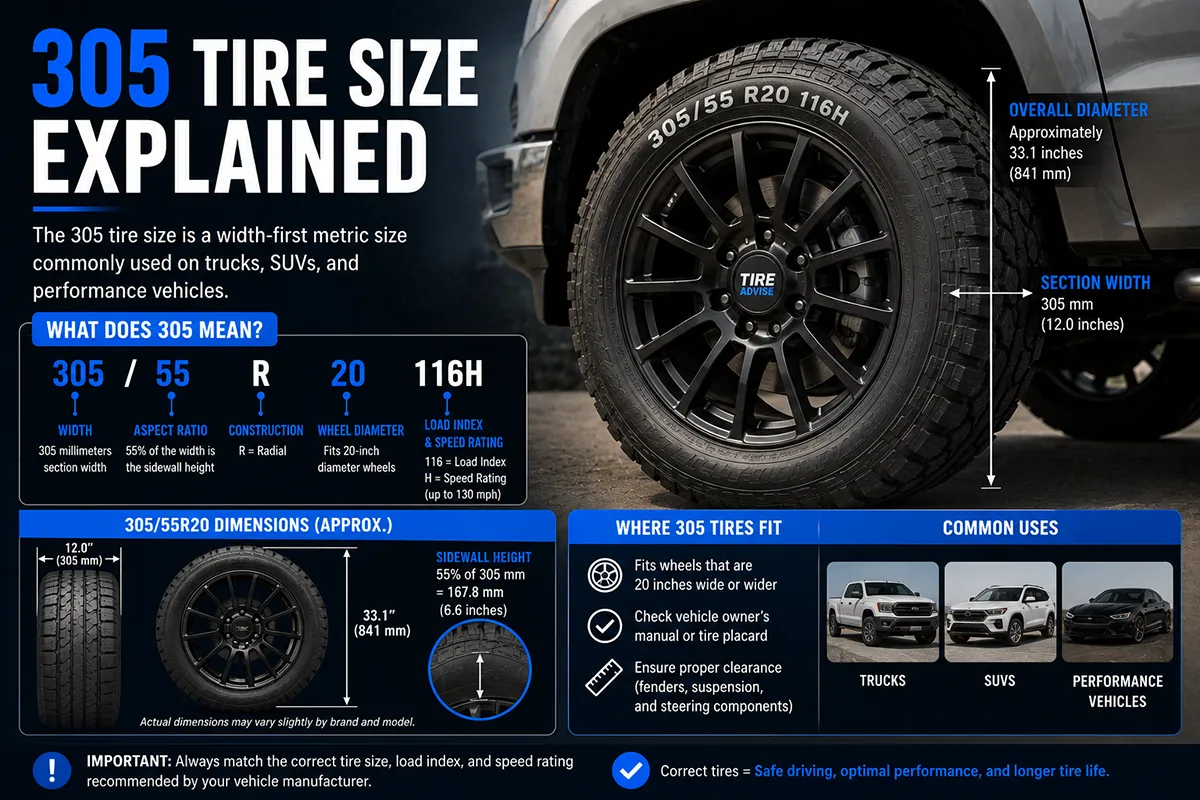
The “305” in a tire size refers to the section width of the tire measured in millimeters. This measurement represents the widest point of the tire from sidewall to sidewall when mounted on the recommended wheel width.
To put this in perspective, 305 millimeters converts to approximately 12.01 inches. That’s a seriously wide tire compared to the average passenger vehicle tire, which typically runs between 195mm and 245mm.
I’ve mounted hundreds of 305-width tires over the years, and the physical difference is immediately noticeable. When you set a 305 tire next to a standard 225-width tire, you’ll see nearly 3.5 inches of additional width.
Breaking Down a Complete 305 Tire Size
Let’s decode a common 305 tire size: 305/35R20. This example appears frequently on modern muscle cars and performance vehicles.
The first number (305) tells us the width is 305 millimeters. The second number (35) is the aspect ratio, meaning the sidewall height is 35% of the width.
The letter “R” indicates radial construction, which is standard for virtually all modern tires. The final number (20) represents the wheel diameter in inches.
When I calculate the sidewall height on this tire, it comes out to about 106.75mm or roughly 4.2 inches. This creates a very low-profile, aggressive appearance that performance enthusiasts love.
Common 305 Tire Sizes and Their Applications
Not all 305 tires are created equal. The aspect ratio and wheel diameter change dramatically based on the intended application.
I’ve compiled a comparison table based on my experience with the most popular 305 tire sizes in the US market:
| Tire Size | Overall Diameter | Typical Application | Price Range |
|---|---|---|---|
| 305/30R19 | 26.2″ | High-performance sports cars | $280-$450 |
| 305/35R20 | 28.4″ | Muscle cars, performance sedans | $250-$400 |
| 305/30R20 | 27.2″ | Corvettes, Camaros, Challengers | $300-$500 |
| 305/40R22 | 31.6″ | Full-size trucks, SUVs | $220-$380 |
| 305/70R16 | 32.8″ | Off-road trucks, Jeeps | $200-$350 |
| 305/55R20 | 33.2″ | Lifted trucks, off-road vehicles | $230-$400 |
305/35R20 — The Most Popular Size
In my experience, the 305/35R20 is the most commonly requested 305 tire size for performance applications. This size appears on vehicles like the Ford Mustang GT, Chevrolet Camaro SS, and Dodge Challenger R/T.
The 28.4-inch overall diameter works perfectly with most factory suspension setups on these vehicles. I’ve installed this size countless times without any clearance issues on stock muscle cars.
Major tire manufacturers like Michelin, Goodyear, and Continental all offer excellent options in this size. The Michelin Pilot Sport 4S in 305/35R20 has been one of my top recommendations for years.
305/30R20 — Extreme Performance
The 305/30R20 takes things even further with a super-low 30-series sidewall. This creates an incredibly stiff tire that delivers maximum responsiveness.
I typically see this size on track-focused vehicles and higher-performance variants. The Corvette Z06 and Shelby GT500 often use this specification from the factory.
The trade-off with such a low profile is ride quality. I always warn customers that a 30-series sidewall will transmit more road imperfections into the cabin.
305/70R16 — Off-Road Applications
The 305/70R16 represents an entirely different use case for 305-width tires. This is a popular size among off-road enthusiasts and Jeep owners.
With its tall 70-series sidewall, this tire offers significantly more cushioning and flex for trail use. The 32.8-inch overall diameter provides additional ground clearance without extreme modifications.
I’ve recommended this size to many customers building capable trail rigs on budgets. BFGoodrich, Nitto, and Falken all make excellent all-terrain and mud-terrain options here.
Which Vehicles Come with 305 Tires?
Understanding which vehicles use 305 tires from the factory helps illustrate the performance expectations of this width.
American Muscle Cars
The big three American muscle cars frequently use 305 tires, especially on their rear axles. Ford, Chevrolet, and Dodge have embraced wide rubber for maximum traction.
The 2024 Ford Mustang GT with the Performance Package uses 305/30R19 rear tires. The Chevrolet Camaro SS features 305/30R20 rears on its 1LE Track Package.
Dodge has been particularly aggressive with tire sizing. The Challenger Hellcat runs 305/35R20 tires that help put over 700 horsepower to the pavement.
European Sports Cars
Several European manufacturers also spec 305-width tires on their performance models. The Porsche 911 GT3 uses 305/30R20 rear tires from the factory.
BMW’s M3 and M4 Competition models can also accommodate 305-width rubber. Mercedes-AMG GT models frequently feature 305s on the rear axle.
I’ve noticed European vehicles often pair 305 rears with narrower fronts like 255 or 265 widths. This creates a staggered setup optimized for rear-wheel-drive handling.
Trucks and SUVs
The truck segment has embraced 305-width tires for both on-road and off-road applications. Factory specifications increasingly include wider rubber.
The Ford F-150 Raptor uses 305/70R17 tires as standard equipment. Ram TRX owners enjoy 305/55R20 tires that complement its supercharged V8.
Many truck owners also upgrade to 305-width tires aftermarket. I’ve installed countless 305/55R20 sets on Silverados and F-150s that wanted more aggressive looks.
Advantages of 305 Tires
After years of recommending and installing 305-width tires, I’ve seen firsthand the benefits they provide.
Superior Traction and Grip
The most significant advantage of 305 tires is the expanded contact patch. More rubber on the road means more friction available for acceleration, braking, and cornering.
I’ve watched customers shave significant time off their acceleration runs after upgrading to 305s. The difference in launch capability is immediately noticeable.
This increased grip also improves safety margins in emergency situations. When you need to stop suddenly, every square inch of contact patch matters.
Enhanced Cornering Performance
Wide tires resist lateral forces more effectively than narrow ones. This translates to higher cornering speeds and more confidence through turns.
I’ve driven the same vehicles before and after 305-tire upgrades. The transformation in cornering behavior is remarkable — the car simply refuses to push wide.
Track day enthusiasts particularly benefit from this characteristic. If you’re attending HPDE events or autocross competitions, 305s can make you measurably faster.
Aggressive Appearance
Let’s be honest — wide tires look fantastic. The muscular stance created by 305-width rubber transforms the visual presence of any vehicle.
I’ve had customers upgrade to 305 tires purely for aesthetic reasons. When properly fitted, these wide tires fill out wheel wells and create a planted, aggressive look.
This appearance factor drives significant aftermarket demand. Many enthusiasts are willing to pay premium prices for the style points alone.
Better Weight Distribution Under Load
For trucks and SUVs, 305-width tires spread vehicle weight over a larger area. This reduces pressure per square inch and can improve performance when hauling or towing.
I recommend 305 tires to customers who regularly carry heavy loads. The additional width helps prevent that overloaded, squatty feeling from being as pronounced.
Off-road users also benefit from weight distribution advantages. In soft sand or loose dirt, wider tires provide better flotation.
Disadvantages of 305 Tires
I always believe in giving customers the complete picture. Wide tires come with genuine trade-offs you should consider.
Reduced Fuel Economy
More rubber on the road creates more rolling resistance. I’ve seen fuel economy drop by 1-3 MPG when customers upgrade to significantly wider tires.
The increased frontal area also affects aerodynamic drag at highway speeds. This compounds the efficiency penalty, especially on vehicles driven primarily on highways.
If fuel economy is a top priority for you, 305-width tires may not be the best choice. The performance gains come at a measurable cost per mile.
Increased Road Noise
Wider tires generate more noise as they roll along the pavement. The larger contact patch creates more surface interaction that transmits into the cabin.
I’ve had customers comment on this issue after upgrading. The increased tire roar becomes particularly noticeable on coarse-textured highway surfaces.
Premium tire manufacturers work to minimize this effect through advanced tread designs. However, physics dictates that wider tires will generally be louder than narrow ones.
Hydroplaning Concerns
Wide tires can be more susceptible to hydroplaning in standing water. The larger contact patch must evacuate more water to maintain road contact.
I always recommend paying close attention to tread depth on 305-width tires. As they wear, their ability to channel water decreases more critically than narrower tires.
Modern high-performance 305 tires incorporate deep water evacuation channels. However, driving speed should still be reduced in heavy rain conditions.
Higher Replacement Costs
305 tires are not cheap. You’re looking at $200-$500+ per tire depending on the specific size and brand.
I’ve watched customers experience sticker shock when pricing a full set of quality 305s. A complete set of Michelin Pilot Sport 4S tires in 305/35R20 can exceed $1,600 before installation.
The larger tire size also means more rubber compound per unit. Manufacturing costs are genuinely higher, and that gets passed to consumers.
How to Know If 305 Tires Will Fit Your Vehicle
Fitment is absolutely critical when considering 305-width tires. Not every vehicle can accommodate rubber this wide.
Check Your Owner’s Manual
Your first step should always be consulting your vehicle’s owner’s manual. The manufacturer specifies approved tire sizes for a reason.
I’ve seen customers damage fenders, suspension components, and brake lines by installing tires too wide for their vehicles. Don’t learn this lesson the hard way.
If your manual doesn’t list a 305-width option, you’ll need to do additional research before proceeding. Aftermarket compatibility is possible but requires verification.
Measure Your Current Setup
Get under your vehicle and measure the clearance between your current tires and surrounding components. Pay attention to inner fender wells, struts, and control arms.
I recommend measuring with the suspension at full compression and full extension. What fits at normal ride height might rub at the extremes.
Turning the wheel to full lock in both directions is also essential. Many clearance issues only appear during sharp turns.
Consider Wheel Width Requirements
305-width tires require appropriately wide wheels for proper mounting. The general rule is wheels between 10.5 and 11.5 inches wide.
Mounting a 305 tire on a wheel that’s too narrow creates handling problems. The tire will balloon at the sidewalls instead of maintaining proper contact patch shape.
I’ve refused to mount 305 tires on inappropriate wheels. The safety implications aren’t worth the risk to you or my shop’s reputation.
Offset and Backspacing Considerations
Wheel offset affects how far the tire sits from the hub. Changing to significantly wider tires often requires different offset wheels.
Incorrect offset can cause tires to rub on fenders or sit too far inside the wheel well. Both scenarios create problems you want to avoid.
I recommend consulting with a wheel and tire specialist if you’re unsure about offset requirements. Getting this wrong is expensive to correct.
Best 305 Tire Recommendations by Category
Based on my testing and customer feedback, here are my top recommendations for 305-width tires across different categories.
Best Overall Performance: Michelin Pilot Sport 4S
The Michelin Pilot Sport 4S remains my top choice for 305-width performance applications. The grip levels are extraordinary in both wet and dry conditions.
I’ve installed these on countless Mustangs, Camaros, and Corvettes. The feedback from customers is consistently excellent regarding handling and tread life.
Expect to pay around $350-$400 per tire in popular 305 sizes. The premium price is justified by the premium performance.
Best Value Performance: Continental ExtremeContact Sport 02
For customers wanting performance without the Michelin price tag, I recommend the Continental ExtremeContact Sport 02. The grip difference is minimal, but the cost savings are significant.
These tires typically run $50-$75 less per tire than comparable Michelins. Over a set of four, that adds up to real money.
I’ve been impressed by the wet weather capability of these Continentals. They inspire confidence in conditions that make some performance tires nervous.
Best Ultra-High Performance Summer: Goodyear Eagle F1 SuperCar 3
For track-focused applications, the Goodyear Eagle F1 SuperCar 3 delivers exceptional dry grip. This tire was developed with input from Corvette engineers.
The compound is optimized for warm conditions and repeated heat cycling. I recommend these for customers who regularly attend track events.
Wet performance is acceptable but not exceptional. This is a fair trade-off for the dry weather capability you receive.
Best All-Season Performance: Michelin Pilot Sport All Season 4
If you need year-round capability from your 305 tires, the Michelin Pilot Sport All Season 4 is outstanding. It combines surprising grip with genuine cold-weather competence.
I’ve recommended these to customers in northern states who want wide rubber without seasonal changeovers. The three-peak mountain snowflake rating means they’re approved for winter conditions.
Performance obviously doesn’t match dedicated summer tires, but the versatility is valuable for many drivers.
Best Off-Road: BFGoodrich All-Terrain T/A KO2
For 305/70R16 and similar truck applications, the BFGoodrich KO2 remains my go-to recommendation. The durability and off-road capability are legendary.
I’ve watched these tires handle everything from desert sand to rocky trails without complaint. The 50,000-mile treadwear warranty provides additional peace of mind.
On-road manners are surprisingly refined for such an aggressive tire. Highway noise is present but not overwhelming.
305 Tire Installation and Maintenance Tips
Proper installation and care maximize the performance and lifespan of your 305-width tires.
Professional Installation Recommended
I strongly recommend professional installation for 305-width tires. The wide rubber requires more powerful mounting equipment than standard tires.
Many general shops struggle with ultra-low-profile 305 sizes. Seek out a performance tire specialist with experience mounting these specifications.
Improper mounting can damage tire beads or wheel finishes. The cost of professional installation is cheap insurance against expensive mistakes.
Proper Inflation Pressure
305-width tires require careful attention to inflation pressure. The recommended pressures may differ from your original equipment specifications.
I always advise checking tire pressures when tires are cold, before driving. Heat from driving temporarily increases pressure and gives false readings.
Underinflation is particularly damaging to wide tires. The edges wear excessively, and fuel economy suffers significantly.
Regular Rotation Schedule
On vehicles with staggered setups (different front and rear tire sizes), side-to-side rotation is still possible and recommended. This helps equalize wear patterns.
For vehicles with square setups (same size all around), full rotation patterns keep wear even. I recommend rotation every 5,000-7,000 miles.
305 tires are expensive to replace, so maximizing their lifespan makes financial sense. Regular rotation is the easiest way to extend tread life.
Alignment Verification
After installing 305-width tires, I always recommend a wheel alignment check. The different tire dimensions can affect existing alignment settings.
Improper alignment causes rapid, uneven wear on expensive tires. A $100 alignment check can save hundreds in premature tire replacement costs.
Pay particular attention to camber settings with wide tires. Excessive negative camber — popular for appearance — kills inside tread edges quickly.
Cost Breakdown: What to Expect When Buying 305 Tires
Let me give you realistic expectations about the total cost of running 305-width tires.
Tire Purchase Costs
Budget between $200-$500+ per tire for quality 305-width rubber. Performance summer tires typically fall at the higher end of this range.
A complete set of four premium 305 tires can exceed $1,500-$2,000 easily. Factor this into your vehicle ownership budget before committing.
Economy options exist, but I generally advise caution with unknown brands in performance applications. Cheap tires can compromise safety.
Installation and Balancing
Professional mounting and balancing typically runs $25-$40 per tire. Wider tires sometimes incur additional labor charges due to difficulty.
Road force balancing is worth the extra cost on 305-width performance tires. This advanced process catches vibration issues standard balancing misses.
Total installation cost for four tires: approximately $120-$200. Some shops offer free installation with tire purchase.
Ongoing Maintenance Costs
Plan for professional rotations every 5,000-7,000 miles, costing $30-$60 per service. Many tire shops offer free rotation programs.
Alignment checks should occur annually or whenever you notice uneven wear. Budget $80-$120 for alignment services.
305-width tires typically last 25,000-40,000 miles depending on driving style and compound. Performance summer tires tend toward the lower end of this range.
Frequently Asked Questions
What does 305 mean on a tire?
The number 305 indicates the tire’s section width in millimeters, measured from sidewall to sidewall at the widest point when mounted on the recommended wheel width. A 305 tire is approximately 12 inches wide, making it a wide performance tire typically used on muscle cars, sports cars, and trucks. This measurement is the first number in the complete tire size designation (for example, 305/35R20).
How wide is a 305 tire in inches?
A 305 tire is approximately 12.01 inches wide when properly mounted on the recommended wheel width. This makes 305 tires significantly wider than standard passenger car tires, which typically range from 7.5 to 9.5 inches wide. The extra width provides a larger contact patch for improved traction and handling performance.
Will 305 tires fit on my car without modifications?
Whether 305 tires fit your car without modifications depends on your specific vehicle, wheel width, and suspension setup. Many muscle cars like the Mustang GT, Camaro SS, and Challenger R/T can accommodate 305 tires on factory suspension with appropriate wheels. However, most standard sedans and compact cars cannot fit 305-width tires without fender modifications, different wheels with proper offset, or suspension changes. Always verify fitment by consulting your owner’s manual, measuring clearances, and checking wheel width compatibility (typically 10.5-11.5 inches for 305 tires).
Are 305 tires good for daily driving?
305 tires can work for daily driving if your vehicle is designed to accommodate them, but there are trade-offs to consider. Advantages include superior grip, enhanced cornering, and an aggressive appearance. Disadvantages include reduced fuel economy (typically 1-3 MPG lower), increased road noise, higher replacement costs ($200-$500 per tire), and potential hydroplaning concerns in heavy rain. If you choose all-season 305 tires like the Michelin Pilot Sport All Season 4, daily driving is more practical than with pure summer performance compounds.
How much do 305 tires cost?
305 tires typically cost between $200-$500+ per tire depending on the specific size, brand, and performance category. Budget-friendly options from brands like Falken or Nitto start around $200 per tire, while premium options like Michelin Pilot Sport 4S can exceed $400 per tire. A complete set of four quality 305 tires will cost $800-$2,000+, plus $120-$200 for professional mounting and balancing. Premium performance sizes like 305/30R20 tend to be more expensive than standard sizes like 305/35R20.
What is the difference between 305/35R20 and 305/30R20?
The difference between 305/35R20 and 305/30R20 lies in the aspect ratio (sidewall height). Both tires are 305mm wide and fit 20-inch wheels, but the 305/35R20 has a sidewall height equal to 35% of the width (about 4.2 inches), creating a 28.4-inch overall diameter. The 305/30R20 has a shorter sidewall at 30% of the width (about 3.6 inches), resulting in a 27.2-inch overall diameter. The 305/30R20 offers sharper handling response but a harsher ride, while the 305/35R20 provides slightly more cushioning and a taller stance.
What wheel width do I need for 305 tires?
For 305-width tires, you need wheels between 10.5 and 11.5 inches wide for optimal performance and safety. An 11-inch wheel is considered ideal for most 305 tire applications. Using wheels that are too narrow causes the tire sidewalls to bulge outward, negatively affecting handling and contact patch shape. Using wheels that are too wide stretches the tire and can cause bead seating issues. Always verify the specific wheel width range recommended by the tire manufacturer for your exact 305 tire size.
Final Thoughts on 305 Tire Size
After years of working with 305-width tires, I can confidently say they represent an excellent upgrade for the right applications. The performance gains in traction, handling, and appearance are substantial and measurable.
However, they’re not for everyone. The costs — both upfront and ongoing — are real considerations that deserve honest evaluation.
If your vehicle can accommodate 305 tires without major modifications, and you prioritize performance over efficiency, I encourage you to consider them. The driving experience transformation is genuinely exciting.
Just remember to invest in quality rubber from reputable manufacturers. Your safety depends on those 12 inches of contact patch performing when you need them most.
I hope this guide has helped clarify everything you need to know about 305 tire size. If you have questions about specific fitment for your vehicle, drop them in the comments below, and I’ll do my best to help you out.
