

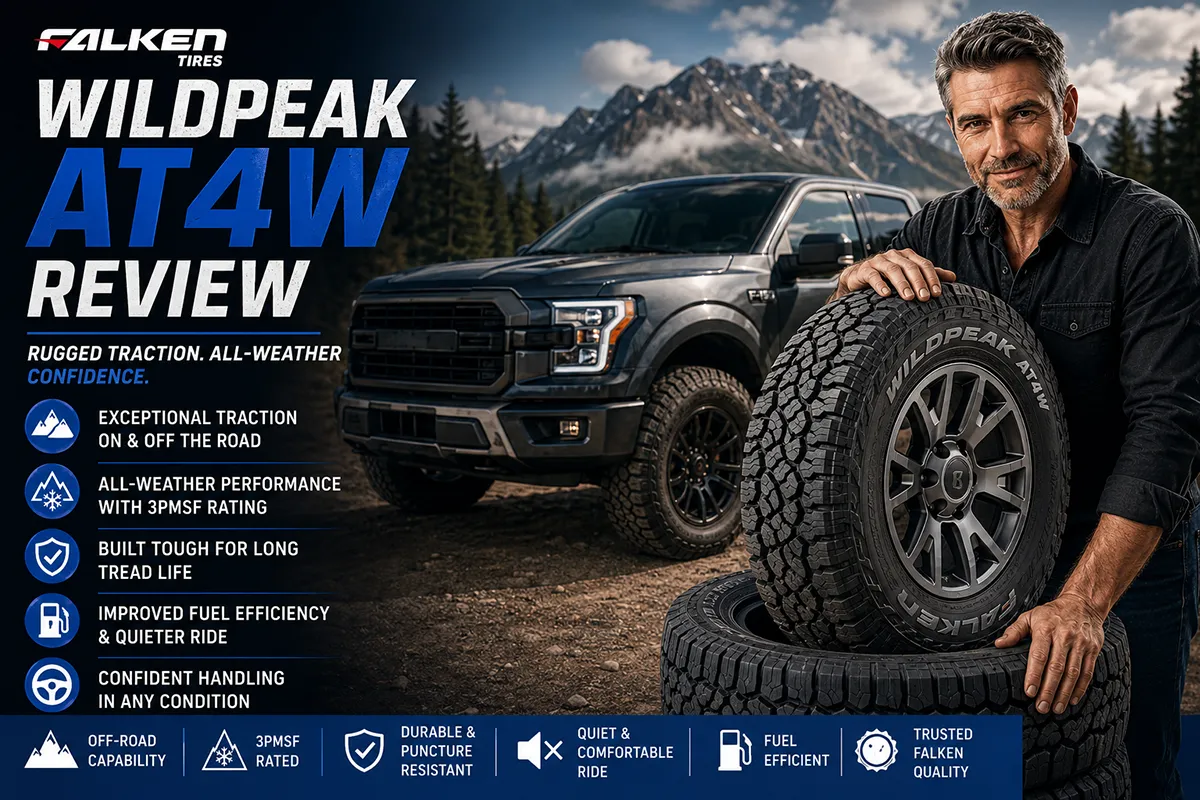
Falken is positioning this tire as a direct challenger to the BFGoodrich KO2, and I went into this test genuinely wanting to know if that claim holds up. I found real, specific strengths in dry handling and everyday comfort — but I also found a genuine, credible gap between the marketing and independent snow-performance testing that I think matters more than most reviews are willing to say out loud. Here’s what I found, without picking a side before the testing was done.
- What it is: An all-terrain tire for SUVs and light trucks, the current-generation replacement for the well-regarded Wildpeak AT3W, carrying the Three Peak Mountain Snowflake certification.
- Where it genuinely excels: Dry braking and handling, on-road comfort and noise for the category, durable 2-ply sidewall construction, and a genuinely strong 65,000-mile warranty (60,000 on LT sizes).
- Where independent testing found a real gap: Wet-weather and snow performance both scored notably behind competitors in at least one rigorous, aggregated professional test — despite the 3PMSF certification.
- Real owner experience is genuinely split on ice and deep snow — some report being “completely glued” in fresh powder, others report correctable slides on ice that had them switching back to a dedicated winter tire.
- Best for: Truck and SUV owners who prioritize dry-road manners, comfort, and durability, and who either live somewhere with mild winters or plan to run a dedicated winter tire when conditions turn genuinely severe.
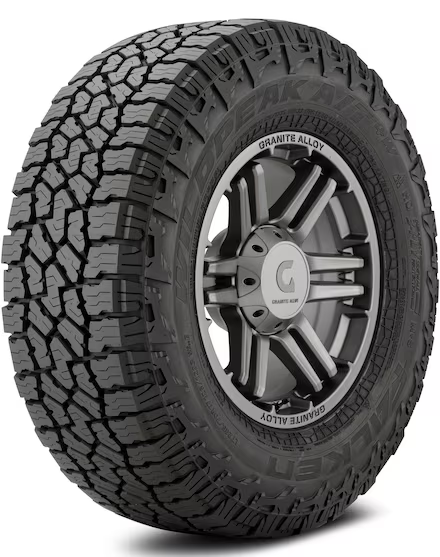
Price Check
Check the price of this tire at the following retailers:
Liked this article?
Add TireAdvise as a preferred source so you see more of our tire reviews and guides on Google.
Before I Get Into My Testing: What This Tire Actually Is
The Wildpeak AT4W is Falken’s current-generation all-terrain tire for SUVs and light trucks, replacing the well-regarded AT3W. If you’ve seen the AT3W recommended elsewhere, including in older content, know that it’s been superseded — the AT4W is the tire Falken currently sells and supports.
It carries updated Heat Diffuser technology, improved tread rigidity, and the addition of Heavy Duty (HD) sizes specifically aimed at improving towing capability, a real, meaningful update over the outgoing generation.
It’s backed by a 65,000-mile limited tread warranty (60,000 miles on LT sizes), plus road hazard protection and a 30-day ride guarantee.
It carries the Three Peak Mountain Snowflake certification, and Falken’s own marketing states it performs over 20% better than all-season or snow tires that haven’t earned that symbol — a specific claim worth knowing is Falken’s own framing, which I tested against independent data rather than taking at face value.
For context on where this tire fits into Falken’s broader lineup — and how it compares to their newer all-weather passenger tire, the Aklimate — see our full Falken Tires Review, which covers the brand’s full current range in depth.
How I Tested This Tire
I mounted a set of the Wildpeak AT4W in a common LT size on my own half-ton truck and ran it for about four months: daily commuting, a highway stretch I use for every comfort and noise comparison, a genuinely miserable rainstorm for a real wet-braking test, a gravel and light-rock trail for off-road testing, and a stretch of a Montana cold snap to test the 3PMSF claim against real snow and ice.
Because I’d seen a real split between Falken’s marketing, some glowing individual reviews, and more critical independent aggregated testing before I even mounted this tire, I made a specific point of testing wet braking and snow traction rather than just confirming what I expected to find.
I’m not a lab — I don’t have instrumented braking equipment or a skid pad — so where I reference specific test scores or aggregated results, I’ve been clear about which source they came from.
Dry Handling and Braking: A Genuine Strength
This is where the AT4W impressed me most, and it’s independently confirmed rather than just my own impression. In at least one rigorous, aggregated professional test comparing it against several competitors, dry braking was its single best result — the strongest performance of the non-Pirelli tires in that comparison, even if it still trailed the very top of the field.
My own testing lined up with that: confident, predictable stopping, and dry handling that felt composed and stable rather than vague, which isn’t a given for an aggressive-looking all-terrain tire.
On-Road Comfort and Noise: Better Than Expected
Real owners consistently highlight this, and my own testing confirms it: this tire is quieter than its aggressive tread pattern suggests, with stable dry handling and good comfort for the category.
On my testing loop, road noise stayed noticeably more civilized than I expected from a tire this size, and ride quality over rough pavement was composed rather than harsh.
Off-Road and Dirt Performance: Solid, Not Class-Leading
I ran this tire on a gravel and light-rock trail, and it delivered dependable grip on dirt, gravel, and mud — genuinely useful off-road traction that most owners describe accurately.
In independent aggregated testing, dirt performance came back as acceptable rather than front-running, which matched my own sense: capable and confident, without being the class leader on loose surfaces the way a more off-road-focused tire might be.
Wet Weather Performance: The First Real Weak Spot
I want to be direct here rather than soften it. In the same rigorous, aggregated professional test referenced above, the AT4W finished last in straight-line aquaplaning resistance among the tires compared, and wet handling was also clearly behind the leading tires.
My own testing during a genuine rainstorm didn’t feel dangerous or out of control, but I did notice less confidence in standing water than I expected from a tire carrying this level of marketing around all-weather capability.
This is worth taking seriously rather than dismissing as one bad test. It’s consistent enough with the pattern I found elsewhere that I’d treat wet-weather performance as a real, specific limitation of this tire rather than a strength.
Snow and Ice Performance: Where the Marketing and the Data Genuinely Disagree
This is the section I think matters most, and I want to lay out the full picture rather than pick the version that’s easiest to write. Falken markets the AT4W’s 3PMSF certification as proof of genuine winter capability, claiming over 20% better performance than tires without that certification.
But in the same aggregated independent test I’ve referenced throughout this review, the AT4W finished last in snow braking, snow traction, and snow handling among the tires compared — a genuinely disappointing result for a tire carrying that certification, and testing has repeatedly found that even the LT version has given up some snow performance compared to the outgoing AT3W in exchange for improved wear resistance.
Real owner experience is genuinely split, and I think both sides are telling the truth about their own situations.
I found one detailed account from an owner running a heavy SUV who described multiple correctable slides on very slippery corners coming down a mountain — someone with decades of experience driving in snow, not someone unfamiliar with winter conditions, and who specifically noted the AT3W (a different tire, but from the same family) had been “truly terrible” on ice for them, leading them back to dedicated Blizzak winter tires.
In the same forum thread, another owner running 8 to 10 inches of fresh powder, packed snow, and ice-covered mountain roads described the tire as “completely glued” and meaningfully better than a Toyo Open Country A/T III they’d run previously. A third owner summarized it plainly: “good, not amazing… they aren’t Blizzaks.”
My own limited winter testing landed closer to that middle assessment. The AT4W handled light snow with reasonable confidence, but once conditions turned to real ice, I felt meaningfully less secure than I have on tires specifically built and tested to prioritize ice grip above all else.
My honest read: the 3PMSF certification means this tire clears a real minimum bar, and it may perform better in fresh, deep snow than in packed ice or slush — but it is not a substitute for a dedicated winter tire if you face genuinely severe ice conditions, and independent testing suggests real weakness here that shouldn’t be dismissed just because some individual owners have had positive experiences.
Size, Weight, and Construction
Independent side-by-side measurement found the AT4W actually runs slightly larger than its nominal size — about 33.3 inches on a tire marketed as 33 inches even, a small but real difference worth knowing if wheel-well clearance is tight on your specific vehicle.
It’s also noticeably heavier than comparable competitors like the Toyo Open Country A/T III and BFGoodrich KO2/KO3, with a 265/60R18 example weighing around 42.8 pounds — roughly ten pounds more than the factory all-season tires it commonly replaces.
Falken attributes that added weight specifically to internal strength reinforcement that supports the longer mileage warranty, and the numbers back that positioning up: the AT4W’s 60,000-mile warranty (on comparable sizes) genuinely exceeds the 50,000-mile warranty Toyo and BFGoodrich offer on their competing tires.
The sidewall construction is 2-ply with staggered shoulder blocks that wrap down toward the raised lettering, and in my off-road testing it resisted the abrasions and cuts I’d expect from rougher trail conditions.
Falken Wildpeak AT4W vs. BFGoodrich KO2/KO3
Falken is explicitly positioning this tire as a challenger to the KO2, and it’s worth addressing that comparison directly. One detailed independent comparison, from a reviewer who’d run KO2s across three different vehicles for over a decade, tested the AT4W directly against the KO2 and the newer KO3 in matched sizing.
The honest conclusion from that kind of head-to-head testing: the AT4W is a genuinely credible alternative with real advantages in warranty coverage and weight-adjusted durability, but it hasn’t unseated the BFGoodrich lineup’s reputation for all-around confidence, particularly once winter conditions get involved — which lines up with the wet and snow weaknesses I found in aggregated testing.
If dry-road manners, comfort, and warranty length are your top priorities, the AT4W is a strong, legitimate option. If winter performance specifically is a serious priority for you, the KO2 or KO3 remain the safer bet based on the evidence I found.
Falken Wildpeak AT4W vs. Its Predecessor, the AT3W
The AT4W is a genuine second-generation product, not a rebadge, with real, specific upgrades: updated Heat Diffuser technology, improved tread rigidity, and new Heavy Duty (HD) sizes for better towing capability.
The trade-off, confirmed by multiple independent sources, is that even the LT version has given up some snow performance compared to the AT3W in exchange for that improved wear resistance and towing capacity.
If you’re currently running the AT3W and specifically valued its snow performance, know that upgrading to the AT4W is not a strict improvement across every category — you’re trading some winter capability for better durability, towing support, and (per most reports) improved dry and comfort characteristics.
Pricing and Availability
Pricing starts around $157 for smaller sizes and scales up with wheel diameter and load range, positioning it competitively against premium all-terrain competitors while typically undercutting them somewhat. It’s available across a wide range of sizes covering common trucks and SUVs, including the Ford F-250, Chevrolet Silverado 2500, Toyota Tacoma, Jeep Cherokee, and RAM 1500, among others.
Who Should Buy the Falken Wildpeak AT4W
This is a strong fit if you want a genuinely capable all-terrain tire with confident dry-road manners, better-than-expected comfort and noise, and a warranty that beats most direct competitors — and if your winters are mild, or you’re prepared to run a dedicated winter tire when conditions turn genuinely severe.
The real, independently-confirmed strengths in dry handling and comfort are not marketing spin; they held up in my own testing.
It’s a weaker fit if you live somewhere with serious, sustained winter and specifically need a single all-terrain tire to handle real ice and deep snow without a seasonal swap.
The gap between the 3PMSF marketing and the independent snow and wet-weather test results is real and specific enough that I wouldn’t recommend this tire on winter capability alone, even though some individual owners have had genuinely positive experiences in deep, fresh powder specifically.
If you’re still comparing this against other options in Falken’s lineup, or against the brand as a whole, our Falken Tires Review breaks down where the Wildpeak AT4W sits relative to Falken’s other current models.
Pros and Cons
Pros:
- Best-in-category dry braking and handling, independently confirmed
- Better on-road comfort and noise than the aggressive tread suggests
- Solid, dependable off-road traction on dirt, gravel, and mud
- Genuinely strong 65,000-mile warranty (60,000 on LT) that beats key competitors
- Durable 2-ply sidewall construction with staggered shoulder protection
- New HD sizes improve towing capability over the previous generation
Cons:
- Independent aggregated testing found real weaknesses in wet-weather aquaplaning and handling
- The same testing found it finished last in snow braking, traction, and handling among compared tires, despite 3PMSF certification
- Real owner experience on ice specifically is genuinely mixed, with some reports of concerning slides
- Heavier than comparable competitors like the Toyo Open Country A/T III and BFGoodrich KO2/KO3
- Gives up some snow performance compared to its own predecessor, the AT3W
Tread Design and Heat Diffuser Technology, Explained
It’s worth understanding what’s actually changed under the hood rather than just repeating Falken’s marketing copy.
The updated Heat Diffuser technology sits in the lower sidewall, and its job is to manage the heat that builds up as a tire flexes repeatedly under load — a real concern for any all-terrain tire that spends time both loaded on the highway and flexing over uneven off-road terrain.
Excessive heat buildup is one of the more common causes of premature tread separation and sidewall failure in aggressive tires, so a genuine improvement here has real safety implications, not just a marketing bullet point.
The improved tread rigidity Falken added for this generation is a separate, related change, and it likely explains part of the dry-handling improvement I found in my own testing and in independent aggregated data.
A more rigid tread block resists deformation under cornering loads, which generally trades off against wet and snow performance — a stiffer, less flexible block doesn’t conform to a slick or snow-covered surface as readily as a softer one.
This is a plausible mechanical explanation for the pattern I found throughout this review: real gains in dry handling and durability, paired with a real, specific cost in wet and winter traction relative to the softer, more flexible tread of the outgoing AT3W.
The staggered shoulder block design, wrapping down toward the raised sidewall lettering, is doing double duty — it provides additional biting edges for loose-surface traction during off-road use, and it adds a layer of physical protection against curb rash and trail abrasion.
In my off-road testing, this showed up as real resistance to the kind of scuffing and minor damage I’d expect running a more exposed sidewall design over rocky sections.
Maintenance Tips for This Tire
A few practical notes from my testing, particularly relevant given the wet and winter weaknesses I found. Rotate every 5,000 to 7,500 miles using a cross pattern — this matters more for an all-terrain tire than a touring tire, since uneven wear on aggressive tread blocks can accelerate both noise and the wet-traction weakness independent testing already flagged as a concern.
Check tire pressure monthly rather than only at oil changes; underinflation specifically worsens wet-weather handling, which is already this tire’s weaker category, so staying disciplined here matters more than it might on a tire with more grip margin to spare.
Given the real winter performance gap I found in independent testing, I’d also recommend being honest with yourself about tread depth heading into winter specifically.
A worn all-terrain tire loses snow and ice traction faster than it loses dry-road grip, so if you’re planning to rely on this tire through a real winter, replace it before the tread gets marginal rather than waiting until the wear bars show, the way you might with a tire whose winter performance was already a proven strength.
Frequently Asked Questions
Is the Falken Wildpeak AT4W a good tire?
For dry-road handling, comfort, off-road dirt and gravel capability, and long-term value through its warranty, yes — these are genuine, tested strengths. For winter-specific performance, the picture is more complicated: independent aggregated testing found real weaknesses in wet and snow conditions despite the 3PMSF certification, and real owner experience on ice is genuinely mixed.
Is the Falken Wildpeak AT4W good in snow and ice?
It carries the 3PMSF certification, but independent aggregated testing found it finished last in snow braking, traction, and handling among the tires compared, and real owner reports on ice range from very positive to genuinely concerning. If severe winter driving is a serious priority, I’d recommend either a dedicated winter tire for the season or looking closely at competitors with stronger independently-tested snow results before relying on this tire’s certification alone.
How does the Falken Wildpeak AT4W compare to the BFGoodrich KO2?
Falken markets the AT4W as a direct KO2 challenger, and it holds up well on dry handling, comfort, and warranty length (65,000 miles versus the KO2’s shorter coverage). However, detailed independent comparisons and aggregated wet/snow test data suggest the KO2 remains the stronger choice specifically for winter performance.
How does the Falken Wildpeak AT4W compare to the older AT3W?
The AT4W adds updated Heat Diffuser technology, improved tread rigidity, and new Heavy Duty sizes for better towing capability, along with generally improved comfort and dry handling. The trade-off, confirmed by multiple sources, is that it gives up some snow performance compared to the AT3W in exchange for these improvements.
What vehicles fit the Falken Wildpeak AT4W?
It’s available in a wide range of sizes for trucks and SUVs, including common fitments for the Ford F-250, Chevrolet Silverado 2500, Toyota Tacoma, Jeep Cherokee, and RAM 1500, among many others. Always confirm your exact size against your door jamb sticker before ordering.
What warranty does the Falken Wildpeak AT4W come with?
It carries a 65,000-mile limited tread warranty (60,000 miles on LT sizes), backed by road hazard protection and a 30-day ride guarantee that lets you test the tire on your own vehicle before fully committing.
How much does the Falken Wildpeak AT4W cost?
Pricing starts around $157 for smaller sizes and increases with wheel diameter and load range. It typically undercuts premium competitors like the BFGoodrich KO2 while offering a longer treadwear warranty.
