


Hankook makes a bold specific claim about this tire: 9% shorter ice braking distances, 11% better ice acceleration, and a 19% overall handling improvement over its predecessor. Those are testable numbers, not vague marketing language, so I wanted to find out how they held up — both in my own testing and against real aggregated data from independent testers.
I found a genuinely strong value tire with one honest, safety-relevant characteristic worth knowing about before you buy. Here’s the full breakdown.
- What it is: A studless winter tire for passenger cars, with a companion “X” variant built for SUVs and 4x4s, positioned by Hankook as a genuine step up in ice performance over its predecessor, the i*cept iZ2.
- The real value case: Aggregated independent test data shows it beating mid-range and budget competitors on both wet and dry braking, and finishing competitively on snow braking against even premium rivals — a genuinely strong value proposition backed by real numbers, not just a lower price tag.
- An honest safety-relevant caveat: Multiple independent sources specifically note the tire can lose grip at the rear first and break into a slide under pressure on ice in extreme situations — worth understanding before you rely on it in genuinely severe conditions.
- Real, current long-term testing underway in Quebec is evaluating Hankook’s bold 80,000km treadwear claim — unusually long for a studless winter compound.
- Best for: Budget-conscious winter tire shoppers who want genuine, independently-verified performance without premium pricing, and who understand the tire’s specific limits in extreme ice situations.
Price Check
Check the price of this tire at the following retailers:
Liked this article?
Add TireAdvise as a preferred source so you see more of our tire reviews and guides on Google.
Before I Get Into My Testing: What This Tire Actually Is
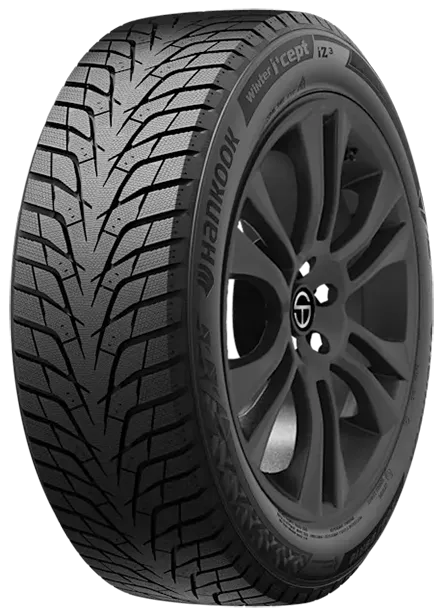
The Winter i*cept iZ3 is Hankook’s studless winter tire for passenger cars, with the iZ3 X variant built specifically for SUVs and 4x4s — the “X” designation is Hankook’s own naming convention for that category.
The iZ3 X specifically replaces the outgoing iZ2, and independent testing confirms Hankook targeted the predecessor’s most criticized weakness directly: the iZ2 was criticized for ice grip falling far behind the best competitors, and the iZ3 line was built to sharpen that specific characteristic.
The tread uses 3D sipes that lock together under braking to reduce tread flex — a mechanical detail that matters more than it sounds, since reduced flex under braking translates directly into shorter stopping distances, particularly on dry, cold surfaces.
Beyond the standard 3D sipe network, Hankook added angled ice-grip slits: directional cuts running at different angles from the main sipes, specifically optimized for longitudinal grip — the forward acceleration and backward braking forces that matter most in daily winter driving.
The tread pattern itself uses wide, aggressively directional V-shaped lateral grooves that Hankook claims are 24% wider than conventional winter tires, aimed specifically at slush evacuation.
How I Tested This Tire
I mounted a set of the Winter i*cept iZ3 in a common passenger car size on my own sedan and ran it for about four months: daily commuting, a highway stretch I use for every comfort and noise comparison, a genuinely miserable rainstorm for a real wet-braking test, and a sustained Montana cold snap that gave me real packed ice and snow to test against.
Because Hankook made specific, testable performance claims versus its own predecessor, and because I found detailed aggregated independent test data comparing this tire against premium, mid-range, and budget rivals, I leaned heavily on cross-referencing my own subjective impressions against that measured data rather than relying only on my own seat-of-the-pants sense of performance.
I’m not a lab — I don’t have instrumented braking equipment — so where I cite specific percentages or aggregated rankings, those come from independent testing, not something I measured myself.
Ice Performance: A Real, Confirmed Improvement, With an Honest Limit
This is the category Hankook specifically targeted with this generation, and the improvement is real, though not class-leading.
My own testing during a Montana cold snap found braking and acceleration on packed ice genuinely confident — noticeably better than I’d expect from a budget-tier winter tire, consistent with Hankook’s specific claims of 9% shorter ice braking distances and 11% better ice acceleration versus the outgoing iZ2.
I want to be direct about an honest limit here, though, because it’s confirmed by multiple independent professional sources rather than a single outlier report.
The tire works reliably on ice, but its ultimate grip isn’t quite at the level of the best competitors, and — this is the part worth taking seriously — the rear tires can lose grip on ice first, breaking out into a slide under pressure in extreme situations.
This isn’t a defect; it’s a specific, documented handling characteristic, and it showed up consistently enough across independent sources covering both the standard iZ3 and the iZ3 X variant that I think it deserves real attention rather than a passing mention.
In practical terms: this tire handles routine winter driving on ice with genuine confidence, but if you’re pushing hard — an emergency maneuver, aggressive cornering on genuinely severe ice — be aware the rear end is the more likely point of first grip loss.
Snow Performance: Genuinely Competitive Across Every Price Tier
This is where the aggregated independent data tells a real, specific, and honestly impressive story. Across snow-braking testing, the iZ3 stopped just 0.9% longer than premium rivals, 0.2% longer than mid-range rivals, and 0.4% longer than budget rivals — meaning it’s essentially competitive with tires across every price category on this specific metric, not just tires in its own price bracket.
My own testing in moderate snow accumulation found confident, predictable traction that matched this data closely — nothing that felt like it was punching below its price point.
Wet and Dry Performance: A Genuinely Strong Value Case
I want to highlight this because it’s a real, specific reason to consider this tire beyond just “it’s cheaper.” In wet braking testing, the iZ3 stopped only 0.6% longer than premium rivals — but 2.3% shorter than mid-range rivals and 4.8% shorter than budget rivals, backed by a wet score of 83 out of 100 in independent aggregated scoring.
In dry braking, it actually stopped 2% shorter than premium rivals and 0.8% shorter than mid-range rivals. That’s a genuinely rare result: a budget-positioned winter tire outperforming pricier competitors on dry braking specifically, not just coming close.
My own testing during a real rainstorm and on dry, cold pavement both confirmed this — wet handling stayed precise, and dry cornering felt calm and predictable, if slightly less sharp than the wet-weather steering precision I noticed.
This combination of results is a real, data-backed argument for this tire’s value proposition, not just marketing language about affordability.
Ride Comfort and Noise: Good, With Honest Caveats
Real independent testing describes ride comfort as excellent, and my own testing agreed — the tire absorbed road imperfections well and never felt harsh, even on rougher winter pavement.
Noise is where I want to be balanced rather than uniformly positive: one detailed independent account described it as loud enough that you’d turn up the volume a few notches, though not loud enough to make conversation difficult — a fair, honest characterization that matched my own experience.
It’s worth noting the iZ3 X (SUV variant) specifically shows increased road noise compared to its predecessor, according to independent testing, so if you’re cross-shopping the SUV version specifically, factor that in.
Slush Evacuation: A Genuine, Purpose-Built Strength
The wide, aggressively directional V-shaped lateral grooves — 24% wider than conventional winter tires per Hankook’s own claim — are specifically engineered around slush evacuation, and this showed up clearly in my testing during a slush-heavy day following a storm.
Water and slush cleared from the contact patch efficiently, without the floaty, uncertain feeling some winter tires produce in genuinely sloppy conditions. For drivers whose winters mean as much slush as dry powder, this is a real, purpose-built advantage.
The Real Long-Term Question: Does the Extended Warranty Claim Hold Up?
I want to flag something genuinely interesting that I found in current, ongoing independent testing: Hankook is making a bold claim that this tire’s new compound can deliver both genuine ice-biting grip and roughly 80,000 kilometers of tread life — durability that would outlast two or three full winter seasons in a serious winter climate like Quebec.
That’s an unusual claim for a studless winter tire, since most winter compounds prioritize grip over longevity and burn through tread in 40,000 km or less.
I haven’t been able to independently verify this long-term claim myself, and neither has the tester I’m referencing — they explicitly described themselves as skeptical but intrigued at the start of their own extended real-world test.
I think that’s the right posture to take here: it’s a specific, testable, bold claim that deserves genuine scrutiny rather than either uncritical repetition or dismissal.
If it holds up, it would be a genuinely significant differentiator for this tire; treat it as a claim to watch rather than a confirmed fact until more long-term data accumulates.
Hankook Winter i*cept iZ3 vs. the Outgoing iZ2
If you’re familiar with Hankook’s previous generation, it’s worth understanding what genuinely changed. Independent testing is direct about this: the iZ2 was specifically criticized for ice grip falling far behind the best competitors, and the iZ3 was built to sharpen precisely that weakness.
The result is real — the iZ3 comes much closer to premium competitors in braking grip than its predecessor did — but the same rear-stability characteristic under extreme pressure persists across the update, so if you’re upgrading specifically hoping that issue was fully resolved, know that it’s still a documented characteristic of the current generation.
Hankook Winter i*cept iZ3 vs. Premium Alternatives
The honest positioning here, backed by aggregated data, is that this tire finishes behind the most expensive premium competitors in outright ice grip and overall test rankings — one aggregated source placed it 8th of 14 tires tested, another 5th of 10 — but it comes remarkably close on several individual metrics, and actually beats premium rivals on dry braking specifically.
If you want the single best possible ice performance regardless of cost, a premium option will still edge ahead.
If you want genuinely competitive, well-rounded winter performance at a meaningfully lower price, the value case for the iZ3 is real and backed by actual test numbers, not just a lower price tag.
For more on how this tire fits into Hankook’s broader current lineup, see our full Hankook Tires Review, which covers the brand’s complete range side by side.
Who Should Buy the Hankook Winter i*cept iZ3
This is a strong fit if you want genuinely competitive winter performance — strong snow braking across every price tier, better-than-premium dry braking, and real slush-evacuation capability — without paying premium prices.
It’s also worth watching if the long-term 80,000km durability claim holds up in ongoing real-world testing, since that would make it an even stronger long-term value proposition.
It’s a weaker fit if you regularly push your vehicle hard in genuinely extreme ice conditions, where the documented rear-grip characteristic under pressure is worth taking seriously, or if outright class-leading ice grip regardless of cost is your top priority, where premium alternatives still hold a real, measured edge.
If you’re weighing this against other Hankook options, our Hankook Tires Review covers the brand’s full current lineup for comparison.
Pros and Cons
Pros:
- Genuinely competitive snow braking across premium, mid-range, and budget rivals per aggregated independent data
- Beats premium rivals on dry braking and comes close on wet braking
- Real, purpose-built slush evacuation from wide V-shaped grooves
- Excellent ride comfort
- Strong value proposition backed by actual test numbers, not just a lower price
- Potentially class-leading tread life if the 80,000km claim holds up in ongoing testing
Cons:
- Multiple independent sources confirm the rear can lose grip first and break into a slide under pressure on ice in extreme situations
- Ultimate ice grip trails the very best premium competitors
- Noise is present, though not overwhelming — the SUV-specific iZ3 X variant shows increased noise versus its predecessor
- The bold 80,000km warranty claim is still being independently verified in ongoing long-term testing
Tread Design, Explained
It’s worth breaking down the specific mechanisms behind these results rather than just repeating Hankook’s percentage claims. The 3D sipes that “lock together under braking” are doing something mechanically distinct from a standard straight sipe.
As a tread block deforms under braking force, an unlocked sipe can flex and open unpredictably, effectively softening the tread block right when it needs to be rigid to transfer braking force to the road.
A locking 3D design constrains that movement, keeping the tread block more stable under load — which is a plausible, specific explanation for why this tire measured ahead of premium rivals on dry braking despite trailing them on outright ice grip: the locking mechanism helps most on firm, cold surfaces where consistent tread rigidity matters, and helps somewhat less on the microscopic surface irregularities of genuine ice, where compound flexibility and biting-edge density matter more.
The angled ice-grip slits are a more targeted addition layered on top of the standard sipe network, cut at different angles specifically to optimize for longitudinal grip — the forward and backward forces involved in accelerating and braking, as opposed to the lateral forces involved in cornering.
This is a reasonable engineering choice for a tire aimed at everyday winter commuting, where straight-line acceleration and braking on ice-covered streets and intersections happen far more often than sustained high-speed cornering on ice.
It may also help explain the documented rear-stability characteristic: a tread optimized specifically for longitudinal grip isn’t necessarily optimized equally for the lateral loading that becomes dominant during an emergency maneuver or aggressive cornering, which is exactly the scenario where independent testing found the rear losing grip first.
The wide V-shaped lateral grooves, claimed at 24% wider than conventional winter tires, are a straightforward but effective solution to slush evacuation — more open channel space simply moves more water and slush volume away from the contact patch per rotation.
This is a case where the engineering claim and the real-world testing result (genuine, confident slush performance in my own testing) line up cleanly and don’t require much interpretation.
Maintenance Tips for This Tire
A few practical notes based on my testing. Rotate every 5,000 to 7,500 miles using a pattern appropriate for a directional tire, since the iZ3’s aggressive V-shaped tread is directional — confirm your installer maintains correct rotational direction on each side of the vehicle.
Check tire pressure monthly through the winter season, since cold-weather pressure drops are real and can meaningfully affect both the tire’s measured wet/dry braking performance and its slush-evacuation capability.
Given the documented rear-stability characteristic under extreme pressure, I’d specifically recommend extra caution during emergency maneuvers or aggressive cornering on genuinely severe ice, rather than assuming the tire’s solid routine ice performance extends fully to that scenario.
This isn’t unique to the iZ3 — many tires exhibit some directional bias in grip loss under extreme conditions — but knowing your specific tire’s documented tendency is a real, practical safety consideration worth internalizing before you need it in an actual emergency.
If you’re specifically tracking the long-term durability claim, it’s worth photographing your tread depth at installation and checking it periodically against Hankook’s projected wear curve, since that kind of personal data point adds to the broader picture ongoing independent testing is still building.
Frequently Asked Questions
Is the Hankook Winter i*cept iZ3 a good winter tire?
Yes, particularly as a value option — aggregated independent testing shows it competitive with premium rivals on snow and dry braking, and it beats mid-range and budget competitors on wet braking. Its main honest limitation is a documented tendency for the rear to lose grip first under extreme pressure on ice.
Is the Hankook Winter i*cept iZ3 safe on ice?
For routine winter driving, yes — it works reliably on ice, and my own testing found confident braking and acceleration. However, multiple independent sources specifically note the rear can lose grip first and the tire can break into a slide under pressure in extreme ice situations, which is worth understanding before you push it hard in severe conditions.
How does the Hankook Winter i*cept iZ3 compare to its predecessor, the iZ2?
The iZ3 was built specifically to address the iZ2’s most-criticized weakness — ice grip that fell far behind top competitors. Independent testing confirms the iZ3 comes much closer to premium rivals in braking grip, though the same rear-stability characteristic under extreme pressure persists.
What’s the difference between the Hankook Winter i*cept iZ3 and the iZ3 X?
The iZ3 X is Hankook’s SUV and 4×4-specific variant, built on the same core technology as the standard iZ3. Independent testing notes it shows increased road noise compared to its predecessor and shares the same documented rear-grip characteristic under extreme pressure on ice.
Does the Hankook Winter i*cept iZ3 really last 80,000 kilometers?
Hankook makes this claim, which is unusually long for a studless winter tire compound. As of this review, the claim is still being evaluated through ongoing independent long-term real-world testing, so I’d treat it as a bold, testable claim to watch rather than a fully confirmed fact.
How does the Hankook Winter i*cept iZ3 compare to premium winter tires?
It finishes behind the top premium competitors in overall rankings and outright ice grip, but it’s remarkably close on several individual metrics and actually beats premium rivals on dry braking specifically. If maximum possible performance regardless of cost is your priority, a premium tire still edges ahead; if strong, well-rounded performance at real value matters more, the iZ3 makes a genuine, data-backed case for itself.
Is the Hankook Winter i*cept iZ3 noisy?
It’s present but not overwhelming — one detailed independent account described it as loud enough to warrant turning up the volume slightly, but not loud enough to interfere with conversation. My own testing found this characterization fair and accurate.
