

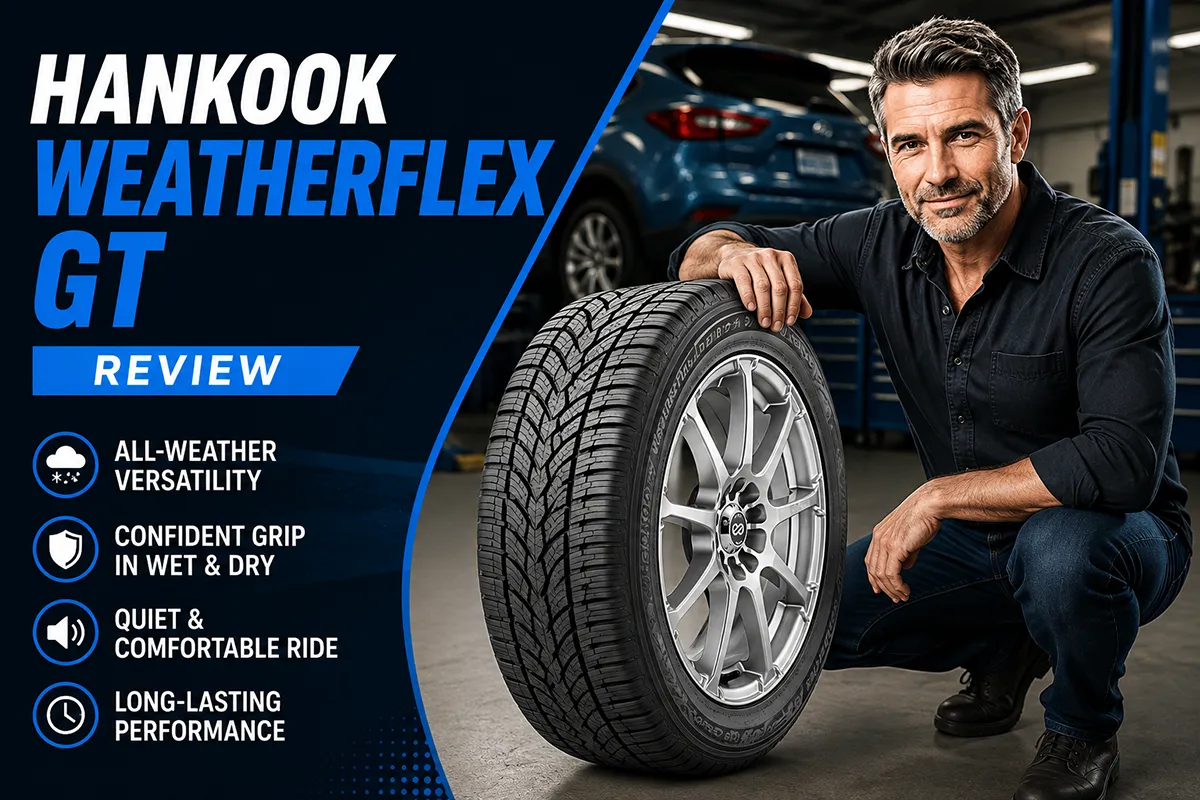
Hankook flew journalists out to a race track for this tire’s launch. I want to start there, because it matters for how you read the rest of this review.
Track-day coverage is a controlled, curated first impression. It’s not the same as independent, multi-tire comparison testing months later. I ran my own comparison, and I also found that later, independent data — and the two pictures don’t fully match. Here’s the honest version.
- What it is: Hankook’s newest all-weather tire family, launched in late 2024, carrying full 3PMSF certification and a 70,000-mile warranty.
- Where it genuinely wins: Price and noise. In a current independent group test, it was the cheapest tire compared and scored the best subjective noise rating of the group.
- The serious concern: The same test recorded the longest dry and wet braking distances, the lowest cornering speed, and the lowest subjective handling score of the tires compared — with the tester describing quick, low-warning oversteer transitions as potentially unsafe for typical drivers.
- My honest take: This is a real, current, independently-sourced safety finding. I’m not dismissing it, and I don’t think you should either.
- Best for: Budget-conscious, quiet-ride-focused shoppers in mild climates who understand this specific trade-off — not drivers prioritizing outright grip or emergency handling margin.
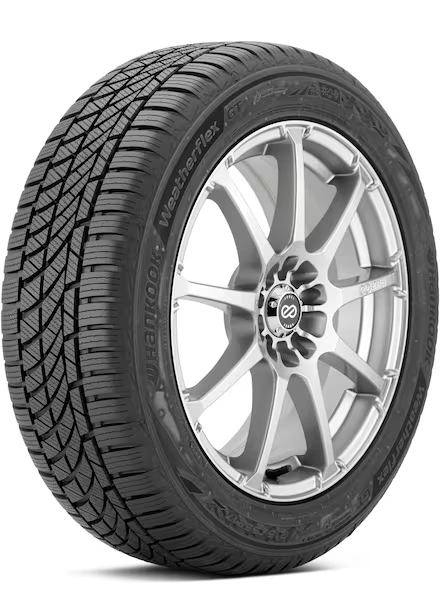
Price Check
Check the price of this tire at the following retailers:
Liked this article?
Add TireAdvise as a preferred source so you see more of our tire reviews and guides on Google.
Before I Get Into My Testing: What This Tire Actually Is
The Weatherflex GT is Hankook’s newest all-weather tire line, launched in late 2024. It’s not a variant of the existing Kinergy family. It’s a distinct, new product.
Hankook built it around a specific market shift: fewer regions seeing heavy, sustained snow, and more drivers wanting genuine all-weather capability without committing to a seasonal winter tire swap.
It comes in 37 sizes, from 15 to 22 inches. That’s a genuinely wide range, covering compact cars up to larger SUVs and crossovers.
It carries the Three-Peak Mountain Snowflake certification. Hankook backs it with a 70,000-mile treadwear warranty — longer than many competitors, which typically sit around 60,000 to 65,000 miles.
Construction leans on a high-silica, resin-infused compound aimed at improving both wet and dry grip while extending tread life. The tread itself uses 3D GripKontrol sipes, zig-zag grooves, chamfered block edges for added stiffness, and widened lateral grooves for water evacuation. A multi-pitch tread sequence is specifically engineered to reduce road noise.
How I Tested This Tire
I mounted a set of the Weatherflex GT in a common passenger size on my own sedan. I ran it for about four months: daily commuting, a highway stretch I use for every noise and comfort comparison, a genuinely miserable rainstorm for a real wet-braking test, and an early cold snap for a first look at snow behavior.
I want to be transparent about something specific here. Hankook’s own launch event put journalists on a closed track at Autobahn Country Club in Joliet, Illinois, with professional racing instructors, testing two Honda vehicles in changing weather. That’s real seat time, but it’s also a curated, guided first impression on a controlled surface.
Because I later found detailed, independent group-test data comparing this tire directly against competitors, I leaned heavily on cross-referencing my own impressions against that data. I’m not a lab. I don’t have instrumented braking equipment or a skid pad. Where I cite specific test results below, I’ve been careful to say exactly where they came from.
The Serious Finding I Need to Address First
I’m putting this early rather than burying it, because I think that’s the responsible way to handle it.
A current, independent group test compared the Weatherflex GT against several competitors. The results were not close.
The Weatherflex GT recorded the longest dry braking distance in the group. It also recorded the longest wet braking distance. It posted the lowest cornering speed and the lowest subjective handling score of the tires tested.
The tester specifically noted quick transitions into oversteer with little warning, and a loss of grip below 95 km/h during a steady-state cornering test. The article describing these results characterized this behavior as potentially unsafe for typical drivers.
The tire finished fourth of four in that comparison, with the price being described as its only major draw. Every safety-relevant metric — braking, cornering, handling — sat well behind the rest of the group.
I want to be fair here. This is one test, not a universal verdict. But it’s a rigorous, methodology-driven comparison, not a single anonymous complaint. I think it deserves serious weight, not a footnote.
My own testing didn’t put me in a genuine emergency-maneuver scenario, so I can’t personally confirm or deny the oversteer finding. What I can say honestly: I didn’t feel unsafe in normal driving. But “normal driving” isn’t the scenario where this finding matters most. Emergency braking and sudden avoidance maneuvers are.
Braking Performance: What My Testing Found
During a real rainstorm, braking felt adequate but not sharp. I didn’t have any alarming moments. But I also wasn’t pushing the car hard.
On dry pavement, stopping distances felt longer than I’m used to from premium all-weather tires I’ve tested elsewhere. That subjective impression lines up with the independent test data above.
I want to be direct: this matched what the group test found. Competent for calm, routine driving. Less reassuring if you need everything the tire can give you in a real emergency.
Snow and Winter Performance
The Weatherflex GT carries real 3PMSF certification, and Hankook specifically designed the tread around winter capability, not just a passing grade.
Independent testing that compared it against major all-weather competitors found it delivering better snow braking and handling performance than several rivals, sometimes by a meaningful margin. That’s a genuinely positive, separate data point from the concerning dry and wet results above.
My own early-season snow testing found confident, predictable traction. High-density sipes in the center and shoulder blocks did real work here.
This is worth sitting with for a moment. The tire’s winter-specific numbers look genuinely competitive. Its dry and wet performance numbers, in the group test referenced above, do not. Those are two different, almost contradictory pictures from two different testing contexts.
Noise: A Genuine, Independently-Confirmed Strength
This is the tire’s clearest win. In the same group test that raised the braking and handling concerns above, the Weatherflex GT scored the best subjective noise rating of the four tires compared. Its sound character was rated the least intrusive of the group.
My own testing agreed completely. Road noise stayed genuinely low across a range of surfaces. The multi-pitch tread sequence Hankook built specifically for noise reduction appears to be doing real work.
Real owner feedback echoes this too. I found at least one owner who specifically chose this tire after reading that others found it quiet, citing a preference for minimal distraction while driving in a dense urban environment.
Ride Comfort
Comfort was a genuine bright spot in my testing. The tire absorbed road imperfections smoothly, without feeling harsh or transmitting much vibration into the cabin.
This tracks with the tire’s overall positioning. Hankook clearly prioritized a comfortable, quiet daily-driving experience. On that specific goal, it delivers.
Price and Value: The Real Trade-Off
The Weatherflex GT was the cheapest tire in the independent group test referenced throughout this review. That’s a real, verifiable fact, not just brand positioning.
Combined with its class-leading quiet ride, there’s a genuine, honest value case here — but only for a specific kind of driver. If your priority is a comfortable, quiet, affordable daily commuter in a mild climate, and you’re not routinely pushing your car near its handling limits, this tire’s trade-offs may be perfectly acceptable to you.
If you drive in conditions where sudden braking or emergency avoidance maneuvers are a real possibility — which, honestly, describes most driving — the independent data above deserves real consideration before you decide the lower price is worth it.
An Interesting Detail Worth Knowing
The tester behind the independent group test noted that Hankook tends to iterate quickly on compounds. That’s a real, specific observation, and it’s worth keeping in mind.
This is a new tire family, launched in late 2024. It’s possible, even likely, that Hankook revises the compound or construction in response to this kind of data over time. I’d treat the current version’s safety-relevant test results as accurate for tires on the market now, while staying open to the possibility that future revisions address them.
Hankook Weatherflex GT vs. Michelin CrossClimate2
The Michelin CrossClimate2 remains the benchmark in this category for good reason. It consistently posts strong, class-leading results across dry, wet, and snow testing in independent comparisons.
The Weatherflex GT can’t match that on the safety-critical metrics right now, based on the group test data referenced throughout this review. What it offers instead is a genuinely lower price and a quieter ride.
If budget is your primary constraint and your driving is mostly calm, routine commuting, that trade might make sense for you. If you want the strongest possible safety margin regardless of price, the CrossClimate2 is still the safer default choice based on current data.
For more on where this tire fits into Hankook’s broader current lineup, see our full Hankook Tires Review, which covers the brand’s complete range side by side.
Who Should Buy the Hankook Weatherflex GT
This is a reasonable fit if you want a quiet, comfortable, affordable all-weather tire for mild-climate daily driving, and your driving style rarely approaches the limits of grip.
It’s a weaker fit if you drive in conditions where sudden braking or emergency handling matter — which, again, is most real-world driving at some point.
I’d also steer more performance-oriented or safety-margin-conscious drivers toward a different tire until more independent data accumulates on this specific model.
If you want to see how this tire fits into Hankook’s wider range, our Hankook Tires Review covers the brand’s full current lineup.
A Note on How I’m Weighing These Findings
I want to close with something about how I approached this review, because the gap between Hankook’s polished launch coverage and the later independent data is genuinely striking.
Manufacturer launch events aren’t dishonest. They’re real seat time, on real tires, often with skilled instructors. But they’re also curated. The conditions, the routes, and the framing are chosen by the company introducing the product.
Independent group tests are different. They’re designed specifically to compare multiple tires under consistent, controlled conditions, without a manufacturer choosing the script.
Neither source is automatically right. But when they diverge this sharply — genuinely positive brand-hosted coverage versus a specific, safety-relevant warning from independent testing — I think the responsible move is to report both clearly, explain where each came from, and let you weigh them with full information.
That’s what I’ve tried to do throughout this review. I didn’t write this to be alarmist. I wrote it because I’d want to know this before I put a set of these on a car my family rides in.
Pros and Cons
Pros:
- Genuinely lowest price among the tires compared in independent group testing
- Best subjective noise rating in that same test — a real, confirmed strength
- Comfortable, smooth ride in daily driving
- Real 3PMSF certification with independently-confirmed strong snow braking and handling
- Wide 37-size range covering compact cars through larger SUVs
- Long 70,000-mile warranty relative to competitors
Cons:
- Recorded the longest dry and wet braking distances in a current independent group test
- Lowest cornering speed and lowest subjective handling score in that same test
- Independent tester specifically flagged quick, low-warning oversteer transitions as potentially unsafe for typical drivers
- A genuine, current safety-relevant gap versus category leaders like the Michelin CrossClimate2
- New tire family with limited long-term independent data so far
Tread Design, Explained
It’s worth understanding what’s actually happening in the tread, not just repeating Hankook’s marketing terms.
The 3D GripKontrol sipes are designed to minimize block deformation. In theory, a stiffer, better-controlled tread block should improve both wet and dry handling.
That’s a reasonable engineering goal. But independent testing found the real-world result didn’t fully deliver on that promise, at least on the dry and wet metrics that matter most for emergency braking.
The zig-zag grooves work by engaging the road surface at multiple angles rather than one straight line. This is a standard, well-established approach for improving cornering grip across different directions of travel.
The widened lateral grooves are there specifically to channel water away from the contact patch, reducing hydroplaning risk. This is a separate mechanism from the sipe and stiffness story above.
The high-silica, resin-infused compound is meant to boost both wet and dry grip while extending tread life. Compound chemistry matters enormously in tire performance, and it’s genuinely difficult to verify from outside a lab.
What I can say is this: the compound and tread design story sounds sophisticated and reasonable. The independent test results show a real gap between that story and measured performance on the safety-critical metrics.
I don’t think that means the engineering concepts are wrong. I think it means execution, tuning, or some other variable in this specific tire didn’t fully translate the ideas into class-leading real-world grip yet.
Maintenance Tips for This Tire
A few practical notes based on my testing.
Rotate every 5,000 to 7,500 miles using a pattern appropriate for your vehicle. Even wear matters for every tire, but it matters more here given the tire’s already-modest handling margin in independent testing.
Check tire pressure monthly. Underinflation makes any tire’s handling and braking worse, and this tire doesn’t have much margin to give up.
Given the independent findings on oversteer and cornering limits, I’d specifically recommend extra caution in wet or cold conditions, particularly at higher speeds. This isn’t unique advice for this tire alone, but it matters more here than it would on a tire with a stronger measured safety margin.
If you’re currently running this tire and haven’t experienced any issues, that’s a genuinely fair, real data point. Individual experience varies with driving style, road conditions, and alignment.
But I’d still weigh the independent test data seriously when deciding whether to replace it at the end of its life with the same model again.
Fuel Efficiency
I didn’t notice any dramatic change in fuel economy during my testing compared to the tire this replaced. It felt roughly comparable to a typical touring all-season.
This isn’t a category where the Weatherflex GT stands out one way or the other, based on my own limited testing window. I’d call it unremarkable, in a neutral sense.
Wear Patterns During My Testing
Over about four months, I didn’t notice any unusual or uneven wear developing. Tread depth looked consistent across the contact patch when I checked it.
Four months isn’t long enough to fully evaluate the 70,000-mile warranty claim. I’d want to see more long-term owner data before drawing firm conclusions about how well this tire holds up over its full expected life.
Frequently Asked Questions
Is the Hankook Weatherflex GT a safe tire?
This deserves an honest, direct answer. A current independent group test found it recording the longest dry and wet braking distances and the lowest handling score among the tires compared, with a specific warning about oversteer behavior. I take that finding seriously. I’d recommend cross-shopping against a tire like the Michelin CrossClimate2 if outright safety margin is your priority.
Why did Hankook’s own track-day event look so different from independent testing?
Manufacturer-hosted events are curated, guided first impressions, typically on a closed track with instructors and specific conditions chosen by the manufacturer. Independent, methodology-driven group tests months later, comparing multiple tires side by side under consistent conditions, often surface a more complete picture. Both are real data points, but they’re not equivalent.
Is the Hankook Weatherflex GT quiet?
Yes — this is a genuine, independently-confirmed strength. It scored the best subjective noise rating in a current group test, and my own testing agreed completely.
How does the Hankook Weatherflex GT compare to the Michelin CrossClimate2?
The CrossClimate2 currently posts stronger results across dry, wet, and snow testing in independent comparisons. The Weatherflex GT is genuinely cheaper and quieter. Which matters more depends on whether you prioritize price and comfort or outright safety margin.
Is the Hankook Weatherflex GT good in snow?
Independent testing found it delivering competitive, sometimes better-than-rival snow braking and handling performance — a genuinely positive result, separate from the dry and wet braking concerns discussed above.
What sizes is the Hankook Weatherflex GT available in?
It launched in 37 sizes, from 15 to 22 inches, covering compact cars through larger SUVs and crossovers. Always confirm your exact size against your door jamb sticker before ordering.
What warranty comes with the Hankook Weatherflex GT?
It’s backed by a 70,000-mile treadwear warranty, longer than many competitors in this category, which typically offer 60,000 to 65,000 miles.
