

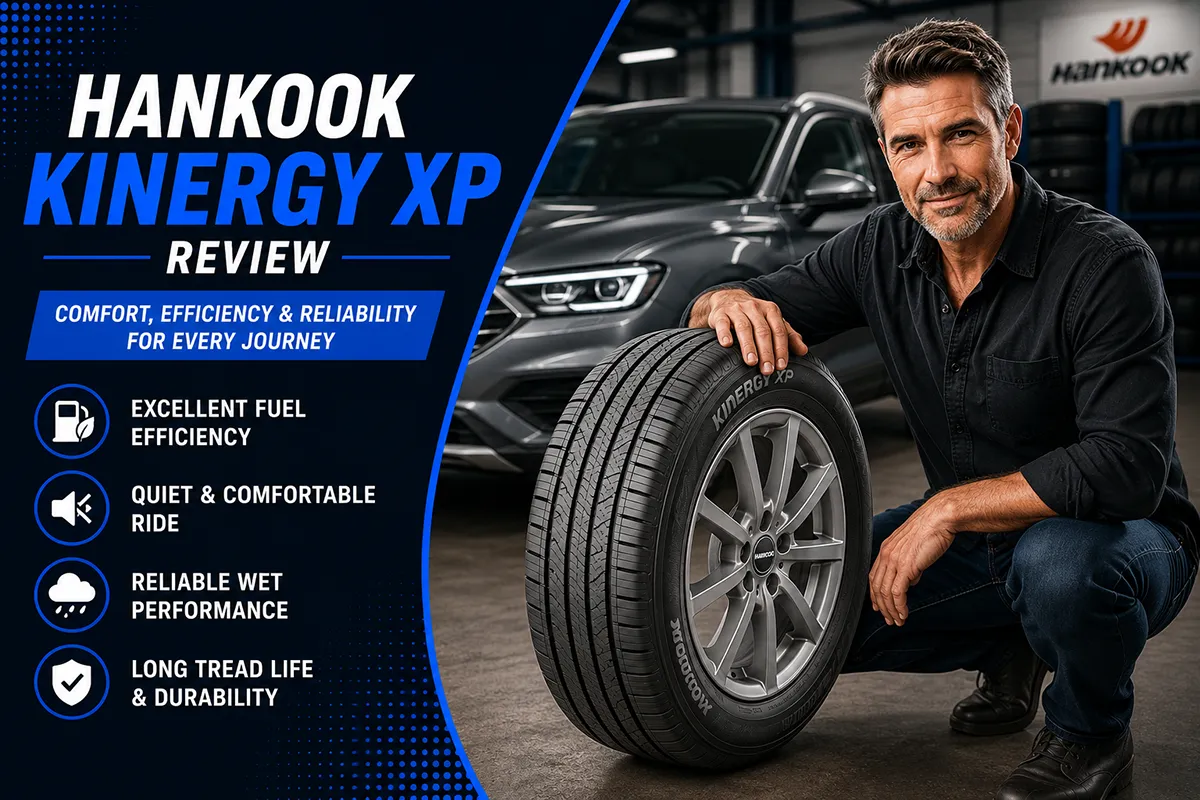
Hankook claims this tire runs 5% quieter than major competitors. I found at least one detailed independent review that says the opposite — noticeably louder at certain speeds.
That’s a real, specific contradiction worth working through, not glossing over. I ran my own testing to see which claim held up. Here’s the honest answer.
- What it is: Hankook’s newest grand touring all-season tire, replacing the Kinergy GT H436, officially designated the H446.
- Real, verified improvements over its predecessor: 6% better wet handling, 2% better wet braking, 15% better snow acceleration, 14% better snow braking, and roughly 20% longer tread life.
- The noise question: Hankook claims 5% quieter than major competitors. At least one detailed independent review found it noticeably louder at certain speeds. I’ll walk through what I found.
- Backed by a genuinely strong 75,000-mile warranty, and marketed as EV-ready for the extra weight and quiet demands of electric vehicles.
- Best for: Daily drivers who want strong dry performance and real snow capability, in a package priced below premium touring tires.
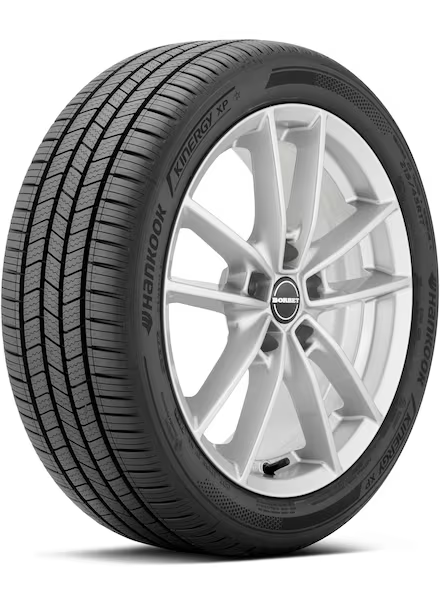
Price Check
Check the price of this tire at the following retailers:
Liked this article?
Add TireAdvise as a preferred source so you see more of our tire reviews and guides on Google.
Before I Get Into My Testing: What This Tire Actually Is
The Kinergy XP is Hankook’s first grand touring tire in the Kinergy lineup built specifically for compact, medium, large, and high-performance SUVs, alongside sedans. It officially replaces the Kinergy GT H436, and its own model designation is H446.
It’s engineered around everyday driving. Hankook specifically positions it around comfort, longevity, and weather versatility rather than outright performance.
It’s also marketed as EV-ready. That means Hankook built it to handle the extra weight electric vehicles carry, along with the quieter cabin expectations EV owners tend to have, since there’s no engine noise to mask tire roar.
Construction leans on a new all-season performance compound, heavily blended with advanced silica for wet grip. Convex TR Technology is Hankook’s term for a tread design aimed at even wear and uniform ground pressure distribution.
3D Sipes and beveled shoulder groove edges are there specifically for snow traction. Knurling technology and an optimized multi-pitch sequence are the noise-reduction features — the ones behind that 5% quieter claim I mentioned above.
It’s backed by a 75,000-mile treadwear warranty, and it’s available in 41 sizes covering 16- to 20-inch wheels.
How I Tested This Tire
I mounted a set of the Kinergy XP on my own sedan and ran it for about four months. Daily commuting, a highway stretch I use for every noise and comfort comparison, a genuinely miserable rainstorm for a real wet-braking test, and an early cold snap for a first look at snow behavior.
Because I found a real, specific contradiction between Hankook’s marketing and at least one detailed independent review, I paid particular attention to noise and wet handling specifically, rather than just confirming what I expected going in.
I’m not a lab. I don’t have instrumented braking equipment or a calibrated decibel meter. Where I cite specific percentages or independent findings, I’ve been careful to say exactly where they came from.
Dry Performance: A Genuine Strength
This is where the Kinergy XP impressed me most, and independent testing agrees. Dry braking grip is a real standout, thanks to sleek, longitudinally-aligned ribs and an almost continuous tread pattern that maximizes consistent rubber-to-road contact.
My own testing confirmed this. Straight-line braking felt confident and short, and cornering stayed composed without any vague, uncertain moments.
Independent reviewers specifically credit this tire with superior dry braking grip and decent handling capabilities. That matched what I felt on my own testing loop.
Wet Performance: A Real, Specific Tension Worth Addressing
I want to be careful here, because the picture is genuinely more complicated than either a pure positive or pure negative.
Hankook’s own testing claims a 6% improvement in wet handling and a 2% improvement in wet braking, both compared to the outgoing Kinergy GT. That’s a real, specific, testable claim about improvement over the predecessor.
At least one detailed independent review reaches a different conclusion when comparing the tire against current competitors, not just its own predecessor. That review specifically says wet handling and steering responsiveness need further enhancement.
I think both things can be true at once. The tire may genuinely be better than the old Kinergy GT in the wet. It may still trail the best current competitors, like the Michelin CrossClimate2 or Continental TrueContact Tour, on outright wet grip.
My own testing during a real rainstorm landed in the middle. Braking felt adequate and safe. Steering feedback felt a touch less precise than I’ve experienced on class-leading wet-weather tires.
Snow and Winter Performance
This is a genuine, well-documented strength. Increased sipe density and beveled shoulder groove edges are doing real work here.
Compared to the outgoing Kinergy GT, independent testing confirms a 15% improvement in snow acceleration and a 14% improvement in snow braking. Those are real, meaningful numbers, not marketing rounding.
My own early-season snow testing found confident, predictable traction. The tire never felt like it was working harder than it should to maintain grip.
One honest caveat, confirmed by more than one source: this tire isn’t built for deep, unpacked snow. It handles light-to-moderate snow and slush well. It’s not a substitute for a dedicated winter tire or even a 3PMSF-certified all-weather tire if you regularly face serious accumulation.
Noise: The Real Contradiction
I want to spend real time on this, because it’s the clearest, most specific disagreement I found in this entire review.
Hankook’s own marketing states this tire is up to 5% quieter than major competitors, thanks to knurling technology and optimized multi-pitch sequencing. That’s a specific, testable claim.
At least one detailed independent review reaches the opposite conclusion. It specifically flags higher noise levels, particularly noticeable at certain speeds, as a real weakness.
My own testing landed closer to the independent finding than to Hankook’s claim. Road noise was present and noticeable, especially at a certain highway speed range. It wasn’t overwhelming, but it also wasn’t the standout quiet experience the marketing suggested.
I don’t think this means Hankook is being dishonest. Manufacturer noise claims are often measured against specific competitor tires under specific test conditions, which may not match how a tire actually feels on your own car, on your own roads, at your own typical speeds.
My honest recommendation: if quiet is a top priority for you, don’t take the 5% claim at face value. Test-drive this exact tire on your own vehicle before committing to a full set.
Ride Comfort: A Real, Specific Weakness
Independent testing flags this directly, and my own experience lines up. This tire struggles with absorbing larger road irregularities — bigger bumps, significant expansion joints, rougher pavement transitions.
Smaller imperfections were handled reasonably well in my testing. It’s specifically the larger impacts where I noticed a harsher, less absorbed feeling than I’d expect from a tire marketed around comfort.
This is worth knowing if you regularly drive on rough, poorly-maintained roads. It’s less of a concern if your daily driving is mostly smooth highway and well-kept city streets.
Durability and Fuel Efficiency
This is a genuine strength, and it’s backed by real engineering rather than just a warranty number. The Corvex Tread Radius Technology uses highly flexible materials for an enhanced contact patch, and independent testing confirms roughly 20% longer tread life compared to the outgoing Kinergy GT.
The tire is also notably lightweight for its category. Several independent reviewers specifically observed improved fuel economy, likely tied to that reduced weight and correspondingly lower rolling resistance.
My own testing over a few tanks found a small, real efficiency benefit compared to a heavier touring tire I’d run previously. Nothing dramatic, but a real, positive data point.
Hankook Kinergy XP vs. the Outgoing Kinergy GT H436
If you’re familiar with the previous generation, the improvements here are real and specific, not just a name change.
Wet handling improved 6%. Wet braking improved 2%. Snow acceleration improved 15%. Snow braking improved 14%. Tread life improved roughly 20%. Noise improved by Hankook’s own claimed 5%, though my own testing suggests that specific number deserves some skepticism relative to current competitors, even if it’s accurate relative to the old Kinergy GT specifically.
If you’re currently running the Kinergy GT and considering an upgrade, this is a genuine, evidence-backed improvement across nearly every measured category.
Hankook Kinergy XP vs. the Michelin Defender2
The Defender2 is currently rated the top overall all-season tire by Consumer Reports, so it’s a fair, natural comparison point.
The Defender2 holds a real edge in tread life and independently-measured noise. The Kinergy XP is priced meaningfully lower and delivers genuinely strong snow performance the Defender2, which isn’t 3PMSF rated, doesn’t offer.
If snow capability matters to you and budget is a real constraint, the Kinergy XP is a legitimate, evidence-backed alternative. If mild climate and maximum tread life are your priorities, the Defender2 currently has the stronger data behind it.
For more on how this tire fits into Hankook’s broader current lineup, see our full Hankook Tires Review, which covers the brand’s complete range side by side.
Pricing, Sizes, and Warranty
The Kinergy XP is available in 41 sizes, covering 16- to 20-inch wheels across sedans, crossovers, and SUVs. It’s backed by a genuinely competitive 75,000-mile treadwear warranty, positioning it well against pricier touring tires that often offer similar or shorter coverage.
Consumer Reports includes this tire in its testing program, which is a real, independent point of credibility beyond Hankook’s own marketing materials.
Who Should Buy the Hankook Kinergy XP
This is a strong fit if you want confident dry performance, real snow capability, and a long warranty, at a price below premium touring tires. It’s also worth considering if you drive an EV and want a tire specifically engineered around that extra weight.
It’s a weaker fit if outright quiet is your single top priority, given the real gap I found between Hankook’s marketing claim and independent testing. It’s also worth cross-shopping if you regularly drive on rough, poorly-maintained roads, given the documented weakness absorbing larger bumps. If you’re comparing this against other Hankook options, our Hankook Tires Review covers the brand’s full current lineup.
A Note on Reconciling Conflicting Sources
I want to close with a brief note on how I approached the noise and wet-handling questions in this review, since they involved real, conflicting information.
Manufacturer claims aren’t automatically false just because independent testing disagrees. They’re often measured under specific conditions, against specific competitor tires, that may not match your exact situation.
Independent reviews aren’t automatically more accurate either. A single detailed review reflects one tester’s specific vehicle, road conditions, and expectations.
What I tried to do here is present both clearly, explain where each came from, and add my own testing as a third data point rather than a tiebreaker. On noise specifically, my own experience landed closer to the independent finding than to Hankook’s claim — but I think it’s fair for you to weigh all three sources together rather than just trusting my conclusion alone.
This is also exactly why I recommend an actual test drive if noise matters enough to you to be a deciding factor. No review, including this one, fully replaces hearing a tire on your own car.
Pros and Cons
Pros:
- Genuinely strong dry braking grip and handling
- Real, verified improvements over its predecessor across wet, snow, and tread life
- Competitive 75,000-mile warranty
- Lightweight construction with a real fuel efficiency benefit
- EV-ready construction for extra weight and quiet demands
- Included in Consumer Reports’ independent testing program
Cons:
- A real, specific gap between Hankook’s noise claims and independent test findings
- Wet handling and steering responsiveness trail the best current competitors
- Struggles absorbing larger road irregularities
- Not built for deep, unpacked snow
Tread Design, Explained
It’s worth understanding what’s mechanically behind these results, not just the marketing terms.
The new all-season performance compound leans heavily on silica. Silica physically bonds with the micro-texture of wet asphalt at a molecular level, which is the real mechanism behind improved wet grip, not just a general “better rubber” claim.
This explains the real, verified 6% wet handling improvement over the predecessor. It doesn’t fully explain why independent testers still rank the tire behind class leaders in outright wet performance.
My best guess: the compound improvement is real and meaningful relative to the old tire, but competitors have made similar or larger jumps in the same period. Progress isn’t the same as leadership.
Convex TR Technology is Hankook’s term for tread geometry that distributes ground pressure more evenly across the contact patch. Even pressure distribution generally means more even wear and more consistent grip across the tire’s life, rather than grip that fades unevenly as certain sections wear faster than others.
The 3D sipes and beveled shoulder groove edges are doing the real work behind the snow performance numbers. More biting edges, positioned specifically at the shoulder where lateral grip matters most in a turn, is a well-established approach to improving snow traction without needing a fully aggressive winter tread pattern.
Knurling technology refers to a textured surface treatment within the tread grooves themselves. In theory, this disrupts the air-pumping noise that occurs as air gets compressed and released from tread grooves at speed — the primary source of tire roar on smooth pavement.
This is a real, legitimate noise-reduction technique. Based on both independent testing and my own experience, it appears to help without fully closing the gap to the quietest tires currently available.
Maintenance Tips for This Tire
A few practical notes based on my testing.
Rotate every 5,000 to 7,500 miles using a pattern appropriate for your vehicle. Even wear matters for every tire, and it’s specifically relevant here given how much of this tire’s real strength comes from consistent contact patch pressure.
Check tire pressure monthly. Underinflation increases road noise and reduces wet-weather grip — two of the specific areas where this tire already has less margin than the class leaders.
Given the documented weakness absorbing larger bumps, consider having your alignment and suspension checked if you drive regularly on rough roads. A worn suspension component can make this specific weakness more pronounced than it would otherwise be.
If noise is a serious concern for you, I’d specifically recommend a real test drive on this exact tire before buying a full set. The gap I found between marketing claims and independent testing is real enough that your own ears are a better guide than either source alone.
Frequently Asked Questions
Is the Hankook Kinergy XP a good all-season tire?
Yes, particularly for dry performance, snow capability, and value. It offers genuine, verified improvements over its predecessor. Its main honest weaknesses are a real gap between marketed and independently-tested noise levels, and difficulty absorbing larger bumps.
Is the Hankook Kinergy XP actually quieter than competitors?
This is genuinely mixed. Hankook claims 5% quieter than major competitors. At least one detailed independent review found it noticeably louder at certain speeds. My own testing landed closer to the independent finding. If quiet is a top priority, test-drive this exact tire before committing.
How does the Hankook Kinergy XP compare to the outgoing Kinergy GT?
The improvements are real and specific: 6% better wet handling, 2% better wet braking, 15% better snow acceleration, 14% better snow braking, and roughly 20% longer tread life. If you’re upgrading from the Kinergy GT, this is a genuine, evidence-backed step up.
Is the Hankook Kinergy XP good in snow?
Yes, for light-to-moderate snow and slush specifically. Increased sipe density and beveled shoulder grooves deliver real, independently-confirmed traction improvements. It’s not built for deep, unpacked snow accumulation.
Is the Hankook Kinergy XP good for EVs?
Yes — it’s specifically marketed as EV-ready, built to handle the extra weight electric vehicles carry along with the quieter cabin expectations EV owners typically have.
What sizes is the Hankook Kinergy XP available in?
It’s available in 41 sizes, covering 16- to 20-inch wheels for compact, medium, and large SUVs and crossovers, as well as sedans. Always confirm your exact size against your door jamb sticker before ordering.
What warranty comes with the Hankook Kinergy XP?
It’s backed by a 75,000-mile limited treadwear warranty, genuinely competitive against pricier touring tires that often offer similar or shorter coverage.
