

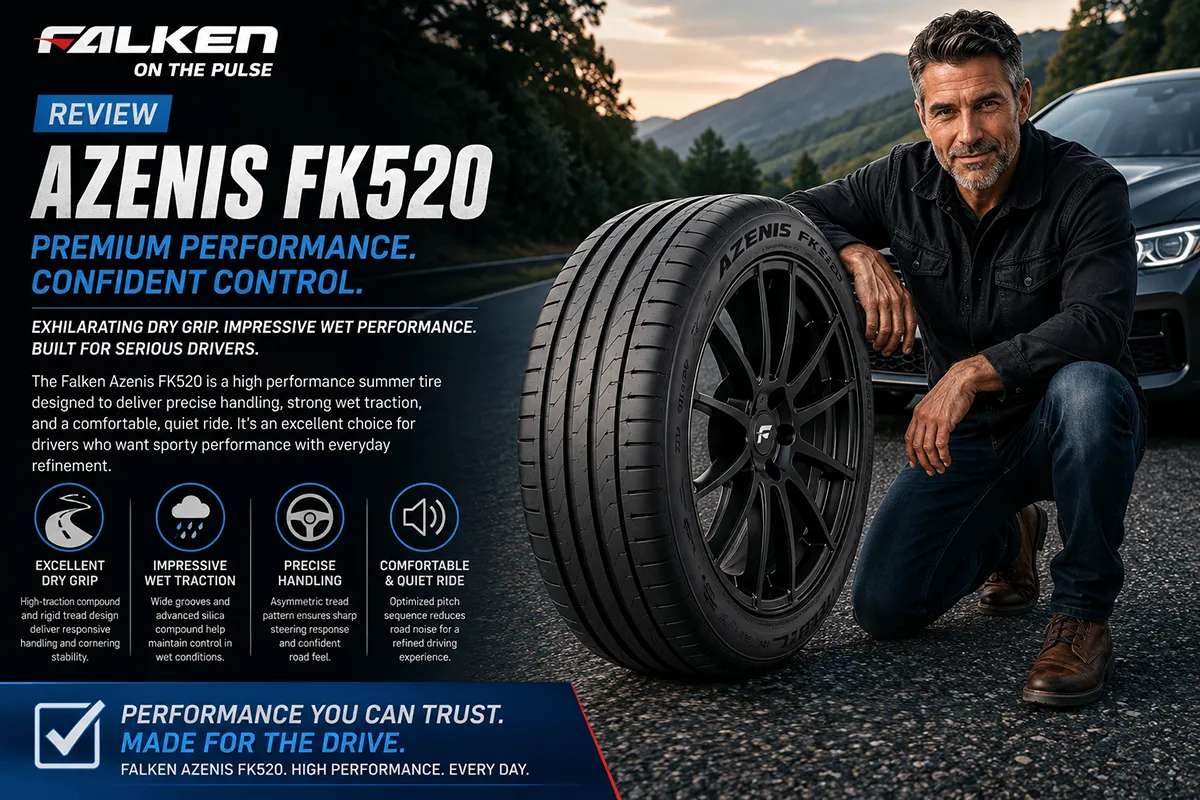
The Falken Azenis FK520 has built a genuine reputation as a strong-value ultra-high-performance summer tire since replacing the FK510 in 2023. Real strengths show up consistently across independent testing — but so does a genuinely specific, documented weakness most reviews skip past.
In at least one detailed independent test, this tire posted the shortest dry braking distance of the entire field while simultaneously finishing dead last in dry handling on the same course. That’s not a small inconsistency — it’s a real, honest split personality worth understanding before you buy.
This review is based on manufacturer specifications, aggregated professional and owner test data, and real long-term reports — not a single set of personal impressions.
- What it is: A mid-range ultra-high-performance summer tire with an asymmetric tread pattern, released in 2023 as the direct successor to the FK510.
- Real strengths: Genuinely class-leading braking (both dry and wet), low noise and rolling resistance, strong value relative to premium rivals.
- Real weaknesses: A documented, specific inconsistency between braking and dry handling in at least one detailed test, along with weaker performance in curved aquaplaning and wet handling limits.
- The catch: Two major independent aggregators show genuinely different overall pictures — one places it mid-pack across 19 tests, the other places it near the top of a smaller 13-test sample — worth knowing rather than assuming either number tells the whole story.
- Bottom line: A genuinely strong-value tire for drivers who prioritize braking performance and comfort, with real, specific handling trade-offs worth weighing depending on driving style.
Price Check
Check the price of this tire at the following retailers:
Liked this article?
Add TireAdvise as a preferred source so you see more of our tire reviews and guides on Google.
A Genuine Split Personality: Brakes Brilliantly, Handles Inconsistently
This is worth addressing directly, since it’s the single most specific, documented finding about this tire and most reviews don’t report it in this much detail, instead defaulting to a single, simplified verdict that flattens a genuinely more nuanced picture.
In one detailed independent test, the FK520 was specifically described as “the braking specialist of the test,” posting the shortest dry braking distance of all candidates and also delivering strong wet braking. Sand traction was the best in the entire field, and rolling resistance was genuinely low, reflecting real fuel-efficiency benefit.
At the very same time, in that same test, testers described “delayed steering response and weak side guidance” in dry handling — a real, specific limitation that dropped the tire to last place on the dry handling course. Gravel traction was also the weakest in that particular field.
This isn’t a contradiction so much as a genuine, documented trade-off: whatever engineering choice gives this tire its exceptional straight-line braking grip appears to come at a real cost to steering precision and side-to-side confidence in at least some testing conditions.
Broader aggregated data across 41 reviews confirms this pattern in less extreme terms too, describing “steering feel/turn-in” as softer or less precise than top-tier rivals as a recurring minority theme, alongside “reduced confidence in heavy standing water” for a smaller but notable group of reviewers.
A Genuine Discrepancy Between Independent Aggregators
This is also worth reporting honestly, since two credible, independent data sources paint meaningfully different overall pictures of this tire.
Tyre Reviews’ Bayesian-aggregated analysis, drawing on 19 independent professional tests, shows the FK520 averaging a 7th-place finish — describing it as “a mid-range option without a standout strength or major weakness” in its broadest summary, occupying “mid-pack to lower-mid-pack” territory overall, with an average position of 7.1 across the full test history.
AllTyreTests’ independent analysis, drawing on a smaller sample of 13 tests, tells a more favorable story — an average position of 4.2nd, a 97% overall rating, and a single outright test win, describing the tire as “competitive compared to top competitors.”
Both are legitimate, methodologically serious aggregation sources, and the honest explanation for the gap likely comes down to which specific tests each source has incorporated, since different publications use different vehicles, conditions, and comparison fields.
The practical takeaway: treat any single aggregate score with some healthy skepticism, and weigh the category-specific strengths and weaknesses detailed throughout this review more heavily than either overall number in isolation.
What the FK520 Actually Is
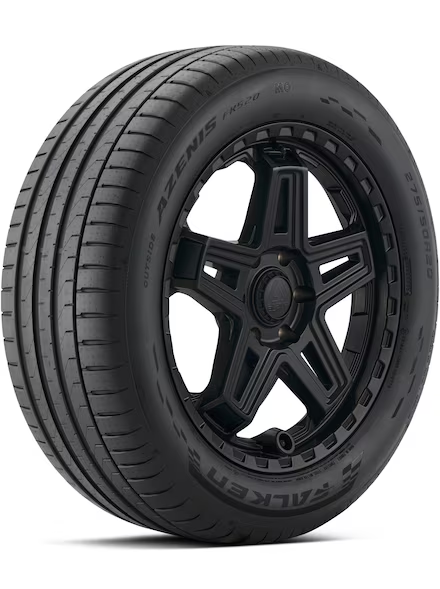
The Azenis FK520 is Falken’s ultra-high-performance summer tire, released in 2023 as the direct successor to the well-regarded FK510, available in 128 sizes spanning 17 to 21 inches for passenger cars and crossovers.
Falken states the FK520 builds on the FK510’s foundation with genuine, specific engineering changes: structurally stronger construction for improved steering precision and feedback, and roughly 10% lighter to reduce unsprung mass and improve rolling resistance.
The tire also carries an “A” fuel-efficiency rating in European labeling standards, reflecting real, documented low rolling resistance.
Dry Performance
This category deserves the nuanced treatment established above rather than a single verdict, since the honest picture genuinely depends on which specific measure matters most.
Braking is a real, consistently documented strength — the tire posted the shortest dry braking distance in at least one detailed field test, and AllTyreTests’ independent data places dry braking at a strong 7th-place ranking overall.
Real owner feedback across 41 aggregated reviews consistently praises “confident dry grip” and a “progressive, predictable breakaway that makes it easy to trust on the road.”
Handling is where the picture gets genuinely mixed. AllTyreTests describes dry handling as a real strength at 6th place overall, while the specific detailed test cited above found the opposite — delayed steering response dropping the tire to last in that particular comparison.
The honest synthesis: dry handling appears competent-to-strong in broader aggregated data, but isn’t uniformly dominant, and at least one credible test found it a genuine weak point relative to that specific field of competitors.
Wet Performance
Wet braking is a real, consistently strong category — described directly as one of the tire’s clear strengths across multiple independent sources, with a notable “wet/dry braking double win” specifically documented in the 2026 Sport Auto test against the Michelin Pilot Sport 5.
Aquaplaning resistance shows a genuine, specific split worth understanding. AllTyreTests describes straight-line and lateral aquaplaning resistance as real strengths, ranking 3rd and 4th respectively in that dataset.
But broader aggregated owner and test data specifically flags “curved aquaplaning” and general wet handling confidence as weaker points, with one source noting the tire “struggled a little more in curved aquaplaning” specifically, distinct from its strong straight-line water performance.
Wet handling at the limit is the more consistently flagged concern — AllTyreTests ranks it a genuine weak point at 9th place, and aggregated owner feedback echoes “reduced confidence in heavy standing water” for a meaningful minority of reviewers.
Ride Comfort and Noise
This is a genuine, consistently praised strength across nearly every source reviewed. Real owner feedback aggregated across dozens of reviews describes the tire as “quieter and more comfortable than many UHP alternatives at the price” — a real, meaningful advantage given the tire’s mid-range positioning.
Independent comparison testing against the premium Michelin Pilot Sport 5 specifically credits the FK520 with “noticeably lower noise in nearly every test” — a genuine, documented advantage over a flagship-tier competitor, not just a budget-tire consolation prize. Real owner reports also specifically describe improved comfort over the outgoing FK510, particularly on rough or uneven roads.
Tread Life and Durability
This deserves an honest, direct caveat rather than a clean verdict. Aggregated data specifically flags a real “Data Discrepancy” between professional test-measured mileage projections and real owner-reported experience — a documented 35% difference, large enough that the source itself calls it out directly rather than papering over it.
AllTyreTests’ independent wear-resistance ranking places the tire at a respectable 3rd place in that dataset, and real owner feedback aggregated across dozens of reviews describes “respectable wear” as a recurring, generally positive theme.
But given the documented gap between lab projections and real-world reports, treating any single specific mileage figure with some caution is the honest approach — actual results likely vary more than a single number would suggest, based on driving style and conditions.
Value and Pricing
This is where the FK520 makes its clearest, most consistently documented case. Independent comparison analysis specifically credits the tire with “sharp pricing/value metrics” relative to premium rivals like the Michelin Pilot Sport 5, delivering genuinely competitive braking performance — including that documented wet/dry braking double win in specific testing — at a meaningfully lower price point.
Real owner feedback consistently reinforces this, with “value for money” appearing repeatedly across aggregated reviews as one of the tire’s most frequently cited positive themes, alongside specific praise for delivering “a high level of performance at a competitive price.”
How the FK520 Compares to the FK510
Since these are directly, commonly cross-shopped within Falken’s own lineup, a clear comparison is worth including.
The FK510 remains a well-established, proven tire with a longer independent test history and real, strong reputation for near-premium performance at a lower price. The FK520 is genuinely the newer, more refined successor — structurally stronger for improved steering precision, roughly 10% lighter, and real owner reports specifically describe improved comfort over the FK510, particularly on rough roads.
The honest trade-off: the FK520’s documented handling inconsistency in at least one specific test, and the real gap between the two independent aggregators’ overall assessments, mean it hasn’t yet established the same uniformly consistent track record the FK510 built over its longer market history.
For buyers who specifically prioritize a longer-proven track record over the newest engineering, the FK510 remains a genuinely reasonable choice; for those who want the latest refinements and are comfortable with the documented trade-offs, the FK520 is the more current option.
How the FK520 Compares to the Michelin Pilot Sport 5
Independent direct comparison data offers a genuinely useful head-to-head against this premium benchmark competitor.
The FK520 “keeps itself relevant with sharp pricing/value metrics, noticeably lower noise in nearly every test, and occasional standout braking results” specifically including that documented wet/dry braking double win in the 2026 Sport Auto test — a real, credible result against a genuine flagship-tier rival, not a marginal budget-tire footnote.
The practical takeaway: for drivers who prioritize braking confidence, quiet, and value, the FK520 offers a genuinely competitive alternative to a premium tire costing meaningfully more.
For drivers who prioritize the sharpest possible steering precision and handling confidence at the absolute limit, the premium alternative likely remains the safer choice given the FK520’s documented handling inconsistency.
Who the FK520 Makes Sense For
Drivers who prioritize braking confidence and value. This is the tire’s clearest, most consistently documented strength, backed by real, specific test results including outright wins against premium competitors.
Owners who want a genuinely quiet, comfortable UHP tire. The consistently praised noise and comfort advantage over pricier alternatives is real and well-documented across independent sources.
Budget-conscious shoppers cross-shopping against premium flagship tires. Given the documented competitive braking performance against the Michelin Pilot Sport 5 at a meaningfully lower price, this is a genuinely reasonable value trade-off for many drivers.
Who Should Consider Alternatives
Drivers who prioritize sharp, precise steering feel above all else. Given the documented, specific handling inconsistency in at least one detailed test, and the recurring “softer turn-in” theme in broader aggregated feedback, drivers for whom steering precision is the top priority should weigh a premium alternative.
Owners in regions with frequent heavy rain and standing water. Given the more consistently flagged wet handling and curved aquaplaning concerns, drivers facing genuine heavy-rain risk should weigh this limitation seriously.
Anyone relying on a single overall score to make a decision. Given the genuine, documented discrepancy between major independent aggregators, this tire specifically rewards looking at category-level detail rather than trusting one overall number.
Sizing and Availability
The FK520 is available across 128 sizes spanning 17 to 21 inches, a genuinely wide range covering common passenger car and crossover fitments in the US and European markets alike.
Given the tire’s positioning as a genuine mid-range alternative to premium UHP options, many popular sizes for sport sedans and hot hatches are well covered, though as with any tire purchase, confirming the exact size against the vehicle’s door jamb placard remains the safest first step, particularly for owners of vehicles with staggered factory fitments where front and rear sizes differ.
Getting the Most Out of This Tire
Given the tire’s documented strengths and specific trade-offs, a few habits genuinely help drivers get the most out of it.
Lean into its braking strength rather than fighting its handling character. Given the well-documented braking advantage and the more mixed handling picture, driving styles that prioritize confident, early braking over late-apex aggressive cornering will likely get more out of this tire’s genuine strengths.
Check tire pressure regularly, especially before spirited driving. UHP tires are genuinely sensitive to inflation pressure, and given the documented handling inconsistency in some testing, staying within the manufacturer-recommended range is a real, practical way to maximize whatever steering precision the tire does offer.
Exercise real caution in standing water specifically. Given the documented curved aquaplaning and wet handling limit concerns, moderating speed through standing water — rather than assuming uniform wet-weather confidence based on the tire’s strong wet braking reputation alone — is a genuinely sensible precaution.
Rotate on a consistent schedule. Given the documented gap between lab-projected and real-world mileage, regular rotation every 5,000–7,500 miles is a reasonable, practical step to help even wear track closer to expectations.
What Real Owners Say vs. What Test Labs Measure
There’s a genuinely useful pattern worth understanding here, and it echoes the broader theme running through this whole review: owner sentiment and instrumented lab testing don’t always agree, and both sources add real value when read together rather than in isolation.
Real owner reviews across 41 aggregated accounts consistently describe genuine satisfaction with dry grip, braking confidence, and value — closely matching what the instrumented test data shows for those same categories.
This alignment lends real credibility to both sources when they agree, since it suggests the lab measurements are capturing something drivers genuinely notice and appreciate in daily use.
Where the picture gets more textured is the handling and aquaplaning nuances documented throughout this review.
Owners who specifically push the tire hard through tight, technical corners, or who regularly encounter genuine standing water, are the ones most likely to notice the specific limitations independent testing has flagged — a reminder that how any given driver experiences this tire depends heavily on their own specific driving style and the conditions they actually encounter, not just an aggregate score.
Frequently Asked Questions
Is the Falken Azenis FK520 a good tire overall?
Genuinely, it depends on priorities. It’s a real strength in braking (both dry and wet) and offers strong value and comfort relative to premium rivals, but independent testing shows a documented inconsistency in dry handling and wet handling confidence in specific tests. Two major independent aggregators even show meaningfully different overall rankings, so category-specific strengths matter more than any single score.
Is the Falken Azenis FK520 good in the rain?
It’s genuinely mixed depending on the specific measure. Wet braking is a real, well-documented strength, including a specific wet/dry braking double win against the Michelin Pilot Sport 5. However, curved aquaplaning resistance and wet handling confidence at the limit are more consistently flagged as weaker points across independent testing.
What’s the difference between the Falken Azenis FK520 and the FK510?
The FK520 is the direct 2023 successor, genuinely structurally stronger for improved steering precision and roughly 10% lighter for better rolling resistance, with real owner reports describing improved comfort over the FK510. The FK510 has a longer, more established independent test history, while the FK520 shows a real documented handling inconsistency in at least one detailed test that the FK510 doesn’t share to the same degree.
How does the Falken Azenis FK520 compare to premium tires like the Michelin Pilot Sport 5?
It competes genuinely well on specific measures — independent testing documents a wet/dry braking double win against the Pilot Sport 5 in one detailed 2026 test, alongside consistently lower noise and stronger value. The Pilot Sport 5 likely retains an edge in outright steering precision and handling confidence at the limit.
How long does the Falken Azenis FK520 last?
Independent wear-resistance ranking places it at a respectable 3rd place among tested competitors, and real owner feedback generally describes respectable wear. However, aggregated data specifically flags a documented 35% discrepancy between lab-projected and real-world reported mileage, worth factoring in as a genuine caveat rather than trusting a single mileage figure.
Is the Falken Azenis FK520 worth the price?
For most buyers prioritizing value, comfort, and braking confidence, yes — independent comparison data shows it competing genuinely well against premium rivals at a meaningfully lower price. Buyers who specifically prioritize the sharpest possible steering precision above all else may find the documented handling trade-off worth paying more to avoid.
What vehicles is the Falken Azenis FK520 designed for?
It’s built for passenger cars and crossovers, available in 128 sizes spanning 17 to 21 inches, positioned as a mid-range ultra-high-performance summer tire suitable for both daily driving and genuinely spirited driving.
