

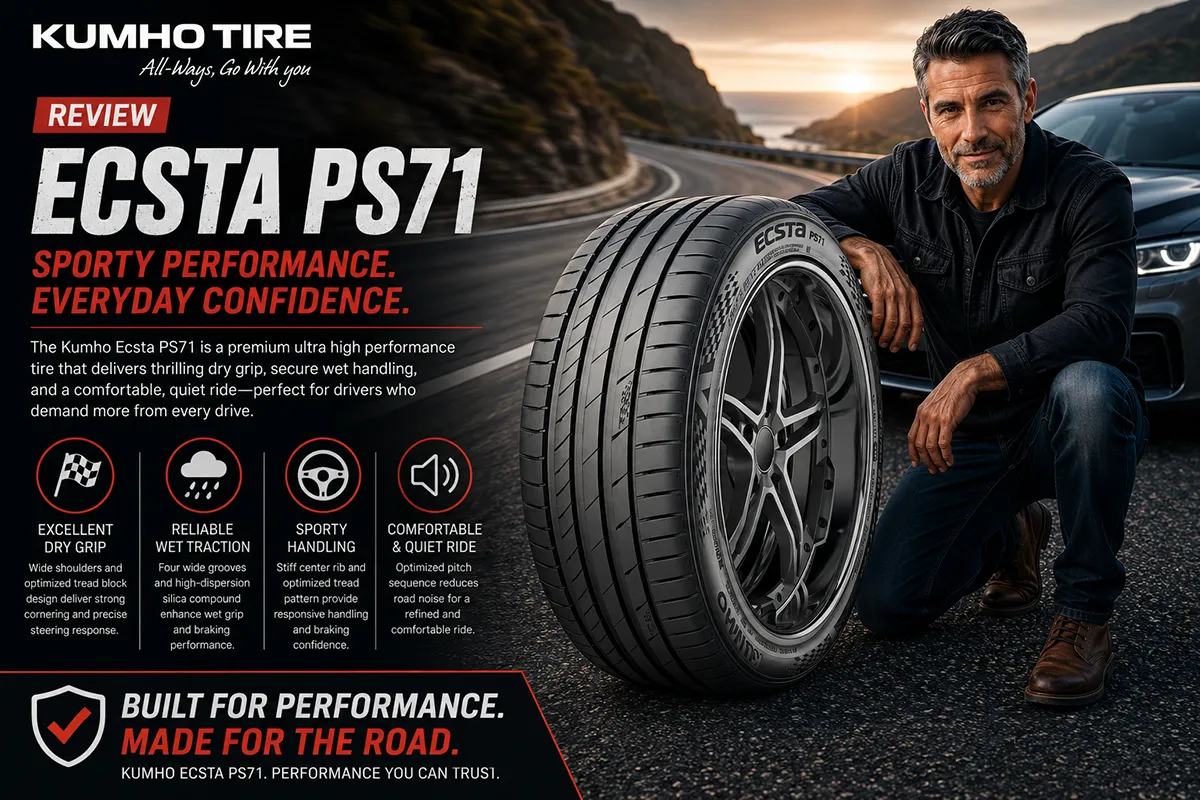
The Kumho Ecsta PS71 has built a genuine, well-documented identity across nearly a decade of independent testing: a mid-range ultra-high-performance summer tire with a clear, consistent wet-weather bias, repeatedly landing podium finishes in wet braking, wet handling, and aquaplaning resistance across major European test programs.
Released in 2016, this is also a genuinely long-serving tire by UHP standards — most tires in this category see a refresh every 5 to 7 years.
That longevity is worth knowing about directly, alongside a real, specific tension in the data: at least one detailed test found the tire’s wet braking merely average, directly at odds with the broader reputation for “confident wet braking” that shows up elsewhere.
This review is based on manufacturer specifications, aggregated professional and owner test data, and real long-term reports — not a single set of personal impressions.
- What it is: A mid-range ultra-high-performance summer tire, released in 2016, with a clear and consistently documented wet-weather focus.
- Real strengths: Genuinely class-leading aquaplaning resistance, strong wet braking and handling in most independent tests, real competitive value.
- Real weaknesses: Higher noise levels, inconsistent wear and durability reported across sources, and at least one specific test found wet braking merely average — a real tension with the tire’s broader wet-weather reputation.
- The catch: This is a genuinely older tire by UHP standards, and it’s available in multiple distinct variants (standard, XRP run-flat, SUV) that shoppers should confirm before ordering.
- Bottom line: A genuinely strong choice for drivers who prioritize wet-weather safety and value, with real, honest trade-offs in noise and wear consistency worth weighing.
Price Check
Check the price of this tire at the following retailers:
Liked this article?
Add TireAdvise as a preferred source so you see more of our tire reviews and guides on Google.
A Genuine Tension: Aquaplaning Champion, But Is Wet Braking Actually Strong?
This is worth addressing directly, since it’s a real, documented inconsistency in the data that most single-source reviews don’t reconcile, instead defaulting to a single, simplified “great in the wet” verdict that glosses over a genuinely more nuanced picture worth understanding before you buy.
Broader aggregated analysis across the tire’s full independent test history describes a clear pattern: “repeated podiums in wet braking, wet handling and aquaplaning, translating into several top overall finishes” — with specific, verifiable results including 4th of 21 in the 2025 Auto Bild test, 4th of 52 in the 2025 Auto Bild shootout, 5th of 21 in the 2023 Auto Bild test, 3rd of 17 in the 2021 ADAC test, and 2nd of 11 in the 2018 ACE test.
That’s a genuine, well-documented track record across multiple credible European testing bodies, not a cherry-picked result.
At the same time, at least one detailed individual test summary states plainly: “The Kumho Ecsta PS71 is the best tyre in aquaplaning testing, but only has average wet braking” — a direct, specific contradiction of the broader pattern in that particular comparison.
This isn’t necessarily an error on either side; different tests use different vehicles, wet-track conditions, and comparison fields, and results can genuinely vary from one test to the next even for a tire with an otherwise consistent overall reputation.
The honest synthesis: aquaplaning resistance is the tire’s single most consistently dominant, undisputed strength across every source reviewed.
Wet braking is very likely a real strength overall, given the weight of evidence across multiple major tests, but it’s not a guaranteed win in every single comparison, and treating it as absolutely bulletproof in every condition would overstate what the full data actually shows.
What the Ecsta PS71 Actually Is
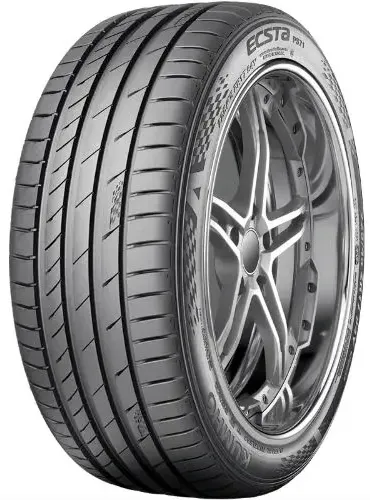
The Ecsta PS71 is Kumho’s ultra-high-performance summer tire, positioned for high-performance sedans and sports cars. It was released in 2016, and it’s genuinely still on the market a decade later — a notably long production run for a tire in this fast-moving category, where competitors typically see meaningful updates every 5 to 7 years.
The tire is available across a wide international footprint, including North America, Canada, Central and South America, Europe, Russia, East Asia, Southeast Asia, the Middle East, North Africa, and Oceania — a genuinely broad market presence reflecting real, sustained demand rather than a niche product.
Beyond the standard passenger-car version, Kumho also offers this tire in a run-flat configuration (marketed as the Ecsta PS71 XRP) and a dedicated SUV variant (Ecsta PS71 SUV) — a real, important distinction for shoppers to understand before ordering, since these aren’t simply different sizes of the identical product but genuinely different constructions suited to different applications.
Wet Performance
This is the tire’s clearest, most consistently documented identity, and the evidence is genuinely strong across independent sources.
Aquaplaning resistance is described directly as best-in-test in at least one detailed comparison, with the tire “scoring best in the straight aquaplaning test” — a real, measured result rather than a subjective impression.
Real owner accounts consistently back this up in concrete terms: one detailed real-world comparison specifically describes switching from a Pirelli Cinturato P7 and finding “a stark difference,” with the Kumho performing “fantastic in the wet” — braking and turning in pouring rain both described as excellent, with the owner specifically noting research suggesting aquaplaning resistance rivaling tires costing twice the price.
Wet handling is similarly strong across most sources, with independently reported testing describing “some of the best times in the wet handling course” in at least one direct comparison.
As covered above, wet braking is very likely a genuine strength overall given the weight of evidence, though it’s worth knowing that at least one specific test found it merely average rather than dominant.
Dry Performance
This is a genuinely more modest category for this tire, and it’s worth reporting honestly rather than overselling it.
Aggregated testing describes dry performance as “usually mid-pack” across the tire’s full test history — competent rather than a standout strength.
One detailed test summary specifically notes the tire is “hindered by its performance on dry roads” when calculating an overall driving-safety rating, even while wet performance remains genuinely strong in that same evaluation.
Real owner feedback includes at least one specific, notable caution worth taking seriously: one detailed account describes the car feeling “not stable and not comfortable” in turns over 100 km/h (roughly 62 mph) — a genuine, specific high-speed stability concern rather than a vague complaint.
A separate real-world comparison account described the tire as “marginally ok (slightly worst than P7 perhaps) on dry roads,” a fair, moderate assessment consistent with the broader “mid-pack” pattern in aggregated testing.
Ride Comfort and Noise
This is the tire’s most consistently flagged weak point across nearly every source reviewed. Aggregated independent testing explicitly lists “Noise” among the tire’s weak points, and broader analysis across the full test history confirms this as a recurring theme rather than an isolated result.
Real owner reports are more mixed here than the aggregated testing data might suggest — one detailed source specifically describes the tire ensuring “a smooth and comfortable ride with minimal cabin noise,” attributed to careful tread and material design.
The honest synthesis: independent instrumented testing consistently measures higher noise levels as a real characteristic of this tire, even if individual owner perception varies based on the vehicle it’s mounted on and personal sensitivity to road noise.
Tread Life and Durability
This deserves direct, honest treatment, since the data here is genuinely more inconsistent than for the tire’s wet-weather performance.
Broader aggregated analysis describes “wear and value” as fluctuating “from average to poor,” specifically dragging down results in tougher, efficiency-weighted tests like ADAC’s evaluation program.
At the same time, at least one detailed test reports genuinely strong mileage — over 42,000 kilometers (roughly 26,000 miles) — combined with excellent cost-per-distance value, earning an “exemplary” rating in that specific comparison.
Real owner reports add further texture: one detailed account specifically describes strong grip “when you’re pushing it” — genuinely track-capable performance — but notes tread wearing “pretty fast” in mixed city and highway use, prompting that owner to consider a different tire for the rear axle specifically.
A separate account also mentions “balance-related issues” reported by some users, worth knowing as a real, if not universal, concern.
Value and Pricing
This is a genuine strength across multiple independent sources, and it’s worth highlighting directly given how consistently it appears.
One detailed test specifically credits the tire with “excellent cost performance” at a concrete, quantified figure — roughly €7.49 per 1,000 kilometers in that evaluation — explicitly describing it as “a value choice among the premium performers.”
Real owner accounts echo this consistently, with at least one reviewer specifically noting the tire “can be found on sale all the time” and describing it as “the best cheap performance tyre” for wet-weather-prone climates.
How the Ecsta PS71 Compares to the Pilot Sport 4S
Since these are genuinely, commonly cross-shopped by owners upgrading from worn OEM tires, a direct comparison is worth including.
One detailed real-world account describes a genuinely useful natural experiment: a used vehicle purchased with nearly new Kumho Ecsta PS71 tires already mounted on the front axle, paired with worn factory Bridgestone Turanzas on the rear.
That owner specifically considered switching to the Michelin Pilot Sport 4S before making a final decision — a real, concrete data point suggesting the Kumho holds up as a credible starting comparison point against a genuine flagship-tier tire, even if the two ultimately serve somewhat different priorities (the Michelin generally leaning more toward outright dry grip and refinement, the Kumho toward wet-weather value).
Should You Consider the Newer Ecsta HS Series Instead?
Given how long the PS71 has been on the market, this is worth raising directly rather than ignoring. At least one real, detailed owner account specifically mentions planning to try the Ecsta HS81 as a replacement after wearing through a set of PS71s — a genuine, sourced signal that Kumho’s lineup has continued to evolve since 2016.
This review focuses specifically on the PS71 as requested, and the newer HS-series tires deserve their own dedicated evaluation rather than an assumption here about how they compare.
But shoppers specifically weighing whether to buy a tire that’s been on the market for nearly a decade should know that newer options within Kumho’s own lineup exist and may be worth researching directly before committing, particularly if long-term parts and compound availability is a concern.
Who the Ecsta PS71 Makes Sense For
Drivers in genuinely rain-heavy climates who prioritize wet-weather safety. This is the tire’s clearest, most consistently documented strength, backed by real competition results across multiple major independent test programs.
Budget-conscious performance drivers. Given the consistently documented value proposition, including specific, quantified cost-per-distance results, this is a genuinely strong choice for drivers who want real UHP capability without flagship pricing.
Owners specifically replacing worn factory tires with a wet-weather-focused upgrade. The real-world comparison account cited above suggests this tire holds up reasonably well even against premium alternatives for drivers prioritizing all-around confidence over outright dry-limit performance.
Who Should Consider Alternatives
Owners who prioritize sharp, confident high-speed dry handling. Given the specific, documented high-speed stability complaint and the broader “mid-pack” dry performance pattern, drivers who regularly push their car hard on dry roads at speed may want a more dry-focused alternative.
Noise-sensitive drivers. Given the consistently flagged noise weakness across independent testing, owners for whom cabin quiet is a top priority should weigh this limitation seriously.
Shoppers specifically wanting Kumho’s newest engineering. Given the tire’s real age and at least one real owner’s stated intent to move to the newer HS81, buyers who prioritize the latest compound and construction technology should research Kumho’s current lineup directly before defaulting to this longer-serving model.
Sizing and Fitment
The Ecsta PS71 is available across a wide range of sizes suited to high-performance sedans and sports cars, with the run-flat XRP and SUV variants covering additional, distinct fitment needs beyond the standard passenger-car version.
Given the genuine construction differences between the standard, XRP, and SUV variants, confirming the exact product name — not just the size — against a vehicle’s factory specification or a trusted fitment guide is a genuinely important step before ordering, since these aren’t interchangeable despite sharing the same core nameplate.
What Real Owners Say vs. What Test Labs Measure
There’s a genuinely useful pattern worth understanding here, consistent with the broader theme running through this review: owner sentiment and instrumented lab testing don’t always align perfectly, and reading both together gives a more complete picture than either alone.
Real owner reviews consistently echo the tire’s documented wet-weather strength, with accounts specifically describing confident braking and turning in heavy rain that closely matches the competition-podium results found in independent testing — a real point of agreement that lends credibility to both sources.
Where the picture gets more textured is tread wear and high-speed dry stability, where individual owner experiences appear to vary more than the aggregated data alone would suggest, likely reflecting real differences in driving style, climate, and vehicle application.
Getting the Most Out of This Tire
Lean into its wet-weather strength. Given the well-documented aquaplaning and wet-handling advantage, drivers in genuinely rain-prone regions get the most value from this tire’s real, standout capability rather than expecting it to match dry-focused rivals at the absolute limit.
Moderate speed through fast, sustained corners on dry roads. Given the specific, documented high-speed stability report, a measured approach to aggressive high-speed dry cornering is a genuinely sensible precaution rather than assuming uniform confidence across every condition.
Check tread wear more frequently than with a longer-proven tire. Given the documented inconsistency in durability reports, regular visual inspection and rotation every 5,000–7,500 miles helps catch uneven wear early and track actual performance against expectations.
Confirm the exact variant before reordering. Given the genuine construction differences between the standard PS71, the XRP run-flat, and the SUV version, double-checking the exact product name against your vehicle’s specification avoids an easy, avoidable mix-up.
Where to Buy
Tire Rack and Discount Tire both carry the Ecsta PS71 across common US sizes, with competitive pricing and professional mounting available.
SimpleTire and other online retailers frequently run promotions on this tire specifically, consistent with real owner reports describing it as commonly available on sale.
Local independent tire shops may also carry it given its long, established market presence, and are worth checking for competitive local pricing.
Frequently Asked Questions
Is the Kumho Ecsta PS71 good in the rain?
Genuinely, yes — this is the tire’s clearest, most consistently documented strength. It has repeatedly placed on podiums for wet braking, wet handling, and aquaplaning resistance across multiple major independent European test programs, and real owner accounts consistently describe confident wet-weather performance, including in heavy rain.
Is the Kumho Ecsta PS71 noisy?
Yes, this is a real, consistently flagged weak point in independent testing, though real owner perception varies somewhat. Aggregated data explicitly lists noise among the tire’s weak points across its full test history.
What’s the difference between the Kumho Ecsta PS71, the XRP, and the SUV version?
These are genuinely distinct products within the same nameplate. The standard PS71 is the passenger-car version, the Ecsta PS71 XRP is a run-flat configuration for vehicles that require it, and the Ecsta PS71 SUV is a separate variant built for SUV applications. Confirming which specific version matches your vehicle’s factory or replacement fitment matters before ordering.
How long does the Kumho Ecsta PS71 last?
Reported results are genuinely mixed. At least one detailed test reports strong mileage over 42,000 kilometers (roughly 26,000 miles) with excellent cost-per-distance value, while broader aggregated analysis describes wear and durability fluctuating from average to poor across the tire’s full test history, and some real owner accounts describe faster-than-expected wear in mixed driving.
Is the Kumho Ecsta PS71 a good alternative to the Michelin Pilot Sport 4S?
It can be, depending on priorities. A real owner account describes cross-shopping the two directly after inheriting a set of near-new PS71 tires, suggesting the Kumho holds up as a credible comparison point for wet-weather value, even though the Michelin generally leans more toward outright dry grip and refinement.
How old is the Kumho Ecsta PS71, and is it still worth buying?
It was released in 2016, making it a genuinely long-serving tire by ultra-high-performance standards. It remains a strong, well-documented choice specifically for wet-weather value, though shoppers who prioritize the newest available engineering may want to research Kumho’s newer Ecsta HS-series options directly before committing.
Is the Kumho Ecsta PS71 stable at high speed?
Reports are genuinely mixed here. At least one detailed real owner account describes reduced stability and comfort in turns over 100 km/h (roughly 62 mph), while aggregated dry performance data describes the tire as generally “mid-pack” rather than either a standout or a serious weakness. Drivers who regularly push their car hard on dry roads at speed should weigh this real, specific report before buying.
