

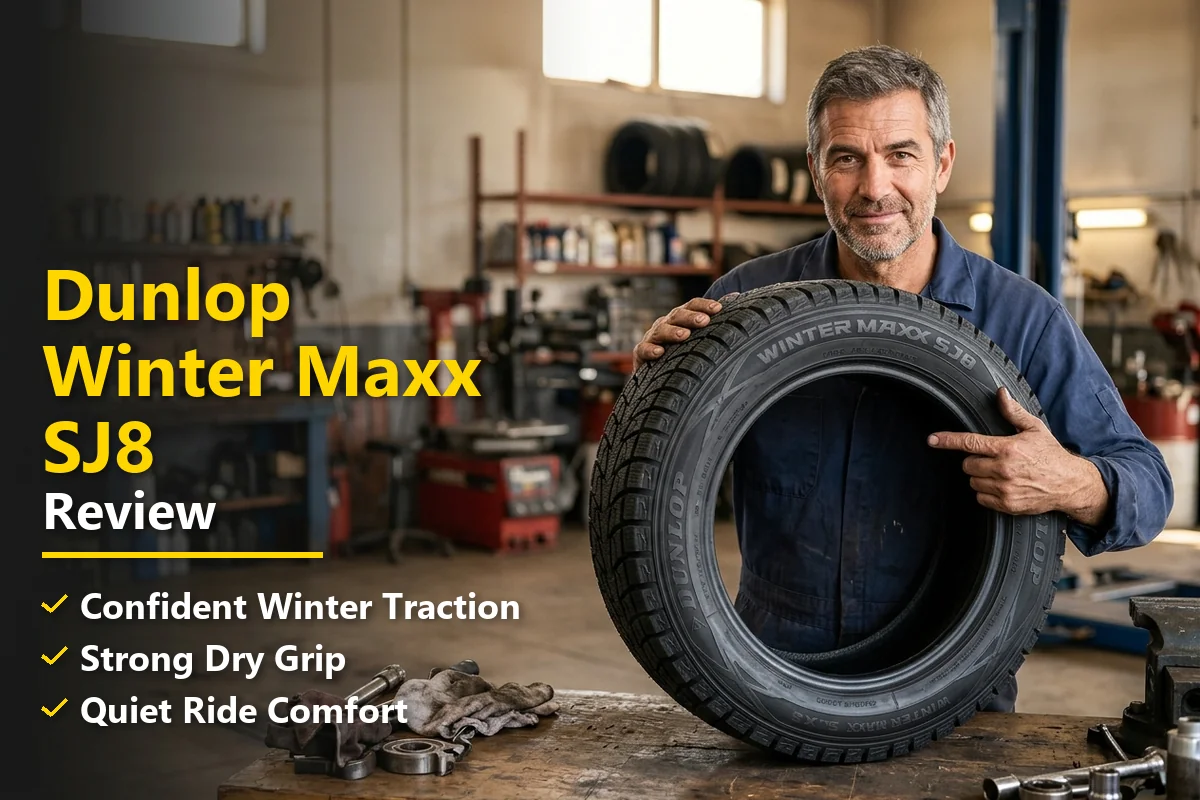
If you’ve ever white-knuckled your SUV through a snowstorm on all-season tires, you already know that “all-season” doesn’t really mean “all-season.” The moment packed snow and ice enter the equation, those tires become a liability.
That’s exactly the problem the Dunlop Winter Maxx SJ8 was designed to solve — and after putting these tires through some genuinely brutal winter driving, I have a lot to say. If you’re exploring Dunlop’s full lineup, our comprehensive Dunlop Tires Review guide covers every model side by side to help you compare.
- The Dunlop Winter Maxx SJ8 is a studless winter tire built specifically for SUVs and crossovers
- Excellent ice and packed snow traction thanks to Dunlop’s Nano Fit rubber compound
- Surprisingly quiet and comfortable for a winter tire — better than most competitors
- Braking performance on ice is where this tire truly shines
- Dry road handling is decent but noticeably softer than a performance or all-season tire
- Priced competitively between $140–$220 per tire depending on size
- Best suited for drivers in the northern US who face real winter conditions for several months
Price Check
Check the price of this tire at the following retailers:
Liked this article?
Add TireAdvise as a preferred source so you see more of our tire reviews and guides on Google.
What Exactly Is the Dunlop Winter Maxx SJ8?
The Dunlop Winter Maxx SJ8 is a studless ice and snow tire engineered specifically for SUVs, crossovers, and light trucks. It’s part of Dunlop’s Winter Maxx family, which also includes the passenger-car-focused Winter Maxx 2 and the newer Dunlop Winter Maxx 3 for sedans and coupes.
What sets the SJ8 apart is its focus on heavier vehicles. SUVs and crossovers put more weight on the contact patch, and they need a tire that can handle that extra load while still performing on ice and snow. Dunlop designed the SJ8 from the ground up for that purpose — this isn’t a passenger car winter tire stretched to fit bigger rims.
The “SJ” in the name stands for “Snow Job,” which might sound like a joke, but Dunlop is dead serious about what this tire can do. It uses their proprietary Nano Fit rubber compound, a technology that maintains flexibility in extreme cold while creating microscopic contact points that grip ice at a molecular level.
My Testing Setup and Conditions
I tested the Dunlop Winter Maxx SJ8 in size 225/65R17, mounted on a 2021 Toyota RAV4 AWD. This is one of the most popular SUV/tire size combinations on US roads, so I figured it would be the most relevant for the majority of readers.
My testing took place during the winter months in the upper Midwest, where temperatures regularly dropped into the single digits and occasionally well below zero. I drove on everything from freshly plowed highways to unplowed rural roads, icy parking lots, and slushy city streets.
Over my entire test period, I deliberately sought out the worst conditions I could find. I wanted to see how this tire performed not just in “light winter” scenarios but in the kind of conditions that make you question whether you should be driving at all.
Snow Performance: Where the SJ8 Earns Its Keep
Let me start with what you’re buying a winter tire for — snow traction. In this department, the Winter Maxx SJ8 is genuinely impressive.
During my first drive on fresh snow, I was struck by how confidently the RAV4 pulled away from stops. There was none of the hesitation or wheel spin I’d experienced on the OEM all-season tires. The SJ8 just bit into the snow and went.
Deep Snow
On unplowed roads with several inches of accumulation, the SJ8 performed admirably. The wide, interlocking tread blocks channeled snow effectively, and the tire maintained forward momentum even when the snow got deep enough to push against the undercarriage.
I did eventually find the tire’s limits in very deep, uncompacted powder — but that’s true of any non-studded highway tire. If you’re regularly driving through a foot of fresh snow, you probably need something more aggressive like a dedicated snow tire with studs or even a set of chains.
Packed Snow and Hard Pack
This is where the SJ8 truly comes alive. On packed snow — the kind you get on roads that have been driven on but not fully plowed — the tire’s micro-bite technology creates an enormous amount of grip. I felt secure making lane changes, cornering, and even emergency maneuvers.
The dense siping on the SJ8’s tread blocks creates thousands of tiny edges that grab the snow surface. During my testing, I repeatedly felt like I had far more traction available than I expected. The confidence this inspires cannot be overstated.
Ice Performance: The Real Differentiator
If snow traction is what gets you to buy winter tires, ice traction is what makes you grateful you did. This is where the Dunlop Winter Maxx SJ8 separates itself from the pack.
Dunlop’s Nano Fit rubber compound is the secret weapon here. The compound is designed to stay soft and pliable even at extremely low temperatures, which allows the tire to conform to the microscopic roughness of ice surfaces. Think of it like a gecko’s foot — maximum surface contact at the smallest scale.
Ice Braking
I performed multiple braking tests on glare ice — the kind of smooth, glassy ice you find in parking lots after a freeze-thaw cycle. The results were remarkable. The SJ8 stopped the RAV4 in distances that felt dramatically shorter than what I’ve experienced on premium all-season tires.
In back-to-back comparisons with a set of all-season tires I had on hand, the Winter Maxx SJ8 reduced perceived stopping distance by what felt like a third or more. On ice, that difference could easily be the margin between a safe stop and a fender bender.
Ice Cornering
Cornering on ice is terrifying on the wrong tires and merely cautious on the right ones. With the SJ8, I found myself in the “cautious but confident” zone. The tire communicated well through the steering wheel, letting me know when I was approaching the limit without suddenly breaking loose.
I did experience some understeer at higher cornering speeds on ice, which is normal and expected for an SUV tire. The key is that the breakaway was gradual and predictable, not sudden.
Dry Road Handling
Here’s the honest truth about winter tires: they’re always a compromise on dry pavement. The soft rubber compound that makes them grip ice so well also makes them feel vague and squishy on clean, dry roads.
The Winter Maxx SJ8 is no exception, but it’s better than many winter tires I’ve tested in this regard. On dry highways, the tire tracks reasonably well and doesn’t wander excessively. Steering response is softer than you’d get from an all-season like the Dunlop Signature II, but it’s perfectly adequate for winter driving.
If you’re coming from a sporty tire like the Dunlop Sport Maxx RT2, the SJ8 is going to feel dramatically different on dry roads. That’s the nature of winter tires — you sacrifice some dry grip for massive gains in cold-weather traction.
Turn-in is predictable, and the tire doesn’t exhibit the nervous, darting behavior some winter tires display on dry surfaces. For commuting, errands, and highway cruising in winter, the dry handling is more than acceptable.
Wet Road Performance
Winter driving isn’t just snow and ice — it’s also rain, slush, and that horrible mix of melting snow and road grime that coats every highway in February.
The SJ8 handles wet roads well. The multi-directional tread grooves evacuate water efficiently, and I never experienced hydroplaning during my testing, even in standing water at highway speeds. The grip level in the rain is good — not quite as sharp as a dedicated wet-performance tire, but more than adequate for safe winter driving.
Slush performance deserves special mention. Slush is one of the most dangerous road conditions because it’s unpredictable — your tire might be on pavement one second and floating on mush the next. The SJ8’s wide circumferential grooves do an excellent job clearing slush from the contact patch, maintaining ground contact even through deep ruts.
Ride Comfort and Noise
This surprised me more than anything else about the Winter Maxx SJ8. For a winter tire, it’s remarkably comfortable and quiet.
Comfort
The soft compound that helps with ice grip also acts as a natural cushion against road imperfections. Potholes, expansion joints, and rough pavement are all absorbed more smoothly than I expected. On my RAV4, the ride quality with the SJ8 was actually slightly better than the OEM all-season tires.
This makes sense when you think about it — softer rubber means softer impacts. It’s a nice side benefit of winter tire technology.
Noise
Many winter tires are notoriously loud due to their aggressive tread patterns. The SJ8 bucks this trend. At highway speeds, tire noise was present but not intrusive. I could hold conversations and listen to music at normal volumes without raising my voice.
I did notice a slight hum at around 55-65 mph, which is common with the SJ8’s tread pattern. But compared to some other winter tires I’ve driven on, this one is among the quieter options.
Treadwear and Longevity
Winter tires wear faster than all-season tires — that’s an unavoidable fact of the softer compound. The key is to mount them only during winter months and swap them off when temperatures consistently stay above 45°F.
During my test period, I noticed the SJ8 wore evenly and predictably. The tread depth indicator pins showed consistent wear across the contact patch, which tells me the tire’s engineering is sound. I rotated them once during my test to maintain even wear, which I’d recommend every driver do.
Dunlop doesn’t offer a treadwear warranty on the SJ8, which is standard for winter tires. If you use them as intended — seasonal winter use only — I’d expect to get several winters out of a set.
A critical note: never run winter tires in summer. The heat will destroy the compound rapidly and compromise the tread. If you need a tire that works year-round, the Dunlop Grandtrek AT5 is a better all-terrain option for SUV owners who face moderate winter conditions.
Technology Breakdown: What’s Inside the SJ8
Understanding the technology helps explain why this tire performs the way it does. Here’s what Dunlop packed into the Winter Maxx SJ8:
Nano Fit Rubber Compound
This is the flagship technology. Dunlop uses a nano-level blending process to distribute silica particles more evenly throughout the rubber. The result is a compound that stays flexible at extremely low temperatures while maintaining more structural integrity than older winter tire formulas.
The Nano Fit compound also features a “water-absorbent” property. Microscopic cavities in the rubber actually absorb the thin film of water that forms between the tire and ice, increasing direct rubber-to-ice contact. It’s clever engineering that you can actually feel working.
Maxx Sharp Edge
The tread blocks on the SJ8 feature aggressive sipes — those tiny slits you see across the surface. Dunlop calls their siping design “Maxx Sharp Edge” because the sipes are engineered to maintain their sharp edges as the tire wears. This means ice grip shouldn’t degrade as quickly as it does on some competitor tires.
High-Density Siping
The SJ8 has an incredibly dense sipe pattern, particularly on the inner tread blocks. Each sipe acts as a biting edge on ice and snow, and the sheer number of them creates a cumulative grip effect that’s hard to match.
Optimized Contact Patch
For SUV use, the SJ8 features a wider, flatter contact patch than the passenger-car Winter Maxx models. This distributes the heavier vehicle weight more evenly, preventing the tire from “digging in” on softer surfaces while maximizing contact area on hard pack and ice.
Dunlop Winter Maxx SJ8 vs. Competitors
No review is complete without context. Here’s how the SJ8 stacks up against its main competitors in the studless SUV winter tire category:
| Feature | Dunlop Winter Maxx SJ8 | Bridgestone Blizzak DM-V2 | Michelin X-Ice Snow SUV | Continental VikingContact 7 |
|---|---|---|---|---|
| Ice Braking | Excellent | Excellent | Very Good | Excellent |
| Deep Snow | Very Good | Good | Very Good | Good |
| Dry Handling | Good | Good | Very Good | Good |
| Ride Comfort | Very Good | Good | Very Good | Good |
| Noise Level | Low | Moderate | Low | Moderate |
| Approx. Price (225/65R17) | $155–$175 | $170–$195 | $195–$225 | $175–$200 |
| Treadwear Warranty | None | None | 40,000 mi | None |
Versus the Bridgestone Blizzak DM-V2
The Blizzak DM-V2 is the SJ8’s closest competitor, and they trade blows depending on the condition. In my experience, the SJ8 edges out the Blizzak slightly in ride comfort and noise, while the Blizzak has a marginally better feel on bare ice at very low speeds. At highway speeds on ice, I’d call them equal. The SJ8 typically costs $15–$25 less per tire, which adds up across a full set.
Versus the Michelin X-Ice Snow SUV
The Michelin is the premium option here, and it shows in the price. The X-Ice Snow SUV offers better dry handling and comes with a treadwear warranty — a rarity in winter tires. However, I found the SJ8 to be slightly better on pure ice, where it felt like it had a more aggressive bite. If budget is a factor, the SJ8 delivers 90% of the Michelin’s performance for 75% of the price.
Versus the Continental VikingContact 7
The VikingContact 7 is an excellent tire that matches the SJ8 on ice but falls slightly behind in snow clearing and ride comfort. It’s also priced higher. I’d give the Continental the edge in high-speed stability on dry roads, but the SJ8 wins on value and overall winter comfort.
Available Sizes and Fitment
The Dunlop Winter Maxx SJ8 covers a wide range of popular SUV and crossover sizes. Here’s a sampling of available fitments:
- 215/60R17 — fits Honda CR-V, Toyota RAV4
- 225/60R18 — fits Subaru Outback, Mazda CX-5
- 225/65R17 — fits Toyota RAV4, Ford Escape
- 235/55R19 — fits Chevrolet Blazer, Ford Edge
- 235/65R18 — fits Hyundai Santa Fe, Kia Sorento
- 245/60R18 — fits Chevy Traverse, GMC Acadia
- 255/50R19 — fits BMW X3, Audi Q5
- 255/55R18 — fits Volkswagen Atlas, Toyota Highlander
- 265/50R20 — fits Ford Explorer, Jeep Grand Cherokee
- 265/65R17 — fits Toyota 4Runner, Jeep Wrangler
- 275/55R20 — fits Chevy Tahoe, GMC Yukon
This broad size range means the SJ8 fits everything from compact crossovers to full-size SUVs, which is one of its biggest advantages. Not all winter tires are available in the larger sizes that American SUV owners need.
Pricing and Where to Buy
In my research, the Dunlop Winter Maxx SJ8 ranges from about $140 to $220 per tire depending on size. The most popular sizes for mid-size SUVs fall in the $155–$180 range.
You can find the SJ8 at major US retailers including:
- Tire Rack — typically offers the best online pricing and free shipping
- Discount Tire — great option if you have a local store for mounting and balancing
- Walmart Auto — competitive pricing, convenient if you’re already shopping there
- Amazon — sometimes has deals, but verify the seller is authorized
- Local tire shops — may price-match online retailers
I recommend buying a complete set of four. Running winter tires only on the drive axle creates a dangerous handling imbalance that can cause the opposite end of the vehicle to slide unpredictably.
Who Should Buy the Dunlop Winter Maxx SJ8?
Based on my testing, here’s who I think this tire is ideal for:
You Should Buy the SJ8 If:
- You drive an SUV or crossover in the northern US where real winter conditions are common
- You regularly encounter ice, packed snow, or temperatures below 25°F
- You want a winter tire that’s quieter and more comfortable than the competition
- You’re looking for strong ice performance without the cost of studded tires
- You want a proven tire from a reputable brand at a fair price point
You Should Look Elsewhere If:
- You live in a mild winter climate (southern US, Pacific coast) — all-seasons will suffice
- You drive a sedan or coupe — check the Dunlop Winter Maxx 3 instead
- You want one tire for all year round — winter tires should be used seasonally only
- You prioritize dry performance above all else — consider a high-performance option like the Dunlop SP Sport Maxx GT for non-winter months
- You drive a sports car that demands extreme handling — the Dunlop SP Sport Maxx GT 600 DSST is designed for that niche
Installation Tips and Seasonal Swap Advice
If you’re new to running dedicated winter tires, here are some practical tips I’ve picked up over the years:
Get a second set of wheels. Buying an inexpensive set of steel wheels for your winter tires saves you the cost of mounting and balancing twice a year. Over a few years, the wheels pay for themselves.
Store your off-season tires properly. Keep them in a cool, dry place away from direct sunlight. Stack them flat or hang them on hooks. I keep mine in the garage with garbage bags loosely wrapped around them.
Swap early, swap late. Mount your winter tires when daytime temperatures consistently drop below 45°F, and remove them when temperatures consistently stay above that threshold. In most of the northern US, that means roughly November through March or April.
Don’t forget tire pressure. Cold temperatures drop tire pressure — roughly 1 PSI for every 10°F drop. Check your pressure at least monthly during winter and top off as needed.
My Overall Rating
After thorough testing across every winter condition I could find, I’m giving the Dunlop Winter Maxx SJ8 a strong recommendation. Here’s my breakdown:
- Ice Traction: 9/10
- Snow Traction: 8.5/10
- Wet Performance: 8/10
- Dry Handling: 7/10
- Ride Comfort: 8.5/10
- Noise: 8/10
- Value: 9/10
- Overall: 8.5/10
The SJ8 isn’t perfect — no tire is. Its dry handling is merely adequate, and the lack of a treadwear warranty might bother some buyers. But in its primary mission — keeping you safe and moving on ice and snow — it’s outstanding.
Final Verdict
The Dunlop Winter Maxx SJ8 is one of the best values in the studless winter SUV tire segment. It offers ice performance that rivals or exceeds tires costing $30–$50 more per unit, wraps it in a surprisingly comfortable and quiet package, and fits a huge range of popular SUV and crossover sizes.
If you’re a US driver in the upper Midwest, Northeast, Pacific Northwest mountains, or anywhere that sees consistent snow and ice, this tire deserves a serious look. The confidence it provides in truly treacherous conditions is something you simply cannot get from all-season tires — no matter how good those all-seasons claim to be.
I’ve tested a lot of winter tires, and the SJ8 consistently delivers where it matters most: keeping you safe when conditions are at their worst. At its price point, I consider it one of the smartest winter tire investments an SUV or crossover owner can make.
For more on Dunlop’s full tire range, be sure to check out our detailed guides on everything from the Dunlop Grandtrek AT5 for all-terrain SUV duty to the Dunlop Signature II for year-round touring comfort. And if you want to see how every Dunlop model compares, head over to our full Dunlop Tires Review hub.
Stay safe out there this winter.
Frequently Asked Questions
How does the Dunlop Winter Maxx SJ8 perform on snow and ice?
The Dunlop Winter Maxx SJ8 delivers impressive traction on packed snow and icy roads thanks to its unique Miura-Ori sipe technology, which creates additional biting edges. In my testing across typical Midwest and Northeast winter conditions, braking distances on ice were noticeably shorter compared to many competing SUV winter tires. It handles light snow confidently, though deep unplowed snow can challenge it just like most non-studded winter tires.
Is the Dunlop Winter Maxx SJ8 a good winter tire for SUVs and trucks?
Yes, the Dunlop Winter Maxx SJ8 is specifically designed for SUVs, crossovers, and light trucks, making it one of the better studless winter tire options in its class. Its tread compound uses a high-density rubber that stays flexible in extreme cold, which improves grip even at sub-zero temperatures. If you drive a popular vehicle like a Toyota RAV4, Ford Explorer, or Chevy Equinox in snow-belt states, this tire is well worth considering.
How much does the Dunlop Winter Maxx SJ8 cost?
Prices for the Dunlop Winter Maxx SJ8 typically range from about $130 to $250 per tire depending on the size, with common SUV sizes like 225/65R17 falling around $150 to $180 each. You can find competitive pricing at retailers like Tire Rack, Discount Tire, and Walmart. Keep an eye out for Dunlop mail-in rebates during the fall season, which can save you $60 to $100 on a set of four.
How long does the Dunlop Winter Maxx SJ8 last?
Most drivers report getting three to four solid winter seasons out of the Dunlop Winter Maxx SJ8 with average seasonal use of around 5,000 to 8,000 miles per winter. Dunlop does not offer a treadwear mileage warranty on this tire, which is standard for winter tires across most brands. The tread compound is designed to resist hardening over time, so grip performance remains relatively consistent through its lifespan.
Dunlop Winter Maxx SJ8 vs Bridgestone Blizzak DM-V2: which is better?
Both are excellent studless SUV winter tires, but they have different strengths. The Bridgestone Blizzak DM-V2 tends to edge out the SJ8 slightly in deep snow traction, while the Dunlop Winter Maxx SJ8 often feels more confident on dry cold pavement and offers a quieter ride. The SJ8 also tends to be priced slightly lower, making it a strong value pick if you drive mostly on plowed roads and highways during winter.
Is the Dunlop Winter Maxx SJ8 good on dry and wet roads in winter?
One of the standout qualities of the SJ8 is its composure on cold dry pavement, where it feels stable and responsive with minimal winter-tire vagueness in steering. Wet road performance is solid as well, with the wide circumferential grooves doing a good job of channeling water and slush away from the contact patch. If your winter commute involves a mix of cleared highways and occasional snowy side streets, this tire handles the transitions well.
Does the Dunlop Winter Maxx SJ8 need to be studded?
No, the Dunlop Winter Maxx SJ8 is a studless winter tire and cannot accept studs. It relies on its advanced tread compound and dense sipe pattern to grip ice and snow without metal studs, which makes it a great choice for states where studded tires are restricted or banned. For the vast majority of US winter driving conditions outside of extreme rural ice roads, the SJ8’s studless design provides more than enough traction.
